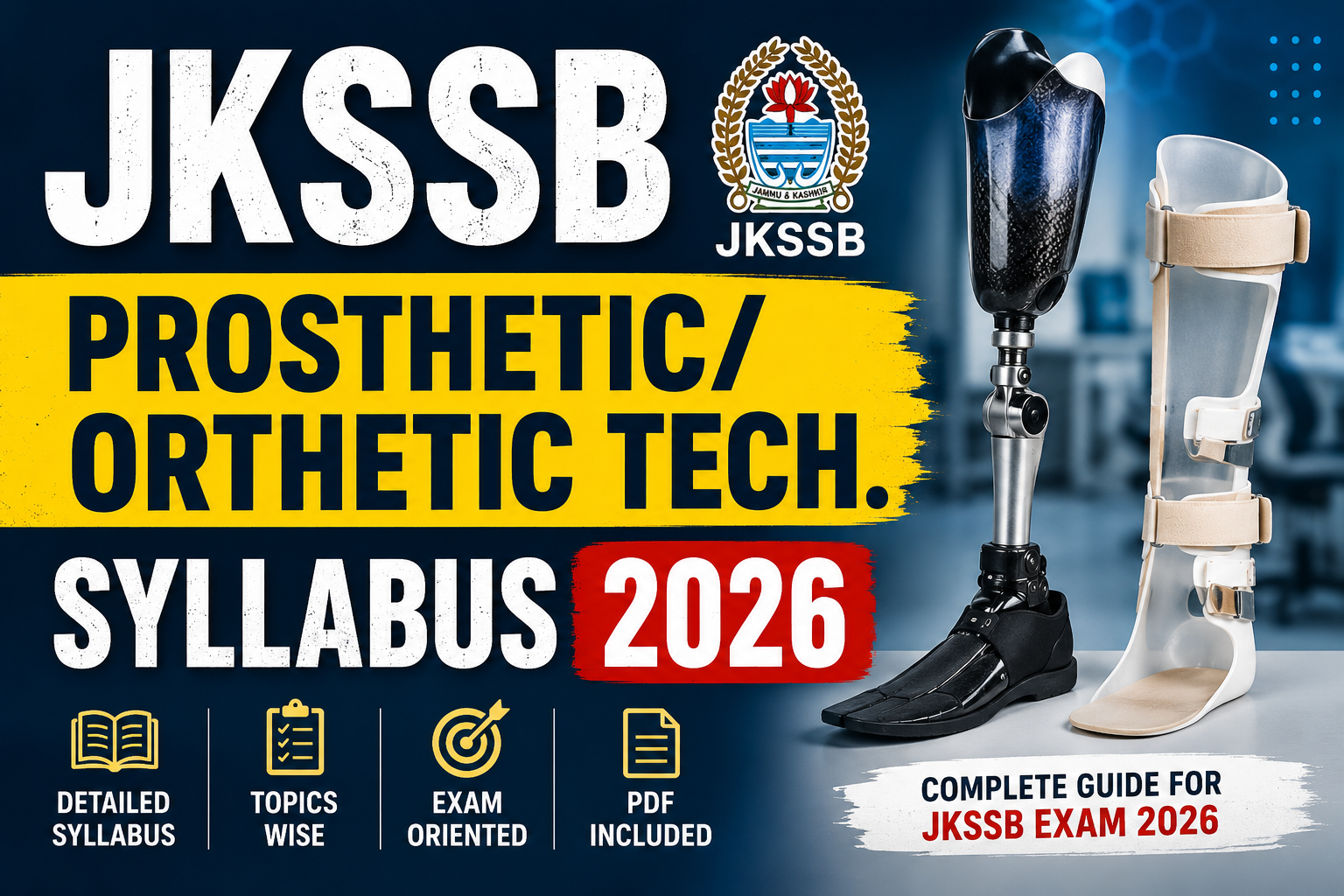
JKSSB Prosthetic/Orthotic Technician Syllabus 2026: Complete Subject-Wise Guide, Exam Pattern & Preparation Strategy
If you are preparing for the JKSSB Prosthetic/Orthotic Technician Recruitment 2026, understanding the latest syllabus is the first step toward success. The syllabus covers a wide range of topics, including anatomy, physiology, pathology, prosthetics, orthotics, biomechanics, rehabilitation, workshop technology, and orthopaedics.
This article provides a detailed and easy-to-understand breakdown of the official syllabus, helping candidates focus on the most important areas for the examination. The syllabus details used in this guide are based on the official Prosthetics & Orthotics syllabus.
JKSSB Prosthetic/Orthotic Technician Exam Overview
| Particular | Details |
|---|---|
| Post Name | Prosthetic/Orthotic Technician |
| Recruiting Body | JKSSB |
| Total Marks | 120 |
| Duration | 2 Hours |
| Mode of Exam | Objective Type |
| Difficulty Level | Technical + Professional |
DOWNLOAD OFFCIAL SYLLABUS LINK
The examination primarily tests candidates' knowledge of prosthetics, orthotics, rehabilitation sciences, anatomy, physiology, workshop technology, and biomechanics.
Detailed JKSSB Prosthetic/Orthotic Technician Syllabus 2026
1. Life Science & Basic Science (Anatomy, Physiology & Pathology)
This section forms the foundation of the entire Prosthetics and Orthotics field and carries significant weightage in the examination.
Anatomy
Candidates should focus on:
- Human body terminology
- Classification of bones
- Skeleton system
- Skull
- Thorax
- Vertebral column
- Pelvic girdle
- Upper limb skeleton
- Lower limb skeleton
- Foot bones
- Joints and their classifications
- Muscular system
- Muscle attachments and nerve supply
- Axilla
- Femoral triangle
- Popliteal fossa
- Surface anatomy and palpation techniques
A strong understanding of musculoskeletal anatomy is essential because many prosthetic and orthotic devices are designed according to anatomical structures.
Physiology
Important topics include:
- Cell structure and body tissues
- Blood and circulation
- Cardiac cycle
- Blood pressure
- Digestive system
- Liver and pancreas
- Respiratory system
- Metabolism
- Endocrine glands
- Urinary system
- Reproductive system
- Nervous system
- Special senses and skin
Understanding normal body functions helps candidates understand pathological conditions and rehabilitation processes.
Pathology
Focus on:
- General pathology
- Inflammation
- Acute and chronic inflammation
- Bacterial and viral infections
- Immunity
- Sterilization techniques
- Tuberculosis
- Leprosy
- Syphilis
- Gonorrhoea
- Poliomyelitis
- Wound healing
- Gangrene
- Arthritis
These topics are highly relevant because prosthetic and orthotic patients often present with these medical conditions.
2. Workshop Technology & Practice
This section evaluates practical technical knowledge required for fabrication and maintenance of prosthetic and orthotic devices.
Important Topics
- Bench work
- Hand tools and measuring instruments
- Riveting
- Soldering
- Brazing
- Welding
- Forging
- Drilling operations
- Reamers and taps
- Lathe machines
- Milling machines
- Shaping machines
- Grinding processes
- Finishing techniques
Candidates should understand both theoretical concepts and practical applications.
Materials Used in Prosthetics & Orthotics
Study:
- Rubber
- Plastics
- Steel
- Aluminium
- Non-ferrous alloys
- Fabrics
- Leather
- Plaster of Paris
- Adhesives
- Fasteners
- Specialized prosthetic tools
Questions from material properties and their applications are frequently expected.
3. Applied Mechanics, Strength of Materials, Electronics & Bio-Electricity
This section carries approximately 10 marks and tests engineering fundamentals.
Strength of Materials
Prepare:
- Stress and strain
- Elasticity
- Poisson's ratio
- Moment of inertia
- Radius of gyration
- Centroid
- Shear force
- Bending moment
- Torsion
- Springs
- Riveted joints
- Friction
Electronics & Bio-Electricity
Important areas include:
- Ohm's Law
- AC and DC circuits
- Resistance
- Capacitance
- Impedance
- Transformers
- Electronic components
- Diodes
- Pentodes
- Amplifiers
- Integrated circuits
- Computers
- Electromyography
- Myoelectric control systems
- Artificial limb control systems
These concepts are especially important for modern myoelectric prostheses.
4. Orthopaedics, Amputation Surgery, Kinesiology & Biomechanics
This is one of the most important sections of the syllabus.
Orthopaedics
Candidates should prepare:
- Congenital deformities
- Poliomyelitis
- Cerebral palsy
- Hemiplegia
- Paraplegia
- Tuberculosis
- Leprosy
- Rheumatoid arthritis
- Osteoarthritis
- Bone tumors
- Fractures
- Spinal injuries
Amputation Surgery
Important topics:
- Principles of amputation
- Types of amputations
- Surgical techniques
- Amputation complications
- Stump care
- Myoplasty
- Myodesis
- Prosthetic prescription
Kinesiology & Biomechanics
Focus on:
- Kinetics
- Kinematics
- Centre of gravity
- Human movement analysis
- Open chain systems
- Closed chain systems
- Four-bar mechanisms
- Gait analysis
- Spine biomechanics
- Upper limb biomechanics
- Lower limb biomechanics
This section forms the scientific basis of prosthetic and orthotic design.
5. Prosthetics (Upper Extremity)
Upper limb prosthetics is an important technical section.
Key Topics
- Classification of amputations
- Congenital limb deficiencies
- Prosthetic prescription
- Harness systems
- Control systems
- Prosthetic fitting
- Alignment
- Upper limb prosthesis care
- Myoelectric prostheses
- Externally powered prostheses
- Amputee training
Special attention should be given to modern myoelectric systems and rehabilitation methods.
6. Orthotics (Upper Extremity)
Important topics include:
- Functional anatomy of the hand
- Functional splints
- Arm braces
- Static finger splints
- Functional hand splints
- Feeders
- Assistive devices
- Myoelectric orthoses
- Biomechanics of hand splints
Questions are often asked from practical clinical applications and orthotic design principles.
7. Physical Medicine, Rehabilitation & Psychology
This section carries around 5 marks.
Topics to Cover
- Muscle charting
- Electrotherapy
- Hydrotherapy
- Neuromuscular disorders
- Arthritis rehabilitation
- Mobility aids
- Crutches
- Bandaging
- Gait training
- Rehabilitation principles
- Counseling
- Psychological assessment
- Vocational rehabilitation
Understanding patient psychology and rehabilitation is crucial for successful prosthetic outcomes.
8. Workshop Administration & Management
Candidates should prepare:
- Workshop organization
- Store management
- Purchasing procedures
- Cost accounting
- Industrial safety
- Accident prevention
- Occupational health
- First aid
- Artificial respiration
- Transportation of casualties
These topics are straightforward and can be scoring if studied properly.
9. Prosthetics (Lower Extremity)
Lower limb prosthetics forms a major part of professional practice.
Important Topics
- Below-knee prosthesis
- Above-knee prosthesis
- Through-knee prosthesis
- Syme's prosthesis
- Hip disarticulation prosthesis
- Hemipelvectomy prosthesis
- Prosthetic alignment
- Gait analysis
- Modular prostheses
- Fluid-controlled prostheses
- Jaipur Foot
- Madras Foot
Candidates must understand fabrication, fitting, maintenance, and biomechanics.
10. Orthotics (Lower Extremity & Spine)
Lower Extremity Orthotics
Prepare:
- Foot anatomy
- Foot orthoses
- Shoe modifications
- Ankle-foot orthoses (AFO)
- Knee orthoses (KO)
- KAFO
- HKAFO
- Gait training
- Pathological gait
Spinal Orthotics
Important areas:
- Surface anatomy of trunk
- Lumbar orthoses
- Thoracic orthoses
- Cervical orthoses
- Milwaukee brace
- Boston brace
- Biomechanics of spine
These topics are highly relevant for clinical orthotic practice.
Preparation Strategy for JKSSB Prosthetic/Orthotic Technician Exam
Phase 1: Build Fundamentals
Start with:
- Anatomy
- Physiology
- Pathology
These subjects create the foundation for understanding all later technical topics.
Phase 2: Technical Subjects
Focus on:
- Prosthetics
- Orthotics
- Orthopaedics
- Biomechanics
These sections carry the highest professional relevance.
Phase 3: Revision
Revise:
- Workshop Technology
- Rehabilitation
- Psychology
- Management
These topics are comparatively easier and can improve overall scores.
ALSO READ: Download health educator syllabus
Last Words for Aspirants
The JKSSB Prosthetic/Orthotic Technician Syllabus 2026 is comprehensive and designed to assess both medical and technical competencies required in the profession. Candidates who systematically cover Anatomy, Physiology, Pathology, Orthopaedics, Prosthetics, Orthotics, Biomechanics, Rehabilitation, and Workshop Technology will have a strong chance of performing well in the examination.
Instead of memorizing isolated facts, focus on understanding concepts, clinical applications, and practical aspects of prosthetic and orthotic management. A structured study plan, regular revision, and practice of technical MCQs can significantly improve your chances of securing a high score in the JKSSB examination.