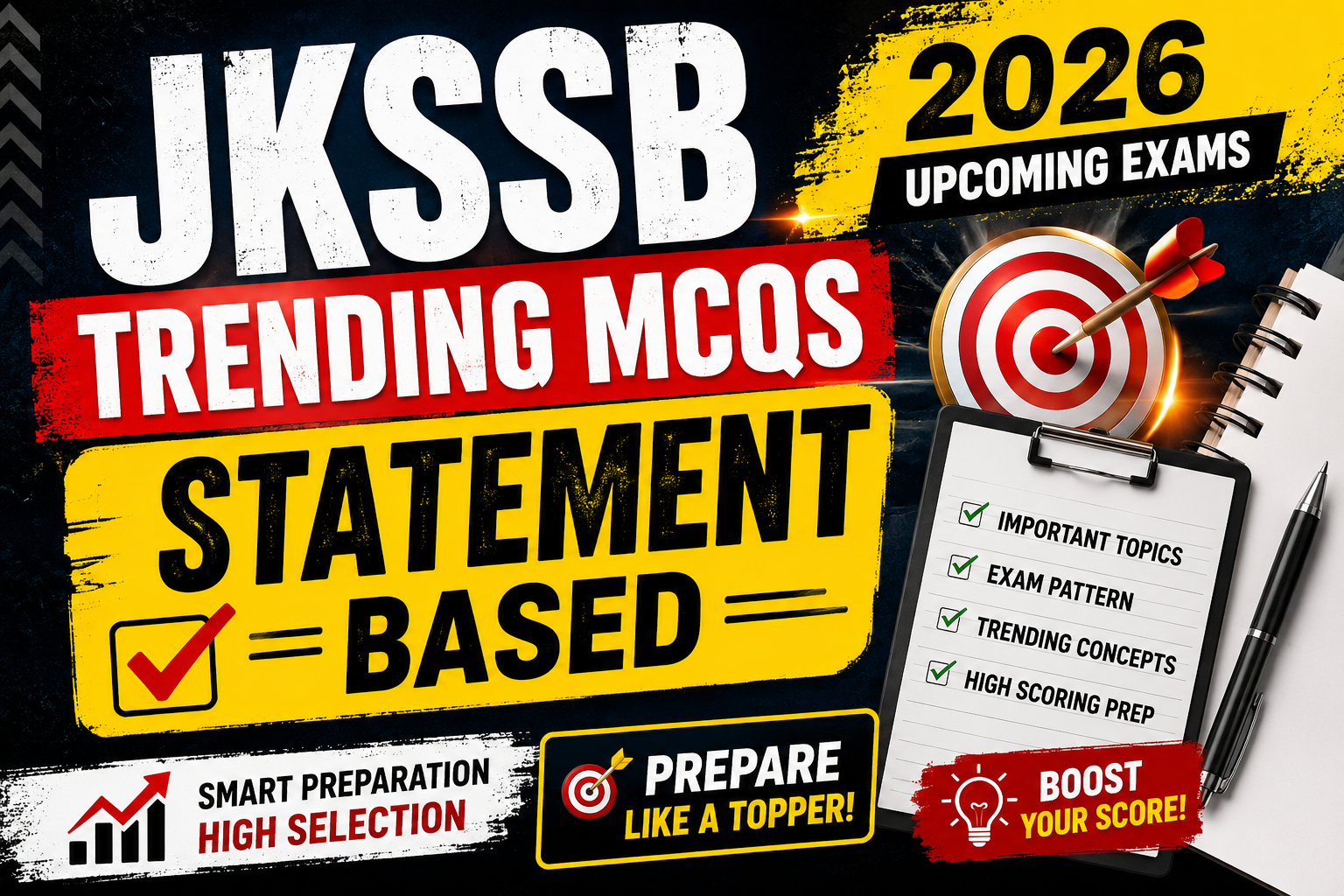
JKSSB Trending Statement Based MCQs for Upcoming Exams 2026
Statement based MCQs are becoming one of the most useful question styles for JKSSB aspirants because they test more than memory. They test reading speed, clarity of thought, elimination skill, and the ability to notice small details under time pressure. In upcoming JKSSB exams, this format matters even more because the paper rewards candidates who can judge accuracy quickly instead of depending only on rote learning.
The real advantage of this topic is simple: when a student understands how statement based questions are framed, the same logic can be applied across reasoning, general studies, current affairs, and even subject-specific sections. That is why candidates preparing for JKSSB 2026 should treat this as a high-priority area rather than a side topic.
Why statement based MCQs matter in JKSSB preparation
Statement based questions have a habit of appearing easy at first glance. Many students read the question, identify a familiar phrase, and answer too quickly. That is exactly where marks are lost. These questions often hide small traps in wording, sequence, conditions, and exception words such as only, always, some, none, not, unless, and except.
Based on recent JKSSB patterns, statement style framing is useful because it measures whether a candidate can think with precision. In competitive exams, that precision is often more valuable than speed alone. A student who is careful, consistent, and able to compare statements logically usually performs better than a student who rushes through familiar-looking questions.
Chck our new course JKSSB Finance Accounts Assistant 2026 Complete study material
Key points that matter most
- Statement based MCQs reward careful reading more than blind memorization.
- Small words can completely change the meaning of a question.
- These questions are commonly seen in reasoning and general awareness sections.
- They help examiners test depth of understanding, not just surface-level recall.
- Two statements may both look correct, but one detail can make the answer wrong.
- Elimination technique is often faster than direct solving.
- Practice improves accuracy more than speed at the beginning.
- JKSSB aspirants should learn to identify absolute and conditional language.
- Previous year questions help reveal how such questions are framed.
- A regular mock test habit builds confidence under time pressure.
- Careless reading is the biggest reason for wrong answers.
- Quick revision should focus on patterns, not long theory.
What statement based MCQs actually test
These questions are built to check whether you can connect logic with language. A statement may contain a fact, a claim, an assumption, a condition, or a conclusion. In exam settings, the task is not only to know the content but also to judge whether the statement is fully true, partially true, or misleading because of wording.
For JKSSB aspirants, this becomes useful in subjects where facts are close to each other. A question may contain two similar statements, one correct and one nearly correct. The nearly correct one may still be wrong because of date, definition, order, or restriction. That is why statement based MCQs are a favorite style in competitive exams: they separate careful learners from casual readers.
Common forms in which they appear
Statement based questions in JKSSB-style papers may appear in several forms. Some ask whether one statement follows from another. Others ask whether both statements are true, whether one supports the other, or whether a conclusion is valid. In some cases, the question may be framed around which statement is incorrect, which one is strongest, or which one can be inferred from the given information.
A student who has studied only definitions will struggle here. A student who has practiced question framing will feel more comfortable. The key is to understand that the exam is not just asking for knowledge; it is asking for judgment.
| Form of Statement Question | What It Tests | Best Approach |
|---|---|---|
| True/False statement | Exact factual accuracy | Read word by word |
| Statement and conclusion | Logical flow | Check whether conclusion necessarily follows |
| Assertion and reason | Relation between two ideas | Test cause, effect, and relevance |
| Inference-based statement | Understanding from given text | Avoid outside assumptions |
| Two-statement comparison | Precision and discrimination | Eliminate half-correct options |
| Except-type statement | Exception handling | Search for the odd one out |
How to approach them in the exam hall
The best approach is not to search for a shortcut first. The first step is controlled reading. Read the statement once for meaning, then again for trap words. If the statement uses words like always, never, completely, or only, slow down immediately. Those words are usually where the examiner hides the trick.
Next, compare the statement with what you actually know, not with what sounds familiar. Many wrong answers happen because a student remembers a related fact and assumes it is the same thing. Competitive exams are full of such traps. A fact can be nearly right and still wrong enough to lose the mark.
A practical habit is to mentally break each statement into three parts: the subject, the condition, and the claim. Once broken down, the statement becomes easier to test. This approach is especially useful in GK, polity, history, science basics, and reasoning sections.
Why this topic is highly relevant for JKSSB 2026
JKSSB 2026 preparation should be built on pattern awareness. The exam environment is increasingly competitive, and candidates need more than a broad study plan. They need topic-level control. Statement based MCQs are useful because they can appear in multiple sections without warning, and they often decide the difference between average and high scores.
Students who regularly attempt free JKSSB mock test practice gain an advantage here because mocks train the mind to detect patterns quickly. Similarly, those who download complete syllabus PDF material and map important topics section by section often notice where statement style questions can appear. The more a student studies through structured practice, the easier it becomes to identify question framing.
Also, previous year questions remain one of the strongest tools for understanding this pattern. When you practice previous year questions, you begin to notice how examiners build statements from commonly repeated areas. That is where real preparation starts.
What strong preparation looks like in this area
A strong approach is not about reading more pages. It is about building question familiarity. Start with the syllabus and identify the sections where statement based framing is common. Then move to topic-wise practice, followed by mixed mock tests. This sequence matters because isolated study improves memory, while mixed practice improves exam performance.
For example, if you study a topic in polity, do not stop at definition level. Turn it into statement checks: what is true, what is partially true, what is an exception, and what is often confused with a similar concept. This habit helps the mind learn in exam language.
A candidate preparing seriously should make room for three layers of revision: concept revision, statement practice, and timed mock revision. Together, these layers improve both confidence and accuracy.
Common mistakes students make
The most repeated mistake is reading too fast. Students see a familiar term and jump to an answer. The second mistake is ignoring restrictive words. A single word can reverse the meaning of the entire statement. The third mistake is relying on memory without verification. Competitive exams do not reward vague familiarity.
Another common error is overthinking simple statements. Sometimes the answer is straightforward, but the student tries to build unnecessary logic. This creates confusion and wastes time. A balanced mind is needed here: neither rushed nor overcomplicated.
Some students also avoid practicing statement style questions because they feel they are too tricky. That is a weak strategy. Trick questions become manageable only after repeated exposure. Based on recent JKSSB patterns, regular practice is the best way to reduce the surprise factor.
Practical strategy to improve accuracy fast
A good study strategy begins with classification. Separate your preparation into factual topics, conceptual topics, and confusion-prone topics. Statement based MCQs are most useful for the confusion-prone areas because they force you to compare similar information carefully.
Then build a daily drill. Spend a small portion of your study time reading statements and checking whether each one is fully correct, partially correct, or wrong because of a single condition. This method trains attention. It also improves reading discipline, which helps in other sections too.
The next step is time-bound practice. Set a fixed limit for a small set of questions. The goal is not only to get them right but also to finish without panic. Mock tests are the best place to do this. When you attempt free JKSSB mock test regularly, you begin to see your weak points more clearly.
Finally, revise using short notes. Do not rewrite entire chapters. Keep a list of common trap words, frequent mistakes, and repeated themes. That revision sheet becomes more valuable than long notes during the last phase of preparation.
Quick revision notes for high retention
- Read every statement slowly on the first pass.
- Notice words like only, always, never, except, and unless.
- Do not trust familiar wording without verification.
- Break the statement into subject, condition, and claim.
- Use elimination when direct recall is unclear.
- Practice mixed questions, not only topic-wise questions.
- Keep revising previous year questions.
- Build accuracy before chasing speed.
- Focus on confusion-prone topics.
- Treat each statement as a logic check, not a memory test.
The smartest way to turn this topic into marks
Statement based MCQs are scoring only when treated seriously. Many students think they are minor questions, but in reality they are high-control questions. They reward the candidate who pays attention to detail and stays calm under pressure. That is why this topic deserves a place in every JKSSB 2026 plan.
The best performers are usually not the ones who read the most. They are the ones who practiced wisely, noticed patterns early, and corrected their mistakes before exam day. If you want better marks, the formula is simple: study the concept, test the statement, and revise the trap.
ALSO READ:JKSSB general knowledge handbook 2026 notes
FAQs
What are statement based MCQs in JKSSB exams?
These are questions that test whether a given statement is true, false, logical, or correctly inferred from the information provided.
How should I prepare for statement based MCQs?
Practice topic-wise questions, read carefully, and revise common trap words and repeated patterns from previous year questions.
What is the best way to solve statement based questions quickly?
Use elimination, check key words, and break the statement into parts before choosing the answer.
Is this topic important for JKSSB upcoming exams?
Yes. It is useful because it improves accuracy in reasoning, GK, and concept-based sections.
Why do students lose marks in statement questions?
Most mistakes happen because of rushed reading, ignoring exceptions, or assuming a statement is correct just because it looks familiar.
How can mock tests help with this topic?
Mock tests train timing, reduce confusion, and show where your reading or reasoning is weak.
Should I use previous year questions for practice?
Yes. They are one of the best tools for understanding how JKSSB frames statement style questions.
What is the best revision method for this topic?
Keep short notes, revise trap words, and revisit questions you answered incorrectly during practice.
Final thought
JKSSB statement based MCQs are not difficult when you understand the pattern behind them. They become difficult only when preparation is vague and rushed. A disciplined approach, regular practice, and careful reading can turn this topic into a reliable scoring area. Stay focused on accuracy, practice from trusted material, and keep checking your progress through previous year questions and mock tests. The candidates who build this habit early usually enter the exam hall with more confidence and leave with better marks.