JKSSB English 10000 MCQs Free: Complete Practice Guide for JKSSB 2026 Aspirants
Every year, thousands of candidates prepare for JKSSB recruitment examinations with the hope of securing a government job. While many focus heavily on General Knowledge and Reasoning, the English section often becomes the deciding factor between selection and rejection. A strong command of English not only improves overall scores but also boosts confidence during the examination.
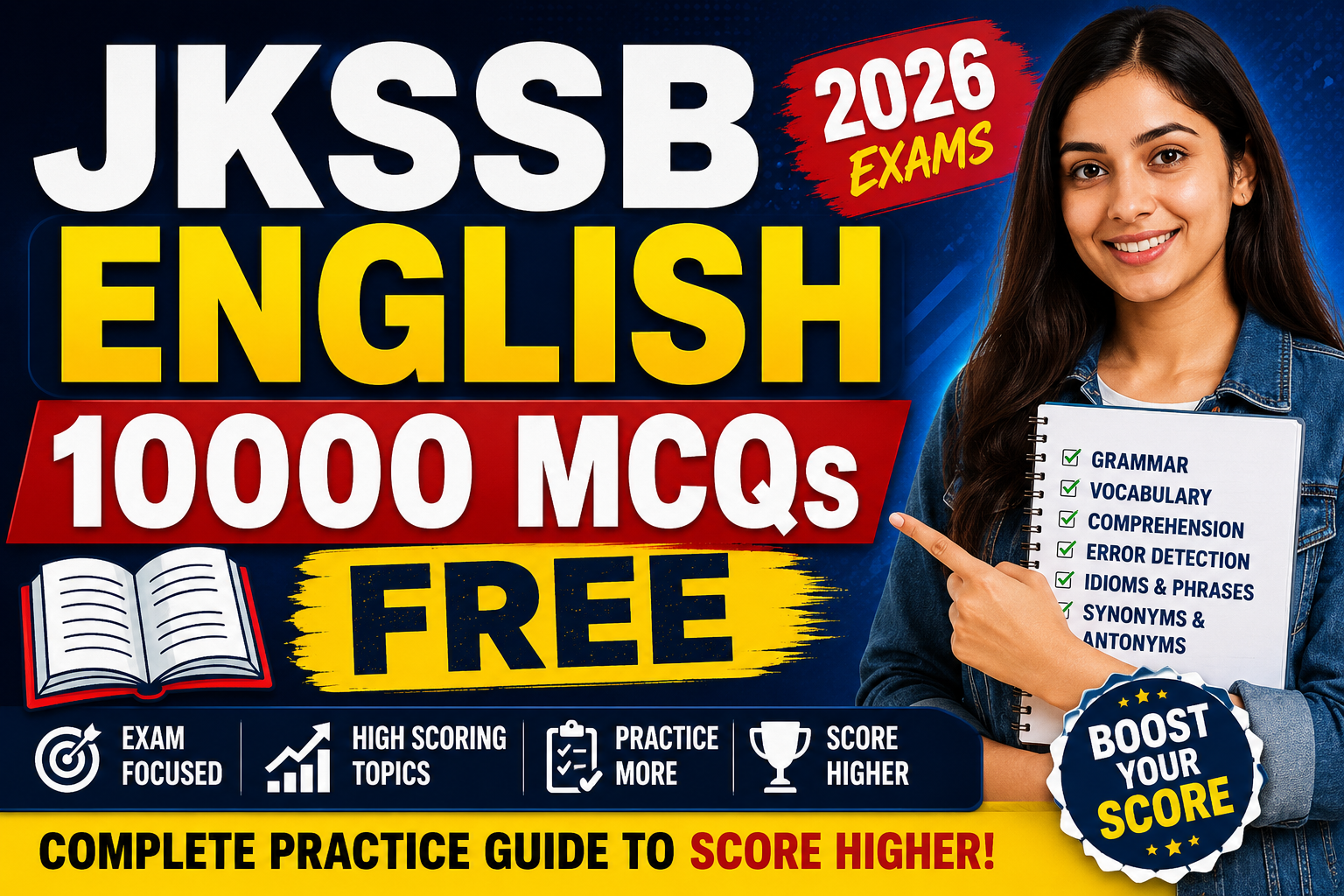
For candidates searching for JKSSB English 10000 MCQs Free, the most effective approach is to use a large question bank covering grammar, vocabulary, comprehension, sentence correction, idioms, phrases, synonyms, antonyms, and error detection. Consistent practice with thousands of MCQs helps identify weak areas, improve accuracy, and increase speed.
A well-structured collection of 10,000 English MCQs serves as a comprehensive preparation resource because it exposes candidates to nearly every question pattern commonly seen in competitive exams.
All 10000 English Mcqs are deployed in my sub domain
Understanding the Importance of English in JKSSB Exams
English is one of the most scoring sections in various JKSSB recruitment examinations. Unlike subjects that require extensive memorization, English rewards regular practice and conceptual clarity.
Candidates frequently encounter questions from:
- Grammar rules
- Vocabulary building
- Sentence improvement
- Fill in the blanks
- Spotting errors
- Reading comprehension
- Active and passive voice
- Direct and indirect speech
- One-word substitutions
- Idioms and phrases
- Synonyms and antonyms
Based on recent JKSSB patterns, questions are generally designed to test practical language understanding rather than advanced literature knowledge.
Why Practicing 10,000 English MCQs Matters
A large MCQ database offers more than just question exposure.
Key benefits include:
- Improves question-solving speed
- Builds confidence before the examination
- Enhances grammar accuracy
- Strengthens vocabulary retention
- Identifies recurring exam trends
- Develops pattern recognition skills
- Reduces negative marking risks
- Improves time management
- Helps track weak and strong topics
- Creates exam-like familiarity
- Increases overall score potential
Candidates who solve a significant number of English MCQs often develop instinctive recognition of correct sentence structures and grammatical patterns.
Major Topics Covered in JKSSB English MCQ Collections
Grammar
Grammar remains the backbone of the English section.
Important areas include:
- Parts of speech
- Tenses
- Subject-verb agreement
- Articles
- Prepositions
- Conjunctions
- Modals
- Determiners
Many candidates lose marks because they memorize rules without applying them through practice.
Vocabulary
Vocabulary questions test language awareness and contextual understanding.
Common topics include:
- Synonyms
- Antonyms
- One-word substitutions
- Idioms and phrases
- Foreign words
- Homophones
Regular revision is essential because vocabulary retention improves through repeated exposure.
Error Detection
This section evaluates grammatical accuracy.
Candidates must identify mistakes involving:
- Verb forms
- Pronouns
- Articles
- Prepositions
- Sentence structure
Error detection questions are commonly seen in competitive exams and often provide easy scoring opportunities.
Reading Comprehension
Comprehension passages assess:
- Understanding ability
- Vocabulary application
- Logical reasoning
- Inference skills
Daily reading significantly improves performance in this area.
Topic-Wise Preparation Framework
| Topic | Difficulty Level | Importance in JKSSB | Practice Priority |
|---|---|---|---|
| Grammar | High | Very High | Highest |
| Vocabulary | Medium | High | High |
| Error Detection | Medium | High | High |
| Comprehension | Medium | High | High |
| Idioms & Phrases | Medium | Moderate | Moderate |
| Synonyms & Antonyms | Easy | Moderate | Moderate |
| Active-Passive Voice | Medium | Moderate | Moderate |
| Narration | Medium | Moderate | Moderate |
Exam Relevance for JKSSB 2026
JKSSB examinations continue to emphasize practical English skills. Candidates preparing for Junior Assistant, Supervisor, Panchayat Secretary, Banking Associate, Accounts Assistant, and other recruitment posts should treat English as a scoring subject.
Based on recent JKSSB patterns, examiners frequently focus on foundational grammar rather than highly advanced language concepts.
This trend highlights the importance of:
- Consistent practice
- Conceptual understanding
- Topic-wise revision
- Previous paper analysis
Candidates should also attempt free JKSSB mock test sessions regularly to evaluate their preparation level under timed conditions.
Likewise, reviewing and practice previous year questions helps identify recurring themes and commonly tested concepts.
How to Use a JKSSB English 10000 MCQs Resource Effectively
Many aspirants collect PDFs and question banks but never use them strategically.
Phase 1: Foundation Building
Spend the first few weeks learning:
- Grammar rules
- Vocabulary basics
- Sentence structure concepts
Without fundamentals, MCQ practice becomes ineffective.
Phase 2: Topic-Wise Practice
Complete questions chapter by chapter.
For example:
- Day 1: Articles
- Day 2: Tenses
- Day 3: Prepositions
- Day 4: Subject-Verb Agreement
This method strengthens conceptual understanding.
Phase 3: Mixed MCQ Sessions
After topic mastery, begin solving mixed question sets.
This replicates actual exam conditions and improves adaptability.
Phase 4: Revision Cycles
Create a notebook for:
- Frequently repeated errors
- Difficult vocabulary
- Grammar rules
- Important observations
Regular revision ensures long-term retention.
Advanced Preparation Insights
Many candidates focus only on solving questions. High performers focus equally on analysis.
After each practice session:
- Review incorrect answers
- Understand why mistakes occurred
- Identify recurring weaknesses
- Revise related concepts immediately
This approach transforms practice into improvement.
A candidate solving 3,000 MCQs with detailed analysis often performs better than someone who mechanically solves 10,000 questions without review.
Common Mistakes JKSSB Aspirants Make
Several preparation mistakes repeatedly affect scores.
Ignoring Grammar Fundamentals
Candidates jump directly into MCQs without understanding concepts.
This leads to repeated mistakes.
Memorizing Without Application
Grammar rules must be applied repeatedly through practice.
Knowledge without application rarely produces results.
Neglecting Vocabulary Revision
Learning new words once is insufficient.
Multiple revisions are necessary.
Avoiding Mock Tests
Mock tests reveal:
- Speed issues
- Accuracy problems
- Time management weaknesses
Skipping Previous Papers
Candidates who ignore previous year papers miss valuable insights into examiner preferences.
Building a High-Scoring English Study Plan
A balanced daily schedule may include:
Morning Session
- Grammar concepts
- Rule revision
Afternoon Session
- Vocabulary practice
- Synonyms and antonyms
Evening Session
- MCQ solving
- Error analysis
Weekly Schedule
- One full mock test
- One revision session
- Previous paper practice
Candidates should also download complete syllabus PDF before beginning preparation to ensure no topic is overlooked.
Quick Revision Notes
Before the examination, focus on these points:
- Revise grammar rules daily
- Learn commonly tested idioms
- Practice error detection regularly
- Read English articles for comprehension improvement
- Maintain a vocabulary notebook
- Solve mixed MCQ sets frequently
- Analyze mistakes immediately
- Attempt mock tests under timed conditions
- Review previous year papers
- Focus on accuracy before speed
These revision points help reinforce concepts and improve retention.
Why English Can Become Your Highest Scoring Section
Many aspirants consider English difficult because of inconsistent preparation.
In reality, English becomes easier when:
- Concepts are understood clearly
- Practice is consistent
- Revision is regular
- Mistakes are analyzed properly
Unlike dynamic subjects, grammar rules remain largely constant. Once mastered, they continue delivering marks across multiple examinations.
This makes English one of the most rewarding sections for serious JKSSB candidates.
Frequently Asked Questions
What is the best way to use JKSSB English 10000 MCQs Free resources?
Start with topic-wise practice, strengthen grammar concepts, and gradually move toward mixed MCQ sets and full-length mock tests.
How many English MCQs should I solve daily for JKSSB preparation?
A target of 50–100 quality questions daily, combined with proper analysis, is generally more effective than solving large numbers without review.
Is English important for JKSSB exams?
Yes. English is commonly included in many JKSSB recruitment examinations and can significantly improve overall scores.
How can I improve English grammar for JKSSB 2026?
Focus on grammar fundamentals, solve topic-wise MCQs, revise rules regularly, and analyze mistakes after every practice session.
Should I practice previous year English questions?
Absolutely. Previous papers reveal frequently tested concepts and help candidates understand exam trends.
What topics are most important in JKSSB English?
Grammar, vocabulary, error detection, sentence improvement, comprehension, idioms and phrases, and synonyms-antonyms remain highly important.
How often should I take mock tests?
One or two mock tests per week is ideal during the early stages of preparation, increasing frequency closer to the examination.
Can 10,000 English MCQs improve exam performance?
Yes. A comprehensive MCQ collection provides extensive exposure to exam-level questions and helps improve accuracy, confidence, and speed.
Final Thoughts
Preparing from a JKSSB English 10000 MCQs Free resource can significantly strengthen your English section when combined with smart strategy and disciplined revision. Success in JKSSB 2026 will not depend solely on how many questions you solve but on how effectively you learn from them.
Focus on grammar fundamentals, build vocabulary steadily, attempt free JKSSB mock test sessions, practice previous year questions, and regularly download complete syllabus PDF updates to stay aligned with the examination requirements. Consistent effort, structured practice, and careful revision will place you ahead of the competition and move you closer to your government job goal.