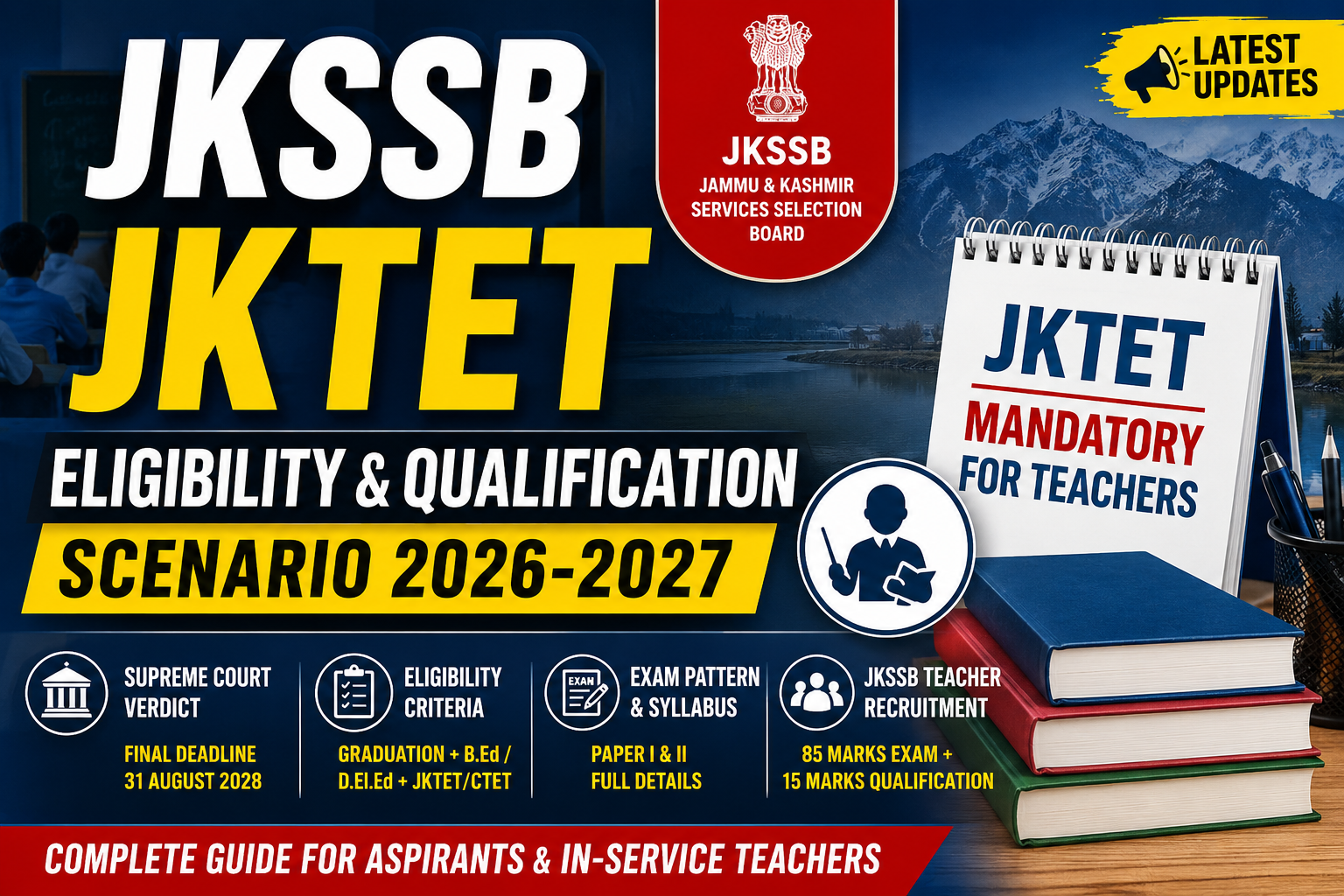
JKSSB JKTET Eligibility & Qualification Scenario 2026–2027: Complete Guide for Teachers
The teaching sector in Jammu & Kashmir is undergoing one of its most significant transformations in recent years. The implementation of the Jammu & Kashmir Teacher Eligibility Test (JKTET) as a mandatory qualification has changed the recruitment landscape for both aspiring teachers and currently serving educators.
For candidates preparing for upcoming JKSSB teacher recruitments, understanding the latest eligibility norms, qualification requirements, Supreme Court directives, and JKTET examination structure has become extremely important.
With thousands of teaching vacancies expected across government schools, aspirants must ensure they meet all qualification requirements before applying. This article provides a complete overview of the JKSSB JKTET eligibility and qualification scenario for 2026–2027.
Introduction to JKTET
The Jammu & Kashmir Teacher Eligibility Test (JKTET) is the official eligibility examination conducted for candidates seeking teaching positions in schools across the Union Territory of Jammu & Kashmir.
The examination is conducted by the Jammu & Kashmir Board of School Education (JKBOSE), which serves as the nodal agency responsible for organizing the test, releasing notifications, conducting examinations, and issuing eligibility certificates.
JKTET is designed to assess whether a candidate possesses the minimum teaching aptitude, pedagogical knowledge, subject understanding, and classroom competencies required for teaching at the primary and upper-primary levels.
The qualification has now become a critical component of teacher recruitment in both government and private educational institutions.
Why JKTET Has Become So Important
Over the past few years, national education policies and judicial interventions have emphasized the importance of teacher quality.
Teacher Eligibility Tests were introduced to ensure that every educator entering the school system possesses the necessary skills and competencies to teach effectively.
For Jammu & Kashmir, the significance of JKTET has increased dramatically following recent legal developments and administrative decisions.
Today, clearing JKTET or possessing a valid CTET certificate is increasingly becoming an essential requirement for:
- Fresh teacher appointments
- Government school recruitment
- Private school teaching positions
- Career advancement opportunities
- Future promotions in the education sector
Supreme Court Verdict: A Landmark Decision
One of the biggest developments affecting teachers in Jammu & Kashmir is the recent Supreme Court ruling regarding Teacher Eligibility Test qualifications.
The apex court has provided clarity on long-pending disputes surrounding the implementation of TET requirements for in-service teachers.
Major Outcomes of the Verdict
| Decision Area | Latest Status |
|---|---|
| TET Requirement | Mandatory |
| Review Petitions | Dismissed |
| Existing Teachers | Must qualify TET |
| Promotion Eligibility | TET required |
| Final Compliance Deadline | 31 August 2028 |
| Implementing Agencies | JKBOSE & SSSA |
The ruling effectively removes ambiguity regarding teacher eligibility standards and establishes a uniform qualification framework for educators across Jammu & Kashmir.
Impact on Existing In-Service Teachers
A major concern among teachers has been whether educators appointed before the implementation of the Right to Education (RTE) norms would receive exemptions.
The latest position indicates that exemption-based arguments may no longer hold relevance.
Key Implications
- Existing teachers must eventually qualify JKTET.
- Seniority alone does not provide exemption.
- Future promotions may require TET qualification.
- Teachers failing to comply within prescribed timelines could face service-related consequences.
However, implementation timelines and procedural aspects continue to be reviewed by the authorities to ensure smooth compliance.
JKTET and Future JKSSB Teacher Recruitment
For candidates preparing for JKSSB teaching examinations, JKTET qualification is becoming one of the most important eligibility requirements.
JKSSB is expected to conduct major recruitment drives for various teaching posts including:
- General Line Teachers
- Science Teachers
- Mathematics Teachers
- Urdu Teachers
- Subject-Specific Teacher Categories
Reports indicate that more than 3,200 teaching vacancies may be filled through future recruitment drives.
Expected Eligibility Criteria for JKSSB Teacher Recruitment 2026–2027
The eligibility framework generally consists of academic qualifications along with teacher eligibility certification.
Qualification Requirements
| Requirement | Status |
|---|---|
| Graduation Degree | Mandatory |
| B.Ed Qualification | Required or Additional Points |
| D.El.Ed (where applicable) | Acceptable |
| Valid JKTET Certificate | Preferred/Required |
| Valid CTET Certificate | Acceptable in applicable cases |
Candidates are advised to keep all educational certificates updated before recruitment notifications are issued.
Age Criteria
Although official notifications may vary, the expected age structure remains similar to previous recruitment cycles.
| Category | Expected Age Limit |
|---|---|
| General Category | 18–40 Years |
| Reserved Categories | Relaxation Applicable |
| Ex-Servicemen | As per Rules |
| Other Reserved Groups | Government Norms Apply |
Applicants should verify age criteria through official recruitment advertisements whenever released.
Selection Process Under JKSSB
The recruitment process has evolved significantly compared to earlier years.
Instead of relying solely on academic qualifications, modern recruitment emphasizes merit-based competitive examinations.
Expected Selection Framework
| Component | Weightage |
|---|---|
| Written Examination (OMR/CBT) | 85 Points |
| Higher Qualification Weightage | 15 Points |
| Total | 100 Points |
This structure rewards both academic achievement and performance in competitive examinations.
Understanding JKTET Examination Structure
JKTET is conducted in two separate papers based on the teaching level candidates wish to pursue.
Paper I – Primary Teacher Level
Paper I is meant for candidates aspiring to teach Classes I to V.
Examination Pattern
| Subject | Questions | Marks |
|---|---|---|
| Child Development & Pedagogy | 30 | 30 |
| Language I | 30 | 30 |
| Language II | 30 | 30 |
| Mathematics | 30 | 30 |
| Environmental Studies | 30 | 30 |
| Total | 150 | 150 |
Paper II – Upper Primary Level
Paper II is intended for candidates who wish to teach Classes VI to VIII.
Core Sections
| Subject | Marks |
|---|---|
| Child Development & Pedagogy | 30 |
| Language I | 30 |
| Language II | 30 |
Candidates must then choose a specialization based on their teaching preference.
Option 1: Mathematics & Science Stream
| Subject | Marks |
|---|---|
| Mathematics | 30 |
| Science | 30 |
Option 2: Social Studies Stream
| Subject | Marks |
|---|---|
| Social Studies | 60 |
Examination Pattern at a Glance
| Feature | Details |
|---|---|
| Mode | Offline |
| Question Type | MCQs |
| Total Questions | 150 |
| Total Marks | 150 |
| Duration | 150 Minutes |
| Negative Marking | No |
| Language | As Prescribed in Notification |
The absence of negative marking makes JKTET a highly scoring examination for well-prepared candidates.
Why Aspirants Should Qualify JKTET Early
Many candidates wait for recruitment notifications before appearing in JKTET. This approach can create unnecessary pressure.
Qualifying JKTET in advance provides several advantages:
Benefits
✔ Immediate eligibility for teacher vacancies
✔ Better preparation focus during JKSSB recruitment
✔ Increased employment opportunities
✔ Eligibility for government and private institutions
✔ Stronger profile for future promotions
✔ Reduced risk of missing recruitment opportunities
For serious teaching aspirants, obtaining a valid JKTET certificate should be considered a priority rather than an optional step.
Preparation Strategy for JKTET 2026–2027
Candidates preparing for JKTET should focus on conceptual understanding rather than rote memorization.
Important Preparation Areas
Child Development & Pedagogy
- Learning theories
- Educational psychology
- Inclusive education
- Teaching methodologies
Language Sections
- Grammar
- Comprehension
- Language pedagogy
- Communication skills
Mathematics
- Number system
- Arithmetic
- Geometry
- Teaching methods
Environmental Studies
- Ecology
- Social environment
- Science fundamentals
Science & Social Studies
- Subject-specific conceptual clarity
- Classroom application techniques
- Curriculum-based pedagogy
Regular practice of previous-year questions and mock tests can significantly improve performance.
Future of Teacher Recruitment in Jammu & Kashmir
The education sector is moving towards standardized recruitment and professional teaching qualifications.
The coming years are likely to witness:
- Greater emphasis on TET qualification.
- Merit-based recruitment systems.
- Enhanced teacher quality standards.
- Structured promotion frameworks.
- Better accountability within educational institutions.
For aspirants planning a long-term teaching career, JKTET qualification is no longer merely an additional certificate—it is becoming the foundation of professional eligibility.
Final Conclusion for TET
The JKSSB teacher recruitment landscape for 2026–2027 is expected to revolve around one central requirement: a valid Teacher Eligibility Test qualification. With the Supreme Court providing clarity on TET implementation and the Jammu & Kashmir administration moving towards stricter qualification standards, both aspiring and serving teachers must adapt to the new framework.
Candidates targeting upcoming JKSSB teacher vacancies should focus on completing their academic qualifications, securing a valid JKTET or CTET certificate, and preparing thoroughly for competitive recruitment examinations.
As teacher recruitment standards continue to evolve, those who qualify JKTET early and maintain updated credentials will enjoy a significant advantage in securing teaching positions across Jammu & Kashmir.