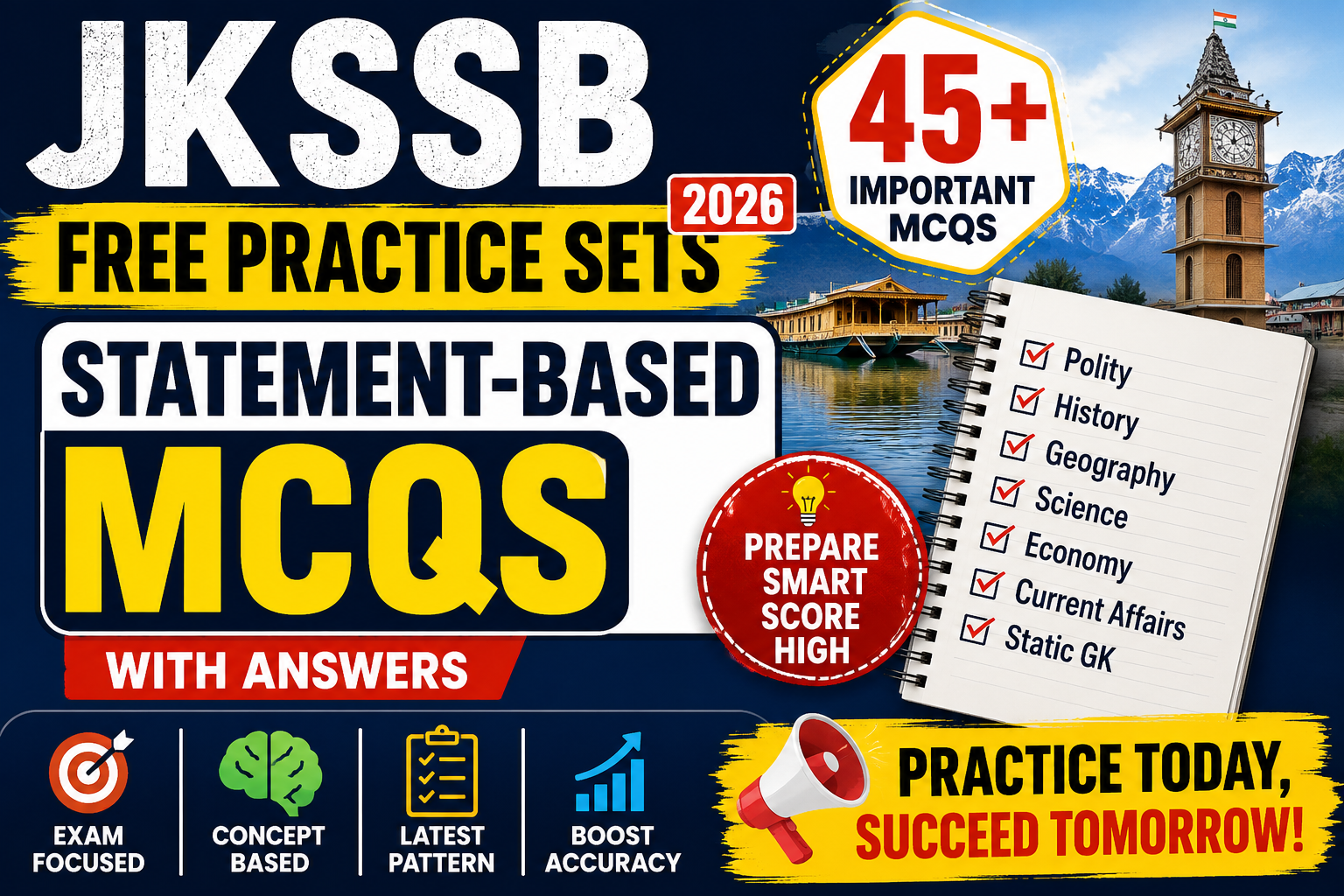
JKSSB Free Practice Sets 2026 – Statement-Based MCQs with Answers
Preparing for JKSSB examinations is no longer just about memorizing facts. Over the last few recruitment exams, the question pattern has shifted noticeably. Candidates are now expected to understand concepts, analyze statements, and choose the most accurate answer instead of recalling a single fact.
This change has made statement-based multiple-choice questions (MCQs) one of the most important sections for aspirants. Whether you are preparing for JK Police Sub Inspector (SI), Junior Assistant, Supervisor, VLW, Panchayat Secretary, Patwari, Health Educator, Naib Tehsildar, or any other JKSSB recruitment, practicing statement-based questions can significantly improve your score.
This free practice set has been specially prepared to match the latest JKSSB examination trend. The questions are designed to test conceptual understanding rather than simple memorization, helping you build confidence before the actual examination.
Why Are Statement-Based Questions Important?
Unlike direct factual questions, statement-based MCQs assess whether a candidate truly understands a topic. Instead of asking, "What is the capital of a country?" the examiner may present two or more statements and ask whether they are correct.
These questions evaluate:
- Concept clarity
- Logical reasoning
- Analytical ability
- Attention to detail
- Decision-making under pressure
A candidate who regularly practices statement-based questions develops the habit of reading every option carefully before answering.
Benefits of Solving Free JKSSB Practice Sets
| Benefit | How It Helps |
|---|---|
| Improves Accuracy | Reduces guesswork during the examination |
| Builds Confidence | Familiarizes you with the latest exam pattern |
| Better Concept Retention | Encourages understanding instead of rote learning |
| Saves Time | Enhances speed in identifying correct statements |
| Improves Revision | Covers multiple topics in a single question |
How to Prepare Statement-Based MCQs Effectively
Many aspirants make the mistake of simply reading notes repeatedly. While notes are important, statement-based questions require application of knowledge.
A smarter preparation strategy includes:
| Preparation Method | Recommended Time |
| Study Theory | 45% |
| Practice Statement-Based MCQs | 35% |
| Revision | 20% |
Try solving at least 25–30 statement-based questions every day. Over time, you will notice a significant improvement in both speed and accuracy.
JKSSB Free Statement-Based Practice Set – General Knowledge
Question 1
Consider the following statements regarding the Indian Constitution:
Statement I: The Constitution of India is the longest written Constitution in the world.
Statement II: It came into force on 26 January 1950.
A. Only Statement I is correct
B. Only Statement II is correct
C. Both Statements I and II are correct
D. Neither Statement I nor II is correct
Answer: C
Question 2
Consider the following statements about Fundamental Rights:
Statement I: Fundamental Rights are mentioned in Part III of the Constitution.
Statement II: Every Fundamental Right can never be suspended.
A. Both are correct
B. Only Statement I is correct
C. Only Statement II is correct
D. Neither is correct
Answer: B
Question 3
Consider the following statements regarding the United Nations:
Statement I: The United Nations was established in 1945.
Statement II: Its headquarters is located in Geneva.
A. Both correct
B. Only Statement I is correct
C. Only Statement II is correct
D. Neither correct
Answer: B
Question 4
Consider the following statements regarding Earth:
Statement I: Earth is the third planet from the Sun.
Statement II: Earth is the largest planet in the Solar System.
A. Both correct
B. Only Statement I is correct
C. Only Statement II is correct
D. Neither correct
Answer: B
Question 5
Consider the following statements about the Reserve Bank of India:
Statement I: RBI regulates monetary policy.
Statement II: RBI issues currency notes except the one-rupee note.
A. Both statements are correct
B. Only Statement I
C. Only Statement II
D. Neither
Answer: A
Question 6
Consider the following statements regarding Parliament:
Statement I: Rajya Sabha is the permanent House.
Statement II: Lok Sabha can be dissolved.
A. Both statements are correct
B. Only Statement I
C. Only Statement II
D. Neither
Answer: A
Question 7
Consider the following statements:
Statement I: The Governor is appointed by the President of India.
Statement II: The Governor is directly elected by the people.
A. Both correct
B. Only Statement I
C. Only Statement II
D. Neither
Answer: B
Question 8
Consider the following statements regarding the Himalayas:
Statement I: The Himalayas are young fold mountains.
Statement II: Mount Everest is the highest peak in the world.
A. Both correct
B. Only Statement I
C. Only Statement II
D. Neither
Answer: A
Question 9
Consider the following statements about the Indian National Flag:
Statement I: The flag contains three horizontal stripes.
Statement II: The Ashoka Chakra has 24 spokes.
A. Both correct
B. Only Statement I
C. Only Statement II
D. Neither
Answer: A
Question 10
Consider the following statements:
Statement I: The Right to Education is a Fundamental Right.
Statement II: It applies to children between 6 and 14 years.
A. Both correct
B. Only Statement I
C. Only Statement II
D. Neither
Answer: A
Common Mistakes Students Make
Many aspirants lose valuable marks despite knowing the topic. Some of the most common mistakes include:
- Reading only the first statement and ignoring the second.
- Assuming a statement is correct because it "sounds familiar."
- Not checking keywords such as only, always, never, all, or none.
- Rushing through the options without carefully analyzing each statement.
- Focusing only on direct factual questions instead of conceptual practice.
Developing the habit of carefully evaluating each statement can help eliminate these errors and improve overall exam performance.
Smart Preparation Tips for JKSSB Aspirants
To maximize your score in statement-based questions:
- Practice at least one statement-based practice set daily.
- Revise static General Knowledge regularly.
- Read Current Affairs consistently to strengthen conceptual understanding.
- Analyze incorrect answers to understand why they are wrong.
- Attempt mixed-topic quizzes to simulate the actual examination pattern.
Regular practice not only improves your knowledge but also enhances confidence during the exam.
Question 11
Consider the following statements regarding the Election Commission of India:
Statement I: The Election Commission conducts elections to Parliament and State Legislatures.
Statement II: The Chief Election Commissioner is appointed by the President of India.
A. Only Statement I is correct
B. Only Statement II is correct
C. Both Statements I and II are correct
D. Neither Statement I nor Statement II is correct
Answer: C
Explanation: The Election Commission is an independent constitutional body responsible for conducting elections to Parliament, State Legislatures, and the offices of the President and Vice-President. The Chief Election Commissioner is appointed by the President.
Question 12
Consider the following statements regarding the National Flag of India:
Statement I: The ratio of the National Flag is 3:2.
Statement II: The Ashoka Chakra is navy blue in colour.
A. Both Statements are correct
B. Only Statement I is correct
C. Only Statement II is correct
D. Neither Statement is correct
Answer: A
Question 13
Consider the following statements about the Right to Constitutional Remedies:
Statement I: It is known as the "Heart and Soul" of the Constitution.
Statement II: This expression was used by Dr. B. R. Ambedkar.
A. Only Statement I is correct
B. Only Statement II is correct
C. Both Statements are correct
D. Neither Statement is correct
Answer: C
Question 14
Consider the following statements regarding the Indian Economy:
Statement I: GST stands for Goods and Services Tax.
Statement II: GST replaced several indirect taxes in India.
A. Both Statements are correct
B. Only Statement I is correct
C. Only Statement II is correct
D. Neither Statement is correct
Answer: A
Question 15
Consider the following statements regarding Science:
Statement I: Water boils at 100°C at normal atmospheric pressure.
Statement II: Pure water freezes at 0°C.
A. Only Statement I is correct
B. Only Statement II is correct
C. Both Statements are correct
D. Neither Statement is correct
Answer: C
Question 16
Consider the following statements regarding Indian Geography:
Statement I: The Ganga is the longest river entirely within India.
Statement II: The Brahmaputra enters India through Arunachal Pradesh.
A. Both Statements are correct
B. Only Statement I is correct
C. Only Statement II is correct
D. Neither Statement is correct
Answer: A
Question 17
Consider the following statements regarding Indian History:
Statement I: The Battle of Plassey was fought in 1757.
Statement II: The battle established the political dominance of the British East India Company in Bengal.
A. Only Statement I is correct
B. Only Statement II is correct
C. Both Statements are correct
D. Neither Statement is correct
Answer: C
Question 18
Consider the following statements regarding Space Science:
Statement I: ISRO stands for Indian Space Research Organisation.
Statement II: Chandrayaan-3 successfully achieved a soft landing on the Moon.
A. Both Statements are correct
B. Only Statement I is correct
C. Only Statement II is correct
D. Neither Statement is correct
Answer: A
Question 19
Consider the following statements regarding Environment:
Statement I: Ozone protects the Earth from harmful ultraviolet rays.
Statement II: Ozone depletion mainly occurs in the troposphere.
A. Both Statements are correct
B. Only Statement I is correct
C. Only Statement II is correct
D. Neither Statement is correct
Answer: B
Explanation: Ozone depletion occurs mainly in the stratosphere, not the troposphere.
Question 20
Consider the following statements regarding the Indian Judiciary:
Statement I: The Supreme Court is the highest judicial authority in India.
Statement II: The Supreme Court can issue writs for the enforcement of Fundamental Rights.
A. Only Statement I is correct
B. Only Statement II is correct
C. Both Statements are correct
D. Neither Statement is correct
Answer: C
Question 21
Consider the following statements regarding Current Affairs:
Statement I: India is a member of the G20.
Statement II: G20 is a military alliance.
A. Both Statements are correct
B. Only Statement I is correct
C. Only Statement II is correct
D. Neither Statement is correct
Answer: B
Answer Key
| Question | Answer |
|---|---|
| 11 | C |
| 12 | A |
| 13 | C |
| 14 | A |
| 15 | C |
| 16 | A |
| 17 | C |
| 18 | A |
| 19 | B |
| 20 | C |
| 21 | B |
Question 22
Consider the following statements:
Statement I: The Comptroller and Auditor General (CAG) audits the accounts of the Union and State Governments.
Statement II: The CAG is appointed by the Prime Minister of India.
A. Both statements are correct
B. Only Statement I is correct
C. Only Statement II is correct
D. Neither statement is correct
Answer: B
Question 23
Consider the following statements:
Statement I: Article 21 guarantees the Right to Life and Personal Liberty.
Statement II: Article 19 can be suspended during a National Emergency.
A. Both statements are correct
B. Only Statement I
C. Only Statement II
D. Neither
Answer: A
Question 24
Consider the following statements:
Statement I: The Indian Parliament consists of the President, Lok Sabha and Rajya Sabha.
Statement II: Rajya Sabha can never be dissolved.
A. Both statements are correct
B. Only Statement I
C. Only Statement II
D. Neither
Answer: A
Question 25
Consider the following statements:
Statement I: Vitamin D helps in calcium absorption.
Statement II: Vitamin C deficiency causes Rickets.
A. Both statements are correct
B. Only Statement I
C. Only Statement II
D. Neither
Answer: B
Question 26
Consider the following statements:
Statement I: Sound cannot travel through vacuum.
Statement II: Light can travel through vacuum.
A. Both statements are correct
B. Only Statement I
C. Only Statement II
D. Neither
Answer: A
Question 27
Consider the following statements:
Statement I: The Sun rises in the east due to Earth's rotation.
Statement II: Earth rotates from west to east.
A. Both statements are correct
B. Only Statement I
C. Only Statement II
D. Neither
Answer: A
Question 28
Consider the following statements:
Statement I: The Tropic of Cancer passes through India.
Statement II: The Equator passes through India.
A. Both statements are correct
B. Only Statement I
C. Only Statement II
D. Neither
Answer: B
Question 29
Consider the following statements:
Statement I: Kaziranga National Park is famous for the one-horned rhinoceros.
Statement II: Kaziranga is located in Assam.
A. Both statements are correct
B. Only Statement I
C. Only Statement II
D. Neither
Answer: A
Question 30
Consider the following statements:
Statement I: The Battle of Panipat was fought only once.
Statement II: There were three Battles of Panipat.
A. Both statements are correct
B. Only Statement I
C. Only Statement II
D. Neither
Answer: C
Question 31
Consider the following statements:
Statement I: The Quit India Movement was launched in 1942.
Statement II: Mahatma Gandhi gave the slogan "Do or Die."
A. Both statements are correct
B. Only Statement I
C. Only Statement II
D. Neither
Answer: A
Question 32
Consider the following statements:
Statement I: RBI is called the Central Bank of India.
Statement II: RBI prints all currency notes including ₹1 note.
A. Both statements are correct
B. Only Statement I
C. Only Statement II
D. Neither
Answer: B
Question 33
Consider the following statements:
Statement I: Inflation reduces the purchasing power of money.
Statement II: Deflation means a continuous rise in prices.
A. Both statements are correct
B. Only Statement I
C. Only Statement II
D. Neither
Answer: B
Question 34
Consider the following statements:
Statement I: Carbon dioxide is a greenhouse gas.
Statement II: Oxygen is the major greenhouse gas.
A. Both statements are correct
B. Only Statement I
C. Only Statement II
D. Neither
Answer: B
Question 35
Consider the following statements:
Statement I: The ozone layer is found in the stratosphere.
Statement II: Ozone protects Earth from ultraviolet radiation.
A. Both statements are correct
B. Only Statement I
C. Only Statement II
D. Neither
Answer: A
Question 36
Consider the following statements:
Statement I: ISRO was established in 1969.
Statement II: Vikram Sarabhai is known as the Father of the Indian Space Programme.
A. Both statements are correct
B. Only Statement I
C. Only Statement II
D. Neither
Answer: A
Question 37
Consider the following statements:
Statement I: India shares its longest international border with Bangladesh.
Statement II: India shares no border with Afghanistan.
A. Both statements are correct
B. Only Statement I
C. Only Statement II
D. Neither
Answer: A
Question 38
Consider the following statements:
Statement I: Jammu and Kashmir has two capital cities.
Statement II: Srinagar is the summer capital.
A. Both statements are correct
B. Only Statement I
C. Only Statement II
D. Neither
Answer: A
Question 39
Consider the following statements:
Statement I: Dal Lake is located in Srinagar.
Statement II: Wular Lake is among the largest freshwater lakes in Asia.
A. Both statements are correct
B. Only Statement I
C. Only Statement II
D. Neither
Answer: A
Question 40
Consider the following statements:
Statement I: The Nobel Prize is awarded every year.
Statement II: The Nobel Peace Prize is awarded in Norway.
A. Both statements are correct
B. Only Statement I
C. Only Statement II
D. Neither
Answer: A
Question 41
Consider the following statements:
Statement I: The Olympics are held every four years.
Statement II: The first modern Olympic Games were held in Athens.
A. Both statements are correct
B. Only Statement I
C. Only Statement II
D. Neither
Answer: A
Question 42
Consider the following statements:
Statement I: India follows a parliamentary form of government.
Statement II: The Prime Minister is the real executive.
A. Both statements are correct
B. Only Statement I
C. Only Statement II
D. Neither
Answer: A
Question 43
Consider the following statements:
Statement I: The President of India is elected indirectly.
Statement II: Every Indian citizen can directly vote for the President.
A. Both statements are correct
B. Only Statement I
C. Only Statement II
D. Neither
Answer: B
Question 44
Consider the following statements:
Statement I: The Constitution originally contained 395 Articles.
Statement II: It originally had 22 Parts.
A. Both statements are correct
B. Only Statement I
C. Only Statement II
D. Neither
Answer: B
Question 45
Consider the following statements:
Statement I: The Indian Constitution is partly rigid and partly flexible.
Statement II: Every Constitutional Amendment requires ratification by all State Legislatures.
A. Both statements are correct
B. Only Statement I
C. Only Statement II
D. Neither
Answer: B
Why Should You Practice Statement-Based MCQs Every Day?
The latest JKSSB examinations are increasingly focusing on conceptual understanding rather than direct one-line facts. Statement-based questions test whether a candidate can distinguish between correct and incorrect information, making them an effective way to assess real understanding.
Daily practice offers several advantages:
- Enhances analytical thinking.
- Improves accuracy by reducing careless mistakes.
- Builds confidence in handling tricky questions.
- Strengthens retention through application of concepts.
- Prepares you for the evolving JKSSB exam pattern.
Instead of memorizing isolated facts, statement-based practice encourages you to connect concepts across subjects such as Polity, History, Geography, Science, Economics, and Current Affairs.
Last-Minute Strategy for JKSSB Aspirants
If your examination is approaching, focus on quality revision rather than learning entirely new topics.
| Daily Activity | Suggested Time |
| Revise Static GK | 45 Minutes |
| Practice Statement-Based MCQs | 45 Minutes |
| Current Affairs Revision | 30 Minutes |
| Previous Year Questions | 30 Minutes |
| Quick Self-Assessment | 15 Minutes |
Following this routine consistently can significantly improve both speed and confidence.
Final Thoughts
Statement-based questions have become one of the most scoring yet challenging sections in recent JKSSB examinations. Candidates who regularly practice these questions develop better conceptual clarity and make fewer mistakes during the actual exam.
This free practice set has been created to help aspirants become familiar with the latest examination style while strengthening their General Knowledge foundation. However, one practice set alone is not enough. Consistent revision, daily MCQ practice, and solving previous year questions remain the keys to success.
Whether you are preparing for JK Police SI, Junior Assistant, Panchayat Secretary, VLW, Supervisor, Health Educator, Naib Tehsildar, Patwari, or any other JKSSB recruitment, make statement-based MCQs a regular part of your preparation strategy.
Remember, success in competitive exams is built through consistent effort—not last-minute cramming. Practice daily, revise regularly, and stay confident.
Frequently Asked Questions (FAQs)
1. Are statement-based questions asked in JKSSB exams?
Yes. In recent JKSSB examinations, statement-based and concept-oriented questions have become increasingly common, especially in General Knowledge, Polity, Science, Geography, and Current Affairs.
2. How many statement-based MCQs should I practice daily?
A good target is 20–30 high-quality statement-based questions every day, along with regular revision of static GK and current affairs.
3. Which subjects contain the most statement-based questions?
Most statement-based questions are asked from:
- Indian Polity
- History
- Geography
- General Science
- Economy
- Environment
- Current Affairs
4. Are these practice questions useful for all JKSSB exams?
Yes. These questions are suitable for candidates preparing for various JKSSB recruitment examinations, including Junior Assistant, JK Police SI, Supervisor, VLW, Panchayat Secretary, Patwari, Health Educator, and similar posts.
5. Where can I find more free JKSSB practice sets?
Regularly solving updated practice sets, previous year papers, and topic-wise quizzes is one of the most effective ways to improve your performance and stay aligned with the latest JKSSB exam pattern.