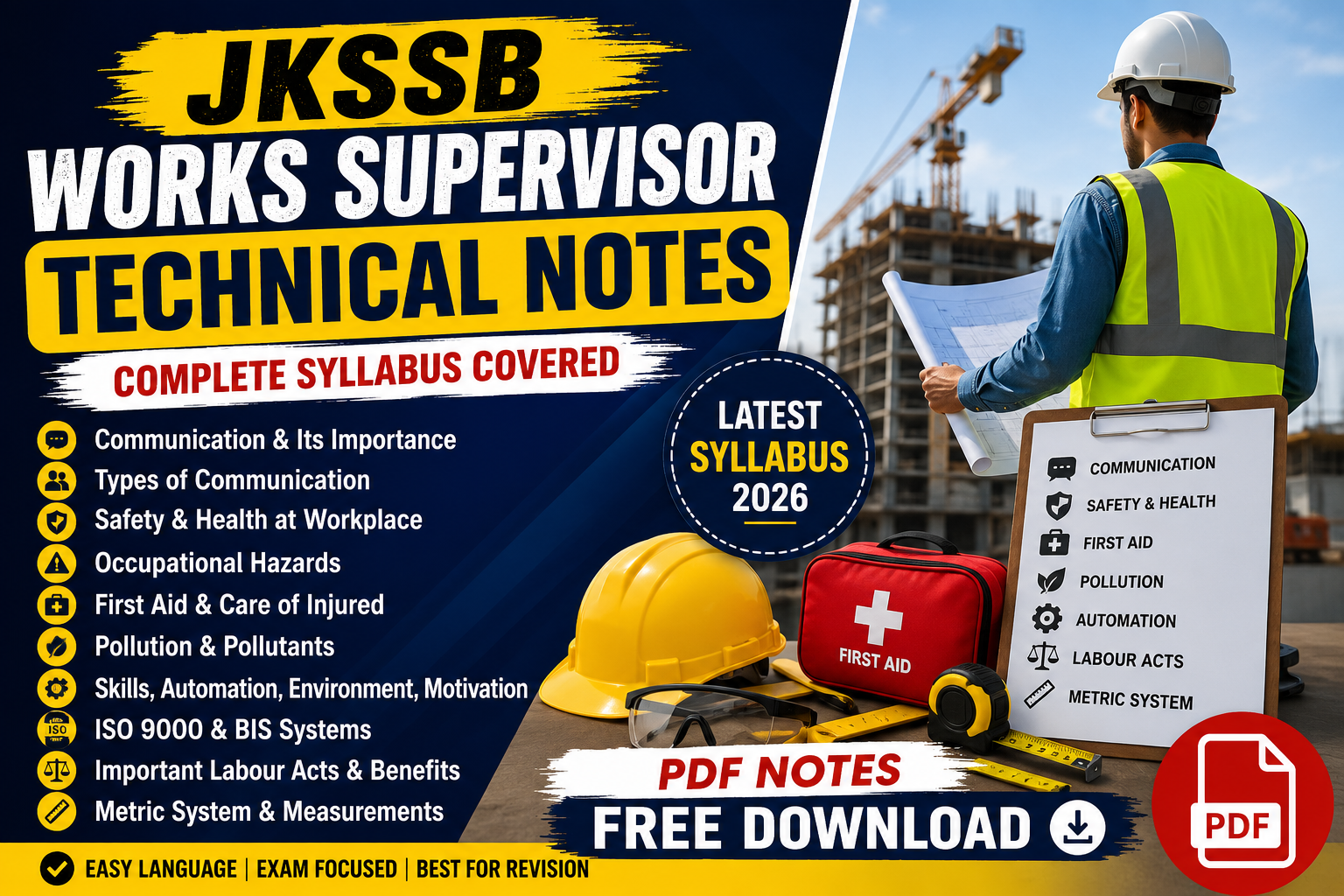
JKSSB Works Supervisor Technical Notes PDF Free Download – Complete Study Material (Latest Syllabus)
Preparing for the JKSSB Works Supervisor Examination requires a strong understanding of the technical section because it carries significant weight in the final merit. Many candidates focus only on General Knowledge and Reasoning, but the technical portion often becomes the deciding factor between selection and rejection.
If you are searching for JKSSB Works Supervisor Technical Notes PDF Free Download, you have reached the right place. In this article, we have explained every topic of the latest technical syllabus in simple and easy language so that beginners as well as experienced candidates can understand the concepts quickly.
These notes are specially prepared according to the latest JKSSB syllabus and are useful for revision, classroom study, self-study, and solving previous year questions.
Download Complete Notes for jkssb works Supervisor
Why Technical Notes are Important for JKSSB Works Supervisor?
The technical section tests your practical understanding of workplace safety, communication, measurement systems, industrial laws, environmental awareness, and quality management.
Good technical preparation helps you:
- Score higher in the technical section
- Improve conceptual understanding
- Solve MCQs quickly
- Revise the syllabus in less time
- Build confidence before the examination
Instead of memorizing facts, candidates should understand the concepts because many JKSSB questions are application-based.
1. Communication and Its Importance
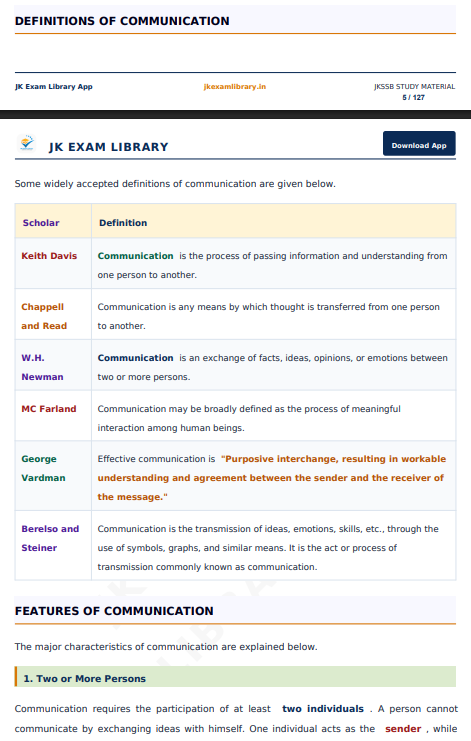
Communication is the process of exchanging information, ideas, thoughts, feelings, or instructions between two or more people. Effective communication is essential in every workplace because it ensures smooth coordination, reduces misunderstandings, and improves productivity.
In construction and engineering works, communication helps workers understand instructions correctly, report problems, and complete projects safely.
Importance of Communication
- Improves teamwork
- Reduces mistakes
- Increases productivity
- Ensures workplace safety
- Helps in decision-making
- Builds trust among employees
- Improves customer satisfaction
A Works Supervisor communicates daily with engineers, labourers, contractors, and government officials. Therefore, communication skills are extremely important.
2. Types of Communication
Communication can take different forms depending on the situation.
Verbal Communication
Verbal communication uses spoken words.
Examples:
- Meetings
- Phone calls
- Face-to-face discussion
- Site instructions
Advantages
- Quick exchange of information
- Immediate clarification
- Better understanding
Non-Verbal Communication
Non-verbal communication includes body language, facial expressions, eye contact, gestures, posture, and hand signals.
Examples:
- Hand signals on construction sites
- Safety signs
- Facial expressions
Good body language increases confidence and improves communication.
Written Communication
Written communication includes information communicated through written documents.
Examples:
- Letters
- Reports
- Notices
- Office files
- Work orders
Advantages:
- Permanent record
- Easy reference
- Legal evidence
Email Communication
Email is one of the fastest digital communication methods used in offices.
Benefits:
- Fast communication
- Document sharing
- Professional record
- Easy coordination
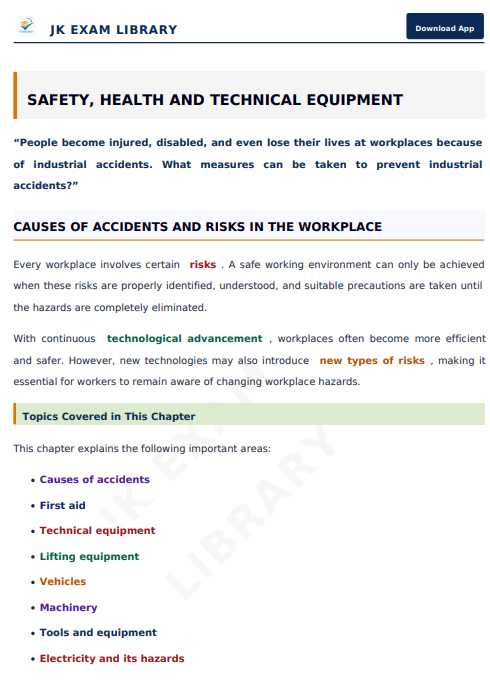
3. Safety and Health at Workplace
Safety means protecting workers from accidents and injuries.
Health refers to the physical and mental well-being of workers.
A safe workplace improves employee performance and reduces financial losses caused by accidents.
Importance of Workplace Safety
- Prevents injuries
- Saves lives
- Improves productivity
- Reduces medical expenses
- Increases worker confidence
- Ensures legal compliance
Basic Safety Rules
- Wear Personal Protective Equipment (PPE)
- Follow safety instructions
- Maintain cleanliness
- Use tools properly
- Report unsafe conditions immediately
- Avoid shortcuts
Personal Protective Equipment (PPE)
PPE protects workers from hazards.
Common PPE includes:
- Safety helmet
- Safety shoes
- Gloves
- Safety goggles
- Ear protection
- Reflective jacket
- Face shield
- Respirator
Every Works Supervisor should ensure workers wear proper PPE before starting work.
4. Occupational Hazards
Occupational hazards are dangers or risks present at the workplace that may cause injury, illness, or damage.
A. Basic Hazards
Basic hazards include:
- Slipping
- Falling
- Tripping
- Poor housekeeping
- Unsafe equipment
These are among the most common causes of workplace accidents.
B. Chemical Hazards
Chemical hazards occur due to exposure to harmful chemicals.
Examples:
- Paints
- Acids
- Solvents
- Cement dust
- Toxic gases
Effects include:
- Skin irritation
- Breathing problems
- Burns
- Poisoning
Prevention:
- Wear gloves
- Use masks
- Ensure ventilation
- Store chemicals safely
C. Mechanical Hazards
Mechanical hazards are caused by moving machines or tools.
Examples:
- Rotating machinery
- Sharp tools
- Conveyor belts
- Cutting machines
Safety Measures:
- Machine guards
- Proper training
- Lock-out procedures
- Regular maintenance
D. Electrical Hazards
Electricity can cause severe injuries or death.
Examples:
- Electric shock
- Short circuit
- Fire
- Electrocution
Safety Tips:
- Never touch live wires
- Use insulated tools
- Proper earthing
- Switch off power before repairs
E. Thermal Hazards
Thermal hazards involve excessive heat or cold.
Examples:
- Welding
- Furnace work
- Steam pipes
- Hot machinery
Protection:
- Heat-resistant gloves
- Cooling breaks
- Protective clothing
5. First Aid and Care of Injured Workers
First aid is the immediate medical assistance given to an injured or sick person before professional medical treatment becomes available.
Quick first aid can save lives.
Objectives of First Aid
- Save life
- Prevent further injury
- Reduce pain
- Promote recovery
Basic First Aid Steps
- Stay calm.
- Ensure the area is safe.
- Check breathing.
- Call emergency services.
- Control bleeding.
- Treat burns.
- Immobilize fractures.
- Comfort the victim.
Common First Aid Situations
Bleeding
- Apply direct pressure.
- Elevate injured part.
- Use clean bandage.
Burns
- Cool with clean running water.
- Do not apply oil or toothpaste.
- Cover with sterile dressing.
Electric Shock
- Switch off electricity.
- Do not touch victim directly.
- Call medical help.
Fracture
- Do not move the injured part unnecessarily.
- Use splints.
- Shift carefully to hospital.
6. Pollution and Pollutants
Pollution is the contamination of the environment by harmful substances.
A pollutant is any substance that causes pollution.
Types of Pollution
Air Pollution
Caused by:
- Smoke
- Dust
- Vehicle emissions
- Industrial gases
Effects:
- Asthma
- Lung diseases
- Global warming
Water Pollution
Sources:
- Industrial waste
- Sewage
- Chemicals
Effects:
- Unsafe drinking water
- Waterborne diseases
- Harm to aquatic life
Soil Pollution
Caused by:
- Plastic waste
- Chemicals
- Pesticides
Effects:
- Reduced soil fertility
- Crop damage
Noise Pollution
Sources:
- Heavy machinery
- Vehicles
- Construction equipment
Effects:
- Hearing loss
- Stress
- Sleep disturbance
Types of Waste
Liquid Waste
Examples:
- Sewage
- Wastewater
- Industrial effluents
Solid Waste
Examples:
- Plastic
- Paper
- Metal
- Construction debris
Gaseous Waste
Examples:
- Carbon dioxide
- Sulphur dioxide
- Nitrogen oxides
Hazardous Waste
Examples:
- Medical waste
- Chemicals
- Batteries
- Paints
Hazardous waste requires special handling and disposal methods.
7. Skills, Working Aids, Automation, Environment and Motivation
Skills
Skills are the abilities required to perform work efficiently.
Examples:
- Technical skills
- Communication skills
- Leadership
- Problem-solving
Working Aids
Working aids are tools or equipment that help workers perform tasks safely and efficiently.
Examples:
- Ladders
- Measuring tapes
- Safety harness
- Scaffolding
- Power tools
Automation
Automation means performing work using machines or computer-controlled systems with minimum human intervention.
Advantages:
- Higher productivity
- Better accuracy
- Faster work
- Lower labour cost
- Improved safety
Environment
The workplace environment includes physical surroundings, cleanliness, ventilation, lighting, and safety conditions.
A good environment increases productivity and employee satisfaction.
Motivation
Motivation is the internal or external force that encourages workers to perform better.
Types:
- Financial motivation
- Non-financial motivation
Examples:
- Salary
- Promotion
- Appreciation
- Awards
- Job security
8. ISO 9000 and BIS
ISO 9000
ISO stands for International Organization for Standardization.
ISO 9000 is a family of standards related to quality management systems.
Objectives:
- Improve quality
- Increase customer satisfaction
- Reduce defects
- Improve efficiency
Benefits:
- Better documentation
- International recognition
- Consistent quality
- Improved customer trust
BIS
BIS stands for Bureau of Indian Standards.
It is India's national standards body.
Functions:
- Product certification
- Standard formulation
- Quality testing
- Consumer protection
The ISI mark issued by BIS indicates that a product meets Indian quality standards.
9. Important Labour Acts
Every Works Supervisor should have basic knowledge of important labour laws.
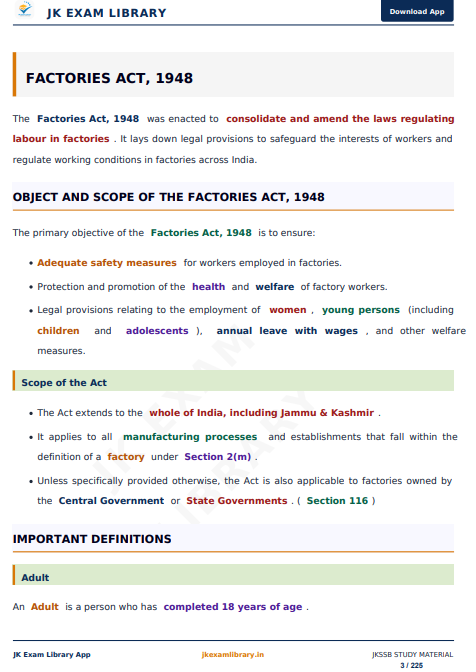
Factories Act, 1948
Purpose:
- Worker safety
- Health
- Welfare
- Working hours
- Leave provisions
Apprentices Act, 1961
Provides training opportunities for apprentices in industries and develops skilled manpower.
Employees' State Insurance (ESI) Act, 1948
Provides medical and financial benefits to workers during sickness, maternity, disability, and employment injuries.
Payment of Wages Act, 1936
Ensures timely payment of wages without unauthorized deductions.
Employees' Provident Fund (EPF) Act, 1952
Provides retirement savings and financial security to employees through provident fund contributions.
Employees' Compensation Act (formerly Workmen's Compensation Act), 1923
Provides compensation to employees or their families in case of injury, disability, or death arising out of employment.
10. Metric System
The metric system is the internationally accepted decimal system of measurement.
It is simple because all units are related by multiples of 10.
Measurement of Length
Units:
- Millimetre (mm)
- Centimetre (cm)
- Metre (m)
- Kilometre (km)
Conversions:
- 10 mm = 1 cm
- 100 cm = 1 m
- 1000 m = 1 km
Measurement of Weight
Units:
- Milligram (mg)
- Gram (g)
- Kilogram (kg)
- Tonne
Conversions:
- 1000 mg = 1 g
- 1000 g = 1 kg
- 1000 kg = 1 tonne
Unit Conversion Examples
- 2 metres = 200 cm
- 5 kg = 5000 g
- 1500 mm = 1.5 metres
- 3 km = 3000 metres
Candidates should practice unit conversion regularly because numerical questions are frequently asked in competitive examinations.
Reading of Plain Scales
Plain scales are used to measure distances accurately on engineering drawings and maps.
Applications include:
- Building plans
- Road layouts
- Site measurements
- Construction drawings
Always read the scale carefully before taking measurements to avoid errors.
Reading of Measuring Tape and Foot Rule
A measuring tape and foot rule are basic tools used for measuring dimensions in construction and engineering work.
Measuring Tape
Used for measuring:
- Room dimensions
- Length of pipes
- Height of structures
- Furniture dimensions
Foot Rule
Generally available in 12-inch (1-foot) length and used for smaller measurements.
Good measurement practices include:
- Keep the tape straight.
- Read measurements at eye level.
- Record values accurately.
- Check measurements twice before finalizing work.
Preparation Tips for JKSSB Works Supervisor Technical Section
To score well in the technical section, focus on understanding concepts instead of rote learning. Revise workplace safety rules, communication methods, labour laws, pollution control, and measurement systems regularly. Practice unit conversions, measurement-based questions, and previous years' MCQs. Make short notes for important acts, ISO 9000, BIS, and occupational hazards so that revision becomes easier during the last few days before the examination.
Consistent revision, concept clarity, and regular MCQ practice will significantly improve your performance and increase your chances of qualifying the JKSSB Works Supervisor examination.
Conclusion
The JKSSB Works Supervisor Technical Notes cover practical topics that are directly related to workplace management, industrial safety, quality standards, labour laws, environmental protection, and engineering measurements. A strong command of these topics not only helps in the examination but also prepares candidates for real-life responsibilities after selection.
Study these notes thoroughly, revise them multiple times, and solve previous year questions to strengthen your preparation. With disciplined practice and concept-based learning, you can score excellent marks in the technical section and improve your overall rank in the JKSSB Works Supervisor examination.