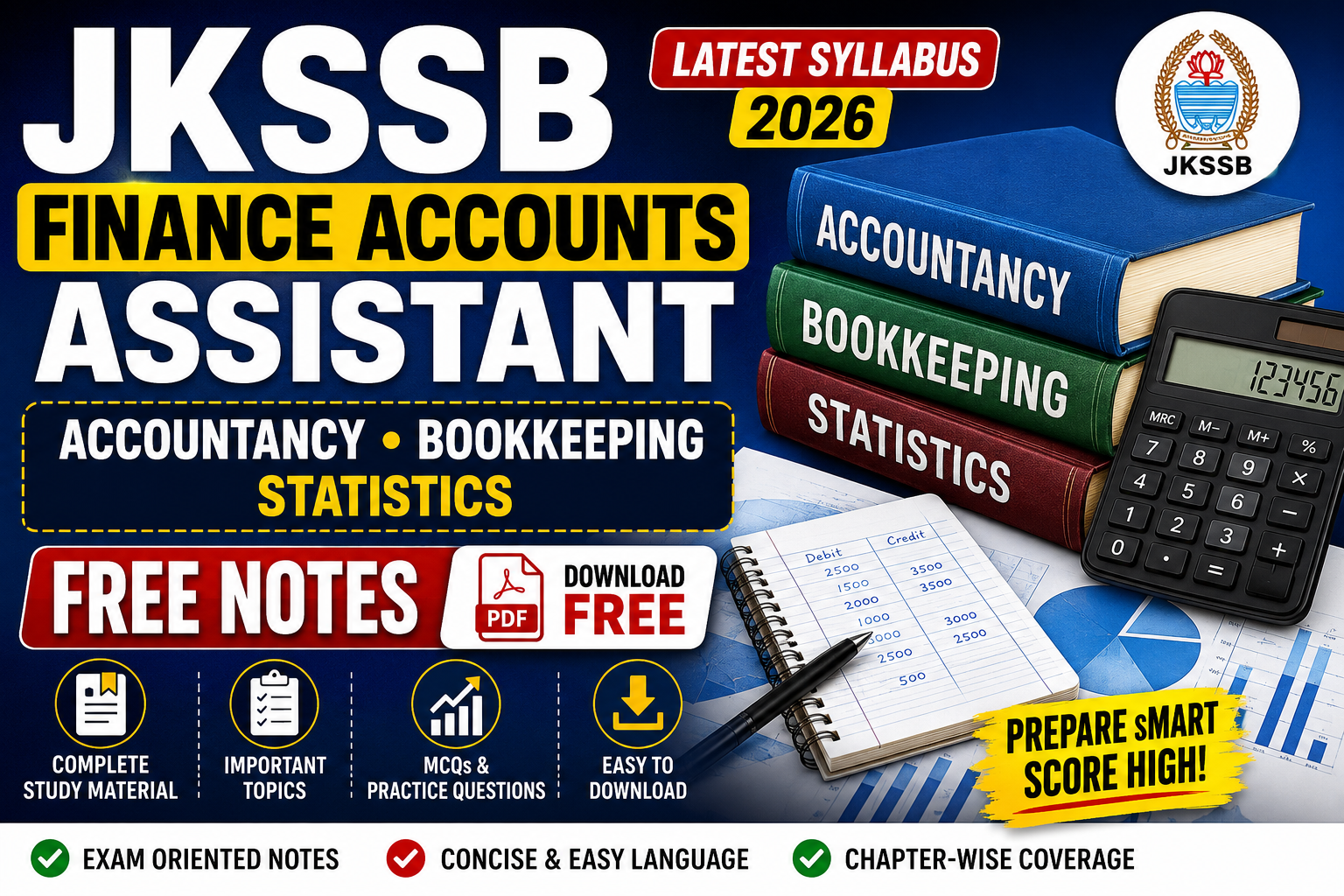
JKSSB Finance Accounts Assistant Free Accountancy, Bookkeeping & Statistics Notes PDF Download
If you're preparing for the JKSSB Finance Accounts Assistant (FAA) examination, having the right study material is one of the biggest advantages. Thousands of candidates search every year for free Accountancy, Bookkeeping, and Statistics notes, but most resources are either incomplete or scattered across multiple websites.
At JK Exam Library, we've created this guide to help aspirants access quality notes, understand the syllabus, and prepare smartly for the upcoming examination.
Whether you're appearing for the exam for the first time or improving your previous score, this article will help you understand what to study, where to focus, and how to download the best study material for free.
Download Complete Notes for jkssb FAA
Why Quality Notes Matter for JKSSB Finance Accounts Assistant
The Finance Accounts Assistant examination isn't just about remembering definitions. Questions are designed to test your conceptual understanding of accounting principles, bookkeeping methods, financial statements, and statistical calculations.
Instead of reading bulky textbooks from cover to cover, structured notes help you:
- Revise faster before the examination
- Understand difficult accounting concepts easily
- Practice important numerical problems
- Remember formulas through concise explanations
- Cover the complete syllabus in less time
A well-prepared set of notes saves hundreds of hours during preparation.
For 3000+ accountancy statistics mcqs u can practice for free
JKSSB Finance Accounts Assistant Syllabus Overview
The technical portion mainly focuses on three major areas:
1. Accountancy
Accountancy forms the backbone of the examination. Candidates should develop strong conceptual clarity because many questions are application-based rather than theoretical.
Major topics include:
- Introduction to Accounting
- Accounting Principles
- Accounting Concepts
- Accounting Conventions
- Accounting Standards
- Accounting Cycle
- Journal
- Ledger
- Trial Balance
- Cash Book
- Subsidiary Books
- Bank Reconciliation Statement
- Rectification of Errors
- Depreciation
- Bills of Exchange
- Final Accounts
- Trading Account
- Profit and Loss Account
- Balance Sheet
- Financial Statements
- Ratio Analysis
- Working Capital
- Partnership Accounts
- Company Accounts
Candidates should practice journal entries regularly because they form the foundation of several advanced topics.
2. Bookkeeping
Bookkeeping is one of the easiest scoring sections if your fundamentals are clear.
Important chapters include:
- Double Entry System
- Source Documents
- Recording Transactions
- Posting Entries
- Balancing Accounts
- Classification of Accounts
- Capital and Revenue
- Errors in Bookkeeping
- Inventory Valuation
- Purchase Book
- Sales Book
- Petty Cash Book
- Cash and Bank Book
Understanding the flow of transactions from journal to ledger makes solving numerical questions much easier.
3. Statistics
Many aspirants ignore Statistics, but this section can significantly improve your overall score.
Important topics include:
- Collection of Data
- Classification of Data
- Tabulation
- Graphical Presentation
- Frequency Distribution
- Mean
- Median
- Mode
- Standard Deviation
- Variance
- Probability
- Correlation
- Regression
- Index Numbers
- Time Series
- Sampling Techniques
- Data Interpretation
Most questions are formula-based, making this section highly scoring with regular practice.
Free JKSSB Finance Accounts Assistant Notes PDF
Finding genuine and updated notes can be difficult because many websites provide outdated material. Our notes are prepared according to the latest JKSSB syllabus and focus only on exam-relevant concepts.
The notes cover:
- Complete Accountancy Notes
- Complete Bookkeeping Notes
- Complete Statistics Notes
- Chapter-wise MCQs
- Important Numerical Questions
- Previous Year Question Analysis
- Quick Revision Notes
- Practice Questions
- Short Tricks
- Formula Sheets
These notes are especially useful during the last month before the examination when revision becomes the top priority.
How to Study Accountancy Effectively
Many candidates struggle because they simply memorize journal entries without understanding the logic behind them.
A better approach is to:
- Learn accounting concepts first.
- Understand debit and credit rules.
- Solve journal entries daily.
- Prepare ledger accounts.
- Practice trial balance.
- Solve complete financial statements.
Consistency matters much more than studying for long hours occasionally.
Best Preparation Strategy for JKSSB Finance Accounts Assistant
Preparing for the JKSSB Finance Accounts Assistant examination requires more than just reading notes. The candidates who secure top ranks usually follow a structured plan that balances concept building, numerical practice, and revision.
A simple strategy is to divide your preparation into three stages.
Phase 1 – Build Strong Concepts
Start by understanding the basics of Accountancy, Bookkeeping, and Statistics. Avoid memorizing journal entries or formulas without knowing the logic behind them. Once your concepts are clear, solving numerical questions becomes much easier.
Focus on:
- Accounting Principles and Concepts
- Golden Rules of Accounting
- Double Entry System
- Journal and Ledger
- Trial Balance
- Final Accounts
- Measures of Central Tendency
- Probability
- Correlation
Spend enough time on understanding the "why" behind every accounting transaction rather than simply remembering formats.
Phase 2 – Daily Practice
Accountancy is a practical subject. Reading alone will not help unless you regularly solve questions.
Every day, try to practice:
- Journal Entries
- Ledger Posting
- Trial Balance Problems
- Cash Book Questions
- Depreciation Numericals
- Final Accounts
- Bank Reconciliation Statement
- Statistics Formula-Based Questions
The more numerical problems you solve, the faster you'll become in the actual examination.
Phase 3 – Revision
The final few weeks before the examination should be reserved mainly for revision.
During revision:
- Read only short notes.
- Revise accounting formulas.
- Practice important MCQs.
- Solve previous year questions.
- Revise Statistics formulas every day.
- Focus on weak chapters.
Avoid starting completely new topics in the last week before the examination.
Important Topics You Should Never Skip
Some chapters have consistently remained important in Finance Accounts Assistant examinations and frequently appear in objective papers.
These include:
- Accounting Principles
- Accounting Equation
- Double Entry System
- Journal Entries
- Ledger
- Trial Balance
- Cash Book
- Subsidiary Books
- Bank Reconciliation Statement
- Depreciation
- Rectification of Errors
- Bills of Exchange
- Trading Account
- Profit & Loss Account
- Balance Sheet
- Partnership Accounts
- Company Accounts
- Cost Accounting Basics
- Ratio Analysis
- Working Capital
- Mean
- Median
- Mode
- Standard Deviation
- Probability
- Correlation
- Regression
- Index Numbers
- Time Series
- Sampling Techniques
If your concepts are strong in these chapters, you'll be well-prepared for a large portion of the technical syllabus.
Common Mistakes Candidates Make
Many aspirants prepare hard but still lose marks because of avoidable mistakes.
Some common errors include:
- Memorizing journal entries without understanding concepts.
- Ignoring Statistics because it seems difficult.
- Not practicing enough numerical questions.
- Reading too many books instead of revising one good source.
- Skipping previous year questions.
- Leaving revision until the last week.
- Depending only on theory without solving MCQs.
Avoiding these mistakes can significantly improve your overall performance.
Best Books for JKSSB Finance Accounts Assistant
While notes are excellent for revision, standard books help build strong fundamentals.
Some highly recommended books include:
- Financial Accounting by T.S. Grewal
- Financial Accounting by S.N. Maheshwari
- Principles of Accounting by R.L. Gupta
- Fundamentals of Accounting by Jain & Narang
- Business Statistics by S.P. Gupta
- Objective Accounting MCQ Books for Competitive Exams
Use one primary book for concepts and rely on concise notes for regular revision.
Why Previous Year Questions Are Important
Previous year papers give valuable insight into the type and difficulty level of questions asked by JKSSB.
By practicing them, you can:
- Understand important topics.
- Improve speed and accuracy.
- Learn question patterns.
- Identify frequently repeated concepts.
- Build confidence before the examination.
Candidates should solve as many previous year papers as possible under timed conditions.
Benefits of Using Chapter-wise Notes
Well-organized notes make preparation easier because they:
- Save valuable study time.
- Cover only exam-relevant topics.
- Highlight important formulas.
- Simplify complex accounting concepts.
- Help in quick revision before exams.
- Improve retention through concise explanations.
- Reduce dependence on multiple textbooks.
A single, comprehensive set of notes is often more effective than studying from several scattered sources.
Frequently Asked Questions (FAQs)
Is Accountancy difficult for JKSSB Finance Accounts Assistant?
Not if you build your fundamentals first. Regular practice of journal entries, ledger posting, and numerical problems makes the subject much easier.
Are Bookkeeping questions theoretical or numerical?
The examination generally includes both conceptual and numerical questions. Candidates should prepare both aspects thoroughly.
How important is Statistics in the examination?
Statistics is one of the highest-scoring sections. Most questions are formula-based, making it easier to score with proper practice.
Can I prepare using only notes?
Notes are excellent for revision, but beginners should first understand concepts using standard books before relying solely on notes.
How many months are sufficient for preparation?
With consistent daily study and regular practice, three to four months are generally enough to complete the syllabus comfortably.
Final Words
The JKSSB Finance Accounts Assistant examination is an excellent opportunity for candidates seeking a stable government career in the finance and accounts sector. Success in this exam depends less on studying countless books and more on following a disciplined preparation strategy with the right study material.
Strong command over Accountancy, Bookkeeping, and Statistics, combined with continuous MCQ practice, previous year question analysis, and timely revision, can significantly improve your chances of securing a high score.
If you're searching for JKSSB Finance Accounts Assistant Notes PDF Download, Accountancy Notes, Bookkeeping Notes, Statistics Study Material, MCQs, and Previous Year Questions, you're in the right place. Start your preparation today with updated, syllabus-oriented resources and revise consistently to stay ahead of the competition.
Download the latest JKSSB Finance Accounts Assistant Notes PDF for free and begin your preparation with chapter-wise study material, concise revision notes, practice MCQs, and exam-focused content designed to help you perform confidently in the upcoming JKSSB examination.