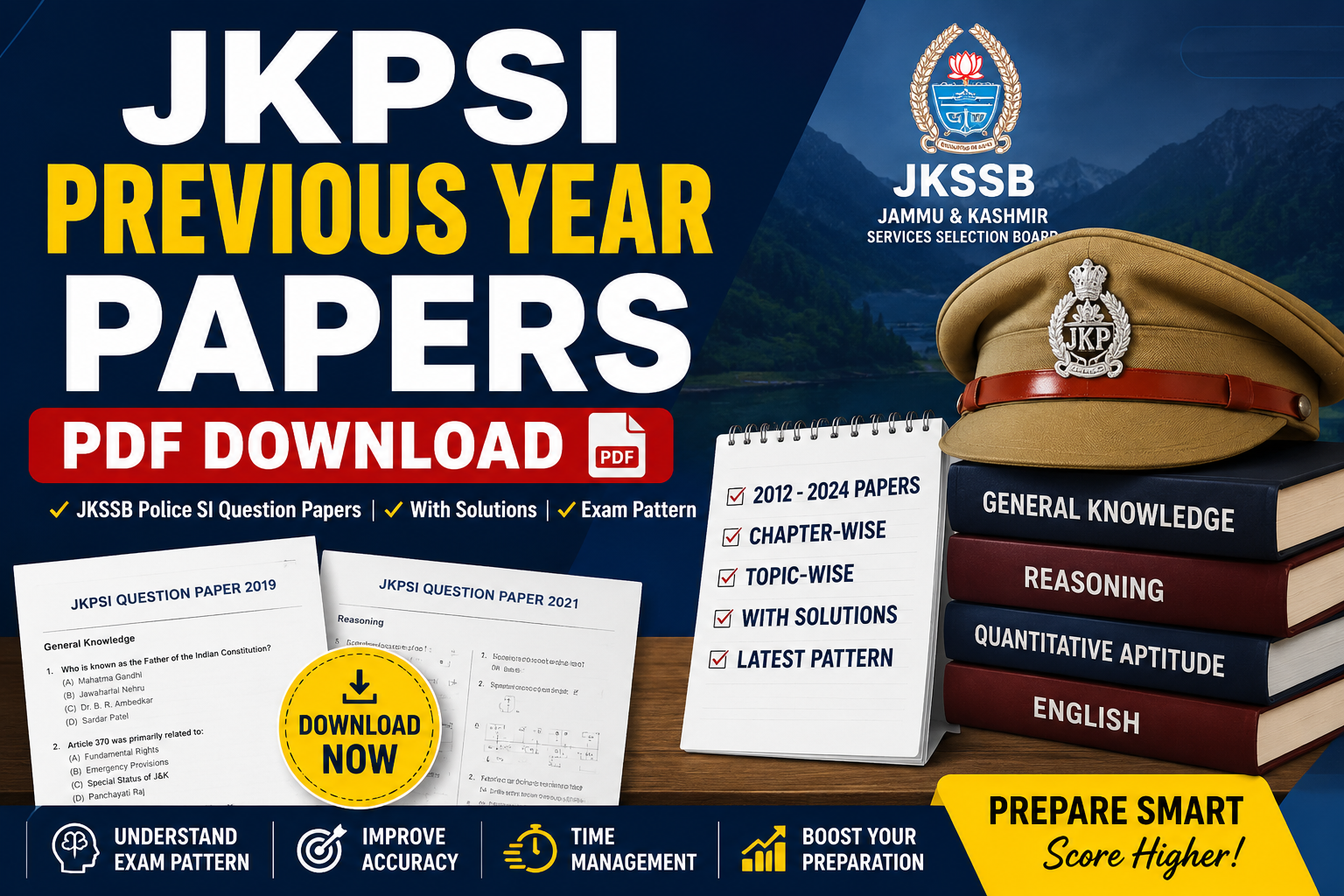
JKPSI Previous Year Papers PDF Download – Complete Guide for Serious Aspirants
If you are preparing for the JK Police Sub Inspector (JKPSI) examination conducted through JKSSB, one thing should be part of your daily study routine—solving previous year question papers.
Many candidates spend months reading books, watching lectures, and making notes, but they ignore one of the most valuable resources available: actual previous year papers. These papers tell you much more than any guidebook. They reveal the examiner's thinking, the difficulty level of questions, frequently repeated topics, and the overall trend of the examination.
Whether you are appearing for the first time or trying to improve your previous score, practicing JKPSI Previous Year Papers can significantly increase your confidence and help you prepare in the right direction.
In this article, you'll learn why previous papers are important, how to use them effectively, what benefits they offer, and where you can download them. If used correctly, these papers can become one of the strongest tools in your preparation journey.
Why Should Every JKPSI Aspirant Solve Previous Year Papers?
Every competitive examination follows a pattern. While questions may change every year, the style of asking questions, subject distribution, and difficulty level often remain similar.
Previous year papers allow you to understand this pattern instead of studying blindly.
Some of the biggest advantages include:
- Understanding the actual level of the examination.
- Identifying important topics that appear repeatedly.
- Improving speed and time management.
- Learning how questions are framed.
- Building confidence before the real examination.
- Finding your weak areas early.
Students who regularly practice previous papers usually perform much better because they already know what to expect on exam day.
📥 JKSSB-SI-Official-Paper-Held-On-13-Dec-2022-Shift-1
📥 JKSSB-SI-Official-Paper-Held-On-12-Dec-2022-Shift-1
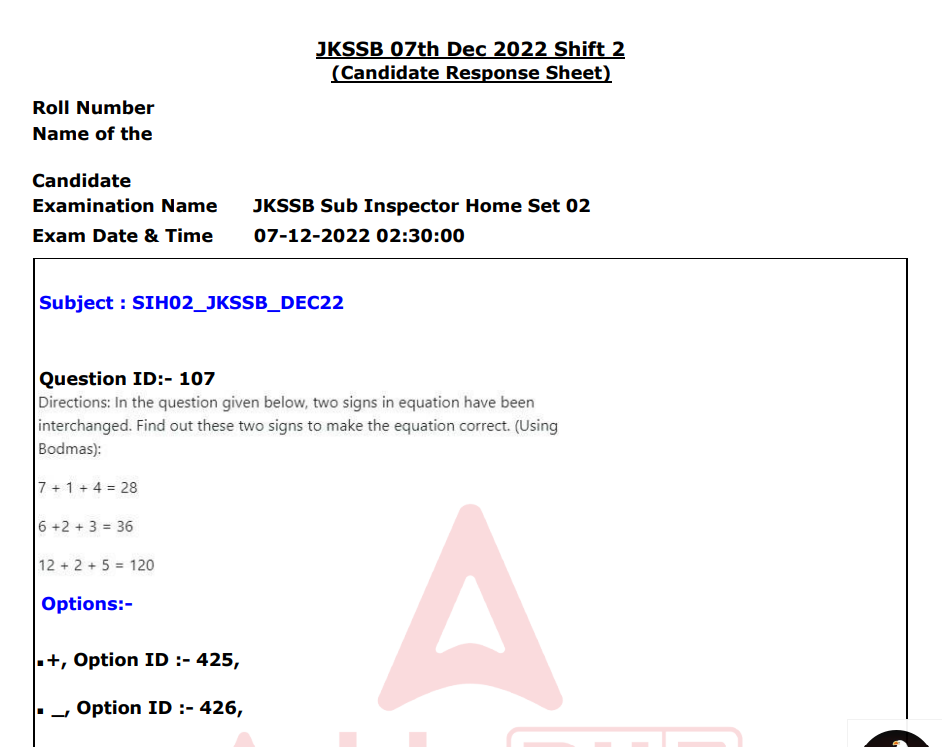
📥 JKSSB-SI-Official-Paper-Held-On_-07-Dec-2022-Shift-2
📥JKSSB-SI-Official-Paper-Held-On-19-Dec-2022-Shift-1
📥 JKSSB-SI-Official-Paper-Held-On-16-Dec-2022-Shift-1
JKPSI Exam Overview
| Particular | Details |
|---|---|
| Exam Name | JK Police Sub Inspector (JKPSI) |
| Recruiting Body | JKSSB |
| Mode of Examination | Offline / OMR Based |
| Question Type | Multiple Choice Questions (MCQs) |
| Negative Marking | As per official notification |
| Selection Process | Written Test + PET/PST + Document Verification (According to Notification) |
Note: Candidates should always follow the latest JKSSB notification because the examination pattern may be updated from time to time.
What Can You Learn from Previous Year Question Papers?
Many aspirants think previous papers are only for practice.
That is not true.
A previous year paper is actually a roadmap of the examination.
When you solve enough papers, you'll start noticing several patterns.
For example:
1. Frequently Asked Topics
Certain topics appear almost every year.
You may notice repeated questions from:
- Indian Polity
- Constitution
- Jammu & Kashmir General Knowledge
- Current Affairs
- Reasoning
- Quantitative Aptitude
- English
- Computer Awareness
Instead of guessing important topics, previous papers help you identify them naturally.
2. Difficulty Level
Books often contain questions that are either too easy or too difficult.
Previous papers show the exact standard expected in the examination.
This prevents over-preparation as well as under-preparation.
3. Time Management
Most candidates know the answers but fail to complete the paper on time.
Practicing previous papers under exam conditions teaches you:
- Which questions to attempt first.
- How much time to spend on each section.
- When to skip difficult questions.
- How to maintain speed without making mistakes.
These small improvements can make a huge difference in your final score.
4. Accuracy Improves Automatically
Competitive exams are not only about solving questions quickly.
Accuracy matters equally.
Every incorrect answer can reduce your final score if negative marking is applicable.
When you solve real papers repeatedly, your accuracy naturally improves because you become familiar with the examiner's style.
How to Use JKPSI Previous Year Papers Properly
Simply downloading PDFs is not enough.
Many students collect dozens of papers but never solve them seriously.
A better approach is to follow a proper strategy.
Step 1: Complete Your Basic Preparation
Finish the important topics first.
Previous papers should not replace your study material—they should strengthen it.
Step 2: Solve Papers Without Looking at Answers
Treat every paper like the actual examination.
Sit in a quiet room.
Set a timer.
Avoid using books or Google.
This gives you a realistic assessment of your preparation.
Step 3: Check Every Mistake
Your mistakes are more valuable than your correct answers.
After solving the paper:
- Identify wrong answers.
- Understand why they were incorrect.
- Revise those topics immediately.
This process helps you avoid repeating the same mistakes.
Step 4: Maintain an Error Notebook
One of the best habits followed by top scorers is maintaining an error notebook.
Whenever you make a mistake, write:
- Question
- Correct Answer
- Topic
- Reason for mistake
Before the examination, revise only this notebook.
It will save time and improve retention significantly.
Year-wise JKPSI Previous Papers
The following table gives an idea of the papers you should practice during your preparation.
| Year | Status |
|---|---|
| JKPSI Previous Paper 2024 | Available |
| JKPSI Previous Paper 2023 | Available |
| JKPSI Previous Paper 2022 | Available |
| JKPSI Previous Paper 2021 | Available |
| Older JK Police SI Papers | Available (If Conducted) |
Should Beginners Solve Previous Papers?
Absolutely.
Many beginners postpone solving previous papers until the last month.
That is a mistake.
Even if you have just started preparing, solving one paper every week will help you understand what the examination actually demands.
Instead of studying random topics, you'll begin focusing on concepts that genuinely matter.
As your preparation improves, gradually increase the number of papers you solve each week.
Combine Previous Papers with Mock Tests
Previous papers show what has already been asked, while mock tests prepare you for what may be asked next.
The best preparation strategy is to combine both.
For example:
| Day | Activity |
|---|---|
| Monday–Friday | Study & Subject-wise MCQs |
| Saturday | Solve One Previous Year Paper |
| Sunday | Full-Length Mock Test + Analysis |
Following this routine consistently for a few months can significantly improve your performance in the actual examination.
JKPSI Previous Year Papers: A Smart Strategy to Score Higher
Many candidates solve previous year papers only a few days before the examination. This is one of the biggest mistakes made during competitive exam preparation.
Previous papers are not meant only for revision—they should be used throughout your preparation journey.
A smart strategy is to divide your preparation into three phases.
| Phase | What to Do |
|---|---|
| Phase 1 | Complete the syllabus and understand basic concepts. |
| Phase 2 | Solve chapter-wise MCQs along with previous year questions. |
| Phase 3 | Attempt full-length previous papers under exam conditions and analyze mistakes. |
By following this approach, you will not only improve your knowledge but also develop the confidence required to perform well on the final examination.
Common Mistakes Candidates Make While Solving Previous Papers
Many aspirants download dozens of PDFs but never use them effectively.
Avoid these common mistakes:
❌ Solving Papers Without Completing Basics
If you have not studied the syllabus, your score will naturally be low. Build your concepts first and then begin practicing papers.
❌ Looking at Answers While Solving
Some students check answers after every question. This completely defeats the purpose of solving a previous paper.
Attempt the entire paper honestly before checking the solutions.
❌ Ignoring Wrong Answers
Getting an answer wrong is not a problem.
Ignoring why it was wrong is.
Every mistake teaches something new. Analyze every incorrect answer and revise that topic immediately.
❌ Never Revising Previous Papers
Many candidates solve one paper and never look at it again.
A better strategy is to revisit the same paper after 15–20 days. You'll be surprised how much your accuracy improves.
How Many Previous Year Papers Should You Solve?
There is no fixed number, but quality always matters more than quantity.
A good target is:
| Preparation Level | Recommended Papers |
|---|---|
| Beginner | 5–8 Papers |
| Intermediate | 10–15 Papers |
| Serious Aspirant | All Available Papers + Multiple Revisions |
Remember, solving the same paper twice with proper analysis is often more beneficial than solving two different papers without reviewing your mistakes.
Why JKPSI Previous Papers Are Better Than Random Practice Sets
Random practice books often contain questions that are either too easy or unrelated to the actual examination.
Previous year papers, on the other hand, are based on real exams conducted by the recruiting authority.
They help you:
- Understand the actual question pattern.
- Identify repeated topics.
- Improve speed and accuracy.
- Build exam temperament.
- Gain confidence before the exam.
This is why almost every successful candidate recommends practicing previous papers regularly.
Download JKPSI Previous Year Papers PDF
If you're looking for authentic JKPSI previous year question papers, download them from our collection and start practicing today.
You can also explore the following resources:
- JKPSI Syllabus
- JKPSI Mock Tests
- JKPSI Study Notes
- Daily Current Affairs
- JKSSB Previous Year Papers
- JK Police Recruitment Updates
Final Preparation Tips
Before appearing for the examination, keep these points in mind:
- Revise important formulas and short notes.
- Solve at least one previous paper every week.
- Read current affairs daily.
- Practice OMR-based mock tests if possible.
- Focus on accuracy instead of attempting every question.
- Stay consistent rather than studying long hours occasionally.
A disciplined preparation plan combined with regular practice of previous year papers can significantly improve your chances of selection.
Frequently Asked Questions (FAQs)
1. Are JKPSI previous year papers enough for preparation?
Previous year papers are extremely important, but they should be used along with the latest syllabus, standard study material, mock tests, and current affairs.
2. Can questions be repeated in the JKPSI exam?
Exact questions may not always be repeated, but similar concepts, topics, and question patterns are frequently seen in competitive examinations.
3. How many years of previous papers should I solve?
Try to solve all available previous year papers. If time is limited, practice at least the last 5–10 years' papers thoroughly.
4. Should I solve papers before completing the syllabus?
You can attempt one or two papers initially to understand the exam pattern, but regular practice should begin after covering the basic syllabus.
5. How should I analyze a previous paper?
Review every incorrect answer, identify weak topics, revise them, and maintain an error notebook for quick revision before the exam.
6. Are JKPSI previous papers useful for other JKSSB exams?
Yes. Subjects like General Knowledge, English, Reasoning, and Quantitative Aptitude often overlap with several JKSSB examinations, making these papers useful for broader preparation.
Practice MCQs (Similar Types of Questions Asked in JKPSI)
These are the types of questions commonly asked in the JKPSI examination. Practice them to strengthen your preparation.
1. Who is known as the Father of the Indian Constitution?
A. Mahatma Gandhi
B. Jawaharlal Nehru
C. Dr. B. R. Ambedkar
D. Sardar Patel
✅ Answer: C
2. Article 370 was primarily related to:
A. Fundamental Rights
B. Emergency Provisions
C. Special Status of Jammu & Kashmir
D. Panchayati Raj
✅ Answer: C
3. Which blood group is known as the universal donor?
A. AB+
B. O−
C. A+
D. B−
✅ Answer: B
4. If SOUTH is coded as TPVUI, then NORTH is coded as:
A. OPSUI
B. OPSUII
C. OPSUI
D. OPSUI (Example coding pattern question)
✅ Answer: Based on the coding rule provided.
5. The headquarters of JKSSB is located in:
A. Jammu only
B. Srinagar only
C. Jammu and Srinagar
D. Leh
✅ Answer: C
6. The SI unit of Force is:
A. Joule
B. Watt
C. Newton
D. Pascal
✅ Answer: C
7. Which Schedule of the Indian Constitution deals with Panchayats?
A. Ninth Schedule
B. Tenth Schedule
C. Eleventh Schedule
D. Twelfth Schedule
✅ Answer: C
8. Which river is known as the lifeline of Kashmir Valley?
A. Ravi
B. Jhelum
C. Chenab
D. Tawi
✅ Answer: B
9. Find the missing number:
2, 6, 12, 20, 30, ?
A. 36
B. 40
C. 42
D. 44
✅ Answer: C
10. The primary function of the police is to:
A. Conduct elections
B. Maintain law and order
C. Collect taxes
D. Prepare budgets
✅ Answer: B
Conclusion
Preparing for the JKPSI examination requires dedication, consistency, and the right study strategy. While books and notes build your concepts, JKPSI Previous Year Papers help you understand the real examination pattern, improve time management, and identify your strengths and weaknesses.
Instead of collecting dozens of study resources, focus on mastering the available previous year papers. Solve them regularly, analyze every mistake, revise weak topics, and combine them with mock tests for the best results.
With disciplined preparation and continuous practice, you can significantly improve your chances of securing a good score in the JKPSI examination.