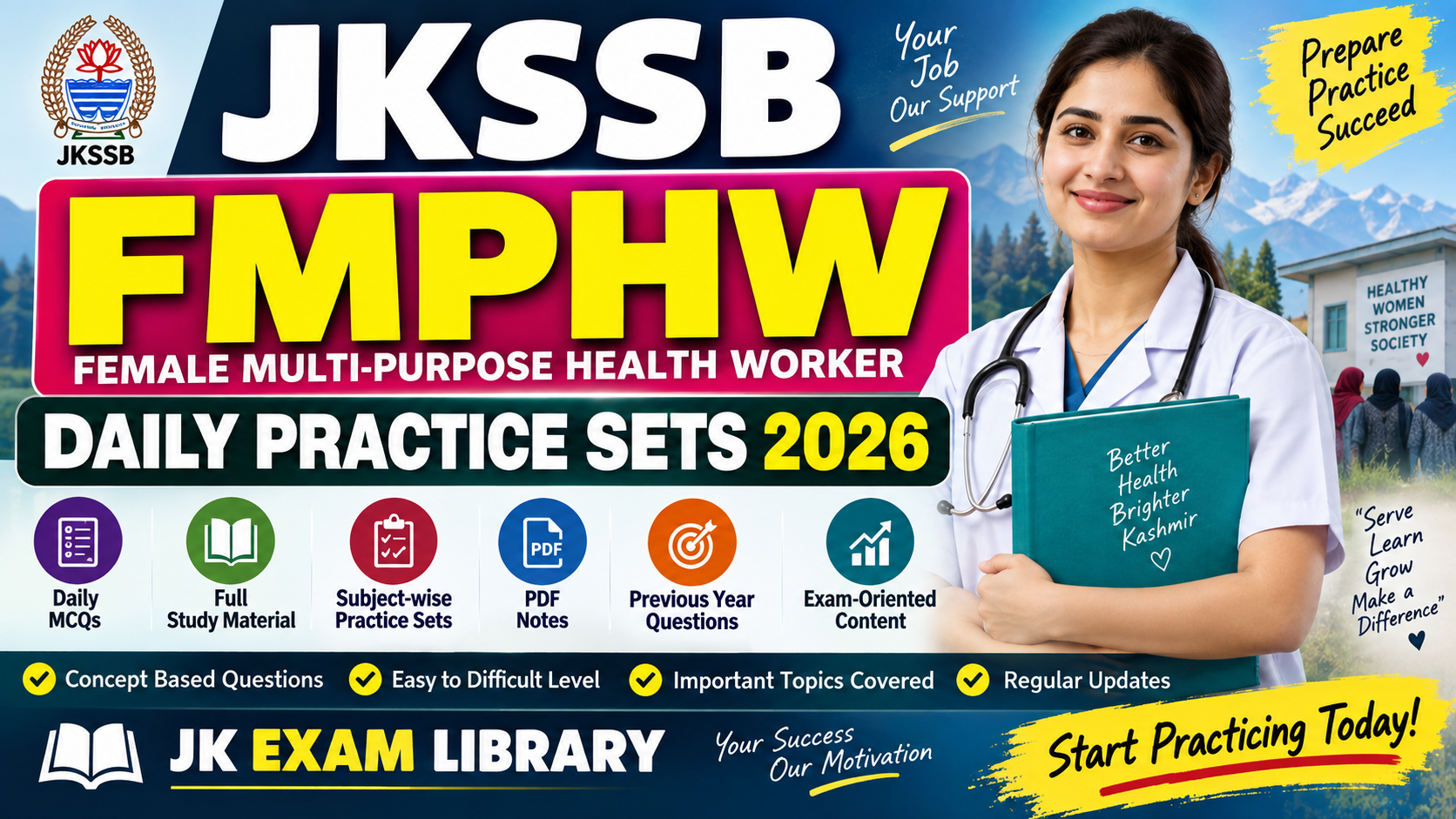
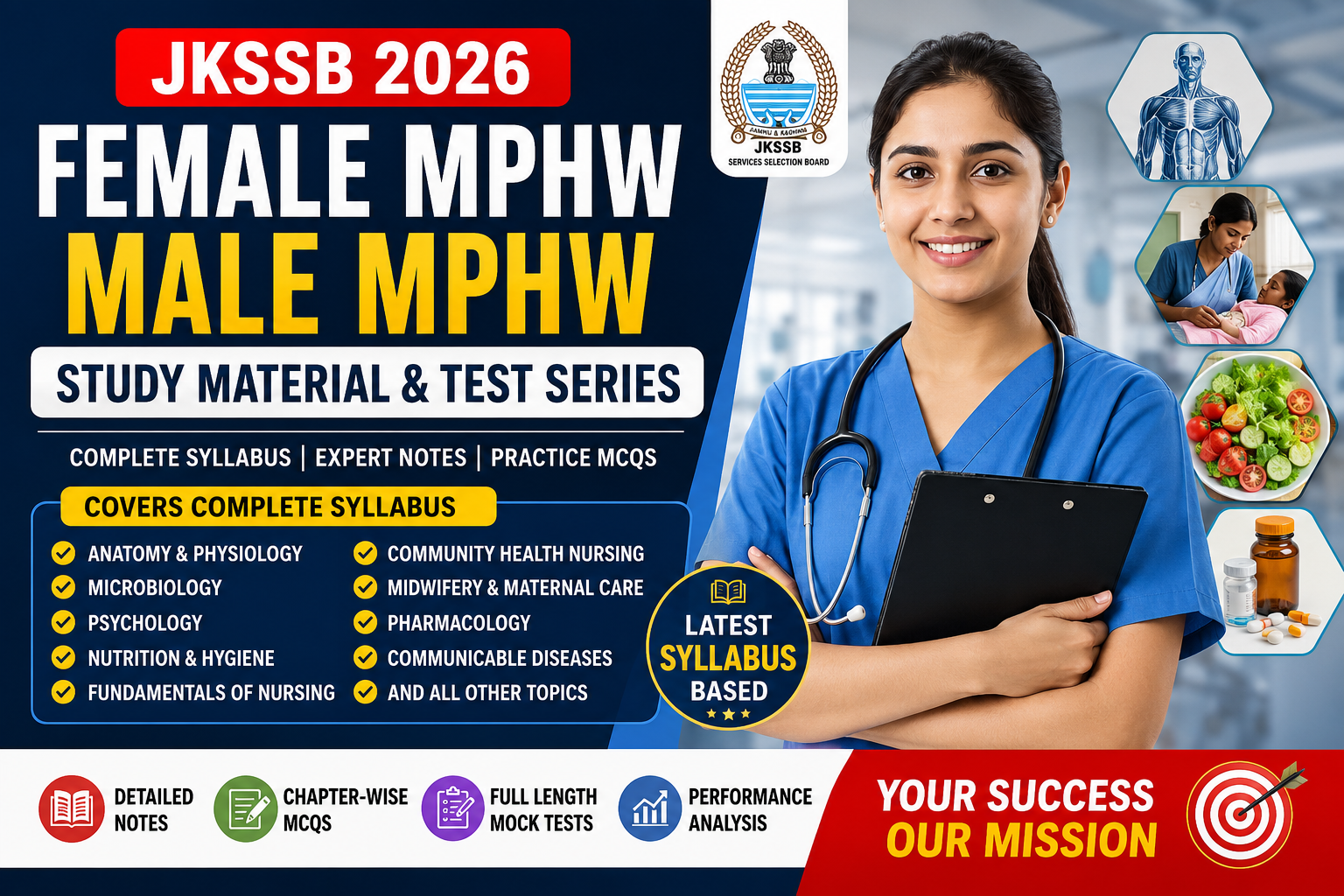
JKSSB Female MPHW/Male MPHW Study Material 2026 – Complete Technical Notes & Full Test Series for Smart Preparation
If you're preparing for the JKSSB Female MPHW/Male MPHW Recruitment 2026, you've probably noticed one thing already—this is not an exam you can clear by studying random PDFs or outdated notes. The syllabus is highly technical and focuses on nursing fundamentals, anatomy, physiology, microbiology, community health, maternal care, nutrition, hygiene, pharmacology, and national health programmes.
Every recruitment cycle, thousands of candidates apply for the JKSSB Female MPHW and JKSSB Male MPHW posts. While many candidates spend months preparing, only those who follow the right study material and practice consistently through mock tests are able to secure a place in the final merit list.
That is exactly why choosing a syllabus-oriented JKSSB Female MPHW/Male MPHW Study Material is one of the most important decisions during your preparation journey.
Instead of reading multiple books and scattered notes, focus on a single, structured resource that covers every topic mentioned in the latest JKSSB syllabus. Combine it with a high-quality JKSSB MPHW Test Series, and your preparation becomes much more organised and effective.
Why the Right Study Material Makes a Huge Difference
Many aspirants begin their preparation with enthusiasm but soon feel overwhelmed because they keep switching between different books, YouTube videos, Telegram PDFs, and coaching notes. This not only wastes valuable time but also creates confusion about what is actually important for the examination.
A well-organised JKSSB Female MPHW/Male MPHW Study Material helps you stay focused on the official syllabus. It allows you to build concepts chapter by chapter, revise quickly before the exam, and practice questions that match the actual JKSSB pattern.
When your notes are prepared according to the latest recruitment syllabus, revision becomes much easier, and you spend more time strengthening concepts instead of searching for study resources.
What Should a Complete JKSSB Female MPHW/Male MPHW Study Material Include?
The latest syllabus is divided into several technical subjects. Your preparation should cover every section thoroughly.
| Subject | Important Topics |
|---|---|
| Anatomy & Physiology | Human body, skeletal system, joints, muscles, heart, respiration, nervous system, endocrine glands, blood circulation, digestion, metabolism, reproduction |
| Microbiology | Bacteria, viruses, fungi, parasites, immunity, vaccines, infection control, specimen collection |
| Psychology | Human behaviour, emotions, motivation, learning, personality, defence mechanisms |
| Sociology | Community organisation, family, Panchayati Raj, rural society, community development |
| Hygiene | Personal hygiene, environmental hygiene, sanitation, waste disposal, disease prevention |
| Nutrition | Balanced diet, nutrients, food preservation, maternal nutrition, deficiency diseases |
| Fundamentals of Nursing | Nursing principles, patient care, nursing ethics, hospital management, first aid |
| Community Health Nursing | Midwifery, maternal health, child health, family planning, health education |
| Pharmacology | Essential medicines, drug administration, basic pharmacology |
| National Health Programmes | Immunization, communicable diseases, health planning, welfare services |
Preparing each subject separately makes revision easier and improves retention over time.
Anatomy & Physiology – Build Strong Concepts First
Anatomy and Physiology form the backbone of the MPHW examination. Before moving to advanced nursing topics, candidates should develop a clear understanding of how the human body is structured and how different organs function together.
Focus on topics such as the skeletal system, muscular system, heart, respiratory organs, nervous system, endocrine glands, digestive system, reproductive organs, blood circulation, metabolism, excretory system, embryology, and cell structure.
Instead of memorising facts blindly, try to understand the functions of each organ system. Conceptual learning helps answer both direct and application-based questions in the examination.
Microbiology – One of the Highest-Scoring Sections
Microbiology frequently appears in JKSSB health-related examinations because infection prevention and disease control are an essential part of an MPHW's responsibilities.
Candidates should thoroughly study the classification of microorganisms, bacteria, viruses, fungi, parasites, immunity, vaccines, pathogenic organisms, food-borne infections, specimen collection, infection control practices, and sterilization methods.
Pay special attention to the modes of transmission of infectious diseases because these concepts are commonly tested in objective examinations.
Nutrition & Hygiene – Practical Topics with High Exam Weightage
Nutrition and Hygiene are not just theoretical subjects; they are directly connected with public health and community welfare.
Study balanced diets, nutrients, calorie requirements, food groups, maternal nutrition, child nutrition, deficiency diseases, food adulteration, cooking methods, preservation techniques, and nutrition education.
Similarly, Hygiene covers personal cleanliness, environmental sanitation, menstrual hygiene, dental hygiene, skin care, mental hygiene, waste disposal, home sanitation, ventilation, and disease prevention.
These topics are comparatively easy to understand and can become scoring areas with regular revision.
Fundamentals of Nursing – The Core of the MPHW Examination
A large portion of the syllabus revolves around basic nursing concepts.
Candidates should prepare:
- Principles of Nursing
- Nursing Ethics
- Patient Care
- Hospital Environment
- Personal Hygiene
- Nutrition of Patients
- Elimination
- Comfort Measures
- Body Mechanics
- Positioning of Patients
- First Aid
- Emergency Care
- Care of Seriously Ill Patients
- Record Keeping
- Reporting System
- Patient Safety
Understanding the purpose behind each nursing procedure is more useful than rote memorisation.
Community Health Nursing – Build Concepts That Matter in the Real Examination
Community Health Nursing carries significant weight in the JKSSB Female MPHW/Male MPHW Examination because the role of an MPHW is closely connected with public health services. Questions from this section are generally practical, concept-based, and linked to the responsibilities performed at Sub Centres, Primary Health Centres (PHCs), and community health programmes.
Rather than memorising definitions, candidates should understand how different health services are implemented at the grassroots level.
Community Health Nursing – I
This section mainly focuses on maternal care, pregnancy, childbirth, and family welfare.
Important topics include:
- Antenatal Care (ANC)
- Home Delivery
- Postnatal Care (PNC)
- Domiciliary Midwifery
- Maintenance of Health Records
- Reproductive System
- Foetal Development
- Pregnancy and Physiological Changes
- Stages of Labour
- Puerperium
- Obstetric Complications
- Drugs Used in Obstetrics
- Family Planning Methods
- National Family Welfare Programme
- Reproductive Health Services
Candidates should also revise government programmes related to maternal and child welfare, as these are frequently linked with objective questions.
Community Health Nursing – II
This section evaluates your understanding of health awareness and community participation.
Prepare the following topics carefully:
- Nutrition Education
- Community Nutrition
- Maternal Nutrition Education
- Child Nutrition Education
- Principles of Health Education
- Teaching-Learning Process
- Community Participation
- Communication Skills
- Interpersonal Communication
- Audio-Visual Aids
- Selection and Preparation of Teaching Aids
Since MPHWs regularly educate communities about health and disease prevention, conceptual questions from this section are quite common.
Community Health Nursing – III
Community Health Nursing III introduces candidates to disease management, pharmacology, and public health programmes.
Focus on:
- Basic Medical Concepts
- Essential Pharmacology
- Safe Drug Administration
- Community Health Problems
- Health Planning
- National Health Programmes
- Health Organisations
- Welfare Services
- Public Health Administration
Understanding the objectives of major national health programmes can help you answer multiple questions in a short time.
Communicable Diseases – One of the Most Important Sections
Almost every MPHW examination includes questions on communicable diseases because prevention and early detection are among the primary responsibilities of Health Workers.
Your preparation should include:
- Immunity
- Immunization
- Infection Prevention
- Tuberculosis (TB)
- Malaria
- Dengue
- Cholera
- Typhoid
- Hepatitis
- Rabies
- Measles
- Diphtheria
- Chickenpox
- Leprosy
- Vector-Borne Diseases
- Water-Borne Diseases
- Disease Surveillance
- Prevention and Control Measures
Instead of learning only symptoms, focus equally on:
- Mode of transmission
- Prevention
- Vaccination
- Treatment
- Control measures
- Public health significance
These areas are highly relevant for both the examination and field work.
Mental Health & Environmental Sanitation
Mental Health has become increasingly important in health-related competitive examinations.
Candidates should study:
- Mental Health Concepts
- Prevention of Mental Illness
- Early Identification of Mental Disorders
- Community Mental Health Services
- Maternal Mental Health
- Child Mental Health
- School Mental Health
- Adolescent Mental Health
Similarly, Environmental Sanitation covers:
- Rural Sanitation
- Urban Sanitation
- Safe Water Supply
- Village Hygiene
- Sterilization
- Disinfection
- Antiseptics
- Disinfectants
- Public Health Measures
- Waste Management
- Disease Prevention through Sanitation
Why Solving a Full JKSSB MPHW Test Series is Essential
Completing the syllabus is only one part of the preparation. The second—and equally important—part is testing yourself regularly.
A well-designed JKSSB Female MPHW/Male MPHW Test Series allows you to apply what you've learned under real exam conditions. It helps improve speed, identify weak areas, and build confidence before the actual examination.
A quality test series should include:
- Chapter-wise Practice Tests
- Subject-wise Mock Tests
- Full-Length Mock Tests
- Previous Year Pattern Questions
- Difficulty Level Similar to JKSSB
- Instant Score Analysis
- Detailed Solutions
- Performance Tracking
- Unlimited Practice Attempts
Mock tests also reduce exam anxiety because you become familiar with the format and time pressure.
Smart Preparation Strategy for JKSSB Female MPHW/Male MPHW
Following a structured study plan can make preparation more productive.
| Week | Focus Area |
|---|---|
| Week 1–2 | Anatomy & Physiology + Microbiology |
| Week 3 | Psychology + Sociology |
| Week 4 | Hygiene + Nutrition |
| Week 5 | Fundamentals of Nursing I |
| Week 6 | Fundamentals of Nursing II |
| Week 7 | Community Health Nursing I |
| Week 8 | Community Health Nursing II |
| Week 9 | Community Health Nursing III |
| Week 10 | Revision + Full-Length Mock Tests + Previous Year MCQs |
Allocate time daily for revision instead of postponing it until the end. Even 30–45 minutes of daily revision can significantly improve retention.
Common Mistakes Candidates Should Avoid
Many aspirants lose marks due to avoidable mistakes rather than lack of knowledge.
Some common mistakes include:
- Studying from outdated notes.
- Ignoring the official syllabus.
- Skipping Community Health Nursing topics.
- Avoiding regular mock tests.
- Not revising previously studied chapters.
- Memorising facts without understanding concepts.
- Ignoring communicable diseases and national health programmes.
- Solving very few MCQs before the exam.
Avoiding these mistakes can make your preparation more focused and efficient.
Why Choose Our JKSSB Female MPHW/Male MPHW Study Material?
Our study resources are designed specifically according to the latest JKSSB syllabus and the pattern followed in recent Health Department examinations.
With our platform, you get:
- ✅ Latest Syllabus-Based Notes
- ✅ Chapter-wise Study Material
- ✅ High-Quality PDF Notes
- ✅ Subject-wise MCQs
- ✅ Previous Year Questions
- ✅ Full-Length Mock Tests
- ✅ Detailed Explanations
- ✅ Regular Current Affairs Updates
- ✅ Easy-to-Understand Language
- ✅ Mobile-Friendly Learning Platform
Whether you're preparing for JKSSB Female MPHW or JKSSB Male MPHW, these resources are designed to help you prepare with confidence.
Final Words
Success in the JKSSB Female MPHW/Male MPHW Recruitment Examination doesn't depend on studying the maximum number of books—it depends on studying the right content consistently.
Build your concepts, revise regularly, solve chapter-wise MCQs, attempt full-length mock tests, and analyse your performance after every test. A disciplined preparation strategy combined with syllabus-oriented study material can make a significant difference in your final score.
If you're serious about securing a position in the Jammu & Kashmir Health Department, start your preparation today with complete JKSSB Female MPHW/Male MPHW Study Material, practice through a comprehensive JKSSB MPHW Test Series, revise consistently, and stay committed to your goal.
Frequently Asked Questions (FAQs)
1. What is the best study material for the JKSSB Female MPHW/Male MPHW exam?
The best study material is one that follows the latest JKSSB syllabus and covers Anatomy & Physiology, Microbiology, Nursing Fundamentals, Community Health Nursing, Nutrition, Hygiene, Pharmacology, and Communicable Diseases along with chapter-wise MCQs and mock tests.
2. Is a test series necessary for JKSSB MPHW preparation?
Yes. A quality test series helps improve time management, accuracy, confidence, and familiarity with the actual exam pattern.
3. Does the study material include Community Health Nursing?
A complete preparation package should include Community Health Nursing I, II, and III, along with Midwifery, Family Welfare, Health Education, and National Health Programmes.
4. How should I prepare for the technical section of the MPHW exam?
Focus on understanding concepts rather than memorising facts. Study one subject at a time, revise regularly, and solve chapter-wise MCQs followed by full-length mock tests.
5. Are previous year questions useful for JKSSB Female MPHW/Male MPHW?
Yes. Previous year questions help you understand the exam pattern, difficulty level, frequently asked topics, and improve your overall preparation strategy.