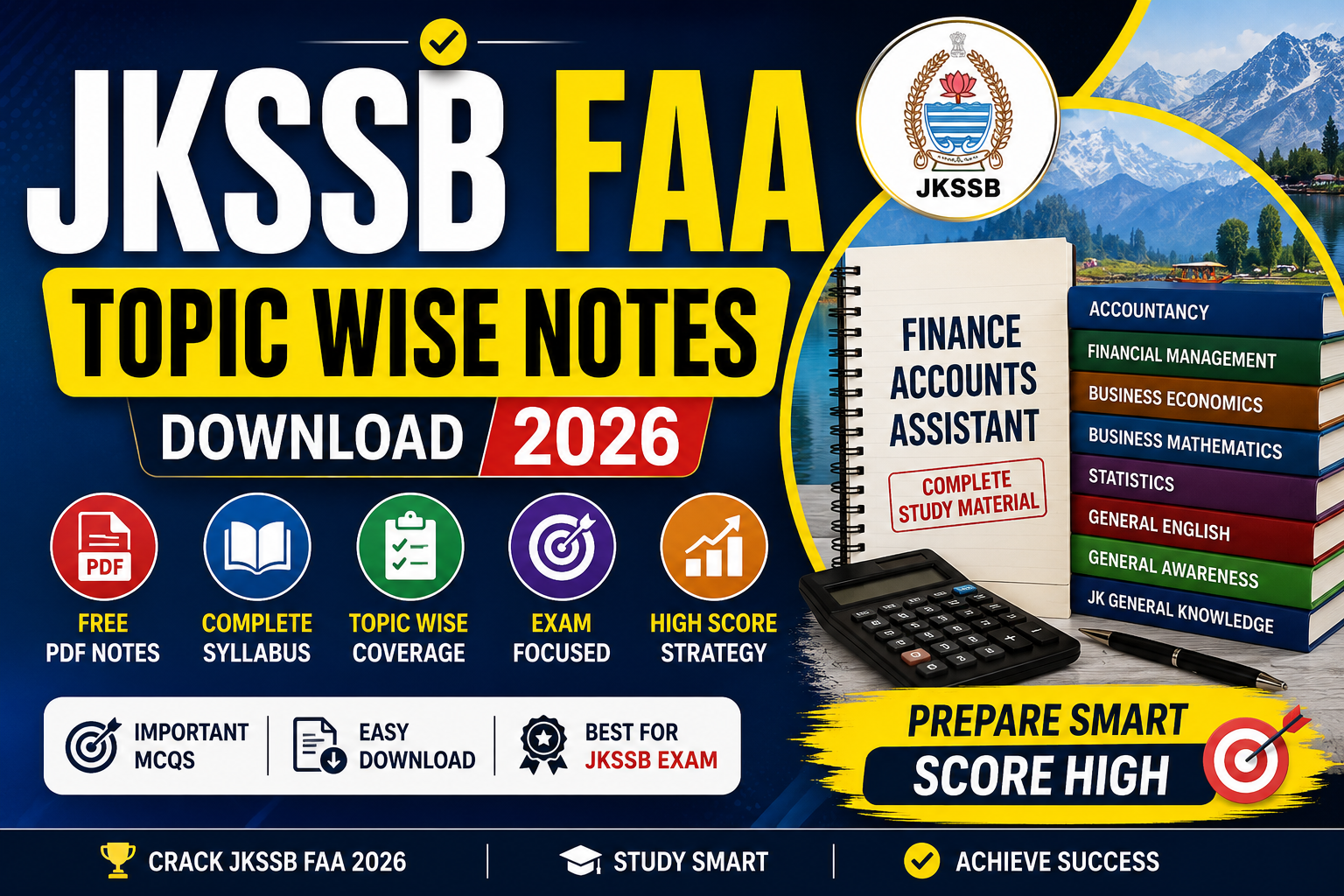
JKSSB FAA Topic Wise Notes Download 2026 – Complete Study Material & Preparation Guide
Preparing for the JKSSB FAA (Finance Accounts Assistant) Examination 2026 requires much more than simply reading textbooks. Thousands of candidates appear every year, but only those who prepare strategically and revise consistently make it to the final selection list. One of the smartest ways to prepare is by studying topic-wise notes, practicing important MCQs, and revising concepts regularly.
If you're searching for JKSSB FAA Topic Wise Notes Download 2026, you've landed at the right place. In this guide, you'll learn why topic-wise notes are important, what subjects to focus on, how to prepare effectively, and how these notes can significantly improve your score.
Why Topic Wise Notes Matter for JKSSB FAA?
Most aspirants make the mistake of reading lengthy books from cover to cover. While books are essential, they often consume a lot of time. Topic-wise notes help you:
- Revise faster before the examination.
- Understand important concepts quickly.
- Cover the entire syllabus systematically.
- Improve retention through concise explanations.
- Save valuable preparation time.
Whether you're preparing full-time or alongside a job, topic-wise notes can make your preparation much more efficient.
JKSSB FAA 2026 Exam Overview
| Particular | Details |
|---|---|
| Exam Name | JKSSB Finance Accounts Assistant (FAA) |
| Conducting Body | Jammu & Kashmir Services Selection Board |
| Mode of Examination | Objective Type (MCQs) |
| Question Type | Multiple Choice Questions |
| Medium | English |
| Negative Marking | As per JKSSB Notification |
| Recommended Preparation | Topic-wise Notes + MCQs + Mock Tests |
Complete Subject-Wise Notes Covered
Our JKSSB FAA Topic Wise Notes are designed strictly according to the latest examination pattern and cover every important concept.
1. Accountancy
This is the backbone of the FAA examination.
Topics include:
- Accounting Principles
- Journal Entries
- Ledger Posting
- Trial Balance
- Bank Reconciliation
- Final Accounts
- Depreciation
- Bills of Exchange
- Rectification of Errors
- Partnership Accounts
- Company Accounts
- Cash Flow Statement
- Ratio Analysis
Each topic is explained with simple examples for quick understanding.
2. Financial Management
Candidates often find this section scoring when concepts are clear.
Important topics include:
- Time Value of Money
- Capital Budgeting
- Cost of Capital
- Working Capital Management
- Dividend Decisions
- Financial Planning
- Leverage Analysis
- Capital Structure
3. Business Economics
Economics questions are mostly conceptual.
Topics include:
- Demand & Supply
- Elasticity
- Market Structures
- National Income
- Inflation
- Fiscal Policy
- Monetary Policy
- Banking System
- Economic Development
4. Business Mathematics
This section tests numerical ability.
Important chapters:
- Percentage
- Profit & Loss
- Ratio & Proportion
- Average
- Time & Work
- Simple Interest
- Compound Interest
- Partnership
- Data Interpretation
- Probability
- Permutation & Combination
5. Statistics
Frequently asked topics include:
- Mean
- Median
- Mode
- Standard Deviation
- Correlation
- Regression
- Index Numbers
- Sampling
- Frequency Distribution
6. General English
English remains a scoring subject.
Focus on:
- Reading Comprehension
- Vocabulary
- Synonyms
- Antonyms
- Idioms & Phrases
- Error Detection
- Sentence Improvement
- Fill in the Blanks
- Active & Passive Voice
7. General Awareness
Questions generally come from:
- Indian History
- Geography
- Indian Polity
- Economy
- Science
- Current Affairs
- Sports
- Awards
- Books & Authors
- Important Days
8. Jammu & Kashmir General Knowledge
One of the most important sections.
Topics include:
- History of J&K
- Geography
- Rivers
- Lakes
- National Parks
- Culture
- Art & Heritage
- Government Schemes
- Administrative Structure
- Current Affairs related to J&K
Why These Notes Are Different?
Unlike ordinary notes available online, these notes are prepared specifically for the JKSSB FAA syllabus.
Some major advantages include:
✔ Easy language
✔ Exam-oriented content
✔ Topic-wise arrangement
✔ Important formulas highlighted
✔ Short revision points
✔ Expected MCQs
✔ Regular updates
✔ Suitable for beginners as well as repeat aspirants
Best Strategy to Use Topic Wise Notes
Simply downloading notes is not enough.
Follow this strategy:
| Day | Task |
|---|---|
| Monday | Study one topic |
| Tuesday | Revise previous topic |
| Wednesday | Practice 50 MCQs |
| Thursday | Learn formulas & concepts |
| Friday | Solve PYQs |
| Saturday | Attempt Mock Test |
| Sunday | Weekly Revision |
This simple routine helps in long-term retention and consistent improvement.
Common Mistakes Aspirants Should Avoid
Many deserving candidates lose marks due to avoidable mistakes.
Avoid these:
- Studying without a proper schedule.
- Ignoring revision.
- Skipping previous year questions.
- Depending only on YouTube lectures.
- Not attempting mock tests.
- Reading too many books simultaneously.
- Ignoring weak subjects.
Consistent practice always beats last-minute preparation.
Download JKSSB FAA Topic Wise Notes 2026
Our notes are organized subject-wise, making it easier for candidates to study chapter by chapter instead of searching multiple websites.
You can revise:
- One chapter daily
- One subject weekly
- Entire syllabus monthly
This structured approach helps reduce exam stress significantly.
Revision Tips Before the Exam
During the last month, avoid starting new books.
Instead:
- Revise topic-wise notes.
- Solve previous year papers.
- Practice at least 100 MCQs daily.
- Make a formula notebook.
- Focus on weak areas first.
- Attempt full-length mock tests regularly.
Smart revision often matters more than studying new material.
Practice MCQs for JKSSB FAA 2026
Test your preparation with these exam-oriented multiple-choice questions. These questions are based on the latest JKSSB FAA syllabus and cover important concepts frequently asked in competitive examinations.
1. Which accounting concept assumes that a business will continue to operate for the foreseeable future?
A) Matching Concept
B) Conservatism Concept
C) Going Concern Concept ✅
D) Dual Aspect Concept
2. Which of the following is considered a Current Asset?
A) Building
B) Machinery
C) Furniture
D) Cash in Hand ✅
3. Depreciation is mainly charged because of:
A) Increase in Asset Value
B) Wear and Tear of Assets ✅
C) Increase in Market Price
D) Increase in Profit
4. The Reserve Bank of India was established in:
A) 1930
B) 1935 ✅
C) 1942
D) 1950
5. Which measure of central tendency is least affected by extreme values?
A) Mean
B) Median ✅
C) Mode
D) Harmonic Mean
6. Fiscal Policy is primarily related to:
A) RBI Policies
B) Banking Reforms
C) Government Revenue and Expenditure ✅
D) Foreign Trade
7. Which article of the Constitution deals with the Comptroller and Auditor General (CAG) of India?
A) Article 280
B) Article 300A
C) Article 148 ✅
D) Article 356
8. Which ratio measures the short-term liquidity of a business?
A) Debt Equity Ratio
B) Return on Capital Employed
C) Inventory Turnover Ratio
D) Current Ratio ✅
9. Which tax was introduced in India on 1st July 2017?
A) VAT
B) Service Tax
C) Excise Duty
D) Goods and Services Tax (GST) ✅
10. Which one is NOT a principle of accounting?
A) Prudence
B) Consistency
C) Going Concern
D) Newton's Law ✅
11. What is the full form of IFRS?
A) International Financial Reporting Standards ✅
B) Indian Financial Regulation System
C) Internal Finance Reporting Scheme
D) International Fiscal Revenue Standard
12. Which of the following is a Direct Tax?
A) GST
B) Customs Duty
C) Excise Duty
D) Income Tax ✅
13. The formula for Compound Interest includes:
A) Principal only
B) Rate only
C) Time only
D) Principal, Rate and Time ✅
14. Which organization prepares India's Union Budget?
A) RBI
B) NITI Aayog
C) Ministry of Finance ✅
D) Finance Commission
15. Which statement is true about Double Entry System?
A) Every transaction affects only one account.
B) Entries are optional.
C) Only cash transactions are recorded.
D) Every transaction has two aspects (Debit and Credit). ✅
Last-Minute Preparation Tips for JKSSB FAA 2026
The final weeks before the examination can make a significant difference in your score. Rather than studying new topics, focus on strengthening what you have already learned.
Follow this revision plan:
| Time Before Exam | Focus Area |
|---|---|
| Last 30 Days | Complete revision of all topic-wise notes |
| Last 20 Days | Previous Year Papers & Daily MCQs |
| Last 15 Days | Full-Length Mock Tests |
| Last 10 Days | Weak Topics & Formula Revision |
| Last 7 Days | Short Notes & Important Facts |
| Last 2 Days | Light Revision & Confidence Building |
Why Topic-Wise Notes Are Better Than Random PDFs
Many aspirants download dozens of PDFs but never complete even half of them. A well-organized set of topic-wise notes allows you to:
- Cover the syllabus in a structured manner.
- Revise important concepts multiple times.
- Identify weak areas quickly.
- Save valuable study time.
- Improve accuracy in objective-type examinations.
Quality study material always outweighs quantity.
How to Maximize Your Score in JKSSB FAA
Scoring well in the Finance Accounts Assistant examination requires a balanced approach.
- Complete one topic before moving to the next.
- Practice MCQs after every chapter.
- Revise your notes weekly.
- Attempt mock tests regularly.
- Analyze mistakes instead of repeating them.
- Focus more on Accountancy and Finance, as these are core subjects.
- Stay updated with Current Affairs and Jammu & Kashmir General Knowledge.
Consistency over several weeks is far more effective than intensive last-minute study.
Frequently Asked Questions (FAQs)
1. Are these JKSSB FAA Topic Wise Notes based on the latest syllabus?
Yes. The notes are prepared according to the latest JKSSB Finance Accounts Assistant syllabus and are regularly updated whenever the official syllabus changes.
2. Can beginners prepare using these notes?
Absolutely. The notes explain concepts in simple language, making them suitable for beginners as well as repeat aspirants.
3. Which subject should I prioritize for the JKSSB FAA exam?
Accountancy, Financial Management, Business Economics, Business Mathematics, Statistics, General English, General Awareness, and Jammu & Kashmir General Knowledge should all be covered. However, candidates should dedicate extra time to the core finance and accounting sections.
4. Are topic-wise notes enough to crack the JKSSB FAA exam?
Topic-wise notes provide an excellent foundation, but they should be combined with regular MCQ practice, previous year papers, revision, and mock tests for the best results.
5. How many hours should I study daily?
A consistent study schedule of 4–6 focused hours with regular revision and practice is generally sufficient for most aspirants.
6. Where can I find mock tests and previous year papers?
You can practice using dedicated mock test series, previous year question papers, and chapter-wise MCQs available on trusted educational platforms.
Final Words
The JKSSB Finance Accounts Assistant (FAA) Examination 2026 is a golden opportunity for candidates aspiring to build a stable career in the government sector. Success in this examination is not about studying endlessly—it is about studying smartly.
Well-structured topic-wise notes, regular revision, chapter-wise MCQ practice, previous year papers, and consistent mock tests can dramatically improve your performance. Instead of collecting multiple books and scattered PDFs, focus on mastering one topic at a time and revising it regularly.
Remember, every hour you invest today brings you one step closer to your goal. Stay disciplined, practice daily, and maintain confidence throughout your preparation journey.
Start your preparation now, revise consistently, and give your best effort in the JKSSB FAA 2026 examination. Best of luck!