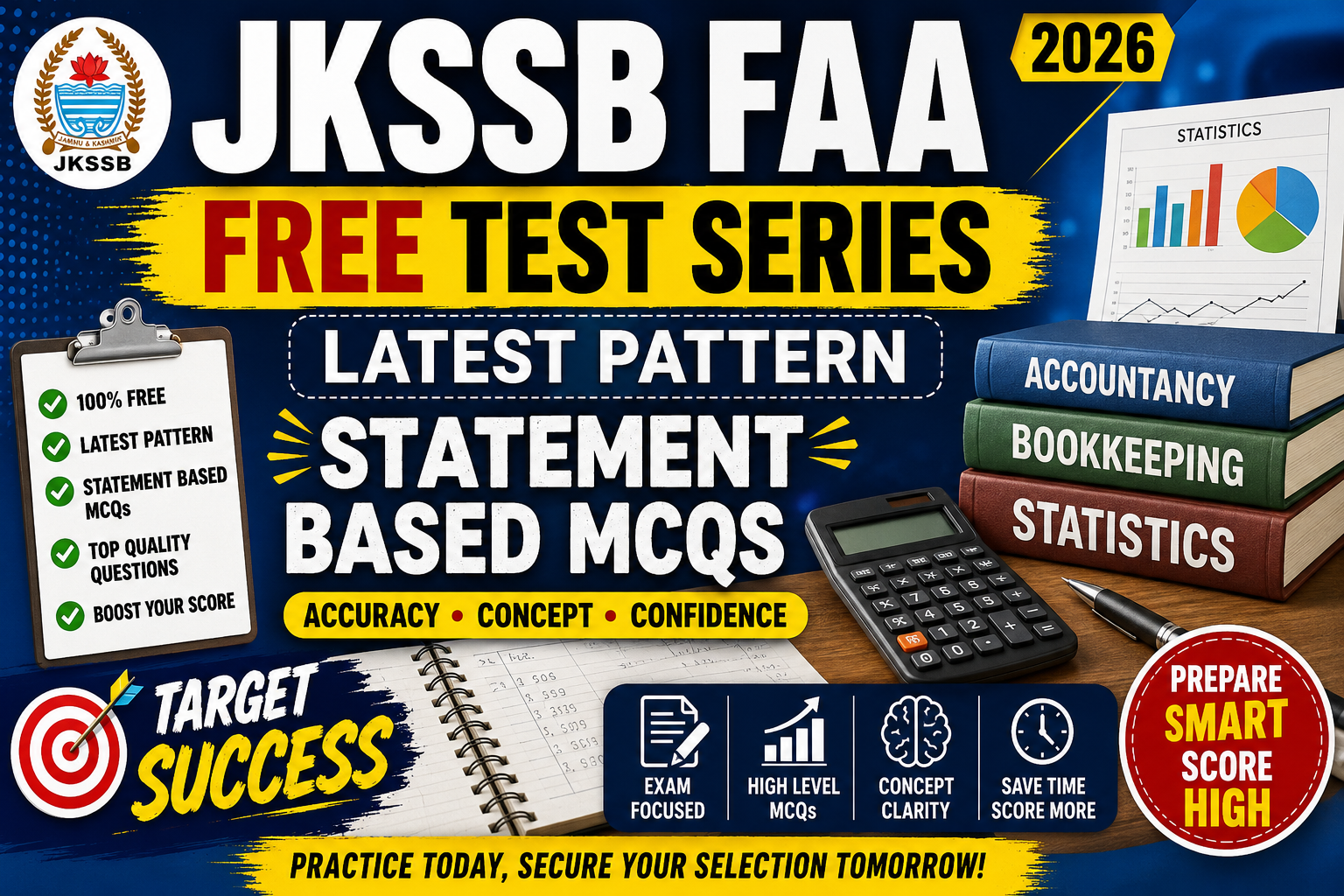
JKSSB FAA Free Test Series 2026 – Statement Based Practice Questions Based on the Latest Exam Pattern (Part 1)
If you are preparing for the JKSSB Finance Accounts Assistant (FAA) Examination 2026, one thing is absolutely clear—the competition is becoming tougher every year. Candidates are no longer selected merely by memorizing definitions or solving simple numerical questions. The latest trend in JKSSB examinations clearly indicates that the board is gradually shifting towards concept-based and statement-based multiple-choice questions, especially in subjects like Accountancy, Bookkeeping, and Statistics.
Many aspirants spend months studying theory but still struggle during the actual examination because they fail to interpret statement-based questions correctly. These questions require not only factual knowledge but also conceptual clarity, logical thinking, and the ability to identify correct and incorrect statements under time pressure.
That is exactly why a high-quality JKSSB FAA Free Test Series becomes one of the most important parts of your preparation strategy.
This article has been specially prepared according to the latest JKSSB examination pattern and is intended to help serious aspirants strengthen their fundamentals before attempting full-length mock tests.
Attempt Full test series and download full Study Material
Why Statement-Based Questions Matter in JKSSB FAA
In recent competitive examinations conducted by JKSSB, SSC, Banking, and other recruitment boards, statement-based questions have become increasingly common.
Instead of asking direct questions like:
"What is Double Entry System?"
The examiner now asks:
Consider the following statements regarding Double Entry System:
Statement I...
Statement II...
Statement III...
Choose the correct answer.
Such questions test multiple concepts at once. A candidate who has only memorized textbook definitions often gets confused between two seemingly correct statements.
Therefore, practicing statement-based MCQs significantly improves:
- Conceptual understanding
- Analytical thinking
- Accuracy under pressure
- Elimination skills
- Time management
Latest JKSSB FAA Exam Trend
The Finance Accounts Assistant examination focuses heavily on practical understanding of accounting principles rather than rote learning.
Some of the most important areas include:
- Principles of Accounting
- Accounting Standards (basic concepts)
- Journal Entries
- Ledger Posting
- Trial Balance
- Rectification of Errors
- Depreciation
- Bills of Exchange
- Final Accounts
- Bank Reconciliation Statement
- Partnership Accounts
- Company Accounts (basic)
- Cost Accounting
- Bookkeeping
- Statistics
- Ratio Analysis
- Financial Statements
Among these topics, statement-based conceptual questions are becoming increasingly important.
How to Use This Free Test Series
Instead of solving hundreds of random questions, follow a systematic approach.
Step 1
Read the complete chapter carefully.
Step 2
Attempt only statement-based MCQs.
Step 3
Analyze why each statement is correct or incorrect.
Step 4
Revise the related concept immediately.
Step 5
Repeat after one week.
This simple strategy improves long-term retention much more effectively than repeatedly solving direct objective questions.
Common Mistakes Made by FAA Aspirants
Many candidates lose marks not because they lack knowledge but because they commit avoidable mistakes.
Some common mistakes include:
- Reading only the first statement and ignoring the remaining ones.
- Assuming every lengthy statement is correct.
- Confusing accounting principles with accounting conventions.
- Forgetting exceptions.
- Ignoring keywords such as always, only, must, never, every, and all.
- Guessing answers without carefully evaluating each statement.
Learning to identify these traps can significantly improve your score.
Topics That Frequently Produce Statement-Based Questions
Certain chapters naturally lend themselves to statement-based questioning because they involve multiple rules and exceptions.
Some of the most important topics include:
Accountancy
- Accounting Concepts
- Accounting Principles
- Double Entry System
- Trial Balance
- Capital vs Revenue
- Rectification of Errors
- Depreciation
- Final Accounts
- Partnership
Bookkeeping
- Journal
- Subsidiary Books
- Cash Book
- Ledger
- Posting Rules
- Errors
- Bank Reconciliation
Statistics
- Measures of Central Tendency
- Dispersion
- Correlation
- Regression
- Index Numbers
- Probability
- Sampling
- Time Series
Candidates should devote extra practice time to these chapters.
Importance of Concept-Based Practice
A common misconception among aspirants is that repeatedly solving numerical questions alone is enough.
However, the latest pattern suggests otherwise.
Statement-based questions test:
- Why a rule exists.
- Where an exception applies.
- Which accounting principle governs a transaction.
- Whether a statistical measure is appropriate in a given situation.
A student who understands concepts can answer both theoretical and numerical questions with confidence.
Benefits of Attempting Free JKSSB FAA Test Series
Regular practice offers several advantages.
It helps identify weak areas before the examination. It improves confidence and reduces exam anxiety. It also exposes candidates to new question formats and helps them manage time more effectively.
Most importantly, repeated exposure to statement-based questions trains your mind to distinguish between closely related concepts—an essential skill for scoring well in competitive examinations.
Preparation Tips for Maximum Score
If your target is a high score in the JKSSB FAA examination, consistency matters more than studying for long hours.
Keep these points in mind:
- Revise accounting concepts daily.
- Practice statement-based MCQs every day.
- Maintain a notebook of frequently confused concepts.
- Learn from mistakes instead of simply checking the answer key.
- Focus on conceptual clarity rather than memorization.
- Solve previous year questions after completing each topic.
- Attempt mock tests regularly to evaluate your progress.
Small, consistent improvements over time often lead to excellent results in the final examination.
Final Thoughts
Success in the JKSSB Finance Accounts Assistant (FAA) examination is not determined by how many books you complete but by how well you understand the concepts behind every question. As the examination pattern evolves, statement-based questions are likely to play an even greater role in assessing candidates' analytical ability and subject knowledge.
A structured practice routine that combines theory, conceptual revision, and high-quality statement-based MCQs can give you a significant edge over the competition. Instead of relying solely on rote learning, train yourself to evaluate each statement carefully, identify subtle differences, and apply accounting principles logically.
This free test series is designed with that objective in mind—to help aspirants build confidence, improve conceptual accuracy, and become familiar with the latest JKSSB examination pattern. Make it a habit to practice regularly, review your mistakes honestly, and strengthen your weak areas one topic at a time.
25 Toughest Statement-Based MCQs (Latest Pattern) + FAQs
Directions (Questions 1–25):
Consider the following statements and choose the correct option.A. Only Statement I is correct
B. Only Statement II is correct
C. Both Statements I and II are correct
D. Neither Statement I nor II is correct
Accountancy & Bookkeeping
Q1.
Statement I: Every business transaction affects at least two accounts under the Double Entry System.
Statement II: Every transaction necessarily increases one account and decreases another account by the same amount.
Answer: A
Explanation: Every transaction affects two or more accounts, but not every transaction involves one increase and one decrease. Sometimes both accounts increase (purchase of assets on credit) or both decrease.
Q2.
Statement I: A Trial Balance proves the arithmetical accuracy of ledger postings.
Statement II: A Trial Balance guarantees that all accounting errors have been detected.
Answer: A
Q3.
Statement I: Outstanding expenses are recorded even if they have not yet been paid.
Statement II: Recording outstanding expenses follows the Accrual Concept.
Answer: C
Q4.
Statement I: Depreciation is charged to determine the market value of an asset.
Statement II: Depreciation allocates the cost of an asset over its useful life.
Answer: B
Q5.
Statement I: Capital expenditure increases the earning capacity of a business.
Statement II: Revenue expenditure generally provides benefit only during the current accounting period.
Answer: C
Q6.
Statement I: Goodwill is always a tangible asset.
Statement II: Goodwill may arise only when the business earns super profits or possesses reputation.
Answer: B
Q7.
Statement I: Errors of principle affect the agreement of the Trial Balance.
Statement II: Errors of omission may leave the Trial Balance balanced.
Answer: B
Q8.
Statement I: The Cash Book serves as both a Journal and a Ledger.
Statement II: Posting of the cash column into the Cash Account is unnecessary.
Answer: C
Q9.
Statement I: Bank Reconciliation Statement is prepared to correct accounting errors.
Statement II: Timing differences are one of the major reasons for preparing a Bank Reconciliation Statement.
Answer: B
Q10.
Statement I: Provision for doubtful debts is created based on the Prudence Concept.
Statement II: Contingent liabilities are recognized in the Balance Sheet like normal liabilities.
Answer: A
Advanced Accountancy
Q11.
Statement I: Realization Account is prepared during the dissolution of a partnership.
Statement II: Partner's Loan Account is settled after distributing capital.
Answer: A
Q12.
Statement I: Interest on Capital is an appropriation of profit.
Statement II: Salary to partners is a charge against profit.
Answer: A
Q13.
Statement I: Preference shareholders have priority over equity shareholders in dividend distribution.
Statement II: Preference shareholders possess voting rights on every company matter.
Answer: A
Q14.
Statement I: A contingent liability is disclosed but generally not recognized in financial statements.
Statement II: A provision is recognized only when there is a present obligation with probable outflow.
Answer: C
Q15.
Statement I: Capital Reserve generally arises from capital profits.
Statement II: Capital Reserve can normally be distributed as dividend.
Answer: A
Statistics
Q16.
Statement I: Arithmetic Mean is highly affected by extreme values.
Statement II: Median is comparatively less affected by extreme observations.
Answer: C
Q17.
Statement I: Standard Deviation can never be negative.
Statement II: Variance may be negative if observations are below the mean.
Answer: A
Q18.
Statement I: If the coefficient of correlation is +1, the variables have perfect positive correlation.
Statement II: Correlation necessarily implies causation.
Answer: A
Q19.
Statement I: The sum of deviations from the Arithmetic Mean is zero.
Statement II: The sum of squared deviations is minimum when taken from the Arithmetic Mean.
Answer: C
Q20.
Statement I: Mode is always uniquely defined.
Statement II: A distribution may have more than one mode.
Answer: B
Q21.
Statement I: Index Numbers measure relative changes over time.
Statement II: Consumer Price Index is commonly used to measure inflation.
Answer: C
Q22.
Statement I: Sampling reduces both time and cost of data collection.
Statement II: A census always provides more reliable information irrespective of practical limitations.
Answer: A
Q23.
Statement I: Probability of an impossible event is zero.
Statement II: Probability of a certain event is one.
Answer: C
Q24.
Statement I: Regression analysis helps estimate the value of one variable using another.
Statement II: Correlation equations are used for prediction instead of regression equations.
Answer: A
Q25.
Statement I: Time Series analysis studies data arranged in chronological order.
Statement II: Seasonal variations repeat themselves at regular intervals within a year.
Answer: C
Frequently Asked Questions (FAQs)
1. Is this JKSSB FAA Free Test Series based on the latest exam pattern?
Yes. The questions are designed according to the recent trend observed in JKSSB and other competitive examinations, where statement-based and concept-oriented questions are becoming increasingly common.
2. Which subjects are covered in this free test series?
This practice set focuses on:
- Accountancy
- Bookkeeping
- Statistics
These are among the most important subjects for the JKSSB Finance Accounts Assistant examination.
3. Are statement-based questions expected in the JKSSB FAA examination?
Yes. Recent examinations have shown a growing emphasis on conceptual and statement-based questions rather than direct factual questions. Practicing such questions can significantly improve analytical skills and accuracy.
4. Is this test series suitable for beginners?
Absolutely. However, candidates should first study the basic concepts of Accountancy, Bookkeeping, and Statistics before attempting advanced statement-based questions.
5. How should I use this free test series effectively?
A good approach is to:
- Revise one topic thoroughly.
- Attempt the statement-based MCQs without referring to notes.
- Analyze every explanation carefully.
- Revise the concepts related to incorrect answers.
- Repeat the same questions after a few days to reinforce learning.
6. Which topics deserve the highest priority for JKSSB FAA preparation?
Some of the most important topics include:
- Accounting Principles and Concepts
- Journal and Ledger
- Trial Balance
- Final Accounts
- Depreciation
- Bank Reconciliation Statement
- Partnership Accounts
- Company Accounts
- Measures of Central Tendency
- Correlation and Regression
- Probability
- Index Numbers
7. Is solving previous year papers enough for JKSSB FAA?
Previous year papers are essential, but they should be supplemented with statement-based MCQs, concept revision, and full-length mock tests to prepare for the evolving exam pattern.
8. How many MCQs should I practice daily?
Practicing 30–50 high-quality conceptual MCQs every day, along with reviewing explanations, is generally more beneficial than attempting a large number of repetitive questions without analysis.
Final Note
Consistent practice, conceptual understanding, and regular revision remain the three pillars of success in the JKSSB Finance Accounts Assistant (FAA) examination. Make statement-based MCQs a regular part of your study routine, and always focus on understanding why an answer is correct—not just which option is correct. This habit will improve both your confidence and your performance in the actual examination.