
Welcome to your ultimate Economics revision module for JKSSB. This series cuts through the noise and focuses strictly on the concepts, terms, and facts that appear repeatedly in JKSSB question papers (for posts like FAA, JKPSI,Jr Assistant, etc.).
How to use this series:
Read thoroughly: Understand the core concepts.
Memorize keywords: JKSSB often tests definitions and associations.
Practice MCQs: After every module, solve previous year questions on that topic.
MODULE 1: Basics of Micro & Macro Economics
Target: Understanding fundamental economic systems and terms.
1. Definitions & Scope
Economics: A social science concerned with the production, distribution, and consumption of goods and services.
Adam Smith: Known as the "Father of Economics." Famous book: An Inquiry into the Nature and Causes of the Wealth of Nations (1776).
Microeconomics: Study of individual units (a consumer, a firm, a specific industry).
Macroeconomics: Study of aggregates (total employment, national income, inflation, poverty).
2. Economic Systems
How nations organize resources. This is a very high-yield area for JKSSB.
Capitalist Economy (Market Economy):
Means of production owned privately.
Guided by "Laissez-faire" (no govt interference).
Driven by profit motive.
Example: USA.
Socialist Economy (Command Economy):
Means of production owned by the State.
Driven by social welfare.
Example: Historically USSR (Cuba/N. Korea are loose examples now).
Mixed Economy:
Co-existence of private and public sectors.
India is the best example.
3. Key Micro Concepts
Law of Demand: As price increases, demand decreases (Inverse relationship, Ceteris Paribus - other things remaining constant).
Law of Supply: As price increases, supply increases (Direct relationship).
Utility: Want-satisfying power of a good.
Law of Diminishing Marginal Utility: As you consume more of something, the extra satisfaction from each additional unit decreases.
MODULE 2: National Income & Inflation
Target: Measuring the economy and understanding price changes.
1. National Income Aggregates
Memorize these definitions exactly as they are often twisted in MCQs.
GDP (Gross Domestic Product): Total value of final goods and services produced within the geographical boundaries of a country during a specific year.
GNP (Gross National Product): Total value of final goods and services produced by the residents of a country (regardless of location).
Formula: GNP = GDP + Net Factor Income from Abroad (NFIA).
NNP (Net National Product): Gross minus Depreciation.
NNP at Factor Cost (National Income): This is the true measure of national income. It calculates earnings based on the cost of factors of production, excluding indirect taxes and including subsidies.
Per Capita Income: National Income divided by Total Population.
2. Inflation
A sustained rise in the general price level.
Types based on causes:
Demand-Pull: "Too much money chasing too few goods." (Caused by excess demand).
Cost-Push: Caused by rise in input costs (wages, raw materials).
Stagflation: High Inflation + High Unemployment + Low Growth. Very dangerous.
Measuring Inflation (India):
WPI (Wholesale Price Index): Measures price changes at the wholesale level. Calculated by the Office of the Economic Adviser (Min. of Commerce & Industry).
CPI (Consumer Price Index): Measures price changes at the retail level (what consumers pay). Used by RBI for inflation targeting.
MODULE 3: Money, Banking & Fiscal Policy
Target: How money is controlled and government budgeting.
1. Reserve Bank of India (RBI)
Established: April 1, 1935 (under RBI Act, 1934).
Nationalized: 1949.
Headquarters: Mumbai.
Functions: Issues currency, Banker to the Govt, Regulator of Banks, "Controller of Credit" (Monetary Policy).
2. Monetary Policy Tools (How RBI controls money supply)
Repo Rate: Rate at which RBI lends to commercial banks (short-term).
Reverse Repo Rate: Rate at which RBI borrows from banks.
CRRs (Cash Reserve Ratio): % of deposits banks must keep with RBI in cash.
SLR (Statutory Liquidity Ratio): % of deposits banks must keep with themselves in liquid assets (gold, cash, govt securities).
To control inflation: RBI increases Repo, CRR, and SLR.
To boost growth: RBI decreases them.
3. Fiscal Policy (Budget & Taxes)
Fiscal Policy: Government's policy regarding revenue (taxes) and expenditure.
Types of Budget:
Balanced (Revenue = Expenditure)
Surplus (Revenue > Expenditure)
Deficit (Expenditure > Revenue) - India always has a deficit budget.
Types of Deficit:
Fiscal Deficit: Total gap between expenditure and revenue. (The most important number).
Revenue Deficit: When govt spends more on daily operations than it earns.
Taxation:
Direct Tax: The person who pays the tax bears the burden (Income Tax, Corporate Tax).
Indirect Tax: The person who pays the tax passes the burden to someone else (GST, Customs Duty).
GST (Goods and Services Tax): "One Nation, One Tax, One Market." It is a destination-based indirect tax.
MODULE 4: Indian Economy & Agriculture
Target: The structure of India's workforce and primary sector.
1. Sectors of the Economy
Primary Sector: Natural resource-based. (Agriculture, Forestry, Fishing). Employs the largest workforce in India.
Secondary Sector: Manufacturing. (Industry, Construction, Electricity).
Tertiary Sector: Services. (Banking, IT, Transport, Health). Contributes the largest share to India's GDP.
2. Agriculture (Crucial for JKSSB)
Green Revolution: Introduced High-Yielding Variety (HYV) seeds, fertilizers, and irrigation in the late 1960s.
Father in India: MS Swaminathan.
Focused crop: Wheat and Rice.
MSP (Minimum Support Price): The price at which govt purchases crops from farmers to protect them from price falls. Recommended by CACP, announced by CCEA.
NABARD: Apex bank for Agriculture and Rural Development.
MODULE 5: Planning, Reforms & Trade
Target: Five-Year Plans, 1991 Reforms, and International Trade.
1. Economic Planning (Historical)
Planning Commission: Established in 1950. Created Five-Year Plans.
NITI Aayog: Replaced Planning Commission in 2015.
Functions as a "Think Tank."
Chairperson: Prime Minister.
Industrial Policy Resolution 1956: Focused on the public sector (Mahalanobis Model).
2. Economic Reforms of 1991
Due to a severe Balance of Payments (BoP) crisis.
Finance Minister: Dr. Manmohan Singh. Prime Minister: PV Narasimha Rao.
LPG Reforms:
Liberalization: Reduced govt controls.
Privatization: Allowed private sector in public sector areas.
Globalization: Opened the Indian economy to the world (WTC membership).
3. External Sector
Balance of Payments (BoP): Systematic record of all economic transactions between India and the rest of the world.
FDI (Foreign Direct Investment): Investment from abroad that brings management control (long-term).
FII (Foreign Institutional Investment): "Hot money" - investment in stock markets (short-term).
WTO (World Trade Organization): Replaced GATT in 1995. Deals with global trade rules.
JKSSB One-Liner High-Yield Points (Memory Boosters)
"Father of Economics": Adam Smith.
"Father of Indian Green Revolution": MS Swaminathan.
RBI Governor (First): Sir Osborne Smith.
RBI Governor (First Indian): CD Deshmukh.
Bank of Issue: Only RBI can issue currency notes (except Re 1, which is by Finance Ministry).
National Income Calculation: Done by Central Statistics Office (CSO), now merged into NSO.
First Five-Year Plan: Focused on Agriculture (Harrod-Domar model).
Second Five-Year Plan: Focused on Heavy Industry (Mahalanobis model).
Poverty Line: Calculated based on consumption expenditure, not income.
SEBI: Regulator of the Stock Market.
CRISIL, ICRA: Credit Rating Agencies in India.
Fiscal Year in India: 1st April to 31st March.
Good luck with your revision! Stay focused and keep revising.
03:13 PMAugust 6, 2026
JKSSB Economics Revision Series: "Economy in a Nutshell"
Download our app

Related Articles
11 Nov 202601:22 PM
JKSSB JE Civil Full-Length Mock Tests 2026–2027 – Practice Online
10 Nov 202609:25 PM
J&K Bank Banking Associate: Top 50 Puzzle & Seating Arrangement MCQs
09 Nov 202607:20 PM
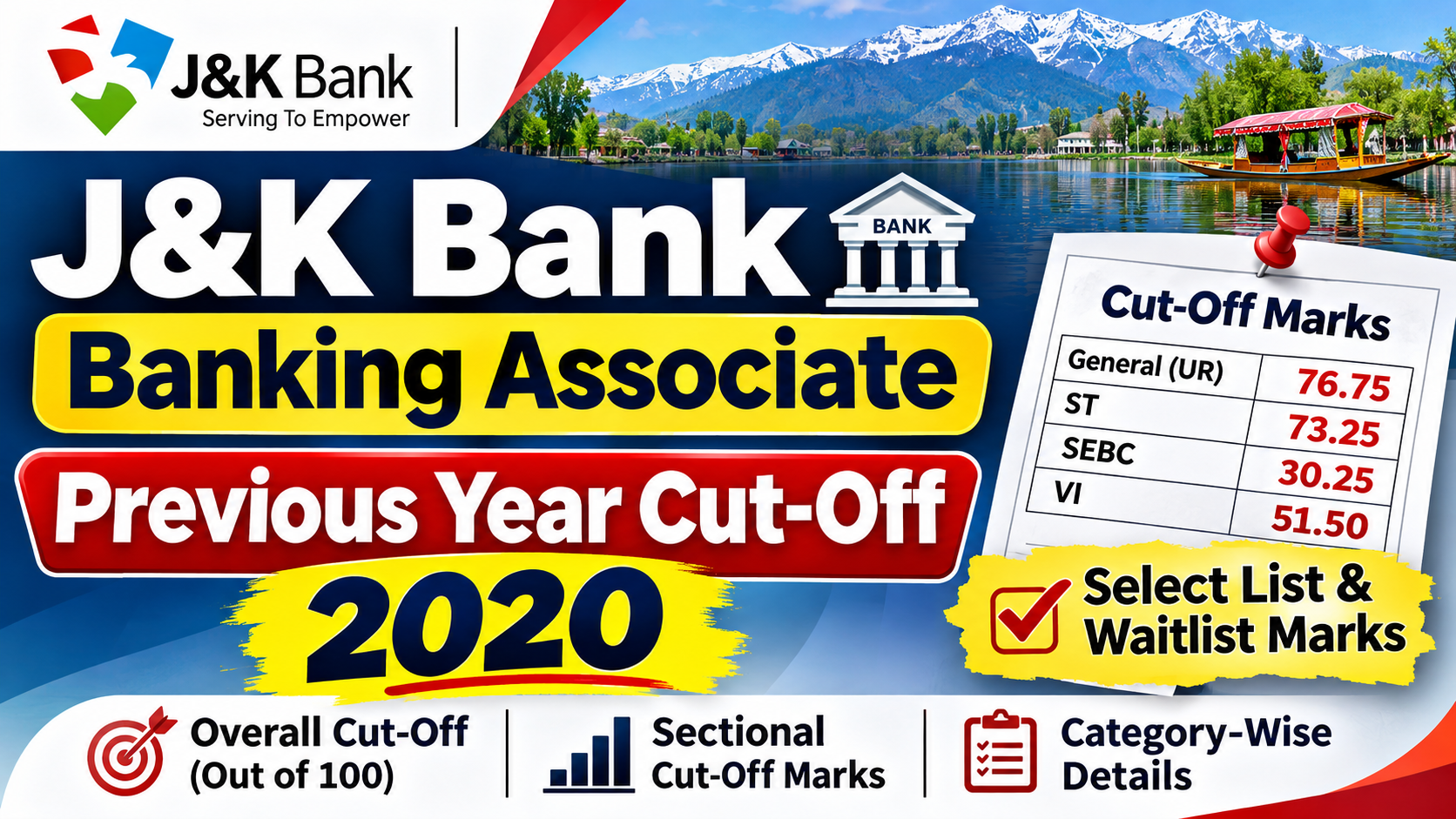
J&K Bank Banking Associate Previous Year Cut-Off 2020 – Category-Wise Marks
08 Nov 202603:50 PM
JK Bank Banking Associate Complete Study Material 2026–2027 | Mock Tests, Sectional Tests & Exam Preparation
07 Nov 202611:08 PM
JKSSB JE Civil Complete Notes + 10 Full-Length Mock Tests Under ₹189 – Prepare Smartly for 2027
06 Nov 202609:53 PM