

JKSSB ECONOMICS NOTES
DEMAND ANALYSIS
Micro-Economics |
1 Meaning of Demand
- Demand = quantity of a good/service a consumer is willing and able to buy at a given price, in a given time period.
- Three essentials: desire for the good + ability to pay + willingness to pay — all three must be present together.
2 Law of Demand
- States: Price ↑ → Quantity demanded ↓, ceteris paribus (other factors constant).
- Establishes an inverse relationship between price and quantity demanded.
- Reasons: Law of diminishing marginal utility, income effect, substitution effect, entry of new consumers at lower price.
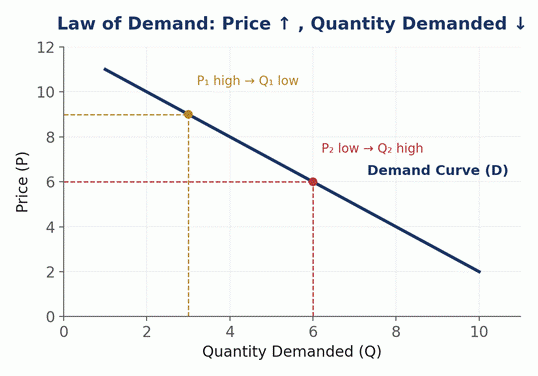
Fig 1: Demand curve slopes downward — as price falls from P₁ to P₂, quantity demanded rises from Q₁ to Q₂.
3 Demand Schedule & Demand Curve
- Demand schedule — a table showing price–quantity combinations.
- Demand curve — graphical representation; slopes downward from left to right.
4 Determinants of Demand
- Price of the good itself
- Price of related goods (substitutes & complements)
- Income of the consumer
- Tastes and preferences
- Consumer expectations (future price/income)
- Number of buyers / population
- Advertising and publicity
5 Types of Demand
Type | Meaning |
Price demand | Relation between demand and own price |
Income demand | Relation between demand and consumer's income |
Cross demand | Relation between demand and price of related goods |
Joint / Composite demand | Demand for goods used together, e.g., car + petrol |
Derived demand | Demand for one good arises from demand for another, e.g., steel from cars |
Direct demand | Demand for final consumption goods |
6 Movement vs Shift in Demand
Movement along the curve | Shift of the curve |
Caused by change in price only | Caused by non-price factors |
Stays on the same curve | Produces a new curve |
Called extension / contraction | Called increase / decrease |
7 Exceptions to the Law of Demand
- Giffen goods — inferior goods where demand rises with price because the income effect dominates the substitution effect (Sir Robert Giffen).
- Veblen goods — status/prestige goods (diamonds, luxury cars); demand rises with price.
- Speculative demand — buyers expect further price rise.
- Necessities such as life-saving drugs — demand stays inelastic to price.
8 Elasticity of Demand
Measures the responsiveness of quantity demanded to a change in price, income, or the price of a related good.
Price Elasticity (Ed) = % change in Quantity Demanded ÷ % change in Price
Category | Condition |
Perfectly elastic | Ed = ∞ |
Perfectly inelastic | Ed = 0 |
Unitary elastic | Ed = 1 |
Relatively elastic | Ed > 1 |
Relatively inelastic | Ed < 1 |
Income Elasticity of Demand
- Meaning: measures how quantity demanded responds to a change in consumer income, price held constant.
- Formula: Ey = % change in Quantity Demanded ÷ % change in Income.
- Positive Ey → Normal good — demand rises as income rises (e.g., branded clothing, dining out).
- Negative Ey → Inferior good — demand falls as income rises (e.g., coarse grains, bus travel for those switching to cars).
- Ey > 1 → Luxury good — demand grows faster than income (e.g., luxury cars, jewellery).
- Ey < 1 (but positive) → Necessity good — demand grows slower than income (e.g., food staples, soap).
- Zero Ey — demand unaffected by income change (e.g., salt).
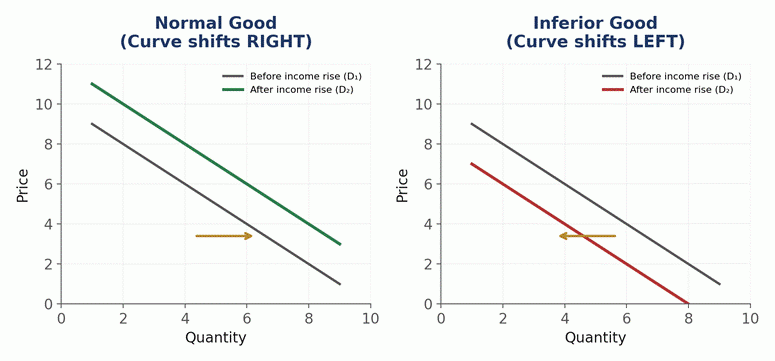
Fig 2: As income rises, a normal good's demand curve shifts right; an inferior good's demand curve shifts left.
Cross Elasticity of Demand
- Meaning: measures how quantity demanded of one good responds to a change in the price of a related good.
- Formula: Exy = % change in Quantity Demanded of Good X ÷ % change in Price of Good Y.
- Positive Exy → Substitutes — price of one rises, demand for the other rises (e.g., tea and coffee, Pepsi and Coke).
- Negative Exy → Complements — price of one rises, demand for the other falls (e.g., car and petrol, printer and ink cartridge).
- Zero / near-zero Exy → Unrelated goods — price change of one good has no effect on demand for the other (e.g., rice and mobile phones).
- Higher the value of Exy, the closer/stronger the substitute or complementary relationship.
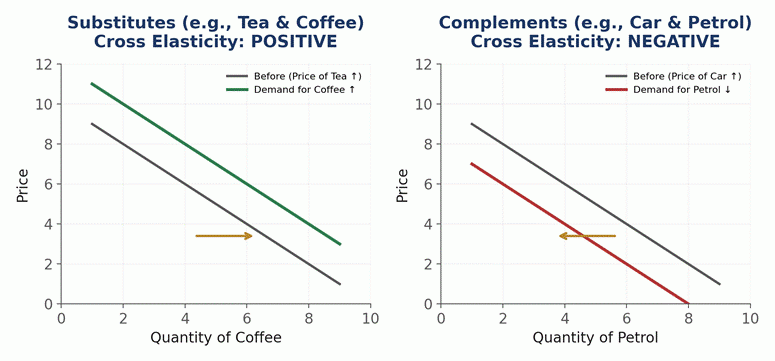
Fig 3: Substitutes shift demand in the same direction as the related good's price; complements shift it in the opposite direction.
9 Factors Affecting Elasticity
- Availability of substitutes
- Necessity vs luxury nature of the good
- Proportion of income spent on the good
- Time period under consideration
- Habit-forming nature of the good
10 Consumer's Equilibrium
- Utility approach: Equilibrium when Marginal Utility (MU) = Price; MU diminishes as consumption increases.
- Indifference curve approach: Equilibrium when Marginal Rate of Substitution (MRS) = Price ratio.
-
Q Practice Quiz
💡 Attempt all questions first, then check the Answer Key at the end.
1. The Law of Demand establishes a relationship between price and quantity demanded that is:
A. Directly proportional
B. Inversely proportional
C. Unrelated
D. Constant
2. Which of the following is an exception to the Law of Demand?
A. Salt
B. Giffen goods
C. Rice
D. Wheat
3. Veblen goods are associated with which kind of demand behaviour?
A. Demand falls as price rises
B. Demand rises as price rises
C. Demand is unaffected by price
D. Demand depends only on income
4. If the price elasticity of demand (Ed) equals 1, demand is said to be:
A. Perfectly elastic
B. Perfectly inelastic
C. Unitary elastic
D. Relatively elastic
5. A negative income elasticity of demand indicates the good is:
A. A normal good
B. An inferior good
C. A luxury good
D. A Veblen good
6. Demand for steel arising from demand for cars is an example of:
A. Direct demand
B. Derived demand
C. Joint demand
D. Cross demand
7. A movement along the demand curve is caused by:
A. Change in income
B. Change in taste
C. Change in price of the good itself
D. Change in price of a related good
8. In consumer's equilibrium under the utility approach, equilibrium is reached when:
A. MU = 0
B. MU = Price
C. TU is maximum at any MU
D. MU is negative
P Statement-Based MCQs New Pattern — JKSSB)
💡 Modeled on the JKPSC / JKSSB statement-based format. Attempt first, then check explanations in the Answer Key.
1. Consider the following statements regarding the Law of Demand:
1. It assumes that factors other than price remain constant.
2. It always holds true for all categories of goods without exception.
3. It establishes a direct relationship between price and quantity demanded.
Which of the statements given above is/are correct?
A. 1 only
B. 1 and 2 only
C. 2 and 3 only
D. 1, 2 and 3
2. Consider the following statements:
1. A Giffen good is a good for which demand rises as its price rises.
2. In the case of a Giffen good, the income effect outweighs the substitution effect.
3. All inferior goods are necessarily Giffen goods.
Which of the statements given above is/are correct?
A. 1 and 2 only
B. 2 only
C. 2 and 3 only
D. 1, 2 and 3
3. With reference to elasticity of demand, consider the following statements:
1. If the cross elasticity of demand between two goods is positive, the goods are complements.
2. If the income elasticity of demand for a good is negative, the good is inferior.
3. Perfectly inelastic demand means quantity demanded does not change with price.
Which of the statements given above is/are correct?
A. 1 and 2 only
B. 2 and 3 only
C. 1 and 3 only
D. 1, 2 and 3
4. Consider the following statements regarding movement and shift of the demand curve:
1. A change in the price of the good itself causes a shift of the demand curve.
2. A change in consumer income causes a shift of the demand curve.
3. 'Extension' and 'contraction' of demand refer to movements along the same curve.
Which of the statements given above is/are correct?
A. 1 and 2 only
B. 2 and 3 only
C. 1 and 3 only
D. 1, 2 and 3
5. Consider the following pairs:
Good — Type of Demand
1. Car and Petrol — Joint/Composite demand
2. Steel (due to demand for cars) — Derived demand
3. Tea and Coffee — Direct demand
Which of the pairs given above is/are correctly matched?
A. 1 and 2 only
B. 2 and 3 only
C. 1 only
D. 1, 2 and 3
6. Consider the following statements about Veblen goods:
1. Demand for a Veblen good rises as its price rises.
2. Veblen goods are typically associated with conspicuous consumption or status signalling.
3. Veblen goods are a violation of the Law of Demand.
Which of the statements given above is/are correct?
A. 1 and 2 only
B. 2 and 3 only
C. 1 and 3 only
D. 1, 2 and 3
Answer Key & Explanations — Statement-Based MCQs
1. Correct Answer: A. 1 only
Statement 1 is correct — the law operates under 'ceteris paribus'. Statement 2 is incorrect — Giffen and Veblen goods are well-known exceptions. Statement 3 is incorrect — the law establishes an inverse, not direct, relationship.
2. Correct Answer: A. 1 and 2 only
Statement 1 is correct — this is the defining paradox of a Giffen good. Statement 2 is correct — the income effect dominates the substitution effect, causing demand to rise with price. Statement 3 is incorrect — all Giffen goods are inferior goods, but not all inferior goods are Giffen goods.
3. Correct Answer: B. 2 and 3 only
Statement 1 is incorrect — positive cross elasticity indicates substitutes, not complements (complements have negative cross elasticity). Statements 2 and 3 are correct as per standard definitions.
4. Correct Answer: B. 2 and 3 only
Statement 1 is incorrect — a change in the good's own price causes movement along the curve, not a shift. Statements 2 and 3 are correct.
5. Correct Answer: A. 1 and 2 only
Pairs 1 and 2 are correctly matched. Pair 3 is incorrect — Tea and Coffee are substitute goods (related through cross elasticity), not an example of direct demand.
6. Correct Answer: D. 1, 2 and 3
All three statements correctly describe Veblen goods — named after economist Thorstein Veblen.