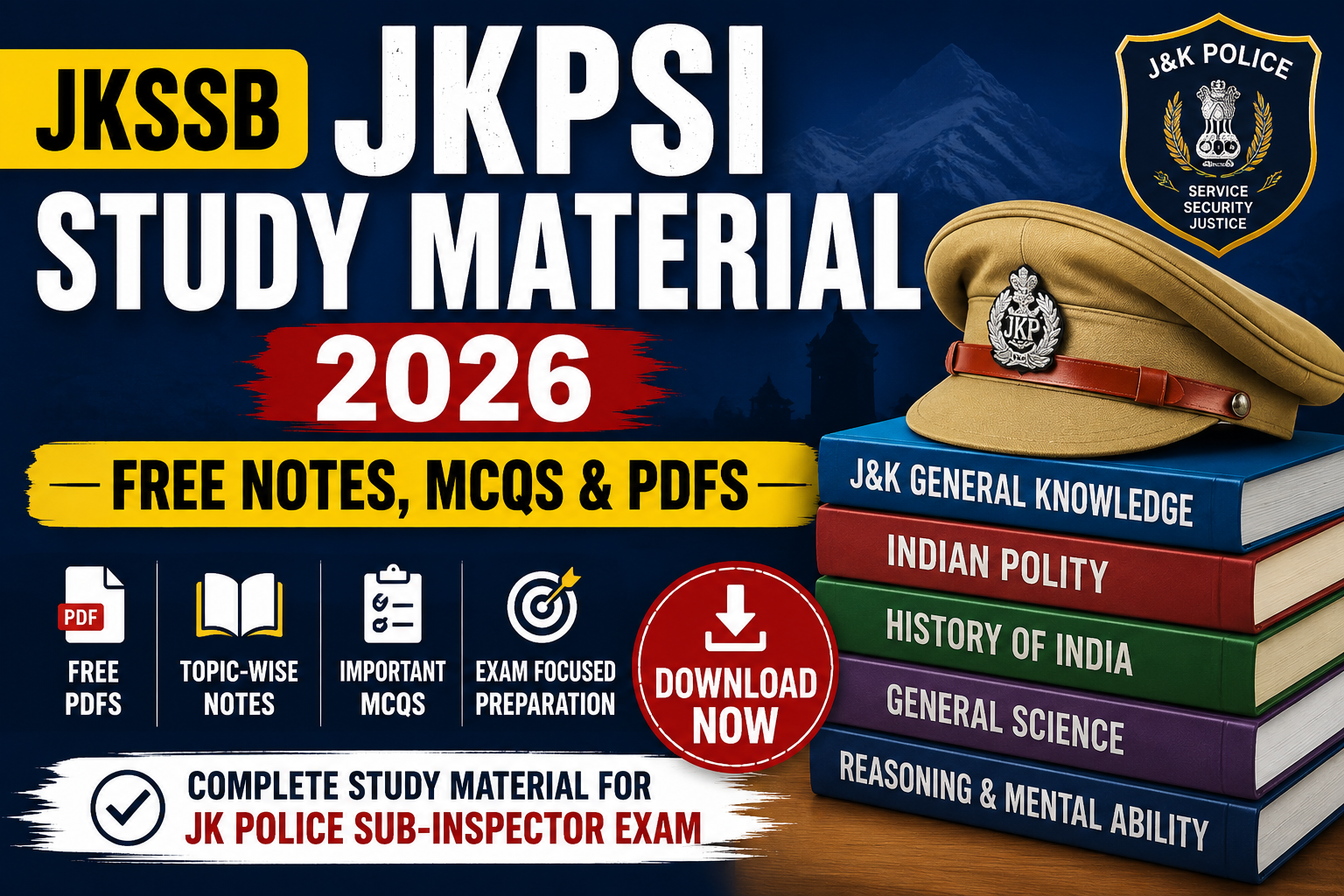
JKSSB JKPSI Study Material 2026 – Free Notes, MCQs & Preparation Guide
Preparing for the JKSSB JKPSI (Jammu & Kashmir Police Sub-Inspector) examination requires more than simply collecting hundreds of PDFs and study materials. The real challenge is finding the right content, understanding what to study, revising it properly, and practising enough questions before the examination.
For many aspirants in Jammu and Kashmir, preparation becomes difficult because study material is scattered across different websites, YouTube videos, PDFs and social media groups. Some resources are too lengthy, some are outdated, while others do not properly match the level of questions asked in competitive examinations.
That is why having well-organised JKSSB JKPSI study material can make preparation much easier.
If you are preparing for JKPSI 2026, this guide will help you understand what kind of material you should use, which subjects deserve more attention, and how to use notes and MCQs effectively.
Download complete jkpsi study material with full mocktests and quizes daily
JKSSB JKPSI Study Material – What Should You Study?
A good JKPSI preparation strategy should cover the complete syllabus instead of depending on one particular subject or one source.
Your study material should ideally include:
- General Knowledge and Current Affairs
- Jammu & Kashmir General Knowledge
- Indian History
- Geography
- Indian Polity
- General Science
- General English
- Reasoning and Mental Ability
- Computer Awareness
- Important national and international events
- Previous-year and exam-oriented MCQs
The purpose of study material is not simply to provide information. It should help you learn a topic quickly, revise it repeatedly and solve questions based on that topic.
For this reason, short and properly structured notes are often more useful during revision than extremely lengthy books.
Why JK & J&K Current Affairs Matter
One area that JKSSB aspirants should not ignore is Jammu & Kashmir-specific General Knowledge and current affairs.
Questions related to Jammu and Kashmir can cover a wide range of areas, including its history, geography, administration, culture, important personalities, rivers, lakes, districts, economy, institutions, schemes and recent developments.
Along with static J&K GK, candidates should regularly revise important current events related to the Union Territory.
Instead of trying to memorise everything that appears in the news, focus on events that are relevant from an examination perspective.
For example, keep track of:
- Important government schemes
- New appointments
- Awards and honours
- Important projects
- Administrative developments
- Sports achievements
- Important places and institutions
- National and international events
- Important reports and indexes
- Defence and security-related developments
- Important dates and themes
Regular revision is particularly important here because current affairs can become difficult to remember if studied only once.
JKSSB JKPSI Notes for Quick Revision
During the initial stage of preparation, detailed study is useful. However, as the examination gets closer, revision becomes equally important.
This is where topic-wise JKSSB JKPSI notes can be extremely helpful.
Instead of opening a 300–500-page book every time you want to revise one topic, you should have concise notes covering the important facts and concepts.
For example, while studying Indian Polity, your revision notes can contain important constitutional articles, fundamental rights, duties, constitutional bodies, Parliament, President, Supreme Court, emergency provisions and other frequently tested areas.
Similarly, for J&K GK, notes can be organised into separate sections such as:
J&K History → Geography → Rivers & Lakes → Culture → Economy → Administration → Important Personalities → Important Places → Current Affairs
This makes revision much faster.
Practice JKSSB JKPSI MCQs Regularly
Studying notes alone is not enough.
After completing a topic, solve MCQs based on that topic. This helps you understand whether you have actually remembered the information or simply recognised it while reading.
For example, after completing a chapter on Indian Polity, don't immediately move to another subject. Spend some time solving objective questions.
MCQ practice helps you identify:
- Topics you already understand.
- Facts you keep forgetting.
- Areas where two options confuse you.
- Topics that require another round of revision.
- The type of questions you need to practise more.
A good approach is to maintain a simple mistake list.
Whenever you answer a question incorrectly, note down the correct concept or fact. Revising this list regularly can be more productive than repeatedly solving questions you already know.
Don't Collect Too Many Study Materials
This is one of the most common mistakes made by competitive-exam aspirants.
You may find dozens of JKSSB JKPSI PDFs, Telegram files, YouTube lectures and online notes. It can feel productive to download everything, but having too many resources often creates confusion.
You don't need ten different sources for the same subject.
Choose one reliable source for your basic preparation, supplement it with good MCQs, and keep a separate source for current affairs if required.
The goal should be:
Study → Revise → Practise → Analyse Mistakes → Revise Again
rather than:
Download → Download → Download → Start another PDF
How to Use JKSSB JKPSI Study Material Effectively
A simple preparation cycle can make your study material much more useful.
Step 1: Complete the Topic
Read one topic properly and try to understand the basic concepts rather than memorising every line.
Step 2: Make Short Revision Points
Mark important facts, definitions, dates, articles, personalities and concepts.
Step 3: Solve MCQs
Attempt questions immediately after studying the topic.
Step 4: Analyse Mistakes
Don't simply check your score. Find out why you got a question wrong.
Step 5: Revise
Return to the same topic after a few days.
This repeated revision is what gradually converts information into something you can recall during the examination.
JKSSB JKPSI Preparation Should Be Exam-Oriented
The objective is not to become an expert in every subject. Your preparation should be focused on performing well in the examination.
When studying a topic, continuously ask yourself:
“Can a question be asked from this?”
If the answer is yes, understand it and revise it.
If a topic is extremely detailed but has little relevance to the examination, don't allow it to consume most of your preparation time.
A balanced approach is much better.
Subject-Wise Preparation Strategy for JKPSI
Once you have organised your study material, the next step is to use it subject by subject. Every subject requires a slightly different approach, so following the same method for everything is not always effective.
1. Jammu & Kashmir General Knowledge
J&K GK should be one of the important areas of your preparation.
Start with the basics of Jammu and Kashmir's geography, history, culture and administration. Gradually move towards more specific facts.
Important areas include:
- History of Jammu & Kashmir
- Geography of J&K
- Major rivers and lakes
- Mountains and passes
- Districts and important towns
- National parks and wildlife
- Important tourist destinations
- Art, culture and traditions
- Important personalities
- Economy and agriculture
- Administrative developments
- Important government institutions
- Recent J&K current affairs
Don't try to memorise everything in one sitting. Divide the syllabus into small topics and revise them repeatedly.
2. General Knowledge and Current Affairs
For General Knowledge, concentrate on important national and international developments along with static GK.
Current affairs should be studied consistently rather than accumulated at the end.
Maintain short notes for important events and revise them periodically.
A useful approach is to combine current affairs + static GK.
For example, if a recent event concerns an important national institution, revise the basic information about that institution as well. This gives you a stronger understanding than simply memorising the headline.
3. Indian Polity
Indian Polity is a subject where conceptual understanding can make MCQ solving much easier.
Focus on topics such as:
- Constitution of India
- Preamble
- Fundamental Rights
- Fundamental Duties
- Directive Principles
- President and Vice-President
- Prime Minister and Council of Ministers
- Parliament
- Supreme Court
- High Courts
- Constitutional bodies
- Election Commission
- Comptroller and Auditor General
- Emergency provisions
- Centre-State relations
- Local government
Make a separate revision sheet for important constitutional articles and bodies.
4. Indian History
History can become easier when studied chronologically.
Instead of memorising isolated facts, try to understand the sequence of major events.
Give attention to:
- Ancient India
- Medieval India
- Modern India
- British expansion
- Major movements
- Important acts
- Indian national movement
- Important personalities
- Important sessions and organisations
- Major events associated with the freedom struggle
MCQs are especially useful for History because they help you identify which facts are repeatedly tested.
5. Geography
For Geography, combine concepts with factual information.
Important areas include physical geography, Indian geography, climate, rivers, mountains, soils, agriculture, natural resources, industries and population.
Maps can also be extremely useful for revision.
For J&K-specific Geography, separately revise major rivers, lakes, mountain ranges, passes, valleys, climatic conditions and important geographical locations.
6. General Science
Don't approach General Science as if you are preparing for a university-level examination.
For a competitive examination, focus on fundamental concepts and frequently asked facts from Physics, Chemistry and Biology.
Biology can include topics related to the human body, diseases, nutrition, cells, genetics, plants and ecology.
Physics can include basic concepts such as motion, force, work, energy, electricity, light and sound.
Chemistry should cover basic concepts, elements, compounds, acids, bases, metals, non-metals and everyday chemistry.
After each chapter, practise objective questions.
The Importance of Previous-Year Questions
Previous-year questions are among the most useful resources available to a competitive-exam candidate.
They help you understand the actual style of examination questions.
While solving them, don't focus only on the answer.
Ask yourself:
- Why is this option correct?
- Why are the other options incorrect?
- Is the question testing a fact or a concept?
- Can the same concept be asked differently?
- Have I seen a similar question before?
This method turns one MCQ into several learning points.
Even when the exact question is not repeated, the underlying topic or concept may appear again.
Make Revision Your Biggest Weapon
A common problem during preparation is that students keep studying new topics but don't revise old ones.
After a few weeks, they may have completed a large portion of the syllabus but remember only a small part of it.
Revision solves this problem.
A simple revision cycle can be:
First Study → Short Revision → MCQ Practice → Second Revision → Final Revision
You don't necessarily need to read the entire chapter again every time.
During later revisions, focus mainly on highlighted points, short notes, difficult facts and questions you previously answered incorrectly.
How to Prepare When You Have Limited Time
If the examination is approaching and you still have a large portion of the syllabus left, don't panic.
Start by dividing topics into three categories:
High Priority:
Important topics that are frequently tested or carry strong relevance.
Medium Priority:
Topics that should be covered after completing the high-priority areas.
Low Priority:
Highly detailed areas that can be studied if sufficient time remains.
This prevents you from spending several hours on a minor topic while leaving important sections untouched.
Build a Personal JKPSI Revision File
One useful technique is to create a single revision file containing only the information you frequently forget.
For example:
JK GK: difficult facts and locations
Polity: confusing articles and provisions
History: dates, acts and personalities
Science: important facts
Current Affairs: important events
English: frequently confused words
Reasoning: difficult question types
This file becomes extremely valuable during the final stage of preparation.
Instead of revisiting dozens of PDFs, you can revise your personal collection of weak areas.
JKSSB JKPSI Study Material – Quality Matters More Than Quantity
The internet has made study material easily available, but more material does not automatically mean better preparation.
A good resource should be:
- Relevant to the syllabus
- Easy to revise
- Factually reliable
- Properly organised
- Updated where necessary
- Supported by MCQs
- Focused on competitive-exam requirements
This is the approach followed by platforms such as JK Exam Library, where aspirants can find exam-focused resources, notes, MCQs and preparation material designed around competitive examinations.
You can organise your preparation material in separate folders for each subject so that everything remains easy to access.
Final Preparation Strategy for JKPSI
As the examination approaches, your strategy should gradually change.
During the beginning:
Learn + Understand
In the middle phase:
Learn + Revise + Practise
During the final phase:
Revise + MCQs + Weak Areas
Don't spend the final days trying to learn every possible new topic.
Instead, strengthen what you have already studied.
Revise important facts, solve quality MCQs, review previous mistakes and keep your preparation organised.
Final Words
Preparing for the JKSSB JKPSI examination is a long process, but it becomes much more manageable when you have the right study material and a clear strategy.
You do not need to study everything available on the internet. You need to study the right topics, revise them multiple times and practise enough questions to build confidence.
Use your JKSSB JKPSI study material as a tool rather than simply collecting it. Read the topic, understand the concept, practise MCQs and return to the topic during revision.
Most importantly, don't judge your preparation by the number of PDFs you have completed. Judge it by how much information you can actually recall and apply when solving a question.
For aspirants preparing for JKPSI 2026, a focused combination of J&K GK, General Knowledge, Current Affairs, Polity, History, Geography, Science, English, Reasoning, Computer Awareness and regular MCQ practice can provide a much stronger foundation for the examination.
Stay consistent, revise regularly and keep your preparation focused on the actual examination.
All the best for your JKSSB JKPSI preparation!