

• JKSSB FAA 2026 — ECONOMICS
Utility & Marginal Utility
Notes with Diagrams, PYQ-style MCQs & Statement-Based Questions
Consumer Behaviour • Cardinal & Ordinal Approaches • Gossen's Laws • Consumer's Surplus
Section 01 — Meaning of Utility
Utility is the want-satisfying power of a commodity — the satisfaction, real or expected, that a consumer derives from consuming a good or service. It is a psychological and subjective concept.
Key Characteristics
- Subjective: Utility differs from person to person and even for the same person over time.
- Relative: Utility of a good depends on the intensity of want at that moment (e.g., water has more utility in a desert than near a river).
- Ethically Neutral: Utility is not the same as usefulness or morality — a cigarette or alcohol has utility for its consumer despite being harmful.
- Cannot be equated with pleasure alone: A bitter medicine has high utility despite no pleasure.
Exam Trap Utility ≠ Usefulness ≠ Morality. Never confuse the economic meaning of utility with social or ethical desirability of a good. |
Section 02 — Total Utility (TU) and Marginal Utility (MU)
Definitions
Total Utility (TU): The sum total of satisfaction a consumer derives from consuming all units of a commodity. TU = ΣMU (sum of marginal utilities of all units).
Marginal Utility (MU): The addition to Total Utility resulting from the consumption of one more (the last) unit of a commodity. MUn = TUn − TU(n−1).
Diagram: Total Utility & Marginal Utility Curves
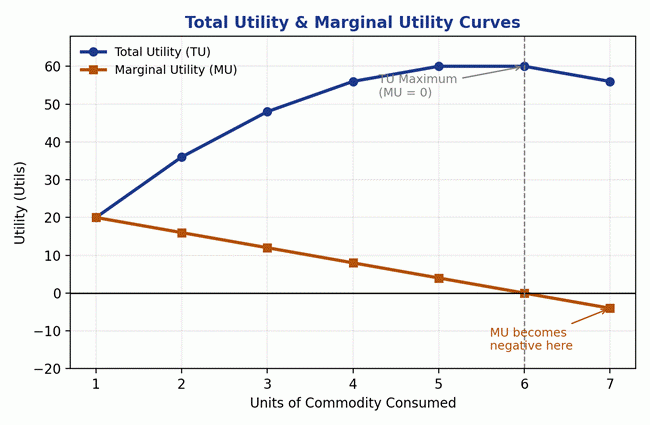
Fig 1 — As units consumed increase, MU steadily diminishes; TU rises at a decreasing rate, peaks when MU = 0, and falls once MU turns negative.
Relationship Between TU and MU
Condition of MU | Behaviour of TU |
MU is positive and falling | TU rises, but at a decreasing rate |
MU = 0 | TU is at its maximum (point of satiety) |
MU is negative | TU falls from its maximum |
Section 03 — Law of Diminishing Marginal Utility (Gossen's First Law)
Statement of the Law As a consumer takes successive units of a commodity, the Marginal Utility derived from each additional unit goes on diminishing, other things (income, tastes, price) remaining constant. |
Assumptions
- Units of the commodity are standard/homogeneous in size and quality.
- Consumption is continuous, without a significant time gap between units.
- The consumer's income, tastes and preferences remain unchanged during consumption.
- The consumer is a 'rational' being, behaving normally.
- No change occurs in the price of the commodity or related (substitute/complementary) goods.
Exceptions to the Law
- Money: Marginal utility of money is assumed to diminish only very slowly, since money can serve many alternative uses.
- Hobbies / Collections: Rare coin, stamp, or art collecting — an additional rare piece may add more satisfaction than the previous one, at least over some range.
- Miser's hoarding of wealth: Each additional rupee may be valued as highly (or more) than the last.
- Initial units of habit-forming goods (e.g., early drinks of alcohol for a habitual drinker) are sometimes cited, though this is contested.
Section 04 — Law of Equi-Marginal Utility (Gossen's Second Law)
Also called the Law of Maximum Satisfaction or Law of Substitution, this law explains how a rational consumer with a fixed income allocates spending across multiple goods to maximise total utility.
Equilibrium Condition MUx / Px = MUy / Py = ... = Marginal Utility of Money (MUm) A rational consumer allocates income such that the marginal utility obtained per rupee spent is equal across all goods purchased. |
Diagram: Consumer Equilibrium
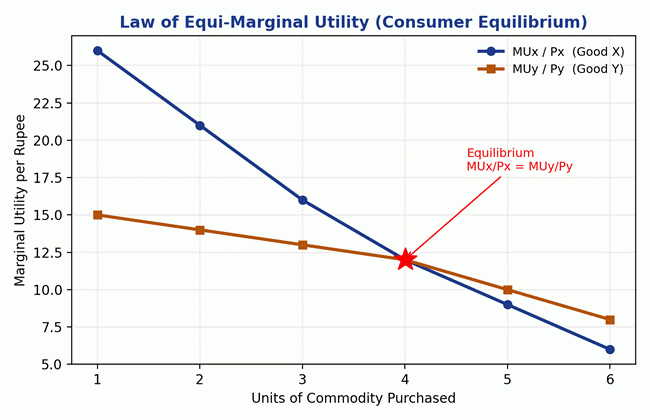
Fig 2 — The consumer keeps substituting spending toward the good with higher MU per rupee until MU/P= MUy/Py at the equilibrium point.
Working of the Law (Illustration)
If MUx/Px > MUy/Py, the consumer gets more satisfaction per rupee from X, so they buy more of X and less of Y. As more X is consumed, MUx falls (per LDMU); as less Y is consumed, MUy rises. This continues until the two ratios become equal — the point of consumer equilibrium (maximum total satisfaction from a given income).
Section 05 — Cardinal vs Ordinal Utility Approach
Basis | Cardinal Approach (Marshall) | Ordinal Approach (Hicks–Allen) |
Measurability | Utility measurable in numerical units ('utils') | Utility only ranked — 'more', 'less', or 'equal' |
Tool of Analysis | Marginal Utility curves / schedules | Indifference Curves & Budget Line |
Equilibrium Condition | MUx/Px = MUy/Py = MUm | Budget line tangent to highest indifference curve |
Key Criticism | Unrealistic to assume utility can be numerically measured | More complex, but more realistic assumption |
The ordinal approach was developed largely as a response to the criticism that utility, being a subjective psychological concept, cannot realistically be quantified in precise numerical units — only ranked in order of preference.
Section 06 — Consumer's Surplus (Marshall)
Consumer's Surplus is the excess of the price a consumer is willing to pay for a commodity (reflecting the utility derived) over the price they actually pay (the market price).
Formula (conceptual): Consumer's Surplus = What a consumer is willing to pay − What a consumer actually pays
Diagram: Consumer's Surplus
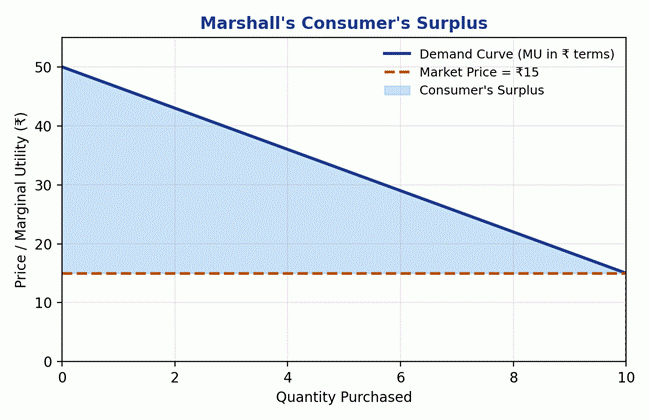
Fig 3 — The shaded area between the demand (marginal utility) curve and the market price line represents total Consumer's Surplus.
Classic Example Salt yields enormous Consumer's Surplus — its price is very low, but the utility derived (especially the utility of the first few units, which are essential) is very high. This is a favourite illustration in Marshallian economics. |
Diamond–Water Paradox
Water has very high Total Utility (essential for life) but low Marginal Utility because it is abundant — the price of the last unit consumed is low. Diamonds have low Total Utility but high Marginal Utility because they are scarce — hence a high price. This paradox is resolved by distinguishing Marginal Utility (which drives price) from Total Utility (which does not).
Section 07 — Quick Revision Map
Utility: Want-satisfying power; subjective, relative, ethically neutral
TU = ΣMU: Total Utility is the sum of all marginal utilities
MU falls → TU rises slower: TU max only when MU = 0
LDMU = Gossen's First Law: MU of successive units diminishes, ceteris paribus
Equi-Marginal Law = Gossen's Second Law: MUx/Px = MUy/Py = MUm at equilibrium
Cardinal (Marshall) vs Ordinal (Hicks-Allen): Measurable utils vs ranked preferences
Consumer's Surplus: Willingness to pay − Actual price paid
Diamond-Water Paradox: Resolved by Marginal Utility, not Total Utility
Section 08 — PYQ-Style MCQs (UPSC + JKSSB Level)
18 conceptual MCQs modelled on the difficulty and phrasing style of UPSC Prelims and JKSSB FAA economics questions, with detailed explanations.
Q1. Utility, in economic analysis, refers to -
(A) The usefulness of a commodity to society (B) The moral worth of consuming a commodity (C) The want-satisfying power of a commodity as felt by the consumer (D) The market price of a commodity
Answer: (C) The want-satisfying power of a commodity as felt by the consumer
Explanation: Utility is subjective and psychological — it is the satisfaction a consumer expects or derives, not a moral or objective property. A cigarette has utility for a smoker despite being harmful, showing utility ≠ usefulness.
Q2. Marginal Utility is best defined as -
(A) The utility derived from the first unit consumed (B) The addition to Total Utility from consuming one more unit (C) The average utility of all units consumed (D) The utility that remains after tax is deducted
Answer: (B) The addition to Total Utility from consuming one more unit
Explanation: MUn = TUn − TU(n−1). It measures the extra satisfaction from the last unit consumed, not an average or the first-unit utility.
Q3. The Law of Diminishing Marginal Utility was first propounded by -
(A) Adam Smith (B) H.H. Gossen (C) J.M. Keynes (D) David Ricardo
Answer: (B) H.H. Gossen
Explanation: This law is also known as Gossen's First Law, later refined by Alfred Marshall in cardinal utility analysis.
Q4. According to the Law of Diminishing Marginal Utility, as a consumer takes successive units of a commodity -
(A) Total Utility always falls (B) Marginal Utility of each successive unit falls, other things remaining constant (C) Marginal Utility remains constant (D) Price of the commodity must fall
Answer: (B) Marginal Utility of each successive unit falls, other things remaining constant
Explanation: TU keeps rising (at a decreasing rate) as long as MU is positive; only MU necessarily diminishes with each additional unit, ceteris paribus.
Q5. Which of the following is NOT a necessary assumption of the Law of Diminishing Marginal Utility?
(A) The units of the commodity consumed are identical/homogeneous (B) Consumption is continuous without a time gap (C) The consumer's income and tastes remain unchanged (D) The price of the commodity must be zero
Answer: (D) The price of the commodity must be zero
Explanation: Price is irrelevant to the psychological law itself. The law rests on standard/homogeneous units, continuous consumption, and constant income, tastes and preferences.
Q6. Total Utility is maximum at the point where -
(A) Marginal Utility is also maximum (B) Marginal Utility equals zero (C) Marginal Utility is negative (D) Marginal Utility equals price
Answer: (B) Marginal Utility equals zero
Explanation: This is the point of satiety. Beyond it, further consumption yields negative MU, causing TU itself to decline.
Q7. If a consumer keeps consuming a commodity beyond the point of satiety, then -
(A) Total Utility continues to rise (B) Marginal Utility becomes negative and Total Utility starts falling (C) Marginal Utility remains zero permanently (D) Total Utility becomes zero immediately
Answer: (B) Marginal Utility becomes negative and Total Utility starts falling
Explanation: Beyond satiety (e.g., overeating), extra units cause disutility — MU turns negative, dragging TU down from its peak.
Q8. Which of the following is commonly cited as a partial exception to the Law of Diminishing Marginal Utility?
(A) Bread (B) Money (C) Water (D) Rice
Answer: (B) Money
Explanation: The marginal utility of money is assumed by Marshall to diminish very slowly, since money can be used for a variety of ends — it is treated as an exception for analytical convenience, along with hobbies like collecting rare coins or stamps.
Q9. The Law of Equi-Marginal Utility is also known as -
(A) Gossen's First Law (B) Gossen's Second Law (C) Law of Substitution only (D) Engel's Law
Answer: (B) Gossen's Second Law
Explanation: It explains how a rational consumer allocates a limited income among goods to maximise total satisfaction — hence also called the Law of Maximum Satisfaction.
Q10. A rational consumer spending income on two goods X and Y is in equilibrium when -
(A) MUx = MUy (B) Px = Py (C) MUx/Px = MUy/Py = Marginal Utility of Money (D) Total Utility from X equals Total Utility from Y
Answer: (C) MUx/Px = MUy/Py = Marginal Utility of Money
Explanation: Equilibrium requires equal marginal utility PER RUPEE spent on each good, not equal marginal utility in absolute terms — a common conceptual trap.
Q11. If MUx/Px > MUy/Py, a rational consumer will -
(A) Buy more of Y and less of X (B) Buy more of X and less of Y (C) Stop consuming both goods (D) The consumer is already in equilibrium
Answer: (B) Buy more of X and less of Y
Explanation: Good X gives more satisfaction per rupee, so reallocating spending toward X raises total utility until the ratios equalise (as MUx falls and MUy rises with the reallocation).
Q12. Marshall's cardinal utility approach assumes that utility -
(A) Cannot be measured at all (B) Can be measured numerically in units called 'utils' (C) Can only be ranked, not measured (D) Is the same for all consumers
Answer: (B) Can be measured numerically in units called 'utils'
Explanation: Cardinal analysis (Marshall) assumes cardinal measurability, unlike the later ordinal approach (Hicks–Allen) which only requires ranking of preferences via indifference curves.
Q13. The main criticism of Marshall's cardinal utility analysis is that -
(A) It ignores the price of goods (B) Utility is subjective and cannot realistically be measured in numerical units (C) It does not explain consumer behaviour at all (D) It applies only to necessities
Answer: (B) Utility is subjective and cannot realistically be measured in numerical units
Explanation: Hicks and Allen replaced cardinal measurement with the ordinal (indifference curve) approach, arguing satisfaction can only be ranked as 'more', 'less' or 'equal', not quantified precisely.
Q14. Consumer's Surplus, as conceptualised by Marshall, refers to -
(A) The excess of a consumer's income over expenditure (B) The excess of what a consumer is willing to pay over what they actually pay (C) The profit earned by a producer (D) The tax saved by a consumer
Answer: (B) The excess of what a consumer is willing to pay over what they actually pay
Explanation: It measures the difference between the price a consumer would be willing to pay (reflecting marginal utility in money terms) and the market price actually paid, summed over all units purchased.
Q15. The 'Diamond–Water Paradox' is best explained using the concept of -
(A) Total Utility (B) Marginal Utility (C) Elasticity of Supply (D) Law of Demand
Answer: (B) Marginal Utility
Explanation: Water has high Total Utility but low Marginal Utility (abundant supply), while diamonds have low Total Utility but high Marginal Utility (scarce) — price is driven by marginal, not total, utility.
Q16. In the ordinal utility approach, consumer equilibrium is explained using -
(A) Marginal Utility curves (B) Indifference curves and the budget line (C) Total Utility schedules only (D) Gossen's First Law only
Answer: (B) Indifference curves and the budget line
Explanation: The ordinal approach (Hicks–Allen) determines equilibrium at the point where the budget line is tangent to the highest attainable indifference curve — utility is not measured, only ranked.
Q17. Which statement about the relationship between Total Utility (TU) and Marginal Utility (MU) is correct?
(A) When MU is positive but falling, TU rises at a decreasing rate (B) When MU is positive, TU always falls (C) When MU is negative, TU still keeps rising (D) MU and TU always move in the same direction
Answer: (A) When MU is positive but falling, TU rises at a decreasing rate
Explanation: As long as MU > 0, TU keeps increasing; because MU itself is falling, the rate of increase of TU slows down. TU only falls once MU turns negative.
Q18. Which of the following goods is often presented as an exception where increasing consumption may not show diminishing marginal utility, at least initially?
(A) Salt in a normal meal (B) Rare stamp or coin collecting as a hobby (C) Drinking water when thirsty (D) Ordinary bread consumption
Answer: (B) Rare stamp or coin collecting as a hobby
Explanation: In hobbies like collecting, each additional (rarer) piece may add more satisfaction than the last, at least over a range — commonly cited alongside money as a textbook exception to LDMU.
Section 09 — Statement-Based / Assertion Questions (High-Order Thinking)
These test conceptual depth, not memorisation — the kind of two/three-statement or Assertion-Reason questions increasingly seen in UPSC Prelims and JKSSB's newer pattern.
Q1. Statement I: The Law of Diminishing Marginal Utility implies that Total Utility must fall as more units are consumed.
Statement II: Total Utility can rise even while Marginal Utility is falling, as long as Marginal Utility remains positive.
(A) Both I and II are correct, and II explains I (B) I is correct, II is incorrect (C) I is incorrect, II is correct (D) Both I and II are incorrect
Answer: (C) I is incorrect, II is correct
Explanation: TU falls only when MU turns negative. A falling but still-positive MU means TU keeps rising, just at a decreasing rate. Statement I is a very common misconception the exam tests directly.
Q2. Statement I: Consumer equilibrium under Gossen's Second Law requires that the Marginal Utility of every good purchased be equal.
Statement II: Consumer equilibrium requires that the Marginal Utility per rupee spent on every good be equal.
(A) Only I is correct (B) Only II is correct (C) Both I and II are correct (D) Neither I nor II is correct
Answer: (B) Only II is correct
Explanation: The equilibrium condition is MUx/Px = MUy/Py (utility per rupee), not MUx = MUy in absolute terms — goods with different prices are not comparable in raw marginal utility.
Q3. Statement I: Marshall's utility analysis is cardinal, treating utility as objectively measurable in 'utils'.
Statement II: The ordinal approach of Hicks and Allen was developed partly because cardinal measurement of a subjective concept like utility was considered unrealistic.
(A) Both statements are correct and II is the correct explanation of why the ordinal approach emerged (B) Both statements are correct but II does not explain the emergence of the ordinal approach (C) Statement I is correct, Statement II is incorrect (D) Statement I is incorrect, Statement II is correct
Answer: (A) Both statements are correct and II is the correct explanation of why the ordinal approach emerged
Explanation: Marshall's cardinal approach assumed measurable 'utils'; Hicks–Allen's ordinal approach (indifference curves) was developed precisely to avoid this unrealistic assumption of cardinal measurability.
Q4. Statement I: Money is often treated as a theoretical exception to the Law of Diminishing Marginal Utility.
Statement II: This is because money, unlike a specific commodity, can be spent on a wide variety of alternative uses, so its marginal utility diminishes only very slowly.
(A) Both statements are correct and II correctly explains I (B) Both statements are correct but II does not explain I (C) Statement I is correct, Statement II is incorrect (D) Statement I is incorrect, Statement II is correct
Answer: (A) Both statements are correct and II correctly explains I
Explanation: Because money is a generalised purchasing power rather than a specific want-satisfier, its marginal utility is assumed (by Marshall) to fall very gradually — hence its treatment as a near-exception.
Q5. Consider the following statements regarding Consumer's Surplus:
1. It is measured as the difference between what a consumer is willing to pay and what they actually pay.
2. It arises because the price paid for all units is generally based on the Marginal Utility of the last unit, while earlier units yielded higher marginal utility.
3. Consumer's Surplus can never be applied to necessities like salt.
Which of the statements given above is/are correct?
(A) 1 and 2 only (B) 2 and 3 only (C) 1, 2 and 3 (D) 1 only
Answer: (A) 1 and 2 only
Explanation: Statements 1 and 2 correctly describe the logic of consumer's surplus. Statement 3 is wrong — Marshall in fact used salt as a classic example of a good yielding very large consumer's surplus, since its price is low relative to the utility derived.
Q6. Statement I: The Diamond-Water Paradox shows that price is determined by Total Utility, not Marginal Utility.
Statement II: Water has greater Total Utility than diamonds but lower Marginal Utility because it is abundant, while diamonds are scarce and have high Marginal Utility despite low Total Utility.
(A) Both I and II are correct and II explains the paradox correctly (B) I is incorrect; II correctly resolves the paradox using Marginal Utility, not Total Utility (C) Both I and II are incorrect (D) I is correct; II is incorrect
Answer: (B) I is incorrect; II correctly resolves the paradox using Marginal Utility, not Total Utility
Explanation: The paradox is resolved by Marginal, not Total, Utility — price tracks the utility of the last (marginal) unit consumed given scarcity, which is exactly what Statement II explains correctly.
Prepared for UPSC CSE & JKSSB FAA 2026 Aspirants
for any query dm 7006392314
E