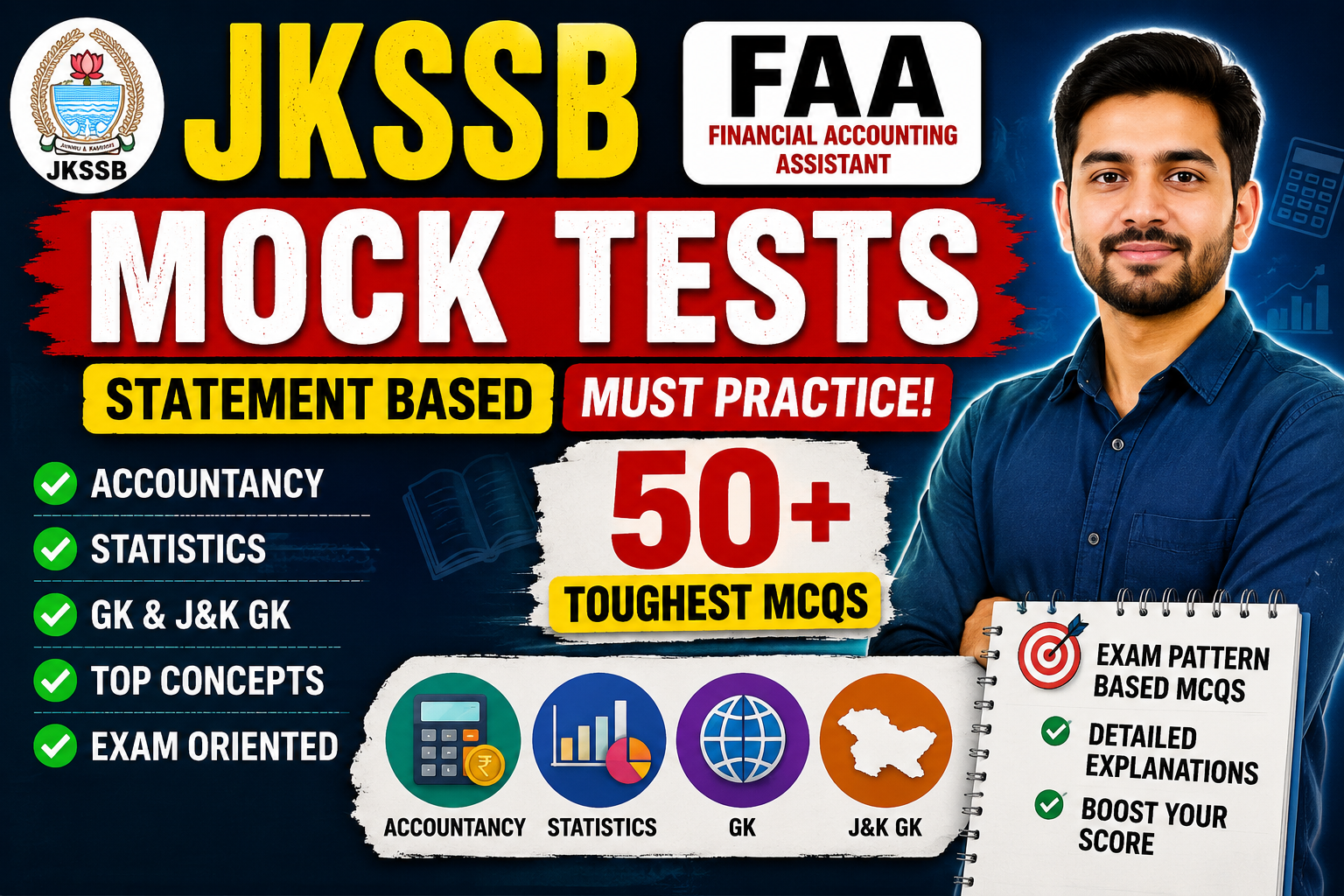
JKSSB FAA Mock Test 2026 – Tough Statement-Based MCQs for Serious Preparation
Preparing for the JKSSB Finance Accounts Assistant (FAA) examination is not simply about memorising accounting definitions or solving a few basic MCQs. The level of competition makes it important to understand concepts, identify small differences between similar options and apply rules correctly under exam pressure.
That is exactly where statement-based questions become important.
A good JKSSB FAA mock test should not only ask direct questions such as “What is a journal?” Instead, it should test whether you can analyse statements related to financial accounting, bookkeeping, accounting equations, trial balance, bank reconciliation statement, partnership accounts, financial statements, statistics, probability, index numbers and General Knowledge with special reference to J&K.
The FAA examination is an objective-type examination carrying 120 marks with a two-hour duration. The syllabus gives significant importance to General Knowledge and Accountancy & Book Keeping, while Statistics, Mathematics, Economics, General Science, Computer Knowledge and English also form part of the preparation.
For a candidate preparing seriously, simply attempting hundreds of easy questions is not enough. The objective should be to practise questions that force you to think before selecting an answer.
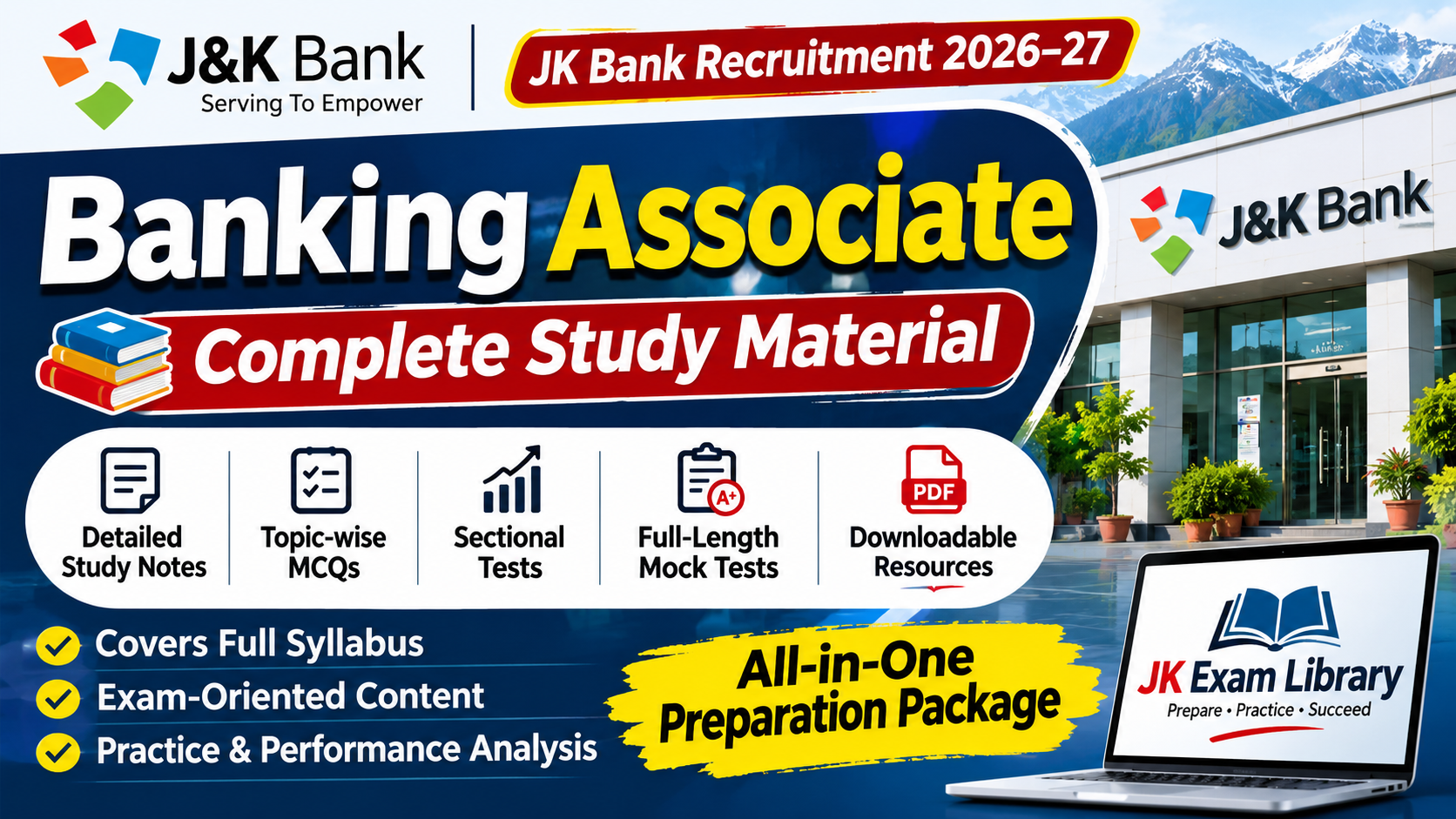
Download JKSSB FAA complete notes and Attempt 20+ full mocktests and 20+ Sectional Tests
Why Statement-Based Questions Matter in JKSSB FAA
Statement-based MCQs are useful because they test conceptual clarity rather than memory alone.
For example, a direct question may ask:
“What is a Bank Reconciliation Statement?”
An examination-level question may instead give three statements about BRS and ask you to identify which statements are correct.
That small change makes the question considerably more analytical.
This style is particularly useful for JKSSB FAA Accountancy preparation because accounting contains several closely related concepts. A candidate may know the definition of an asset but still make an error when dealing with capital expenditure, revenue expenditure, depreciation, outstanding expenses, prepaid expenses, provisions, reserves or accounting adjustments.
The same principle applies to Statistics. Instead of asking only for the definition of mean, a difficult question can combine mean, median, mode, probability, primary data, secondary data, sampling, index numbers and measures of dispersion.
Important JKSSB FAA Mock Test Topics
Candidates should build their practice around the actual syllabus rather than randomly solving questions from unrelated competitive examinations.
Accountancy and Bookkeeping
Accountancy is one of the most important sections for FAA preparation. The syllabus includes financial accounting, accounting terminology, accounting equation, journal, voucher approach, bank reconciliation statement, financial statements, partnership accounts, ledger accounts, cash book, financial audit, double-entry bookkeeping, trial balance, trading account, profit and loss account, balance sheet, social accounting, social audit, PFMS, taxation, cost management, budgetary control and cost accounting.
The important thing here is not merely remembering definitions.
You should be able to determine:
- The effect of transactions on the accounting equation
- Correct debit and credit treatment
- Journal entries
- Ledger posting
- Trial balance implications
- BRS adjustments
- Treatment of depreciation
- Capital and revenue items
- Partnership adjustments
- Preparation of financial statements
- Profit or loss calculation
- Balance sheet classification
- Basic taxation concepts
- Budgetary control and cost accounting principles
These areas are particularly suitable for tough statement-based MCQs.
Statistics Preparation for JKSSB FAA
Statistics may carry fewer marks than Accountancy or GK, but candidates should not ignore it.
Important areas include primary and secondary data, methods of data collection, questionnaires, tabulation and compilation, measures of central tendency, probability, theory of attributes, index numbers, census and vital statistics.
While preparing Statistics, focus on conceptual differences.
For example:
Primary data is collected first-hand for a specific purpose, whereas secondary data has already been collected by another person or organisation.
Similarly, questions can test the difference between:
- Mean and median
- Population and sample
- Census and sampling
- Wholesale Price Index and Consumer Price Index
- Fertility and mortality measures
- Gross and net reproduction rates
- Sampling and non-sampling errors
A statement-based question can combine several of these concepts and therefore requires careful reading.
General Knowledge with Special Reference to J&K
The General Knowledge section is another major area of FAA preparation. It includes Indian and international current affairs along with subjects connected to Jammu & Kashmir.
Important areas include J&K history, J&K geography, J&K economy, J&K culture and heritage, rivers and lakes, flora and fauna, climate, crops, tourist destinations, Indian polity, Constitution, Indian history, environment, ecology, demography, culture and the J&K Reorganisation Act, 2019.
For J&K-specific preparation, candidates should avoid studying only famous facts.
A better approach is to connect facts.
For example, a question can combine a river with its tributary, a district with a geographical feature, or a historical event with its political background.
This is why J&K GK MCQs, JKSSB current affairs, Jammu and Kashmir history questions, J&K geography MCQs, J&K economy questions, and J&K culture and heritage questions should all be part of regular practice.
How to Use JKSSB FAA Mock Tests Properly
A mock test is useful only when you analyse it after completion.
Do not judge your preparation solely by your score.
Suppose you attempt 50 questions and get 38 correct. The remaining 12 questions should be divided into categories:
- Questions you did not know.
- Questions where you misunderstood the concept.
- Questions where you made a calculation mistake.
- Questions where you changed a correct answer to an incorrect one.
- Questions where you were confused between two options.
The fifth category is particularly important for statement-based examinations.
Maintaining an FAA error notebook can make revision much more productive. Write down the concept behind every important mistake instead of copying only the question.
Why Tough Mock Tests Are Better Than Only Easy Questions
Easy questions can create confidence, but difficult questions reveal weaknesses.
A candidate who consistently practises high-level JKSSB FAA MCQs becomes more comfortable with unfamiliar wording, multiple statements and elimination-based questions.
This is especially useful for Accountancy MCQs, where a single word such as “always”, “only”, “not”, “increase”, “decrease” or “normally” can completely change the meaning of a statement.
The same applies to Statistics and GK.
Therefore, your preparation should include a combination of:
concept revision → topic-wise MCQs → statement-based questions → mixed mock tests → error analysis → revision.
Important LSI Keywords for JKSSB FAA Preparation
This preparation resource naturally covers important search terms and related concepts such as JKSSB FAA mock test, JKSSB Finance Accounts Assistant, Finance Accounts Assistant mock test, JKSSB Accounts Assistant, FAA test series, JKSSB FAA practice set, FAA online test, JKSSB accountancy MCQs, accounting MCQs, bookkeeping questions, financial accounting questions, double entry bookkeeping, journal entries, ledger accounts, trial balance, bank reconciliation statement, cash book, partnership accounts, balance sheet questions, profit and loss account, financial statements, cost accounting, budgetary control, taxation MCQs, PFMS, statistics MCQs, probability questions, primary data, secondary data, central tendency, index numbers, vital statistics, demography, J&K GK, Jammu Kashmir current affairs, J&K history, J&K geography, J&K economy, J&K culture, J&K polity, J&K Reorganisation Act, General Knowledge MCQs, competitive exam mock test, statement-based MCQs, difficult MCQs, high-level MCQs, exam-oriented questions, previous year practice, and JKSSB exam preparation.
Using these topics together gives preparation a much more complete direction than concentrating on one subject alone.
Final Preparation Strategy
If you are preparing for the JKSSB FAA 2026 examination, do not wait until the final weeks to start mock tests.
Begin with topic-wise practice. Once your concepts become stronger, move towards mixed papers.
Give special attention to Accountancy and Bookkeeping, because this is a core part of the examination. At the same time, maintain regular practice in J&K General Knowledge, Statistics, Economics, Mathematics, Computer Knowledge, General Science and English.
Most importantly, do not attempt a mock test simply to see a score.
Attempt it to discover what you still do not know.
A difficult statement-based question that you get wrong today can become one of the easiest questions for you in the actual examination if you understand the underlying concept and revise it properly.
The goal of a JKSSB FAA mock test should therefore be simple: improve accuracy, improve speed, identify weak areas and gradually make difficult questions feel familiar.
The practice set below is designed in that spirit, with a stronger focus on Accountancy, Statistics and General Knowledge, including statement-based and concept-oriented questions suitable for serious FAA preparation.
ALSO READ: JKSSB Last month practice sets
JKSSB FAA Mock Test 2026: 60 Tough Statement-Based MCQs
Below are 60 high-level, statement-based MCQs covering Accountancy, Bookkeeping, Statistics, Economics, J&K GK and General Knowledge. The questions are designed to test conceptual understanding, not just memorisation.
1. Accounting Equation
Consider the following statements:
- Every transaction affects at least two elements of the accounting equation.
- An increase in an asset must necessarily be accompanied by an increase in capital.
- Purchase of goods for cash does not change total assets.
- Payment of a liability reduces both cash and liability.
Which of the above statements are correct?
A. 1, 3 and 4 only
B. 1 and 2 only
C. 2, 3 and 4 only
D. 1, 2, 3 and 4
Correct Answer: A
Solution: Statement 2 is incorrect because an asset can increase through an increase in liability. Purchase of goods for cash merely changes the composition of assets.
2. Double Entry System
Consider the following:
- Every debit has a corresponding credit.
- Double-entry bookkeeping guarantees that all errors will be detected.
- The system helps in determining the arithmetical accuracy of ledger accounts through a trial balance.
- A transaction may involve more than two accounts.
Which statements are correct?
A. 1 and 2 only
B. 1, 3 and 4 only
C. 2 and 3 only
D. 1, 2, 3 and 4
Correct Answer: B
Solution: Double entry does not detect every error. Errors such as complete omission or compensating errors may remain undetected.
3. Trial Balance
- Trial balance is prepared primarily to test the arithmetical accuracy of ledger posting.
- Agreement of a trial balance proves that there are no accounting errors.
- Errors of principle may not affect the agreement of trial balance.
- Complete omission of a transaction may leave trial balance unaffected.
A. 1, 3 and 4 only
B. 1 and 2 only
C. 2, 3 and 4 only
D. All four
Correct Answer: A
4. Bank Reconciliation Statement
- A cheque issued but not yet presented for payment causes a difference between cash book and passbook balances.
- A cheque deposited but not yet collected may cause such a difference.
- Bank charges entered only in the passbook can cause disagreement.
- BRS is itself a part of the double-entry system.
A. 1 and 2 only
B. 2, 3 and 4 only
C. 1, 2 and 3 only
D. All four
Correct Answer: C
5. Capital and Revenue Expenditure
- Capital expenditure generally provides benefit extending beyond the current accounting period.
- Revenue expenditure is always paid in cash.
- Expenditure incurred to acquire a fixed asset is generally capital expenditure.
- Repairs that merely maintain an asset in working condition are generally revenue expenditure.
A. 1, 3 and 4 only
B. 1 and 2 only
C. 2 and 3 only
D. All four
Correct Answer: A
6. Depreciation
- Depreciation is generally associated with tangible depreciable fixed assets.
- Depreciation represents a fall in the market price of an asset only.
- Depreciation is an expense for accounting purposes.
- Charging depreciation reduces the carrying amount of an asset under the usual accounting treatment.
A. 1 and 2 only
B. 1, 3 and 4 only
C. 2, 3 and 4 only
D. All four
Correct Answer: B
7. Outstanding Expenses
An expense is outstanding at the end of the accounting year.
- It is added to the related expense in determining profit.
- It is shown as a current liability.
- It is deducted from the related expense.
- It represents an expense incurred but not yet paid.
A. 1 and 2 only
B. 2 and 3 only
C. 1, 2 and 4 only
D. 1, 3 and 4 only
Correct Answer: C
8. Prepaid Expenses
- A prepaid expense represents an amount paid in advance.
- It is generally treated as an asset until the related benefit is consumed.
- It is added to the expense for determining current-year profit.
- It is deducted from the relevant expense.
A. 1, 2 and 4 only
B. 1 and 3 only
C. 2 and 3 only
D. All four
Correct Answer: A
9. Bad Debts
- Bad debts are losses arising from irrecoverable amounts from debtors.
- Writing off bad debts reduces the amount recoverable from debtors.
- Bad debts recovered are treated identically to fresh credit sales.
- Bad debts can affect profit.
A. 1 and 2 only
B. 1, 2 and 4 only
C. 2, 3 and 4 only
D. All four
Correct Answer: B
10. Provision and Reserve
- Provision is generally created for a known liability or anticipated loss whose exact amount may be uncertain.
- Reserve is generally an appropriation of profit.
- Provision and reserve are completely identical accounting concepts.
- Provision is generally charged against profit before arriving at divisible profit.
A. 1, 2 and 4 only
B. 1 and 3 only
C. 2 and 3 only
D. All four
Correct Answer: A
11. Journal
- Journal is commonly described as the book of original entry.
- Transactions are recorded chronologically in the journal.
- Every journal entry necessarily contains exactly one debit and one credit account.
- Compound journal entries may contain more than one debit or credit account.
A. 1 and 2 only
B. 1, 2 and 4 only
C. 2, 3 and 4 only
D. All four
Correct Answer: B
12. Ledger
- Ledger contains individual accounts.
- Posting from journal to ledger classifies transactions account-wise.
- Ledger is unnecessary if a journal is maintained.
- Trial balance is generally prepared from ledger balances.
A. 1 and 2 only
B. 1, 2 and 4 only
C. 2 and 3 only
D. All four
Correct Answer: B
13. Trading Account
- Trading account is prepared to determine gross profit or gross loss.
- Closing stock generally affects the calculation of gross profit.
- Administrative expenses are normally transferred to trading account.
- Cost of goods sold is relevant to determination of gross profit.
A. 1, 2 and 4 only
B. 1 and 3 only
C. 2, 3 and 4 only
D. All four
Correct Answer: A
14. Profit and Loss Account
- Profit and Loss Account determines net profit or net loss.
- Indirect expenses are generally considered in determining net profit.
- Gross profit is generally transferred to the Profit and Loss Account.
- Closing stock is always directly debited to the Profit and Loss Account.
A. 1 and 2 only
B. 2 and 4 only
C. 1, 2 and 3 only
D. All four
Correct Answer: C
15. Balance Sheet
- Balance sheet shows the financial position at a particular date.
- It includes assets and liabilities.
- It is prepared to directly calculate gross profit.
- Capital is generally shown on the liabilities/equity side.
A. 1, 2 and 4 only
B. 1 and 3 only
C. 2 and 3 only
D. All four
Correct Answer: A
16. Cash Book
- Cash book records cash transactions.
- A cash book can also contain bank transactions.
- Cash book serves both as a book of original entry and a ledger for cash/bank accounts.
- Credit sales are directly entered in the cash column.
A. 1 and 2 only
B. 1, 2 and 3 only
C. 2, 3 and 4 only
D. All four
Correct Answer: B
17. Accounting Concepts
- Going concern assumes that the business will continue for the foreseeable future.
- Business entity concept treats business and owner as separate for accounting purposes.
- Money measurement concept records every qualitative aspect of a business.
- Consistency helps in meaningful comparison across accounting periods.
A. 1, 2 and 4 only
B. 1 and 3 only
C. 2 and 3 only
D. All four
Correct Answer: A
18. Matching Principle
- Expenses should be matched with the revenues they help generate.
- Matching is relevant to determination of accounting profit.
- Every cash payment is necessarily treated as an expense of the same period.
- Accrual accounting facilitates application of matching.
A. 1 and 2 only
B. 1, 2 and 4 only
C. 2 and 3 only
D. All four
Correct Answer: B
19. Accrual Basis
- Revenue may be recognised when earned rather than only when cash is received.
- Expenses may be recognised when incurred rather than only when paid.
- Accrual accounting ignores outstanding expenses.
- Accrual accounting generally provides a better measure of periodic performance than pure cash accounting.
A. 1, 2 and 4 only
B. 1 and 3 only
C. 2 and 3 only
D. All four
Correct Answer: A
20. Partnership
- Partnership involves an agreement between persons to share profits of a business.
- Profit-sharing ratio is always necessarily equal.
- Interest on capital may be allowed if provided by the agreement and applicable rules.
- Admission of a new partner can affect the profit-sharing arrangement.
A. 1 and 2 only
B. 2, 3 and 4 only
C. 1, 3 and 4 only
D. All four
Correct Answer: C
Statistics MCQs
21. Arithmetic Mean
- Arithmetic mean uses all observations in the dataset.
- Arithmetic mean is always equal to the median.
- Extreme values can significantly influence arithmetic mean.
- Sum of deviations from arithmetic mean is zero.
A. 1, 3 and 4 only
B. 1 and 2 only
C. 2 and 4 only
D. All four
Correct Answer: A
22. Median
- Median is a positional measure.
- Median requires observations to be arranged in order.
- Median is generally less affected by extreme values than arithmetic mean.
- Median necessarily uses every observation in its numerical calculation.
A. 1 and 2 only
B. 1, 2 and 3 only
C. 2, 3 and 4 only
D. All four
Correct Answer: B
23. Mode
- Mode represents the most frequently occurring value.
- A distribution may have more than one mode.
- Mode is always uniquely defined.
- Mode can be useful for qualitative or categorical data.
A. 1, 2 and 4 only
B. 1 and 3 only
C. 2 and 3 only
D. All four
Correct Answer: A
24. Measures of Dispersion
- Range is based on the largest and smallest observations.
- Variance is expressed in squared units of the original variable.
- Standard deviation is the positive square root of variance.
- Greater dispersion always means a smaller standard deviation.
A. 1 and 2 only
B. 2, 3 and 4 only
C. 1, 2 and 3 only
D. All four
Correct Answer: C
25. Primary Data
- Primary data are collected first-hand for a particular investigation.
- Data collected through a questionnaire can be primary data.
- Primary data are necessarily more accurate than all secondary data.
- Interviews can be a method of collecting primary data.
A. 1, 2 and 4 only
B. 1 and 3 only
C. 2 and 3 only
D. All four
Correct Answer: A
26. Secondary Data
- Census reports can serve as sources of secondary data for a researcher.
- Published government statistics may be secondary data.
- Secondary data are always unsuitable for research.
- Suitability of secondary data depends on factors such as relevance and reliability.
A. 1 and 2 only
B. 1, 2 and 4 only
C. 2, 3 and 4 only
D. All four
Correct Answer: B
27. Census and Sampling
- Census attempts to cover every unit of the population.
- Sampling studies a subset of the population.
- Sampling can save time and cost.
- Sampling always eliminates sampling error.
A. 1 and 2 only
B. 2, 3 and 4 only
C. 1, 2 and 3 only
D. All four
Correct Answer: C
28. Probability
- Probability of an impossible event is zero.
- Probability of a certain event is one.
- Probability of any event cannot exceed one.
- Probability can be negative when the event is highly unlikely.
A. 1, 2 and 3 only
B. 1 and 4 only
C. 2, 3 and 4 only
D. All four
Correct Answer: A
29. Index Numbers
- Index numbers measure relative changes in a variable or group of variables.
- Price index numbers can measure changes in prices over time.
- An index of 125 with base 100 indicates a 25% increase relative to the base.
- Index numbers always measure absolute quantities.
A. 1 and 2 only
B. 1, 2 and 3 only
C. 2, 3 and 4 only
D. All four
Correct Answer: B
30. Vital Statistics
- Birth and death statistics form part of vital statistics.
- Fertility is related to childbearing.
- Mortality refers to the occurrence of deaths.
- Vital statistics have no relevance to public policy.
A. 1 and 2 only
B. 2 and 3 only
C. 1, 2 and 3 only
D. All four
Correct Answer: C
31. Correlation
- Correlation measures the degree of association between variables.
- Perfect positive correlation has coefficient +1.
- Perfect negative correlation has coefficient −1.
- Correlation coefficient greater than +1 is possible.
A. 1 and 2 only
B. 1, 2 and 3 only
C. 2, 3 and 4 only
D. All four
Correct Answer: B
32. Data Classification
- Classification helps organise raw data into meaningful groups.
- Frequency distribution shows frequencies associated with values or classes.
- Classification always destroys the usefulness of data.
- Tabulation facilitates comparison.
A. 1, 2 and 4 only
B. 1 and 3 only
C. 2 and 3 only
D. All four
Correct Answer: A
Economics & General Knowledge
33. GDP
- GDP measures the value of final goods and services produced within a country's territory during a specified period.
- Intermediate goods are separately added to GDP along with final goods.
- GDP is a flow concept.
- GDP and national income are necessarily identical concepts.
A. 1 and 3 only
B. 1, 2 and 3 only
C. 2 and 4 only
D. All four
Correct Answer: A
34. Inflation
- Inflation refers to a sustained increase in the general price level.
- Inflation necessarily means that the price of every individual good rises.
- Persistent inflation can reduce purchasing power of money.
- Consumer price indices are commonly used to study consumer-level price movements.
A. 1 and 2 only
B. 1, 3 and 4 only
C. 2 and 3 only
D. All four
Correct Answer: B
35. Fiscal Policy
- Fiscal policy concerns government taxation and expenditure.
- Fiscal policy is implemented exclusively by commercial banks.
- Government borrowing can be part of fiscal operations.
- Changes in government expenditure can influence aggregate demand.
A. 1 and 2 only
B. 2 and 3 only
C. 1, 3 and 4 only
D. All four
Correct Answer: C
36. Monetary Policy
- Monetary policy is primarily concerned with money, credit and interest-rate conditions.
- In India, the Reserve Bank of India plays the central role in monetary policy.
- Monetary policy and fiscal policy are exactly the same.
- Changes in policy rates can influence borrowing conditions.
A. 1, 2 and 4 only
B. 1 and 3 only
C. 2 and 3 only
D. All four
Correct Answer: A
37. Public Finance
- Government revenue and expenditure are components of public finance.
- Tax revenue is an important source of government receipts.
- Public finance deals exclusively with private household budgets.
- Fiscal deficit represents a financing gap in government finances under the relevant accounting definition.
A. 1 and 2 only
B. 1, 2 and 4 only
C. 2, 3 and 4 only
D. All four
Correct Answer: B
38. Indian Constitution
- The Constitution of India establishes a parliamentary system at the Union level.
- Fundamental Rights are contained in Part III.
- Directive Principles of State Policy are contained in Part IV.
- Fundamental Rights and Directive Principles are identical in legal nature.
A. 1 and 2 only
B. 2 and 3 only
C. 1, 2 and 3 only
D. All four
Correct Answer: C
39. Parliament of India
- The Indian Parliament consists of the President and two Houses.
- Rajya Sabha is the permanent House.
- Lok Sabha has a fixed membership of exactly 552 elected members under the present constitutional arrangement.
- Money Bills have a special constitutional procedure.
A. 1, 2 and 4 only
B. 1 and 3 only
C. 2 and 3 only
D. All four
Correct Answer: A
40. Fundamental Duties
- Fundamental Duties are contained in Article 51A.
- They were originally included in the Constitution.
- Fundamental Duties are directly identical to Fundamental Rights.
- The Swaran Singh Committee is associated with the recommendation relating to Fundamental Duties.
A. 1 and 2 only
B. 1 and 4 only
C. 1, 2 and 4 only
D. All four
Correct Answer: C
J&K GK
41. Jammu & Kashmir Reorganisation
- The Jammu and Kashmir Reorganisation Act, 2019 reorganised the former State of Jammu and Kashmir.
- The reorganisation created the Union Territories of Jammu and Kashmir and Ladakh.
- Both Union Territories were created with identical constitutional structures.
- The reorganisation came into effect on 31 October 2019.
A. 1 and 2 only
B. 1, 2 and 4 only
C. 2, 3 and 4 only
D. All four
Correct Answer: B
42. J&K Geography
- The Jhelum is an important river associated with Kashmir.
- Wular Lake is located in the Kashmir region.
- Dal Lake is located in Jammu region.
- The Pir Panjal range is an important physiographic feature of J&K.
A. 1 and 2 only
B. 1, 2 and 4 only
C. 2, 3 and 4 only
D. All four
Correct Answer: B
43. J&K Economy
- Agriculture has historically been an important component of the economy of J&K.
- Horticulture is particularly significant in the region.
- Apple production is associated with the horticulture sector of Kashmir.
- Tourism has no economic significance for J&K.
A. 1 and 2 only
B. 2 and 3 only
C. 1, 2 and 3 only
D. All four
Correct Answer: C
44. J&K Culture
- Kashmiri handicrafts include traditional crafts such as carpet weaving and papier-mâché.
- Pashmina is associated with fine wool production.
- Traditional Kashmiri handicrafts have no connection with tourism.
- Jammu and Kashmir has diverse cultural traditions.
A. 1, 2 and 4 only
B. 1 and 3 only
C. 2 and 3 only
D. All four
Correct Answer: A
45. J&K History
- The Treaty of Amritsar was signed in 1846.
- Gulab Singh became the first Maharaja of Jammu and Kashmir under the Dogra rule.
- The Dogra dynasty had no historical association with Jammu.
- 1846 is an important year in the political history of Jammu and Kashmir.
A. 1 and 2 only
B. 1, 2 and 4 only
C. 2, 3 and 4 only
D. All four
Correct Answer: B
46. Kashmir Rivers
- The Jhelum originates at Verinag in the Kashmir region.
- The Jhelum is a tributary of the Chenab.
- The river flows through the Kashmir Valley.
- Wular Lake is associated with the Jhelum river system.
A. 1, 3 and 4 only
B. 1 and 2 only
C. 2, 3 and 4 only
D. All four
Correct Answer: A
47. J&K Lakes
- Dal Lake is associated with Srinagar.
- Wular is among the major freshwater lakes of the Kashmir region.
- Pangong Lake is located entirely within Jammu and Kashmir.
- Mansar Lake is associated with the Jammu region.
A. 1 and 2 only
B. 1, 2 and 4 only
C. 2, 3 and 4 only
D. All four
Correct Answer: B
48. J&K Agriculture
- Saffron cultivation is associated with Pampore.
- Apple is an important horticultural crop.
- Rice cultivation has historical importance in Kashmir.
- Horticulture is completely unrelated to the rural economy of J&K.
A. 1 and 2 only
B. 1, 2 and 3 only
C. 2, 3 and 4 only
D. All four
Correct Answer: B
Mixed High-Level FAA Questions
49. Accounting Equation — Analytical
A business purchases machinery for ₹2,00,000 by paying ₹80,000 cash and taking a loan of ₹1,20,000.
Which statements are correct?
- Total assets increase by ₹1,20,000.
- Cash decreases by ₹80,000.
- Machinery increases by ₹2,00,000.
- Liabilities increase by ₹1,20,000.
A. 1, 2 and 3 only
B. 2, 3 and 4 only
C. 1, 2 and 4 only
D. All four
Correct Answer: D
50. Error in Trial Balance
Which of the following statements are correct?
- Complete omission of a transaction may not affect trial balance.
- An error affecting only one side of an account can cause disagreement.
- Compensating errors may cancel each other.
- Trial balance agreement is absolute proof of accounting accuracy.
A. 1, 2 and 3 only
B. 1 and 4 only
C. 2 and 4 only
D. All four
Correct Answer: A
51. Financial Statements
- Balance sheet shows financial position at a specific date.
- Trading account is associated with gross profit or gross loss.
- Profit and Loss Account determines net profit or net loss.
- Balance sheet itself is a statement of cash flows.
A. 1 and 2 only
B. 2, 3 and 4 only
C. 1, 2 and 3 only
D. All four
Correct Answer: C
52. Cost Accounting
- Cost accounting is concerned with ascertainment and analysis of costs.
- Cost control seeks to keep costs within predetermined or desirable limits.
- Cost accounting is completely unrelated to managerial decision-making.
- Cost classification can assist management in planning and control.
A. 1 and 2 only
B. 1, 2 and 4 only
C. 2 and 3 only
D. All four
Correct Answer: B
53. Budgetary Control
- A budget is a quantitative expression of a plan for a future period.
- Budgetary control involves comparing actual performance with budgeted performance.
- Variance analysis can help identify deviations.
- Budgetary control eliminates all business uncertainty.
A. 1 and 2 only
B. 1, 2 and 3 only
C. 2, 3 and 4 only
D. All four
Correct Answer: B
54. Mean and Median
Consider the observations:
4, 5, 6, 7, 8, 100
Which statements are correct?
- The mean will be strongly affected by 100.
- The median is less affected by the extreme observation.
- Mean is 21.67 approximately.
- Median is 6.5.
A. 1 and 2 only
B. 1, 2 and 3 only
C. 2, 3 and 4 only
D. All four
Correct Answer: D
55. Standard Deviation
- Standard deviation is a measure of dispersion.
- It is derived from variance.
- A standard deviation of zero indicates that all observations are identical.
- Standard deviation can be negative.
A. 1 and 2 only
B. 1, 2 and 3 only
C. 2, 3 and 4 only
D. All four
Correct Answer: B
56. Probability — Conceptual
A fair six-sided die is thrown once.
- Probability of obtaining an even number is 1/2.
- Probability of obtaining a number greater than 4 is 1/3.
- Probability of obtaining a number less than 7 is 1.
- Probability of obtaining zero is 1/6.
A. 1 and 2 only
B. 1, 2 and 3 only
C. 2, 3 and 4 only
D. All four
Correct Answer: B
57. Data Collection
- A questionnaire can be used for primary data collection.
- Observation can be a method of primary data collection.
- Published Census data may be used as secondary data.
- Secondary data never require evaluation for reliability.
A. 1 and 2 only
B. 2, 3 and 4 only
C. 1, 2 and 3 only
D. All four
Correct Answer: C
58. Accounting Adjustments
At year-end:
- Outstanding salary is added to salary expense.
- Outstanding salary is shown as a liability.
- Prepaid insurance is deducted from insurance expense.
- Prepaid insurance is generally shown as an asset.
Which statements are correct?
A. 1 and 2 only
B. 2 and 3 only
C. 1, 2 and 4 only
D. 1, 2, 3 and 4
Correct Answer: D
59. Current Assets
- Cash is generally a current asset.
- Trade receivables are generally current assets when expected to be realised in the normal operating cycle.
- Inventory is generally treated as a current asset.
- Every fixed asset is a current asset because it has monetary value.
A. 1 and 2 only
B. 1, 2 and 3 only
C. 2, 3 and 4 only
D. All four
Correct Answer: B
60. Comprehensive FAA Concept Test
Consider the following statements:
- Trial balance agreement does not guarantee complete absence of accounting errors.
- Median is generally less sensitive to extreme values than arithmetic mean.
- A BRS explains differences between the bank balance shown by cash book and the corresponding bank statement balance.
- J&K Reorganisation Act, 2019 resulted in the creation of the Union Territories of Jammu and Kashmir and Ladakh.
Which of the above are correct?
A. 1 and 2 only
B. 2 and 3 only
C. 1, 2 and 3 only
D. 1, 2, 3 and 4
Correct Answer: D
Quick Answer Key
| Q | Ans | Q | Ans | Q | Ans |
|---|---|---|---|---|---|
| 1 | A | 21 | A | 41 | B |
| 2 | B | 22 | B | 42 | B |
| 3 | A | 23 | A | 43 | C |
| 4 | C | 24 | C | 44 | A |
| 5 | A | 25 | A | 45 | B |
| 6 | B | 26 | B | 46 | A |
| 7 | C | 27 | C | 47 | B |
| 8 | A | 28 | A | 48 | B |
| 9 | B | 29 | B | 49 | D |
| 10 | A | 30 | C | 50 | A |
| 11 | B | 31 | B | 51 | C |
| 12 | B | 32 | A | 52 | B |
| 13 | A | 33 | A | 53 | B |
| 14 | C | 34 | B | 54 | D |
| 15 | A | 35 | C | 55 | B |
| 16 | B | 36 | A | 56 | B |
| 17 | A | 37 | B | 57 | C |
| 18 | B | 38 | C | 58 | D |
| 19 | A | 39 | A | 59 | B |
| 20 | C | 40 | C | 60 | D |