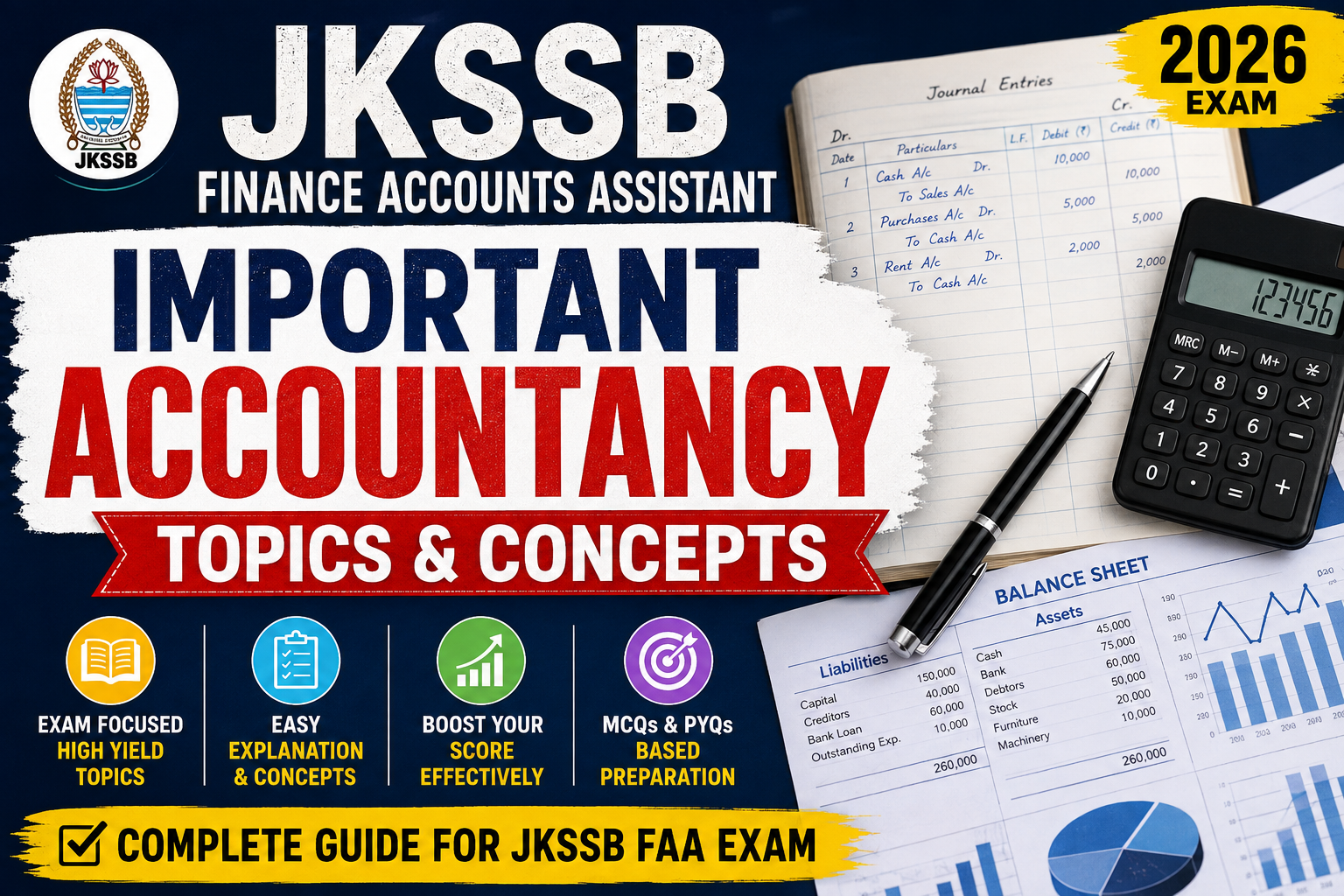
JKSSB Finance Accounts Assistant: Important Accountancy Topics & Concepts You Must Know
If you are preparing for the JKSSB Finance Accounts Assistant (FAA) exam, Accountancy is one subject that you simply cannot afford to ignore. Many students spend a lot of time memorising definitions but struggle when questions are presented in the form of practical situations, journal entries or accounting concepts.
The good thing is that Accountancy becomes much easier once your basics are clear.
For the JKSSB Finance Accounts Assistant exam, your preparation should not be limited to reading theory. You should understand why a particular account is debited or credited, how transactions move from the journal to the ledger, how a trial balance is prepared and how final accounts are made.
This guide covers some of the most important Accountancy topics for JKSSB FAA preparation, along with simple explanations that can help you revise the subject more effectively.
Download Full Course with full study material and full mocktests 20+ and sectional tests 20+
Why Accountancy Is Important for JKSSB FAA
The Finance Accounts Assistant post is directly connected with financial and accounting work. Therefore, questions related to basic accounting principles, recording of transactions, financial statements, assets, liabilities, income, expenditure and related concepts are particularly important.
Instead of trying to study every topic with equal priority, divide Accountancy into three levels:
High priority: Journal, Ledger, Trial Balance, Final Accounts, Depreciation, Rectification of Errors, Bank Reconciliation Statement, Bills of Exchange and Accounting Concepts.
Medium priority: Partnership basics, company accounts basics, ratios, provisions and reserves, capital and revenue expenditure, inventory valuation and non-profit organisation accounts.
Revision priority: Accounting terminology, conventions, principles, classifications and short theoretical concepts.
1. Meaning of Accountancy and Accounting
Before moving to advanced topics, understand the basic meaning of accounting.
Accounting is the systematic process of identifying, recording, classifying, summarising and interpreting financial transactions of a business.
For example, suppose a business purchases furniture for ₹20,000 in cash. This is a financial transaction and needs to be recorded in the books of accounts.
Accounting generally involves:
- Identifying financial transactions
- Recording transactions
- Classifying them into appropriate accounts
- Summarising financial information
- Analysing and interpreting results
A simple way to remember the process is:
Transaction → Journal → Ledger → Trial Balance → Final Accounts
This sequence is extremely important for exam preparation.
2. Basic Accounting Terms
You should be comfortable with common accounting terminology because direct MCQs can be asked from these concepts.
Assets
Assets are resources owned or controlled by a business that have economic value.
Examples include:
- Cash
- Bank balance
- Machinery
- Furniture
- Building
- Debtors
- Stock
Assets can broadly be divided into current assets and non-current/fixed assets.
Liabilities
Liabilities are amounts that a business owes to outsiders.
Examples:
- Creditors
- Bank loan
- Outstanding expenses
- Bills payable
Capital
Capital represents the amount invested by the owner in the business.
Drawings
When the owner withdraws cash or goods from the business for personal use, it is called drawings.
Revenue
Revenue is income generated from the normal activities of a business.
Expense
An expense is a cost incurred to earn revenue, such as rent, salaries, electricity and transportation expenses.
These basic terms should be revised repeatedly because they form the foundation of Accountancy.
3. Accounting Equation
The accounting equation is one of the most fundamental concepts in accounting:
Assets = Capital + Liabilities
For example, if a business has assets worth ₹5 lakh and liabilities of ₹2 lakh, the owner's capital will be ₹3 lakh.
The equation must remain balanced after every transaction.
Suppose the owner introduces ₹1 lakh cash into the business:
Assets increase by ₹1 lakh
Capital increases by ₹1 lakh
Therefore, the equation remains balanced.
Questions based on the accounting equation are generally straightforward once you understand the relationship between assets, liabilities and capital.
4. Double Entry System
The double-entry system is a core concept for any Finance Accounts Assistant aspirant.
Under this system, every financial transaction affects at least two accounts.
One account is debited and another account is credited.
For example, if goods are purchased for cash:
Purchases A/c — Debit
Cash A/c — Credit
The basic principle is:
Every debit has a corresponding credit.
Understanding the double-entry system will make Journal, Ledger and Trial Balance much easier.
5. Journal Entries
The Journal is known as the book of original entry because transactions are initially recorded here.
A basic journal entry contains:
Date | Particulars | L.F. | Debit Amount | Credit Amount
For example, if goods are purchased for cash worth ₹10,000:
Purchases A/c Dr. ₹10,000
To Cash A/c ₹10,000
Students preparing for JKSSB FAA should practise different types of journal entries rather than memorising only definitions.
Important transactions to practise include:
- Cash purchases
- Credit purchases
- Cash sales
- Credit sales
- Purchase of assets
- Sale of assets
- Payment of expenses
- Receipt of income
- Capital introduced
- Drawings
- Outstanding expenses
- Prepaid expenses
- Accrued income
- Depreciation
- Bad debts
6. Rules of Debit and Credit
This is an extremely important area.
For Personal Accounts:
Debit the receiver, Credit the giver.
For Real Accounts:
Debit what comes in, Credit what goes out.
For Nominal Accounts:
Debit all expenses and losses, Credit all incomes and gains.
You should practise applying these rules to actual transactions.
For example, salary paid in cash:
Salary A/c Dr.
To Cash A/c
Salary is an expense, so it is debited. Cash goes out, so Cash Account is credited.
7. Ledger
After journal entries, transactions are posted into individual accounts in the Ledger.
The ledger is important because it provides a classified record of transactions.
For example, all cash-related transactions are recorded in the Cash Account, while transactions involving a particular customer are recorded in that customer's account.
Remember the sequence:
Journal → Ledger → Trial Balance
Questions can test the purpose of the ledger, posting rules, balancing of accounts and the difference between journal and ledger.
8. Trial Balance
A Trial Balance is prepared to check the arithmetical accuracy of ledger accounts.
It contains debit and credit balances.
Under the traditional approach:
Total Debit = Total Credit
However, remember an important point: agreement of the trial balance does not guarantee that there are no accounting errors.
Certain errors may not affect the agreement of the trial balance, such as errors of omission, errors of principle and compensating errors.
This is a favourite conceptual area for MCQs.
9. Bank Reconciliation Statement
The Bank Reconciliation Statement (BRS) is prepared to reconcile the difference between the bank balance shown by the Cash Book and the balance shown by the Bank Statement/Pass Book.
Differences may occur because of:
- Cheques issued but not presented
- Cheques deposited but not yet collected
- Bank charges
- Direct deposits by customers
- Interest credited by the bank
- Standing instructions
- Errors in recording transactions
For JKSSB FAA preparation, understand the reason behind each difference instead of simply memorising adjustment rules.
10. Depreciation
Depreciation is another high-priority topic.
It refers to the gradual reduction in the value of a depreciable fixed asset due to factors such as use, passage of time, wear and tear or obsolescence.
Important methods include:
Straight Line Method
Under this method, depreciation is generally charged at a fixed amount every year.
Annual Depreciation = (Cost − Scrap Value) ÷ Useful Life
Written Down Value Method
Under this method, depreciation is calculated on the reduced book value of the asset.
Students should understand:
- Meaning of depreciation
- Causes of depreciation
- Need for depreciation
- Straight Line Method
- Written Down Value Method
- Difference between the two methods
- Treatment of depreciation in final accounts
11. Final Accounts
Final Accounts are extremely important for Accountancy preparation.
They generally include:
Trading Account
Profit and Loss Account
Balance Sheet
The Trading Account is prepared to determine Gross Profit or Gross Loss.
The Profit and Loss Account determines Net Profit or Net Loss.
The Balance Sheet shows the financial position of the business on a particular date.
You should especially practise adjustments relating to:
- Closing stock
- Outstanding expenses
- Prepaid expenses
- Accrued income
- Income received in advance
- Depreciation
- Bad debts
- Provision for doubtful debts
These adjustments are important because one adjustment can affect more than one account.
12. Capital and Revenue Items
Another important theoretical topic is the difference between capital expenditure and revenue expenditure.
Capital expenditure generally creates or improves a long-term asset or provides long-term benefit.
Examples:
- Purchase of machinery
- Purchase of building
- Installation cost of machinery
Revenue expenditure is generally incurred for the day-to-day operation of the business.
Examples:
- Rent
- Salaries
- Electricity
- Repairs and maintenance
Students should also study capital receipts, revenue receipts, capital profit and revenue profit.
13. Rectification of Errors
Accounting errors can occur while recording, posting or classifying transactions.
Important types include:
- Error of omission
- Error of commission
- Error of principle
- Compensating error
- Error of original entry
You should understand whether an error affects the Trial Balance and how it is corrected.
This topic is especially useful for conceptual and statement-based MCQs.
14. Bills of Exchange
Bills of Exchange is another topic worth preparing carefully.
A bill of exchange is a written instrument containing an unconditional order directing a person to pay a certain amount to another person either immediately or at a specified future date.
Important terms include:
- Drawer
- Drawee
- Payee
- Acceptance
- Maturity
- Discounting
- Endorsement
- Dishonour
- Renewal
Questions can be based on both definitions and accounting treatment.
15. Accounting Ratios
Basic accounting ratios can also be useful for the exam.
Important ratios include:
Current Ratio = Current Assets ÷ Current Liabilities
Quick Ratio = Quick Assets ÷ Current Liabilities
Other important ratios include:
- Gross Profit Ratio
- Net Profit Ratio
- Operating Ratio
- Debt-Equity Ratio
- Stock Turnover Ratio
Focus on the formula, meaning and interpretation of each ratio.
16. Partnership and Company Accounts
For broader Accountancy preparation, do not completely ignore partnership and company accounts.
Important areas include:
- Partnership basics
- Profit-sharing ratio
- Admission of a partner
- Retirement of a partner
- Dissolution
- Shares
- Debentures
- Basic company financial statements
The depth required depends on the detailed syllabus and notification for your particular JKSSB FAA recruitment, so always match your preparation with the official syllabus.
How to Prepare Accountancy for JKSSB FAA
The best approach is not to read Accountancy like a general theory subject.
Start with the basics:
Accounting Terms → Accounting Equation → Debit & Credit → Journal → Ledger → Trial Balance
Then move towards:
BRS → Depreciation → Final Accounts → Errors → Bills of Exchange → Ratios
Once the concepts are clear, solve MCQs and numerical questions regularly.
A useful strategy is to maintain a small Accountancy Revision Notebook. Write down formulas, important rules, common journal entries and mistakes you repeatedly make.
Also remember that Accountancy is a practice-based subject. Reading the same chapter five times is usually less useful than reading it twice and solving twenty questions.
Final Revision Checklist
Before the JKSSB Finance Accounts Assistant exam, make sure you can confidently handle:
- Accounting concepts and terminology
- Accounting equation
- Double-entry system
- Rules of debit and credit
- Journal entries
- Ledger posting
- Trial balance
- Bank Reconciliation Statement
- Depreciation
- Capital and revenue expenditure
- Final accounts
- Adjustments
- Rectification of errors
- Bills of exchange
- Accounting ratios
- Partnership basics
- Company accounts basics
The key is concept + practice + revision.
ALSO READ: Last month jkssb faa preperation tips
If your basics are strong, even a slightly tricky Accountancy question becomes much easier to approach. For JKSSB FAA preparation, don't try to memorise every accounting treatment blindly. Understand the logic behind the debit and credit, practise numerical questions and revise the high-priority topics repeatedly.
Accountancy can look difficult in the beginning, but once Journal, Ledger, Trial Balance and Final Accounts become clear, the rest of the subject becomes much more manageable.