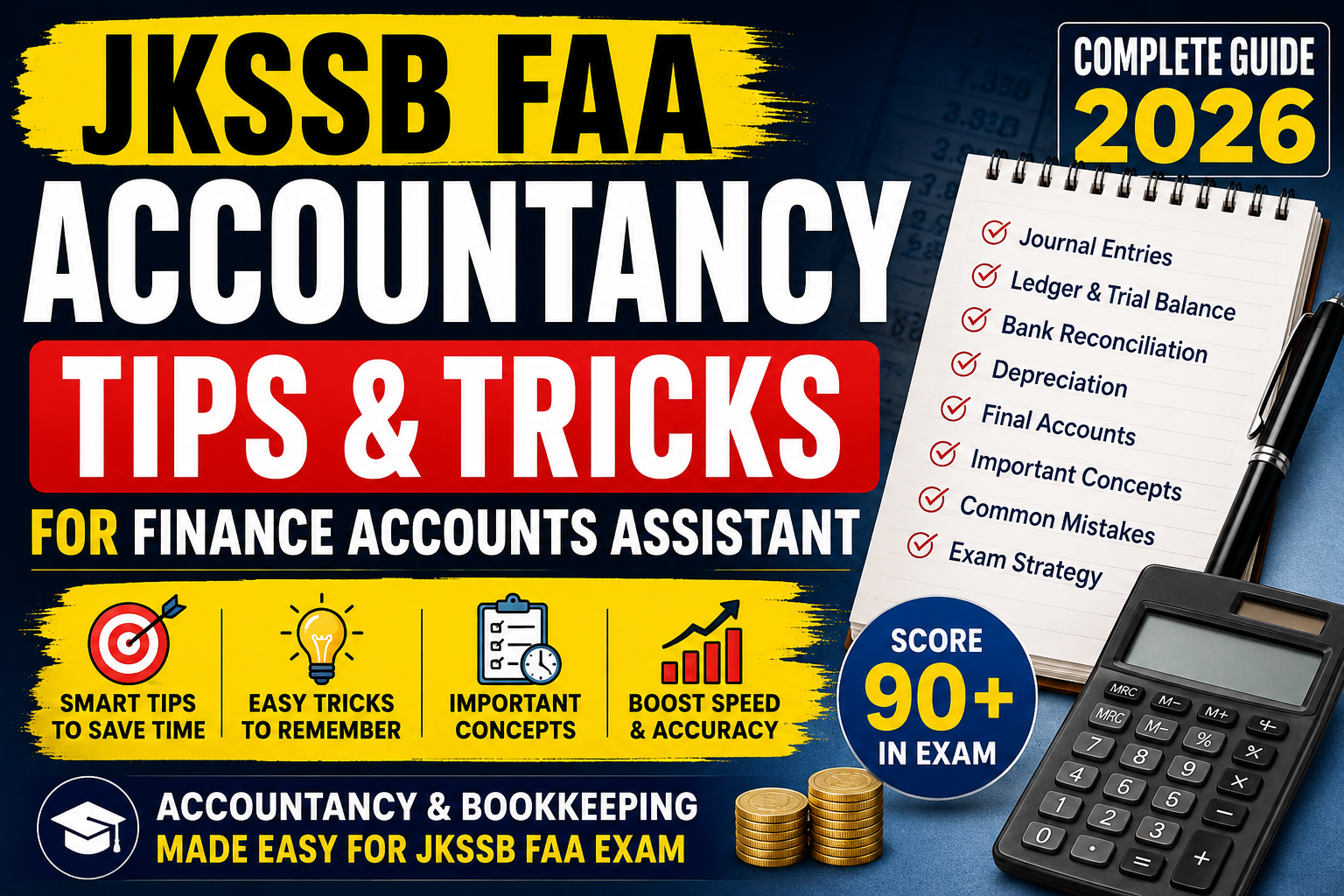
JKSSB FAA Accountancy Tips and Tricks: How to Prepare Accountancy & Bookkeeping
Accountancy is one of those subjects in the JKSSB Finance Accounts Assistant (FAA) exam where preparation can make a huge difference. At first, topics such as journal entries, ledger, trial balance, depreciation, bank reconciliation and final accounts may look confusing. But once the basic logic becomes clear, Accountancy becomes much more manageable.
The biggest mistake many candidates make is trying to memorize every rule without understanding why an entry is passed. For the JKSSB FAA exam, you need a combination of conceptual understanding, regular practice and quick revision.
If you are preparing for JKSSB Finance Accounts Assistant 2026, this guide will help you organize your Accountancy and Bookkeeping preparation in a practical way.
Download Complete study material of jkssb FAA with full mocktests and sectional tests
1. Start With the Basic Accounting Concepts
Before jumping into difficult numerical questions, make your foundation strong.
Begin with:
- Meaning and objectives of accounting
- Bookkeeping vs accounting
- Accounting principles
- Accounting concepts and conventions
- Business entity concept
- Going concern concept
- Money measurement concept
- Dual aspect concept
- Accrual concept
- Matching concept
- Capital and revenue expenditure
- Assets, liabilities and capital
These topics may appear simple, but they are extremely important because questions from basic accounting terminology can be solved quickly if your concepts are clear.
A useful accountancy preparation strategy is to understand the meaning of every term instead of simply reading its definition once.
2. Master the Golden Rules of Accounting
The golden rules of accounting should be on your fingertips.
Personal Account
Debit the receiver, Credit the giver.
Real Account
Debit what comes in, Credit what goes out.
Nominal Account
Debit all expenses and losses, Credit all incomes and gains.
Don't just memorize these three lines. Practice applying them to actual transactions.
For example, if cash is paid for rent:
Rent A/c Dr.
To Cash A/c
Rent is an expense, so it is debited. Cash goes out, so it is credited.
This type of logical approach makes journal entry questions much easier.
3. Give Special Attention to Journal Entries
The journal is the starting point of the accounting process. If your journal entry concepts are weak, ledger, trial balance and final accounts can also become difficult.
Practice different types of transactions, including:
- Cash transactions
- Credit purchases
- Credit sales
- Purchase returns
- Sales returns
- Salary paid
- Rent paid
- Commission received
- Capital introduced
- Drawings
- Bad debts
- Depreciation
- Outstanding expenses
- Prepaid expenses
- Accrued income
- Unearned income
One of the best JKSSB FAA Accountancy tips is to practice journal entries every day rather than studying them once and leaving them.
Even 15–20 transactions daily can significantly improve your speed.
4. Understand Ledger Posting
After journal entries, move to the ledger.
Think of the ledger as a collection of individual accounts where transactions relating to a particular account are classified.
For example, all transactions involving Cash Account are recorded in the Cash Ledger.
While preparing for the JKSSB FAA syllabus, understand:
- Posting from journal to ledger
- Debit and credit sides
- Balancing of ledger accounts
- Personal ledger accounts
- Real ledger accounts
- Nominal ledger accounts
Don't rush through this chapter. Practice complete questions where several journal entries are posted into different ledger accounts.
5. Trial Balance: Learn the Logic
The trial balance is another important area of bookkeeping.
The basic purpose is to check the arithmetical accuracy of ledger accounts.
Remember:
Total Debit = Total Credit
But don't assume that agreement of trial balance means there are absolutely no accounting errors. Some errors may still remain undetected.
Prepare a small list of errors that affect and do not affect the trial balance.
For example, errors such as complete omission of a transaction or compensating errors may not necessarily disturb the agreement of the trial balance.
This is a common area for conceptual accountancy MCQs.
6. Don't Ignore Bank Reconciliation Statement
Bank Reconciliation Statement (BRS) is a chapter where students often make unnecessary mistakes.
The main idea is simple: the balance shown by the cash book and passbook may differ because transactions are recorded at different times.
Understand reasons such as:
- Cheques issued but not presented
- Cheques deposited but not cleared
- Bank charges
- Interest credited by bank
- Direct deposits
- Direct payments
- Standing instructions
- Errors in cash book or passbook
Instead of memorizing every adjustment blindly, understand whether the particular item increases or decreases the balance from the starting point.
That approach will help you solve BRS questions much faster.
7. Practice Depreciation Properly
Depreciation is another important topic for JKSSB FAA Accountancy preparation.
You should know the basic meaning of depreciation and understand the major methods, particularly:
Straight Line Method
Under this method, depreciation is generally charged at a fixed amount every year.
Written Down Value Method
Under WDV, depreciation is calculated on the reduced book value of the asset.
Practice questions involving:
- Cost of asset
- Useful life
- Scrap value
- Rate of depreciation
- Accumulated depreciation
- Sale of asset
- Profit or loss on sale
Don't memorize formulas without solving numerical examples.
8. Focus on Final Accounts
Final accounts can initially appear lengthy, but they become easier when you understand the structure.
Pay attention to:
- Trading Account
- Profit and Loss Account
- Balance Sheet
- Gross profit
- Gross loss
- Net profit
- Net loss
- Adjustments
Important adjustments include:
- Closing stock
- Outstanding expenses
- Prepaid expenses
- Accrued income
- Unearned income
- Depreciation
- Bad debts
- Provision for doubtful debts
Create a separate revision sheet for adjustments because these are frequently tested through conceptual and numerical questions.
9. Understand Capital vs Revenue Items
This is a small topic but can produce easy marks.
Understand the difference between:
Capital expenditure: Generally provides benefit over a longer period.
Revenue expenditure: Generally relates to the regular operation of the business.
Similarly, learn:
- Capital receipt
- Revenue receipt
- Capital profit
- Revenue profit
- Deferred revenue expenditure
Don't depend only on examples. Understand the reason behind classification.
10. Make a Separate Bookkeeping Formula & Rules Sheet
Create one small notebook only for Accountancy formulas, rules and adjustments.
Include:
- Golden rules
- Accounting equation
- Depreciation formulas
- Gross profit formula
- Net profit formula
- Current ratio
- Quick ratio
- Important BRS rules
- Final account adjustments
- Important accounting terms
Revise this notebook regularly.
The purpose is not to create another huge set of notes. It should be a quick-revision notebook that you can complete in a few minutes.
11. Solve MCQs After Every Topic
Don't wait until finishing the entire syllabus before solving questions.
Use this pattern:
Concept → Example → MCQs → Mistake analysis → Revision
For example, after completing Journal Entries, immediately solve 30–50 questions.
Then mark the questions you got wrong.
This creates your own JKSSB FAA important questions collection.
Over time, your mistake notebook can become more useful than another textbook.
12. Learn From Your Mistakes
Suppose you solve 50 Accountancy MCQs and get 38 correct.
Don't simply celebrate 38 and move ahead.
Look at the 12 incorrect questions.
Ask:
- Did I misunderstand the concept?
- Did I apply the wrong accounting rule?
- Did I make a calculation mistake?
- Did I read the question incorrectly?
- Did I confuse debit and credit?
This process is extremely important for FAA exam preparation.
Your mistakes show exactly where your preparation is weak.
13. Don't Spend Too Much Time on One Question
In a competitive exam, knowing the answer is not enough. You also need speed.
If a numerical question is taking too long, move ahead and return to it later if the exam pattern allows.
For Accountancy, calculation speed improves naturally through repeated practice.
Try solving questions without looking at solutions first.
14. Use Previous-Year Questions Seriously
Previous-year questions can help you understand the level and style of questions asked in competitive examinations.
While practicing JKSSB FAA previous year questions, don't only check the answer.
Study the concept behind the question.
If one question asks about depreciation, revise the complete depreciation concept.
If one question asks about BRS, revise all major BRS adjustments.
This turns one question into multiple learning points.
15. A Simple Daily Accountancy Routine
You don't need to study Accountancy for the entire day.
A practical routine can be:
30 minutes: Revise concepts
45 minutes: Solve numerical/accounting problems
30 minutes: Practice MCQs
15 minutes: Review mistakes
Even a focused 2-hour session can be productive if you study consistently.
The key is regularity.
Studying Accountancy for six hours once and then ignoring it for a week is usually less effective than studying it for one or two focused hours every day.
16. Important Topics to Prioritize
If your exam is approaching and you need to prioritize, pay special attention to:
- Basic accounting concepts
- Golden rules of accounting
- Journal entries
- Ledger
- Trial balance
- Cash book
- Bank reconciliation statement
- Depreciation
- Errors and rectification
- Capital and revenue items
- Final accounts
- Trading and Profit & Loss Account
- Balance Sheet
- Accounting equations
- Bills of exchange
- Partnership basics
- Ratio analysis
- Basic financial accounting concepts
Your exact priority should ultimately follow the official syllabus and the level of questions expected in your recruitment examination.
17. Final 7-Day Accountancy Strategy
During the final week, don't start collecting ten new books.
Revise what you have already studied.
A useful final-week strategy is:
Day 1: Journal + Golden Rules
Day 2: Ledger + Trial Balance
Day 3: Cash Book + BRS
Day 4: Depreciation + Errors
Day 5: Final Accounts + Adjustments
Day 6: Important formulas + Previous Questions
Day 7: Full revision of mistakes and weak topics
Keep your revision focused and avoid unnecessary sources.
Final Words
Accountancy for the JKSSB Finance Accounts Assistant exam does not have to be frightening. The subject becomes much easier once you stop treating it as a collection of formulas and start understanding the logic behind every transaction.
Start with the basics, strengthen journal entries, ledger posting, trial balance, BRS, depreciation and final accounts, and then move toward mixed MCQs and previous-year questions.
Most importantly, maintain consistency. Even if you currently find Accountancy difficult, regular practice can completely change your confidence in a few weeks.
For JKSSB FAA preparation, your goal should not simply be to finish the Accountancy syllabus. Your goal should be to reach the stage where you can look at a transaction or accounting problem and quickly understand what it is asking.
Understand the concept → practice the question → identify the mistake → revise → repeat.
That simple cycle can make your Accountancy preparation much stronger and help you approach the FAA examination with greater confidence.
JKSSB FAA Accountancy, Finance Accounts Assistant preparation, JKSSB FAA preparation, JKSSB Accountancy syllabus, Accountancy preparation for JKSSB, bookkeeping for JKSSB, accounting concepts, golden rules of accounting, journal entries, ledger posting, trial balance, bank reconciliation statement, BRS questions, depreciation, straight line method, written down value method, final accounts, trading account, profit and loss account, balance sheet, accounting equation, capital and revenue expenditure, accounting MCQs, JKSSB FAA important questions, JKSSB FAA previous year questions, financial accounting, bookkeeping questions, accountancy tips and tricks, FAA exam preparation, JKSSB exam preparation.