Prepare for JKSSB Exams with Daily Free Tests
Preparing for a JKSSB examination is not only about reading books, watching lectures, or collecting notes. The real difference comes when you start testing yourself regularly.
You may know the syllabus, understand the concepts and even remember hundreds of facts, but an exam asks you to recall that information quickly, eliminate confusing options and solve questions within a limited amount of time. This is why regular mock-test practice is so important.
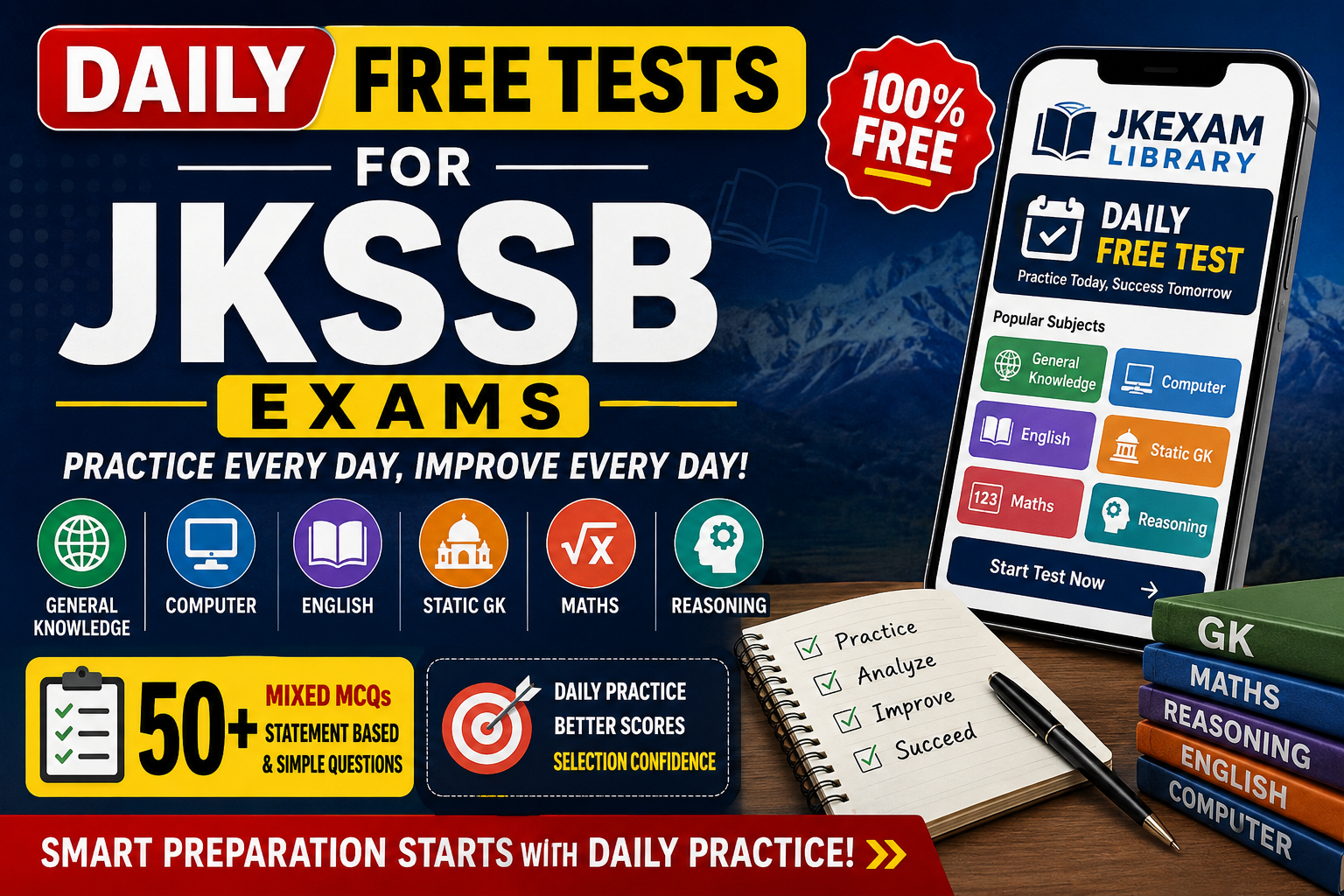
For students preparing for JKSSB examinations, JKExamLibrary provides a simple way to build this habit through daily free tests covering important subjects such as General Knowledge, Computer, English, Static GK, Mathematics, Reasoning and other examination-related areas.
The idea is straightforward: instead of waiting until the final days before the examination to start solving mock tests, make testing a part of your preparation from the beginning.
ATTEMPT IT NOW DAILY FREE JKSSB QUIZ
Why Daily Tests Matter in JKSSB Preparation
A daily test does not have to take hours. Even a short test can tell you a lot about your preparation.
Suppose you are preparing General Knowledge. You may feel confident because you have studied Indian Polity, History and Geography. But when a question gives you four similar-looking options, you may discover that you are confusing two facts.
The same thing happens in Computer, English, Mathematics and Reasoning.
Daily tests help you identify these weak areas before the actual examination.
With regular practice, you can improve:
- Speed and accuracy
- Question-solving confidence
- Time management
- Memory and recall
- Understanding of tricky concepts
- Ability to eliminate incorrect options
- Familiarity with examination-style questions
- Performance under time pressure
Most importantly, tests show you what you actually know, rather than what you think you know.
What Can You Practice on JKExamLibrary?
JKSSB preparation is broad, so your practice should also be broad.
The JKExamLibrary daily-test approach can be useful for candidates preparing different sections of competitive examinations, including:
General Knowledge
General Knowledge questions can cover Indian History, Geography, Polity, Economy, important institutions, national symbols, important personalities, awards, books, sports and other static topics.
For JKSSB aspirants, it is also useful to keep a strong focus on Jammu and Kashmir-related general awareness wherever it is relevant to the examination.
Computer
Computer questions are increasingly important in many competitive examinations. Candidates should practice topics such as computer fundamentals, hardware and software, operating systems, MS Office, internet, networking, memory, shortcuts, cyber security and basic computer terminology.
Some computer questions look easy but contain small differences between options. Regular MCQ practice helps you notice these details.
English
English preparation is not limited to vocabulary. Depending on the examination, candidates may need practice in grammar, sentence correction, synonyms, antonyms, active and passive voice, narration, prepositions, articles, tenses, vocabulary and comprehension-related concepts.
Daily questions can gradually improve both accuracy and speed.
Mathematics
Mathematics requires practice more than passive reading. Topics such as percentages, profit and loss, ratio and proportion, averages, time and work, time and distance, simple and compound interest, number systems and basic arithmetic become easier when you solve questions repeatedly.
Reasoning
Reasoning questions test how quickly you can identify a pattern or logical relationship. Coding-decoding, series, analogy, classification, blood relations, direction sense, syllogism and other reasoning topics become much easier with consistent practice.
Don't Just Count Your Correct Answers
One common mistake students make is completing a mock test, checking the score and immediately moving to the next test.
Instead, spend a few minutes analysing your mistakes.
If you got 35 out of 50 correct, don't only celebrate the 35 correct answers. Look carefully at the 15 incorrect questions.
Ask yourself:
Did I not know the concept?
Did I misunderstand the question?
Did I make a calculation mistake?
Did I choose an option too quickly?
Did two options confuse me?
This small habit can make your test practice much more effective.
A question you get wrong today can become one of your strongest questions later if you understand the reason behind the mistake.
Statement-Based Questions Are Especially Important
Competitive examinations are not always about straightforward one-line questions.
You may encounter questions containing statements such as:
Statement I: A particular fact is true.
Statement II: Another related fact is true.
Then you may have to determine which statements are correct.
These questions require careful reading. A candidate may know the topic but still lose marks by assuming that both statements are correct.
That is why a good practice test should contain a mixture of:
- Simple MCQs
- Statement-based questions
- Match-the-following style questions
- Table-based questions
- Conceptual questions
- Fact-based questions
- Application-based questions
- Slightly confusing options
- Previous-exam-style questions
Practising different formats prepares you for surprises in the actual paper.
A Simple Daily Test Routine
You don't need a complicated study routine to benefit from daily tests.
Try this simple approach:
Step 1: Take the daily test.
Attempt the questions without checking your notes.
Step 2: Record your score.
Your score gives you a baseline.
Step 3: Analyse every wrong answer.
Don't skip this part.
Step 4: Revise the weak topic.
If you made several Computer mistakes, revise Computer rather than simply taking another random test.
Step 5: Return to testing.
After revision, solve similar questions again.
This creates a useful cycle:
Test → Analyse → Revise → Retest
Over time, this can be much more effective than repeatedly reading the same notes.
Why Free Daily Tests Can Be Useful
Preparation material can become expensive when you keep buying different books, test series and subscriptions.
Free practice tests provide an easy way to maintain a regular testing habit without making every practice session dependent on purchasing another resource.
For students preparing for JKSSB examinations, having daily questions available in an app such as JKExamLibrary can also make practice more convenient. You can use short periods of free time to solve questions instead of waiting for a long study session.
Even 15–30 minutes of focused MCQ practice can become valuable when you do it consistently.
Don't Wait for the Exam Notification
One of the biggest preparation mistakes is starting serious practice only after the examination notification is released.
Once the notification arrives, candidates often have to manage several things at the same time: syllabus revision, forms, previous papers, mock tests and daily study.
Starting daily tests earlier gives you an advantage because you can gradually build speed and identify weak subjects before the pressure increases.
Your target should not be to become perfect in one week.
Your target should be to become slightly better every day.
Practice Sample: Mixed JKSSB-Style MCQs
Below is a sample mixed practice set covering General Knowledge, Computer, English, Static GK, Mathematics and Reasoning. The questions intentionally include both direct and statement-based formats.
General Knowledge
1. Which Article of the Indian Constitution deals with the abolition of untouchability?
A) Article 14
B) Article 17
C) Article 19
D) Article 21
Answer: B
2. Consider the following statements about the Indian Parliament:
- The Rajya Sabha is a permanent House.
- The Lok Sabha can be dissolved.
- Every member of the Rajya Sabha is directly elected by the people.
Which statement(s) is/are correct?
A) 1 and 2 only
B) 2 and 3 only
C) 1 and 3 only
D) 1, 2 and 3
Answer: A
3. The Tropic of Cancer passes through how many Indian states?
A) 6
B) 7
C) 8
D) 9
Answer: C
4. Which Schedule of the Constitution contains provisions relating to allocation of seats in the Rajya Sabha?
A) Second Schedule
B) Third Schedule
C) Fourth Schedule
D) Fifth Schedule
Answer: C
5. Who is known as the father of the Indian Green Revolution?
A) Verghese Kurien
B) M. S. Swaminathan
C) Norman Borlaug
D) Homi Bhabha
Answer: B
6. Which of the following pairs is incorrectly matched?
A) Sardar Sarovar — Narmada
B) Hirakud — Mahanadi
C) Bhakra Nangal — Sutlej
D) Nagarjuna Sagar — Godavari
Answer: D
7. Consider the following statements:
- The Fundamental Duties were added by the 42nd Constitutional Amendment.
- They were originally part of the Constitution in 1950.
Which is correct?
A) Only 1
B) Only 2
C) Both 1 and 2
D) Neither 1 nor 2
Answer: A
8. The headquarters of the International Monetary Fund is located in:
A) New York
B) Geneva
C) Washington, D.C.
D) Paris
Answer: C
9. Which one of the following is a landlocked country?
A) Myanmar
B) Vietnam
C) Nepal
D) Thailand
Answer: C
10. The term “Repo Rate” is associated primarily with:
A) Fiscal policy
B) Monetary policy
C) Foreign trade policy
D) Industrial policy
Answer: B
Computer
11. Which memory retains data even after the power supply is switched off?
A) RAM
B) Cache
C) ROM
D) Register
Answer: C
12. Consider the following statements:
- RAM is generally volatile memory.
- ROM is generally non-volatile memory.
- CPU registers are slower than secondary storage devices.
Which statement(s) is/are correct?
A) 1 and 2 only
B) 2 and 3 only
C) 1 and 3 only
D) All three
Answer: A
13. Which shortcut is commonly used to undo an action in Windows applications?
A) Ctrl + X
B) Ctrl + Z
C) Ctrl + Y
D) Ctrl + U
Answer: B
14. Which device is primarily used to connect different networks?
A) Router
B) Keyboard
C) Scanner
D) Monitor
Answer: A
15. In MS Excel, the intersection of a row and a column is called a:
A) Field
B) Cell
C) Record
D) Range
Answer: B
16. Which of the following is NOT an operating system?
A) Linux
B) Windows
C) Android
D) Oracle
Answer: D
17. What does URL stand for?
A) Uniform Resource Locator
B) Universal Reference Link
C) Uniform Retrieval Link
D) Universal Resource Location
Answer: A
18. Which protocol is primarily associated with secure web browsing?
A) HTTP
B) HTTPS
C) FTP
D) SMTP
Answer: B
19. Consider the statements:
- A firewall can help control network traffic.
- Antivirus software is designed to detect and deal with malicious software.
- Phishing is a type of legitimate data-backup technique.
Which is correct?
A) 1 only
B) 1 and 2 only
C) 2 and 3 only
D) All three
Answer: B
20. 1 byte is equal to:
A) 4 bits
B) 8 bits
C) 16 bits
D) 32 bits
Answer: B
English
21. Choose the correct synonym of “Abundant”:
A) Scarce
B) Plentiful
C) Limited
D) Rare
Answer: B
22. Choose the correctly spelt word:
A) Accomodation
B) Acommodation
C) Accommodation
D) Accommadation
Answer: C
23. Choose the correct passive voice: “The teacher praised the student.”
A) The student praised the teacher.
B) The student was praised by the teacher.
C) The student is praised by the teacher.
D) The teacher was praised by the student.
Answer: B
24. Identify the error: “Neither of the boys have completed his work.”
A) Neither
B) boys
C) have
D) his
Answer: C
25. The idiom “A blessing in disguise” means:
A) A visible problem
B) Something that seems bad but proves beneficial
C) A religious ceremony
D) A hidden enemy
Answer: B
26. Choose the antonym of “Transparent”:
A) Clear
B) Obvious
C) Opaque
D) Visible
Answer: C
27. Fill in the blank: “He has been working here ___ 2020.”
A) for
B) since
C) from
D) by
Answer: B
28. One who knows many languages is called a:
A) Linguist
B) Polyglot
C) Orator
D) Grammarian
Answer: B
Static GK
29. The national animal of India is:
A) Lion
B) Elephant
C) Bengal Tiger
D) Leopard
Answer: C
30. Which is the largest planet in the Solar System?
A) Earth
B) Saturn
C) Jupiter
D) Neptune
Answer: C
31. The SI unit of electric resistance is:
A) Volt
B) Ampere
C) Ohm
D) Watt
Answer: C
32. Which blood group is commonly known as the universal red-cell donor?
A) AB+
B) O−
C) A+
D) B−
Answer: B
33. Consider the following pairs:
- Vitamin C — Scurvy
- Vitamin D — Rickets
- Vitamin B1 — Beriberi
Which are correctly matched?
A) 1 only
B) 1 and 2 only
C) 2 and 3 only
D) 1, 2 and 3
Answer: D
34. The study of earthquakes is known as:
A) Ecology
B) Seismology
C) Geology
D) Meteorology
Answer: B
35. Which metal is liquid at ordinary room temperature?
A) Mercury
B) Aluminium
C) Copper
D) Zinc
Answer: A
Mathematics
36. If 20% of a number is 60, what is the number?
A) 200
B) 250
C) 300
D) 350
Answer: C
37. A number is increased by 20% and then decreased by 20%. The net change is:
A) No change
B) 2% decrease
C) 4% decrease
D) 4% increase
Answer: C
38. The average of 12, 18, 20, 25 and 30 is:
A) 20
B) 21
C) 22
D) 23
Answer: B
39. If the ratio of A is 3:5 and B is 10:7, then A is:
A) 3:7
B) 6:7
C) 5:7
D) 7:6
Answer: B
40. A train travels 180 km in 3 hours. Its average speed is:
A) 50 km/h
B) 55 km/h
C) 60 km/h
D) 65 km/h
Answer: C
41. If the cost price of an article is ₹800 and it is sold for ₹920, the profit percentage is:
A) 12%
B) 15%
C) 18%
D) 20%
Answer: B
42. The simple interest on ₹5,000 at 8% per annum for 2 years is:
A) ₹600
B) ₹700
C) ₹800
D) ₹900
Answer: C
Reasoning
43. Find the next number: 3, 7, 15, 31, 63, ?
A) 95
B) 111
C) 127
D) 129
Answer: C
44. If CAT is coded as DBU, how is DOG coded using the same pattern?
A) EPH
B) EOG
C) FPH
D) EPG
Answer: A
45. Find the odd one out:
A) Square
B) Rectangle
C) Triangle
D) Cube
Answer: D
46. A person walks 5 km north, then turns right and walks 3 km. In which direction is he from his starting point?
A) North-East
B) North-West
C) South-East
D) South-West
Answer: A
47. If all roses are flowers and some flowers fade quickly, which conclusion definitely follows?
A) All roses fade quickly
B) Some roses are not flowers
C) Roses are flowers
D) No flower is a rose
Answer: C
48. Find the missing term: AZ, BY, CX, DW, ?
A) EV
B) EU
C) FV
D) EX
Answer: A
49. If Monday is coded as 1, Tuesday as 2, Wednesday as 3 and so on, what number represents Sunday?
A) 5
B) 6
C) 7
D) 8
Answer: C
50. A is the brother of B. B is the sister of C. How is A related to C?
A) Father
B) Brother
C) Uncle
D) Cousin
Answer: B
Mixed Challenge Questions
51. Which Constitutional Amendment reduced the voting age in India from 21 years to 18 years?
A) 42nd Amendment
B) 44th Amendment
C) 61st Amendment
D) 73rd Amendment
Answer: C
52. Which of the following correctly describes cloud computing?
A) Computing performed only without the internet
B) Delivery of computing resources over a network, commonly the internet
C) A type of computer keyboard
D) A method of printing documents
Answer: B
53. Consider the following:
- Ctrl + C is generally used for copying.
- Ctrl + V is generally used for pasting.
- Ctrl + X is generally used for cutting.
Which statements are correct?
A) 1 only
B) 1 and 2 only
C) 2 and 3 only
D) 1, 2 and 3
Answer: D
54. If 5 workers can complete a task in 12 days, assuming equal efficiency and all other conditions remain the same, how many days would 10 workers require?
A) 4
B) 6
C) 8
D) 10
Answer: B
55. Find the next term: 2, 6, 12, 20, 30, ?
A) 36
B) 40
C) 42
D) 44
Answer: C
Make Daily Practice a Habit
The biggest benefit of daily tests is not a single high score. It is the improvement you see after dozens of tests.
Your first test may expose several weak areas. After a few weeks of consistent practice, the same types of questions may become familiar. Your speed can improve, careless mistakes can decrease and difficult questions can become easier to approach.
For JKSSB aspirants, the goal should be to combine concept study + revision + daily MCQ practice + mock-test analysis.
JKExamLibrary is designed to make the testing part easier by bringing practice questions into one convenient place.
So, instead of saying “I will start mock tests after completing the whole syllabus,” start testing yourself alongside your preparation.
Take a daily free test. Check your mistakes. Revise what you got wrong. Come back the next day and try again.
One test may not change your preparation. But hundreds of well-analysed questions can.
If you are preparing for JKSSB examinations, make daily practice a routine and use JKExamLibrary as part of your preparation journey.
Study every day. Test every day. Improve every day.