JKSSB Class IV & MTS Syllabus 2026: Complete Subject-Wise Syllabus and Preparation Guide
If you are preparing for the JKSSB Class IV or MTS examination, knowing the syllabus properly should be your first step. A lot of candidates start preparing randomly, collect multiple books and PDFs, and spend hours watching lectures without having a clear idea of what actually needs to be covered.
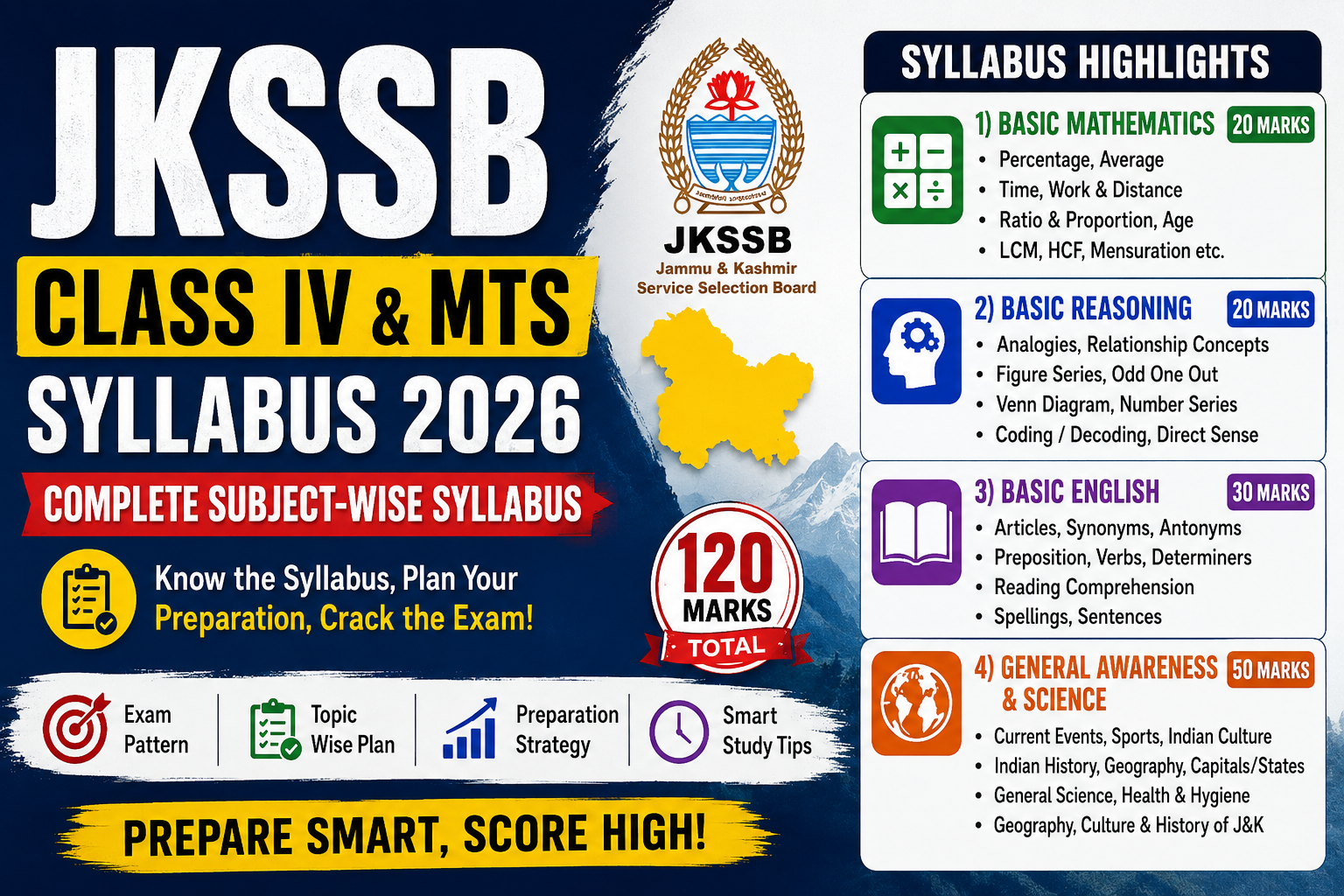
The good thing is that the JKSSB Class IV and MTS syllabus is quite structured. The written examination covers four major areas: Basic Mathematics, Basic Reasoning, Basic English, and General Awareness & Science.
Among these sections, General Awareness and Science carries the highest weightage of 50 marks, followed by English with 30 marks. Mathematics and Reasoning carry 20 marks each.
So, if you are planning your preparation strategically, you should not give equal time to every topic. Your preparation should be based on both the syllabus and the marks distribution.
DOWNLOAD SYLLABUS FOR JKSSB CLASS IV MTS POST
JKSSB Class IV & MTS Syllabus – Marks Distribution
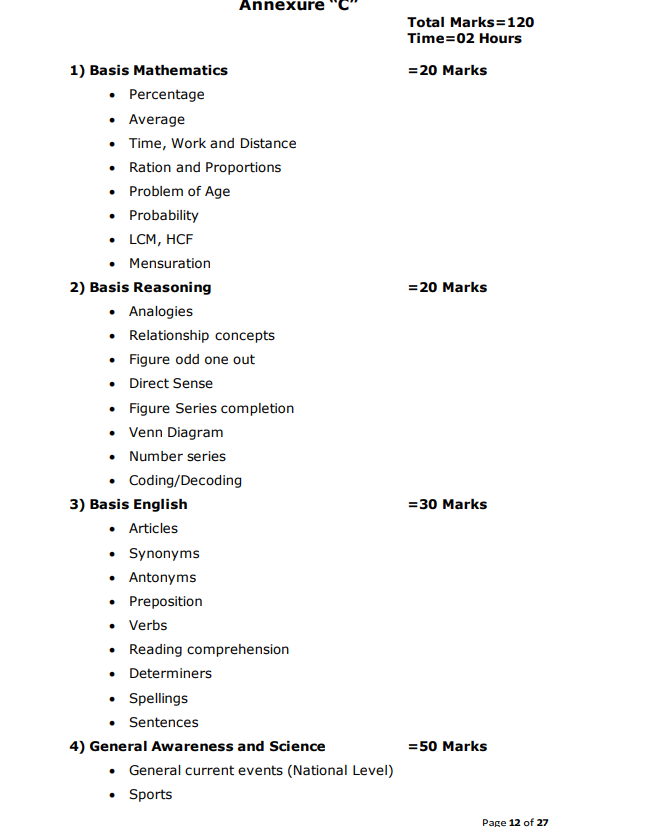
The syllabus is divided into four sections:
| Subject | Marks |
|---|---|
| Basic Mathematics | 20 Marks |
| Basic Reasoning | 20 Marks |
| Basic English | 30 Marks |
| General Awareness and Science | 50 Marks |
| Total | 120 Marks |
Let's look at every section in detail.
1. Basic Mathematics – 20 Marks
The Mathematics section contains basic but important arithmetic concepts. Candidates should focus on understanding the methods instead of simply memorising formulas.
Topics included:
- Percentage
- Average
- Time, Work and Distance
- Ratio and Proportion
- Problems of Age
- Probability
- LCM and HCF
- Mensuration
Questions from these topics can often be solved quickly once your basic concepts are clear. Percentage, Average, Ratio and Proportion, LCM/HCF and Mensuration deserve special attention because they are common areas for objective-type questions.
Do not ignore word problems, particularly questions related to time, work, distance and age. Practice is important here because knowing the formula alone is not enough.
For Mathematics, try to solve questions without spending too much time on a single problem. Since the section carries 20 marks, your target should be accuracy along with speed.
2. Basic Reasoning – 20 Marks
Reasoning is another 20-mark section and can become a scoring area with regular practice.
Topics included:
- Analogies
- Relationship Concepts
- Figure Odd One Out
- Direct Sense
- Figure Series Completion
- Venn Diagram
- Number Series
- Coding/Decoding
The reasoning section tests your ability to identify patterns, relationships and logical connections.
Number Series and Coding/Decoding should be practised regularly. Similarly, figure-based questions such as Figure Odd One Out and Figure Series Completion require familiarity with different patterns.
Relationship concepts and Venn diagrams can also be scoring topics if you understand the basic approach.
The best way to prepare for reasoning is not to read theory for hours. Learn the basic method, then solve a large number of questions. When you repeatedly encounter different patterns, your solving speed naturally improves.
3. Basic English – 30 Marks
English carries 30 marks, making it an important section of the JKSSB Class IV/MTS examination.
Topics included:
- Articles
- Synonyms
- Antonyms
- Prepositions
- Verbs
- Reading Comprehension
- Determiners
- Spellings
- Sentences
This section covers both grammar and vocabulary.
Candidates should have a strong understanding of basic grammar rules, especially Articles, Prepositions, Verbs and Determiners. At the same time, vocabulary-based topics such as synonyms and antonyms require consistent revision.
Reading comprehension should not be left for the last few days. Try reading short English passages regularly and practise answering questions based on the passage.
Spelling-based questions may appear simple, but they can be tricky because several options may look similar. Make a list of commonly confused spellings and revise them regularly.
For sentence-based questions, focus on grammar, sentence structure and correct usage.
One useful strategy is to spend some time every day on English rather than studying it only once or twice a week.
4. General Awareness and Science – 50 Marks
This is the most important section of the JKSSB Class IV & MTS syllabus, carrying 50 marks.
Topics included:
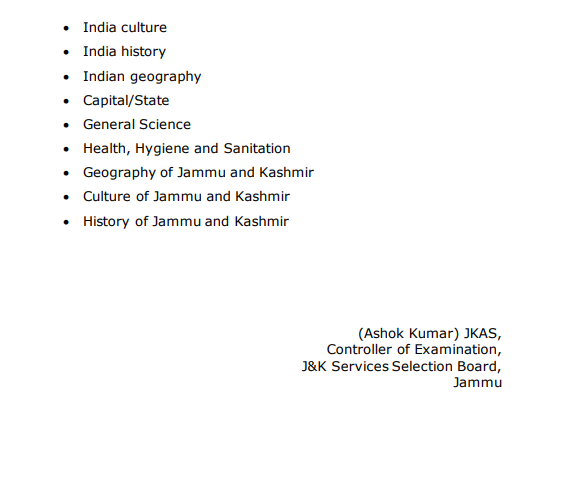
- General Current Events (National Level)
- Sports
- Indian Culture
- Indian History
- Indian Geography
- Capitals/States
- General Science
- Health, Hygiene and Sanitation
- Geography of Jammu and Kashmir
- Culture of Jammu and Kashmir
- History of Jammu and Kashmir
Because this section carries 50 marks, candidates should give it considerable attention during preparation.
The current affairs portion should focus mainly on national-level events, while static General Knowledge should cover important facts about India.
Indian History should include major events, important personalities, movements and significant developments. In Geography, revise important rivers, mountains, states, capitals, climate and other fundamental facts.
General Science should be prepared at the basic level, with emphasis on everyday science, physics, chemistry, biology and common scientific facts.
Jammu & Kashmir-specific preparation
For JKSSB examinations, candidates should pay particular attention to the topics related to Jammu and Kashmir.
The syllabus specifically includes:
- Geography of Jammu and Kashmir
- Culture of Jammu and Kashmir
- History of Jammu and Kashmir
Therefore, your preparation should include important geographical features, rivers, lakes, mountains, districts and other regional facts. You should also revise the cultural heritage, traditions, important personalities and historical developments associated with Jammu and Kashmir.
This part can make a significant difference because candidates sometimes concentrate heavily on national GK while overlooking the J&K-specific portion.
How to Prepare for JKSSB Class IV & MTS Exam
A good preparation strategy does not necessarily mean studying for 10–12 hours every day. What matters more is consistent preparation and repeated practice.
Start by dividing your daily study time among the four sections.
For example, you can dedicate more time to General Awareness and Science because it carries 50 marks. English should also receive regular attention because it carries 30 marks.
Mathematics and Reasoning can be improved through question practice. Instead of solving the same easy questions repeatedly, gradually move towards moderate and difficult questions.
Make revision a daily habit
One of the biggest mistakes candidates make is studying new topics continuously without revising older ones.
Keep short revision sessions for:
- Current affairs
- Important GK facts
- J&K history and geography
- English vocabulary
- Mathematics formulas
- Reasoning patterns
Regular revision helps you retain information for longer.
Practice mock tests
Mock tests are extremely useful for competitive examination preparation. They help you understand your actual preparation level and identify weak areas.
After completing a mock test, don't just check your score. Analyse your mistakes.
Ask yourself:
- Which questions did I get wrong?
- Was the mistake due to lack of knowledge?
- Did I misunderstand the question?
- Did I make a calculation error?
- Did I spend too much time on one question?
This analysis is often more valuable than simply taking another test.
Final Words for class iv aspirants
The JKSSB Class IV & MTS syllabus is manageable if you prepare it systematically. The most important thing is to avoid studying without a plan.
Give special attention to General Awareness and Science because it carries 50 marks, while maintaining regular practice in English, Mathematics and Reasoning.
Also remember that competitive exams are not only about knowing the answer. Speed, accuracy, revision and question-solving practice matter equally.
Prepare the complete syllabus, revise repeatedly, solve previous-style questions and take regular mock tests. With consistent preparation, even a seemingly large syllabus becomes much easier to handle.
Keep your preparation focused, track your weak topics and make the most of every practice session. The goal should not simply be to complete the syllabus—it should be to reach the examination hall with enough practice to solve questions confidently and accurately.