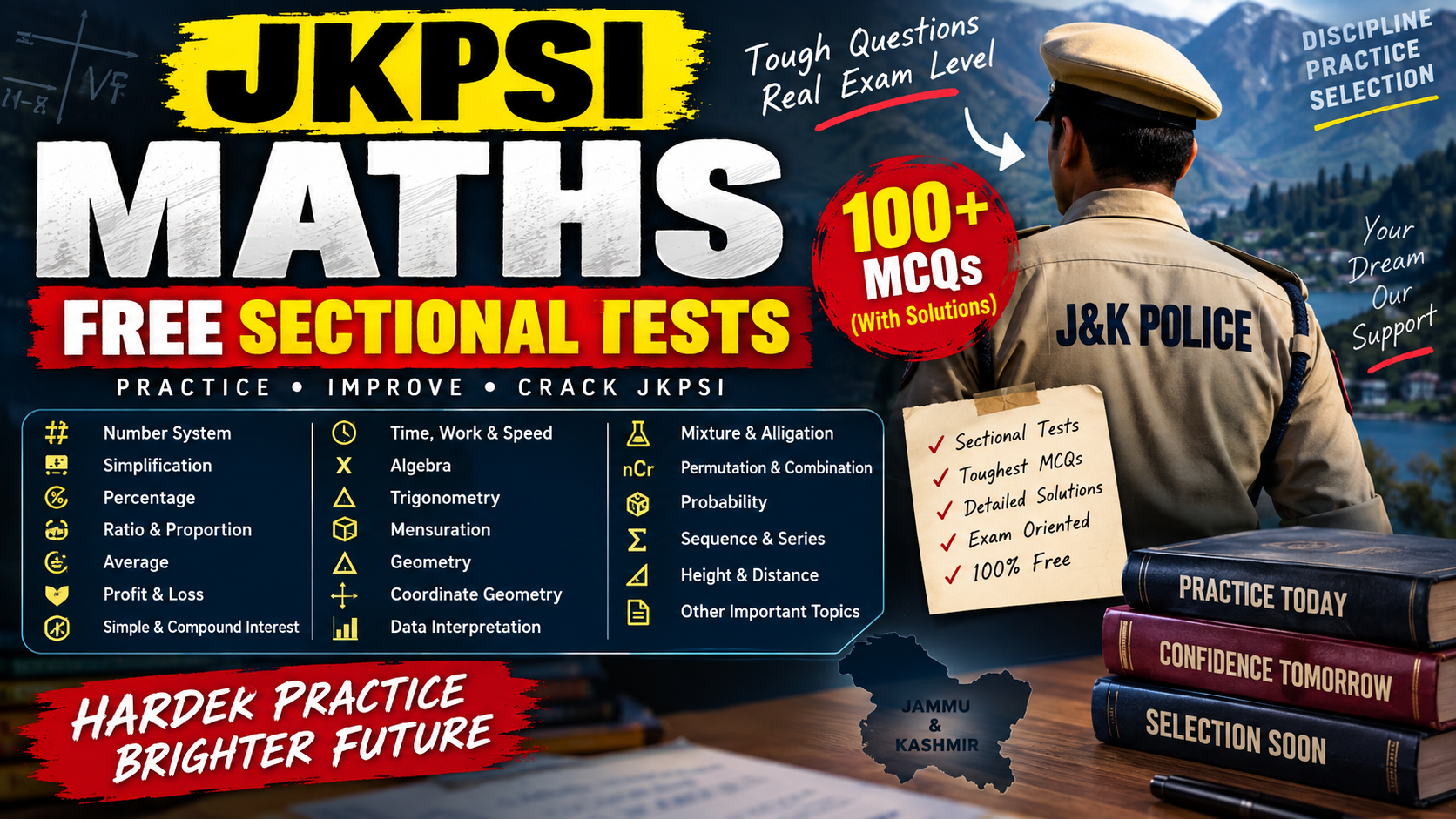
JKPSI Mathematics Free Sectional Tests 2026 – 110 Toughest Quantitative Aptitude & Maths MCQs
Preparing for the JKPSI 2026 examination and looking for a serious mathematics practice source? If yes, this free JKPSI Mathematics Sectional Test is designed for you.
Mathematics can become one of the most scoring parts of the JKPSI examination, but only when preparation goes beyond memorising formulas. The real challenge is solving questions quickly, identifying the correct approach and maintaining accuracy under exam pressure.
The JKPSI written examination consists of objective-type questions, with 100 questions carrying 200 marks, and negative marking makes accuracy particularly important. The mathematics component includes both Quantitative Aptitude and Mathematical Abilities, making it important for candidates to prepare arithmetic as well as school-level algebra, geometry, mensuration and trigonometry.
Download Complete study mateiral with full mock tests and sectional mock tests
JKPSI Mathematics Syllabus – What Should You Prepare?
For JKPSI Mathematics preparation, candidates should not restrict themselves to only percentage, average and ratio. The syllabus is broad enough to test both computational ability and mathematical concepts.
Quantitative Aptitude
Important areas include:
Number System
Whole Numbers
Decimals and Fractions
Simplification
Percentage
Ratio and Proportion
Square Roots
Average
Simple Interest
Compound Interest
Profit and Loss
Discount
Partnership
Mixture and Alligation
Time and Distance
Time and Work
Mathematical Abilities
The mathematical abilities portion extends preparation into:
Algebra
Algebraic identities
Elementary surds
Linear equations
Graphs of linear equations
Geometry
Triangles
Congruence and similarity
Circles and chords
Tangents
Mensuration
2D and 3D figures
Cylinder
Cone
Sphere
Hemisphere
Prism
Pyramid
Trigonometry
Trigonometric ratios
Complementary angles
Heights and distances
Statistics
Mean, median and mode
Standard deviation
Probability
Bar graphs, pie charts and related data interpretation
These topics are reflected in the published JKPSI syllabus material and current 2026 syllabus summaries.
Why These JKPSI Maths Sectional Tests Matter
A common mistake among aspirants is studying mathematics only by reading formulas. That approach may work for basic questions, but competitive examinations require something more.
You need to know which formula to use, when to use it and how to reach the answer quickly.
That is why sectional tests are useful.
If you repeatedly practise questions from percentage, ratio, average, time and work, algebra, mensuration and trigonometry, you start recognising patterns. Eventually, a question that initially takes two or three minutes can often be solved in less than a minute.
The purpose of this free JKPSI Mathematics test is therefore not simply to provide questions. It is to help you develop calculation speed, conceptual clarity and exam temperament.
How to Attempt This JKPSI Maths Test
Do not immediately look at the answers.
Set a timer and attempt the questions as if you are sitting in the actual examination. Mark questions where you are doubtful and return to them later.
A good target is:
Easy question → solve immediately
Moderate question → calculate carefully
Lengthy question → mark and return later
Because the examination has negative marking, blind guessing is not a good strategy. Accuracy should always come before unnecessary attempts.
JKPSI Mathematics Toughest MCQs – Free Sectional Practice Test
Number System, Simplification & Arithmetic
1. The least number which when divided by 12, 15 and 18 leaves remainder 5 in each case is:
A) 175
B) 185
C) 185?
D) 365
Answer: B) 185
2. If HCF of two numbers is 18 and their LCM is 630, and one number is 90, the other number is:
A) 108
B) 126
C) 135
D) 144
Answer: B) 126
3. The remainder when 71037^{103} is divided by 6 is:
A) 0
B) 1
C) 5
D) 3
Answer: B) 1
4. If x+1x=5x+\frac1x=5, then x2+1x2x^2+\frac1{x^2} equals:
A) 21
B) 23
C) 25
D) 27
Answer: B) 23
5. The value of 0.000625\sqrt{0.000625} is:
A) 0.0025
B) 0.025
C) 0.25
D) 2.5
Answer: B) 0.025
6. What least number must be added to 999 to make it divisible by 37?
A) 1
B) 2
C) 3
D) 4
Answer: A) 1
7. If a:b=3:5a:b=3:5 and b:c=10:7b:c=10:7, then a:ca:c is:
A) 3:7
B) 6:7
C) 7:6
D) 5:7
Answer: B) 6:7
8. The average of the first 15 odd natural numbers is:
A) 14
B) 15
C) 16
D) 17
Answer: B) 15
9. A number is increased by 20% and then decreased by 20%. The net change is:
A) 0%
B) 2% decrease
C) 4% decrease
D) 4% increase
Answer: C) 4% decrease
10. If 35% of a number is 84, then 62.5% of that number is:
A) 125
B) 140
C) 150
D) 160
Answer: C) 150
Percentage, Profit, Loss & Discount
11. A person's income increases by 25% and expenditure increases by 20%. If initially he saved 20% of his income, his savings increase by:
A) 35%
B) 40%
C) 45%
D) 50%
Answer: B) 40%
12. An article marked at ₹2,500 is sold after successive discounts of 20% and 10%. Selling price is:
A) ₹1,750
B) ₹1,800
C) ₹1,850
D) ₹2,000
Answer: B) ₹1,800
13. An article is sold at 20% profit. If both CP and SP are increased by ₹100, the profit becomes 16⅔%. The original CP was:
A) ₹400
B) ₹500
C) ₹600
D) ₹750
Answer: B) ₹500
14. A shopkeeper gives 10% discount and still earns 20% profit. If CP is ₹900, marked price is:
A) ₹1,100
B) ₹1,150
C) ₹1,200
D) ₹1,250
Answer: C) ₹1,200
15. If the price of sugar increases by 25%, consumption must be reduced by what percentage to keep expenditure unchanged?
A) 15%
B) 20%
C) 22.5%
D) 25%
Answer: B) 20%
16. A trader sells an article at 15% loss. Had he sold it for ₹180 more, he would have gained 5%. CP is:
A) ₹800
B) ₹850
C) ₹900
D) ₹950
Answer: C) ₹900
17. An article is sold for ₹1,680 at a profit of 12%. Its cost price is:
A) ₹1,450
B) ₹1,500
C) ₹1,520
D) ₹1,550
Answer: B) ₹1,500
18. If an article is sold at 25% profit instead of 10% loss, the selling price is ₹420 more. CP is:
A) ₹1,000
B) ₹1,100
C) ₹1,200
D) ₹1,400
Answer: C) ₹1,200
Ratio, Proportion & Average
19. A:B:C = 2:3:5. If C receives ₹240 more than A, total amount is:
A) ₹480
B) ₹600
C) ₹720
D) ₹800
Answer: B) ₹600
20. The average of 8 numbers is 42. If one number 56 is replaced by 32, new average is:
A) 38
B) 39
C) 40
D) 41
Answer: C) 39
21. Average age of 12 students is 15 years. When teacher's age is included, average becomes 17. Teacher's age is:
A) 39
B) 40
C) 41
D) 42
Answer: C) 41
22. Two numbers are in ratio 7:9. If 12 is added to each, ratio becomes 5:6. The smaller number is:
A) 36
B) 42
C) 48
D) 54
Answer: B) 42
23. The average of 5 consecutive even numbers is 48. The largest number is:
A) 50
B) 52
C) 54
D) 56
Answer: B) 52
24. If 40% of A = 60% of B, then A:B is:
A) 2:3
B) 3:2
C) 4:3
D) 3:4
Answer: B) 3:2
25. A:B = 4:7 and B:C = 14:15. Then A:B:C equals:
A) 4:7:15
B) 8:14:15
C) 8:7:15
D) 4:14:15
Answer: B) 8:14:15
Simple & Compound Interest
26. A sum amounts to ₹7,200 in 2 years and ₹8,640 in 4 years at compound interest. The annual rate is:
A) 8%
B) 10%
C) 12%
D) 15%
Answer: B) 10%
27. Difference between CI and SI on ₹10,000 for 2 years at 10% p.a. is:
A) ₹90
B) ₹100
C) ₹110
D) ₹120
Answer: B) ₹100
28. At what rate will ₹5,000 become ₹6,050 in 2 years at compound interest?
A) 8%
B) 9%
C) 10%
D) 12%
Answer: C) 10%
29. A sum doubles in 8 years at simple interest. In how many years will it become triple?
A) 12
B) 14
C) 16
D) 18
Answer: C) 16
30. Simple interest on a certain sum for 4 years at 7.5% is ₹1,800. Principal is:
A) ₹5,000
B) ₹6,000
C) ₹7,000
D) ₹8,000
Answer: B) ₹6,000
Time & Work
31. A can complete a work in 12 days and B in 18 days. Together they complete it in:
A) 6 days
B) 7.2 days
C) 8 days
D) 9 days
Answer: B) 7.2 days
32. A and B together finish a work in 10 days. A alone takes 15 days. B alone takes:
A) 20 days
B) 25 days
C) 30 days
D) 35 days
Answer: C) 30 days
33. A is 50% more efficient than B. If B takes 18 days, A takes:
A) 10 days
B) 12 days
C) 14 days
D) 15 days
Answer: B) 12 days
34. 12 men complete a work in 15 days. How many men are required to complete it in 9 days?
A) 18
B) 20
C) 22
D) 24
Answer: B) 20
35. A can do a work in 20 days, B in 30 days and C in 60 days. Together they need:
A) 8 days
B) 10 days
C) 12 days
D) 15 days
Answer: B) 10 days
36. A+B can complete a work in 12 days, B+C in 15 days and C+A in 20 days. All three together can complete it in:
A) 8 days
B) 10 days
C) 12 days
D) 15 days
Answer: B) 10 days
Time, Speed & Distance
37. A train 180 m long crosses a pole in 9 seconds. Speed is:
A) 60 km/h
B) 72 km/h
C) 80 km/h
D) 90 km/h
Answer: B) 72 km/h
38. A man travels half the distance at 40 km/h and the remaining half at 60 km/h. Average speed is:
A) 45 km/h
B) 48 km/h
C) 50 km/h
D) 52 km/h
Answer: B) 48 km/h
39. A car covers a distance in 6 hours at 50 km/h. To cover the same distance in 5 hours, required speed is:
A) 55 km/h
B) 60 km/h
C) 65 km/h
D) 70 km/h
Answer: B) 60 km/h
40. Two trains of 150 m and 250 m run in opposite directions at 54 km/h and 72 km/h. Time to cross each other is:
A) 10 sec
B) 11.43 sec
C) 12 sec
D) 15 sec
Answer: B) 11.43 sec
41. A boat moves downstream at 18 km/h and upstream at 10 km/h. Speed of stream is:
A) 3 km/h
B) 4 km/h
C) 5 km/h
D) 6 km/h
Answer: B) 4 km/h
42. If a person walks at 5 km/h, he reaches 12 minutes late. At 6 km/h, he reaches 10 minutes early. Distance is:
A) 10 km
B) 11 km
C) 12 km
D) 15 km
Answer: C) 11 km
Mixture & Alligation
43. Milk and water are mixed in ratio 5:2. If 14 L water is added, ratio becomes 5:4. Initial quantity of mixture is:
A) 35 L
B) 42 L
C) 49 L
D) 56 L
Answer: B) 49 L
44. A 30 L mixture contains milk and water in ratio 4:1. How much water must be added to make ratio 3:1?
A) 1 L
B) 2 L
C) 3 L
D) 4 L
Answer: B) 2 L
45. Rice costing ₹40/kg is mixed with rice costing ₹60/kg to obtain a mixture worth ₹48/kg. Ratio is:
A) 2:3
B) 3:2
C) 4:1
D) 1:4
Answer: B) 3:2
Partnership
46. A invests ₹5,000 for 12 months and B ₹8,000 for 9 months. Profit ratio is:
A) 5:6
B) 15:18
C) 5:4
D) 2:3
Answer: A) 5:6
47. A invests ₹12,000 for 8 months, B ₹16,000 for 6 months and C ₹20,000 for 4 months. Profit ratio is:
A) 4:4:3
B) 4:4:5
C) 8:8:5
D) 6:6:5
Answer: A) 4:4:3
Algebra
48. If x+y=12x+y=12 and xy=35xy=35, then x2+y2x^2+y^2 is:
A) 64
B) 70
C) 74
D) 84
Answer: C) 74
49. If x−1x=3x-\frac1x=3, then x2+1x2x^2+\frac1{x^2} equals:
A) 7
B) 9
C) 11
D) 13
Answer: C) 11
50. The roots of x2−9x+20=0x^2-9x+20=0 are:
A) 2,10
B) 4,5
C) 3,7
D) 1,20
Answer: B) 4,5
51. If a+b=10a+b=10 and a−b=4a-b=4, then abab is:
A) 18
B) 20
C) 21
D) 24
Answer: A) 21
52. If x2−5x+k=0x^2-5x+k=0 has equal roots, k equals:
A) 20
B) 25/2
C) 25/4
D) 5/4
Answer: C) 25/4
53. Simplify: (a+b)2−(a−b)2(a+b)^2-(a-b)^2.
A) 2ab2ab
B) 4ab4ab
C) a2−b2a^2-b^2
D) 2a2+2b22a^2+2b^2
Answer: B) 4ab
54. If x+y=7x+y=7 and x2+y2=29x^2+y^2=29, then xy is:
A) 8
B) 9
C) 10
D) 12
Answer: B) 10
Surds
55. Simplify 48+27\sqrt{48}+\sqrt{27}.
A) 535\sqrt3
B) 737\sqrt3
C) 939\sqrt3
D) 11311\sqrt3
Answer: B) 737\sqrt3
56. Rationalise 15+3\frac1{\sqrt5+\sqrt3}.
A) 5+32\frac{\sqrt5+\sqrt3}{2}
B) 5−32\frac{\sqrt5-\sqrt3}{2}
C) 5−3\sqrt5-\sqrt3
D) 12\frac12
Answer: B) (5−3)/2(\sqrt5-\sqrt3)/2
Geometry
57. The angles of a triangle are in ratio 2:3:4. Largest angle is:
A) 60°
B) 70°
C) 80°
D) 90°
Answer: C) 80°
58. If two similar triangles have corresponding sides in ratio 3:5, their areas are in ratio:
A) 3:5
B) 6:10
C) 9:25
D) 27:125
Answer: C) 9:25
59. The radius drawn to the point of contact of a tangent is:
A) parallel to tangent
B) perpendicular to tangent
C) equal to tangent
D) twice tangent
Answer: B) perpendicular to tangent
60. The angle subtended by a diameter at any point on the circle is:
A) 45°
B) 60°
C) 90°
D) 180°
Answer: C) 90°
61. If two sides of a triangle are 7 cm and 24 cm, the maximum possible integer value of the third side is:
A) 16
B) 30
C) 31
D) 32
Answer: C) 30
62. A triangle with sides 13, 14 and 15 cm has area:
A) 72 cm²
B) 84 cm²
C) 90 cm²
D) 96 cm²
Answer: B) 84 cm²
Mensuration
63. Area of a circle is 154 cm². Its circumference is:
A) 44 cm
B) 46 cm
C) 48 cm
D) 52 cm
Answer: A) 44 cm
64. A cylinder has radius 7 cm and height 10 cm. Its volume is:
A) 1,400 cm³
B) 1,440 cm³
C) 1,540 cm³
D) 1,600 cm³
Answer: C) 1,540 cm³
65. Curved surface area of a cone with r = 7 cm and l = 25 cm is:
A) 500 cm²
B) 525 cm²
C) 550 cm²
D) 575 cm²
Answer: C) 550 cm²
66. A sphere has radius 6 cm. Its volume is:
A) 144π144\pi
B) 216π216\pi
C) 288π288\pi
D) 324π324\pi
Answer: B) 288π288\pi
67. The ratio of volumes of two spheres whose radii are 2 cm and 3 cm is:
A) 2:3
B) 4:9
C) 8:27
D) 16:81
Answer: C) 8:27
68. If the side of a square is increased by 20%, its area increases by:
A) 20%
B) 40%
C) 44%
D) 48%
Answer: C) 44%
69. A rectangular field is 60 m × 40 m. A path 5 m wide is constructed inside along the boundary. Area of path is:
A) 800 m²
B) 850 m²
C) 900 m²
D) 950 m²
Answer: C) 900 m²
70. Total surface area of a cube of side 8 cm is:
A) 256 cm²
B) 384 cm²
C) 512 cm²
D) 576 cm²
Answer: B) 384 cm²
Trigonometry
71. If tanθ=3/4\tan\theta=3/4, then sinθ\sin\theta is:
A) 3/4
B) 4/5
C) 3/5
D) 5/3
Answer: C) 3/5
72. If sinθ=12/13\sin\theta=12/13, then cosθ\cos\theta is:
A) 5/13
B) 12/13
C) 13/5
D) 1/13
Answer: A) 5/13
73. sin2θ+cos2θ\sin^2\theta+\cos^2\theta equals:
A) 0
B) 1
C) 2
D) tanθ\tan\theta
Answer: B) 1
74. tan45∘+sin30∘\tan 45^\circ+\sin30^\circ equals:
A) 1
B) 1.5
C) 2
D) 2.5
Answer: B) 1.5
75. If tanθ=1/3\tan\theta=1/\sqrt3, θ is:
A) 15°
B) 30°
C) 45°
D) 60°
Answer: B) 30°
76. If secθ=13/12\sec\theta=13/12, then tanθ\tan\theta is:
A) 5/12
B) 12/5
C) 13/5
D) 5/13
Answer: A) 5/12
77. From a point 20 m away from the foot of a tower, angle of elevation is 45°. Height of tower is:
A) 10 m
B) 15 m
C) 20 m
D) 25 m
Answer: C) 20 m
78. A pole casts a shadow equal to its height. Angle of elevation of sun is:
A) 30°
B) 45°
C) 60°
D) 90°
Answer: B) 45°
Statistics & Probability
79. Mean of 5, 8, 12, 15 and 20 is:
A) 10
B) 11
C) 12
D) 13
Answer: C) 12
80. Median of 3, 8, 12, 17, 21, 25, 30 is:
A) 12
B) 17
C) 21
D) 18
Answer: B) 17
81. If mean of 8 observations is 15, their total is:
A) 100
B) 110
C) 120
D) 125
Answer: C) 120
82. Probability of getting a prime number on throwing a die is:
A) 1/3
B) 1/2
C) 2/3
D) 5/6
Answer: B) 1/2
83. Two dice are thrown. Probability of getting a sum of 9 is:
A) 1/6
B) 1/9
C) 1/12
D) 1/18
Answer: B) 1/9
84. A bag contains 5 red, 4 blue and 3 green balls. Probability of drawing a blue ball is:
A) 1/4
B) 1/3
C) 4/12
D) Both B and C
Answer: D) Both B and C
85. Probability of getting at least one head when two coins are tossed is:
A) 1/4
B) 1/2
C) 3/4
D) 1
Answer: C) 3/4
Mixed High-Level Questions
86. A number is first increased by 30% and then decreased by 30%. Net effect is:
A) No change
B) 9% decrease
C) 9% increase
D) 6% decrease
Answer: B) 9% decrease
87. If 3x − 7 = 2x + 9, x equals:
A) 14
B) 15
C) 16
D) 17
Answer: C) 16
88. If 20% of x equals 30% of 80, x is:
A) 100
B) 110
C) 120
D) 140
Answer: C) 120
89. A sum is divided among A, B and C in ratio 2:5:7. If C gets ₹450 more than A, total sum is:
A) ₹900
B) ₹1,050
C) ₹1,200
D) ₹1,400
Answer: C) ₹1,200
90. A man spends 75% of his income. If income rises by 20% and expenditure by 10%, his savings rise by:
A) 40%
B) 50%
C) 60%
D) 70%
Answer: C) 50%
91. If a:b=5:6a:b=5:6, b:c=9:10b:c=9:10, then a:ca:c is:
A) 3:4
B) 5:6
C) 15:20
D) 5:9
Answer: A) 3:4
92. A train moving at 90 km/h crosses a 500 m platform in 30 seconds. Length of train is:
A) 200 m
B) 250 m
C) 300 m
D) 350 m
Answer: C) 250 m
93. A can do a work in 24 days. B is 25% more efficient than A. B can complete it in:
A) 18 days
B) 19.2 days
C) 20 days
D) 21 days
Answer: B) 19.2 days
94. The ratio of areas of two circles is 25:49. Ratio of their radii is:
A) 5:7
B) 25:49
C) 10:14
D) Both A and C
Answer: D) Both A and C
95. If the radius of a cylinder is doubled while height remains unchanged, volume becomes:
A) 2 times
B) 3 times
C) 4 times
D) 8 times
Answer: C) 4 times
96. If x+1x=4x+\frac1x=4, then x3+1x3x^3+\frac1{x^3} is:
A) 48
B) 50
C) 52
D) 56
Answer: B) 52
97. A shopkeeper marks an article 40% above CP and allows 15% discount. His profit percentage is:
A) 17%
B) 18%
C) 19%
D) 21%
Answer: C) 19%
98. A man covers 360 km partly by train at 60 km/h and partly by car at 40 km/h. If total time is 7 hours, distance travelled by train is:
A) 120 km
B) 150 km
C) 180 km
D) 210 km
Answer: C) 180 km
99. If 2x+3y=172x+3y=17 and x+y=7x+y=7, then x−y equals:
A) 1
B) 2
C) 3
D) 4
Answer: C) 4
100. A cylinder and a cone have the same radius and height. Ratio of their volumes is:
A) 1:2
B) 1:3
C) 2:3
D) 3:1
Answer: B) 1:3
Bonus 10 Tough Questions
101. A number when increased by 25% becomes 450. The original number is:
A) 350
B) 360
C) 375
D) 400
Answer: B) 360
102. If 5 men or 8 women can complete a work in 24 days, efficiency ratio of one man to one woman is:
A) 5:8
B) 8:5
C) 3:2
D) 2:3
Answer: B) 8:5
103. The difference between two numbers is 20% of their sum. Their ratio is:
A) 2:3
B) 3:4
C) 4:5
D) 5:6
Answer: C) 2:3
104. If the price of an article is reduced by 20%, consumption must increase by what percentage to keep expenditure constant?
A) 20%
B) 22.5%
C) 25%
D) 30%
Answer: C) 25%
105. The perimeter of a rectangle is 100 m and its length is 30 m. Area is:
A) 500 m²
B) 550 m²
C) 600 m²
D) 650 m²
Answer: C) 600 m²
106. If cosθ=4/5\cos\theta=4/5, then tanθ\tan\theta is:
A) 3/4
B) 4/3
C) 5/4
D) 3/5
Answer: A) 3/4
107. A sum of money becomes ₹13,310 in 3 years at 10% compound interest. Principal is:
A) ₹8,000
B) ₹9,000
C) ₹10,000
D) ₹11,000
Answer: C) ₹10,000
108. The average of 10 numbers is 25. If each number is increased by 4, new average is:
A) 27
B) 28
C) 29
D) 30
Answer: C) 29
109. A cone has radius 6 cm and height 8 cm. Its slant height is:
A) 9 cm
B) 10 cm
C) 12 cm
D) 14 cm
Answer: B) 10 cm
110. A card is drawn from a standard deck of 52 cards. Probability of getting either a king or a queen is:
A) 1/13
B) 2/13
C) 4/13
D) 8/13
Answer: B) 2/13
Final Preparation Advice for JKPSI Mathematics
Do not treat these questions as just another PDF or mock test.
The real benefit comes when you analyse your mistakes after completing the test.
If you are repeatedly making mistakes in percentage, revise percentage concepts. If time and work questions take too long, work on efficiency and LCM-based methods. If mensuration is your weak area, revise all 2D and 3D formulas together. For trigonometry, learn the standard values and understand the basic ratios instead of simply memorising answers.
Most importantly, practise mathematics with a timer.
The JKPSI syllabus contains both quantitative aptitude and mathematical abilities, so preparation should cover arithmetic as well as algebra, geometry, mensuration, trigonometry, statistics and probability.
Aspirants should also remember that no practice set can guarantee which exact question will appear in the examination. The smarter approach is to master the complete syllabus and practise different question patterns.
Keep solving sectional tests, maintain an error notebook, revise formulas regularly and gradually reduce your solving time.
Practice → Analyse → Revise → Reattempt.
That cycle is far more valuable than simply solving hundreds of questions without checking where you are losing marks.
Good luck with your JKPSI preparation. Keep practising, stay consistent and aim for accuracy before speed.