JKSSB Class IV / MTS Mathematics & Reasoning Notes 2026
For JKSSB Class IV and MTS examinations, Mathematics and Reasoning are important scoring sections. Questions are generally based on fundamental concepts, calculations, logical patterns, and the ability to solve problems quickly. A candidate who understands the basic formulas and regularly practices exam-oriented questions can improve accuracy as well as speed.
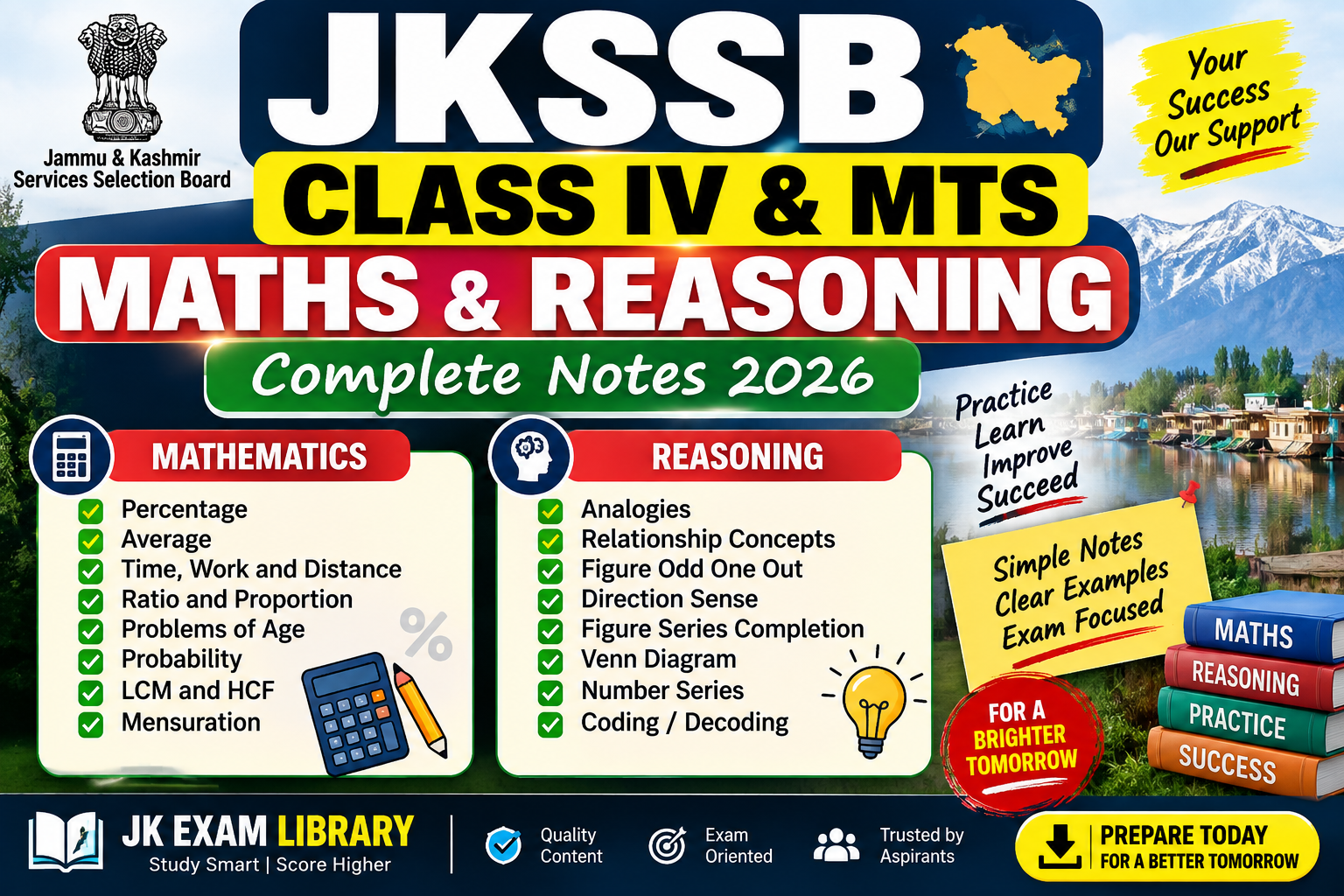
These JKSSB Class IV / MTS Maths and Reasoning Notes cover the major topics commonly required for preparation, including Percentage, Average, Time, Work and Distance, Ratio and Proportion, Problems of Age, Probability, LCM and HCF, Mensuration, Analogies, Relationship Concepts, Figure Odd One Out, Direction Sense, Figure Series Completion, Venn Diagram, Number Series, and Coding-Decoding.
The purpose of these notes is not simply to memorize formulas. Each topic should be studied with its basic concept, formula, shortcut and examples.
Download Complete Class iv mts study material with full mocktests
JKSSB Class IV / MTS Mathematics Notes
1. Percentage
Percentage means a value expressed out of 100.
Basic formula:
Percentage = (Part / Total) × 100
Example:
If a student scores 72 marks out of 100:
Percentage = 72/100 × 100 = 72%
Another important concept is percentage increase or decrease.
Example:
The price of an item increases from ₹500 to ₹600.
Increase = ₹600 − ₹500 = ₹100
Percentage increase = 100/500 × 100 = 20%
Candidates should practice questions based on:
- Percentage increase and decrease
- Successive percentage changes
- Marks and examination questions
- Population-based questions
- Profit/loss percentage
- Finding the original value
Shortcut: If a number increases by 20%, it becomes 120% of its original value.
2. Average
Average represents the equal distribution of the total value.
Formula:
Average = Sum of observations / Number of observations
Example:
Find the average of 12, 18, 20, 25 and 30.
Sum = 12 + 18 + 20 + 25 + 30 = 105
Number of values = 5
Average = 105/5 = 21
For JKSSB/MTS preparation, also practice questions where a number is added or removed from a group.
Example:
The average of 5 numbers is 18. What is their total?
Total = Average × Number of observations
= 18 × 5 = 90
3. Time, Work and Distance
This topic combines basic arithmetic with formulas.
Time and Work
If a person completes a work in 10 days, his one-day work is:
1/10
If another person completes the same work in 15 days:
1/15
Together, their one-day work is:
1/10 + 1/15 = 5/30 = 1/6
Therefore, they complete the work in 6 days.
Time, Speed and Distance
The fundamental formula is:
Distance = Speed × Time
Therefore:
Speed = Distance / Time
Time = Distance / Speed
Example:
A car travels 120 km in 3 hours.
Speed = 120/3 = 40 km/h
Important conversions:
1 km/h = 5/18 m/s
1 m/s = 18/5 km/h
Candidates should particularly practice trains, walking speed, relative speed and simple work-efficiency problems.
4. Ratio and Proportion
A ratio compares two quantities.
For example:
20 : 30 = 2 : 3
A proportion means two ratios are equal.
Example:
2 : 3 = 8 : 12
Example:
Divide ₹500 in the ratio 2 : 3.
Total parts = 2 + 3 = 5
First share = 500 × 2/5 = ₹200
Second share = 500 × 3/5 = ₹300
Questions involving boys and girls, money distribution, ages and quantities are frequently useful for practice.
5. Problems on Age
Age problems are usually solved by forming simple equations.
Example:
The present age of A is 20 years and B is 30 years.
Their age ratio:
20 : 30 = 2 : 3
Remember that the difference between two people's ages remains constant.
If A is 10 years younger than B today, A will still be 10 years younger than B after 5 or 10 years.
Practice:
- Present age
- Past age
- Future age
- Age ratios
- Average age
- Parent-child age problems
6. Probability
Probability measures the chance of an event occurring.
Formula:
Probability = Favourable outcomes / Total possible outcomes
Example:
A coin is tossed once. What is the probability of getting Head?
Possible outcomes = Head, Tail = 2
Favourable outcomes = 1
Probability = 1/2
For a standard die:
Possible outcomes = 1, 2, 3, 4, 5, 6
Probability of getting an even number:
Favourable outcomes = 2, 4, 6 = 3
Probability = 3/6 = 1/2
7. LCM and HCF
HCF (Highest Common Factor) is the greatest number that divides the given numbers exactly.
LCM (Least Common Multiple) is the smallest positive number that is exactly divisible by the given numbers.
Example:
Find LCM of 12 and 18.
Multiples of 12: 12, 24, 36, 48...
Multiples of 18: 18, 36, 54...
Therefore, LCM = 36
For two positive integers:
Product of numbers = HCF × LCM
This relationship is extremely useful in examination questions.
A=4A=4A=4B=6B=6B=6
048120612
LCM=12\text{LCM}=12LCM=12
LCM(4,6)=12\text{LCM}(4,6)=12LCM(4,6)=12
3 jumps of 4 and 2 jumps of 6 meet at 12
8. Mensuration
Mensuration deals with measurement of geometrical figures.
Rectangle
Area = Length × Breadth
Perimeter = 2(Length + Breadth)
Square
Area = Side²
Perimeter = 4 × Side
Triangle
Area = 1/2 × Base × Height
Circle
Area = πr²
Circumference = 2πr
Example:
A rectangle has length 12 cm and breadth 5 cm.
Area = 12 × 5 = 60 cm²
Candidates should memorize basic formulas and practice questions involving area, perimeter, circumference, volume and dimensions.
JKSSB Class IV / MTS Reasoning Notes
Reasoning questions test logical thinking rather than lengthy calculations. The key is to identify the pattern quickly.
9. Analogies
In analogy questions, a relationship between two objects or numbers is given, and you must identify the same relationship in another pair.
Example:
Book : Reading :: Food : ?
Answer: Eating
Another example:
Bird : Nest :: Lion : ?
Answer: Den
For number analogies, identify operations such as addition, subtraction, multiplication, division or squares.
10. Relationship Concepts
These questions involve family relationships.
Example:
A is the brother of B. B is the sister of C. How is A related to C?
Since A is the brother of B and B is the sister of C, A is C's brother.
For difficult family questions, candidates should draw a small family tree rather than trying to solve everything mentally.
Pay attention to words such as:
- Father
- Mother
- Brother
- Sister
- Son
- Daughter
- Uncle
- Aunt
- Grandfather
- Grandmother
11. Figure Odd One Out
In these questions, several figures are given and one figure differs from the others.
The difference may involve:
- Number of sides
- Direction
- Rotation
- Number of elements
- Shading
- Position
- Shape
- Internal pattern
The best approach is to compare the figures systematically instead of choosing an answer based only on appearance.
12. Direction Sense
Direction questions require understanding of North, South, East and West.
A simple method is to draw a small direction diagram.
North
↑
West ← Centre → East
↓
South
Example:
A person walks 10 m East, turns left and walks 5 m. In which direction is he now moving?
If he is initially moving East, his left side is North.
Therefore, he is moving North.
Also practice questions involving multiple turns and final distance from the starting point.
13. Figure Series Completion
A series may contain figures that follow a particular pattern.
Look for:
- Rotation
- Movement of an element
- Addition/removal of lines
- Change in shading
- Change in position
- Alternating patterns
The important skill is to identify what changes from one figure to the next.
14. Venn Diagram
Venn diagrams represent relationships between different groups.
Example:
Suppose a group contains students who study:
- Mathematics
- English
- Both Mathematics and English
The overlapping portion represents students belonging to both groups.
Venn diagrams are especially useful for questions involving:
- Students
- Languages
- Sports
- Occupations
- Categories
- Common and separate groups
15. Number Series
Number-series questions require identifying the pattern between numbers.
Example:
2, 4, 6, 8, ?
Each number increases by 2.
Answer = 10
But JKSSB/MTS-level questions can involve more complicated patterns.
Example:
3, 6, 12, 24, ?
Each number is multiplied by 2.
Answer = 48
Also check:
- or − patterns
- × or ÷ patterns
- Squares
- Cubes
- Alternate patterns
- Increasing differences
- Mixed operations
16. Coding-Decoding
Coding-decoding questions replace letters, words or numbers according to a particular rule.
Example:
If CAT is coded as DBU, determine the code for DOG.
Observe:
C → D (+1)
A → B (+1)
T → U (+1)
Therefore:
D → E
O → P
G → H
Answer = EPH
Candidates should practice:
- Letter shifting
- Reverse alphabet coding
- Number coding
- Word coding
- Mixed coding
- Symbol coding
- Position-based coding
Remember the alphabet positions:
A = 1, B = 2, C = 3 ... Z = 26.
For reverse positions:
A = 26, B = 25, C = 24 ... Z = 1.
How to Prepare JKSSB Class IV / MTS Maths & Reasoning
The most effective preparation is to combine concept learning + formula revision + MCQ practice.
For Mathematics, first memorize the basic formulas and then solve questions without looking at the solution. Start with Percentage, Average, Ratio, LCM/HCF and Time-Work-Distance before moving toward mixed problems.
For Reasoning, focus on identifying patterns. Topics such as Number Series, Coding-Decoding, Analogy, Direction Sense and Relationship Concepts can become much easier with regular practice.
A useful revision cycle is:
Concept → Formula/Rule → Solved Example → MCQs → Mistake Analysis → Revision
Do not spend too much time on one difficult question during practice. JKSSB-style objective examinations require both accuracy and time management.
Final Preparation Checklist
Before the examination, make sure you can confidently solve:
- Percentage calculations
- Average problems
- Time, Work and Distance
- Ratio and Proportion
- Age problems
- Basic Probability
- LCM and HCF
- Mensuration formulas
- Analogies
- Blood/family relationships
- Odd-one-out figures
- Direction Sense
- Figure Series
- Venn Diagrams
- Number Series
- Coding-Decoding
These JKSSB Class IV / MTS Mathematics and Reasoning Notes can be used as a foundation for preparation. After completing each topic, solve topic-wise MCQs and then move toward mixed practice so that you become comfortable switching between different question types.
For aspirants preparing for JKSSB Class IV/MTS, the goal should be to understand the method first and increase speed gradually. Strong basics, repeated practice and regular revision can make Mathematics and Reasoning much more manageable in the actual examination.
download complete study material for jkssb class iv