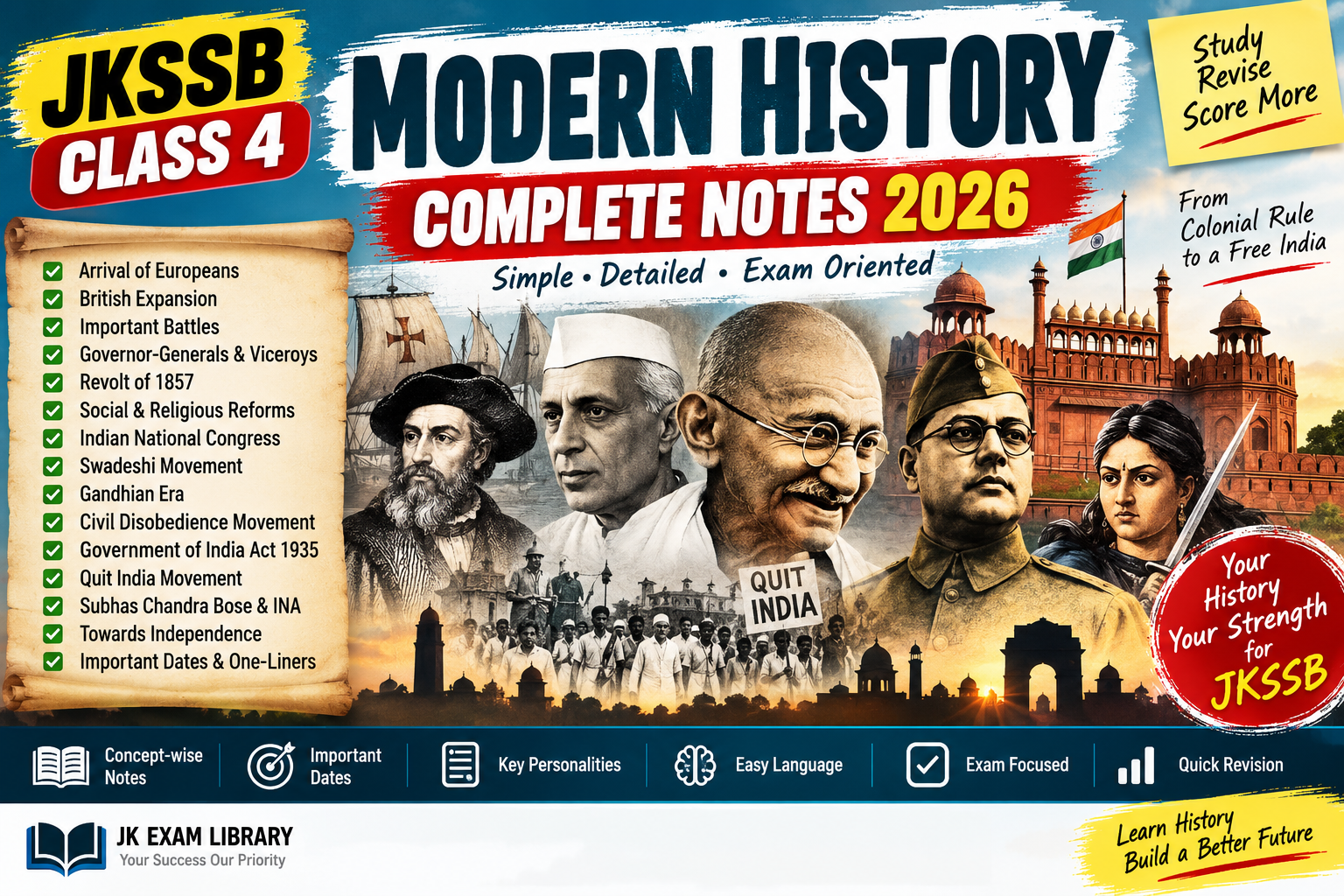
JKSSB Class 4 Modern History Notes 2026 – Complete Study Material
Modern History is one of those subjects where smart revision matters more than simply reading hundreds of pages. For JKSSB Class 4 preparation, you should understand the important events in sequence, remember major personalities, and revise important dates, Acts, movements, battles and organisations repeatedly.
This complete set of JKSSB Class 4 Modern History Notes has been prepared in a simple, exam-oriented and revision-friendly manner. It covers the major developments from the arrival of Europeans in India to the achievement of Independence in 1947.
Download Complete Class iv mts jkssb notes
1. Arrival of Europeans in India
The modern history of India begins significantly with the arrival of European trading powers.
Portuguese
- Vasco da Gama reached India in 1498.
- He landed at Calicut (Kozhikode) on the Malabar Coast.
- He was guided by an Indian sailor traditionally identified as Kanhoji/Kunjali-related local navigation traditions, while standard accounts associate his landing with the assistance of a Gujarati pilot.
- The Portuguese established their influence mainly on the western coast.
- Alfonso de Albuquerque was the most important Portuguese governor in India.
- He captured Goa in 1510.
- The Portuguese introduced several crops and commercial practices to India, including the wider cultivation of tobacco and chilli.
Dutch
The Dutch East India Company was established in 1602.
They established trading centres at places such as:
- Masulipatnam
- Pulicat
- Chinsurah
- Nagapattinam
Their major interest was the spice trade.
English
The English East India Company was established in 1600 through a royal charter granted by Queen Elizabeth I.
Important early English settlements included:
- Surat
- Madras
- Bombay
- Calcutta
The English gradually transformed themselves from traders into political rulers.
French
The French East India Company was established in 1664.
Their important settlements included:
- Pondicherry
- Chandernagore
- Mahe
- Karaikal
- Yanam
The major rivalry between the English and French was seen during the Carnatic Wars.
2. Important Battles
Understanding the major battles is extremely important for competitive examinations.
Battle of Plassey – 1757
The Battle of Plassey was fought between Siraj-ud-Daulah, the Nawab of Bengal, and the forces of the English East India Company led by Robert Clive.
The British victory greatly strengthened their political position in Bengal.
Battle of Buxar – 1764
The British defeated the combined forces of:
- Mir Qasim
- Shuja-ud-Daulah
- Shah Alam II
The British victory at Buxar further established their political and financial control in eastern India.
Treaty of Allahabad – 1765
Following the Battle of Buxar, the Diwani rights of Bengal, Bihar and Orissa were granted to the East India Company by Mughal Emperor Shah Alam II.
This gave the Company the right to collect revenue.
3. Expansion of British Rule
The British used different political and military methods to expand their territory.
Subsidiary Alliance
The Subsidiary Alliance system was introduced by Lord Wellesley.
Under this system, Indian rulers had to:
- Accept British troops in their territory.
- Pay for their maintenance.
- Avoid maintaining independent relations with other powers.
- Accept British influence over external affairs.
Doctrine of Lapse
The Doctrine of Lapse was aggressively used by Lord Dalhousie.
Under this policy, the British annexed states where the ruler died without a natural male heir, refusing in many cases to recognise an adopted heir for succession.
States associated with annexations under the policy included:
- Satara
- Jhansi
- Nagpur
The policy became one of the grievances contributing to the Revolt of 1857.
4. Important Governor-Generals and Viceroys
Warren Hastings
- First Governor-General of Bengal.
- Associated with administrative reforms and the early consolidation of Company rule.
Lord Cornwallis
- Introduced the Permanent Settlement in Bengal in 1793.
- Important for civil service and judicial reforms.
Lord Wellesley
- Introduced the Subsidiary Alliance.
Lord William Bentinck
- Regarded as an important reforming Governor-General.
- Sati was abolished in 1829.
- English education received official encouragement during his administration.
Lord Dalhousie
- Associated with the Doctrine of Lapse.
- Promoted railways, telegraph and modern infrastructure.
- The first railway passenger service in India ran between Bombay and Thane in 1853.
5. Revolt of 1857
The Revolt of 1857 was one of the most important events in Indian history.
Immediate Cause
The introduction of the Enfield rifle and cartridges believed to be greased with cow and pig fat became the immediate trigger for the sepoy uprising.
Beginning
The revolt began at Meerut on 10 May 1857 and spread to several parts of northern and central India.
Important Leaders
| Centre | Leader |
|---|---|
| Delhi | Bahadur Shah II |
| Kanpur | Nana Sahib |
| Lucknow | Begum Hazrat Mahal |
| Jhansi | Rani Lakshmibai |
| Bihar | Kunwar Singh |
| Bareilly | Khan Bahadur Khan |
The revolt was suppressed, but it had enormous consequences.
Consequences
- The rule of the East India Company ended.
- The Government of India Act, 1858 transferred power to the British Crown.
- The office of Viceroy became important in administering British India.
- Bahadur Shah II was exiled to Rangoon.
6. Social and Religious Reform Movements
The 19th century witnessed several important reform movements.
Brahmo Samaj
Founded by Raja Rammohan Roy in 1828.
It opposed social evils and promoted monotheism and social reform.
Arya Samaj
Founded by Swami Dayanand Saraswati in 1875.
Its famous principle was “Back to the Vedas.”
Ramakrishna Mission
Founded by Swami Vivekananda in 1897.
It promoted service, education and spiritual development.
Aligarh Movement
Associated with Sir Syed Ahmad Khan.
It encouraged modern education among Muslims, particularly through the Muhammadan Anglo-Oriental College at Aligarh, founded in 1875.
Sati
The practice of Sati was abolished in 1829 during the administration of Lord William Bentinck.
7. Formation of Indian National Congress
The Indian National Congress (INC) was founded in 1885.
Its first session was held in Bombay.
- First President: W.C. Bonnerjee
- Important organiser associated with its foundation: A.O. Hume
Initially, Congress leaders mainly demanded constitutional reforms, greater Indian participation in administration and expansion of political rights.
8. Partition of Bengal and Swadeshi Movement
In 1905, Lord Curzon partitioned Bengal.
The decision generated widespread opposition.
The Swadeshi Movement encouraged Indians to:
- Boycott foreign goods.
- Promote Indian-made products.
- Develop indigenous industries.
- Spread national education.
The partition was eventually annulled in 1911.
9. Muslim League
The All-India Muslim League was established in 1906 at Dacca (Dhaka).
Its early political objective included representing Muslim political interests.
The Lucknow Pact of 1916 was an important agreement between the Congress and Muslim League.
10. Gandhian Era
Mahatma Gandhi returned to India from South Africa in 1915.
His political methods emphasised:
- Satyagraha
- Non-violence
- Mass mobilisation
Champaran Satyagraha – 1917
Gandhi supported indigo cultivators in Champaran, Bihar.
Kheda Satyagraha – 1918
It was associated with peasants in Gujarat seeking relief from revenue demands following crop problems.
Ahmedabad Mill Strike – 1918
Gandhi intervened in a dispute involving textile workers and mill owners.
11. Rowlatt Act and Jallianwala Bagh
The Rowlatt Act of 1919 allowed the colonial government to take severe measures against suspected revolutionary activities.
Gandhi launched a nationwide protest against it.
On 13 April 1919, British troops under General Reginald Dyer fired on a gathering at Jallianwala Bagh in Amritsar.
The massacre became a major turning point in India's freedom struggle.
12. Non-Cooperation Movement
The Non-Cooperation Movement was launched by Gandhi in 1920.
People were encouraged to boycott:
- Government schools
- Colleges
- Courts
- Foreign cloth
- Government honours
The movement was withdrawn in 1922 after the Chauri Chaura incident, where protesters attacked and killed policemen and the violence led Gandhi to call off the campaign.
13. Civil Disobedience Movement
The Civil Disobedience Movement began in 1930.
Its most famous event was the Dandi March.
Gandhi marched from Sabarmati Ashram to Dandi and broke the colonial salt laws.
The movement challenged British authority through peaceful law-breaking and mass participation.
Gandhi-Irwin Pact
The agreement was signed in 1931 between Gandhi and Viceroy Lord Irwin.
Gandhi subsequently attended the Second Round Table Conference in London.
14. Government of India Act, 1935
The Government of India Act, 1935 was one of the most extensive constitutional measures introduced by the British.
Important features included:
- Provincial autonomy.
- Proposed federation.
- Expansion of provincial legislative structures.
- Further development of electoral representation.
The provincial elections of 1937 were held under its provisions.
15. Quit India Movement
The Quit India Movement was launched in August 1942.
The famous slogan associated with Gandhi was:
“Do or Die.”
The movement demanded an immediate end to British rule.
Many national leaders were arrested shortly after its launch, but protests continued across several parts of India.
16. Subhas Chandra Bose and INA
Subhas Chandra Bose was one of the prominent leaders of the Indian independence movement.
He became associated with the Indian National Army (INA), also known as Azad Hind Fauj.
The INA sought to fight British rule with armed resistance.
Bose is remembered for slogans such as:
“Give me blood, and I will give you freedom.”
The INA trials after World War II generated considerable public attention and sympathy in India.
17. Towards Independence
Several important developments occurred after World War II.
Cabinet Mission – 1946
The British government sent the Cabinet Mission to India to discuss the transfer of power and constitutional arrangements.
Mountbatten Plan – 1947
Lord Mountbatten became the last Viceroy of British India.
The plan announced the partition of British India and the transfer of power.
Indian Independence Act – 1947
The British Parliament passed the Indian Independence Act, 1947.
India became independent on 15 August 1947.
Jawaharlal Nehru became the first Prime Minister of independent India.
Important Modern History One-Liners for JKSSB Class 4
1498 — Vasco da Gama reached Calicut.
1600 — English East India Company established.
1757 — Battle of Plassey.
1764 — Battle of Buxar.
1765 — Company obtained Diwani rights.
1828 — Brahmo Samaj founded.
1829 — Sati abolished.
1853 — First passenger railway in India.
1857 — Revolt of 1857.
1858 — Crown took direct control of India.
1875 — Arya Samaj founded.
1885 — Indian National Congress founded.
1905 — Partition of Bengal.
1906 — Muslim League founded.
1915 — Gandhi returned to India.
1917 — Champaran Satyagraha.
1919 — Rowlatt Act and Jallianwala Bagh massacre.
1920 — Non-Cooperation Movement.
1922 — Non-Cooperation Movement withdrawn.
1930 — Civil Disobedience Movement and Dandi March.
1931 — Gandhi-Irwin Pact.
1935 — Government of India Act.
1942 — Quit India Movement.
1946 — Cabinet Mission.
1947 — India became independent.
Also read: JKSSB CLASS IV MTS MATH AND REASONING NOTES
Final Revision Strategy for JKSSB Class 4
For JKSSB Class 4, don't try to memorise Modern History randomly. Study it as a timeline.
First remember the sequence:
European Arrival → British Expansion → Plassey → Buxar → British Policies → Revolt of 1857 → Social Reform → INC → Partition of Bengal → Swadeshi → Gandhian Movements → Civil Disobedience → Quit India → INA → Cabinet Mission → Independence.
After completing the chapter, revise the dates, personalities, movements, Acts, battles and important organisations separately. These are the areas from which direct factual questions are commonly framed in competitive examinations.
Most importantly, practise MCQs after every topic. A student who can connect “event + year + person + place + significance” will find Modern History much easier during the JKSSB Class 4 examination.
This approach turns a large historical syllabus into a compact, revision-friendly set of notes that you can repeatedly revise before the examination