
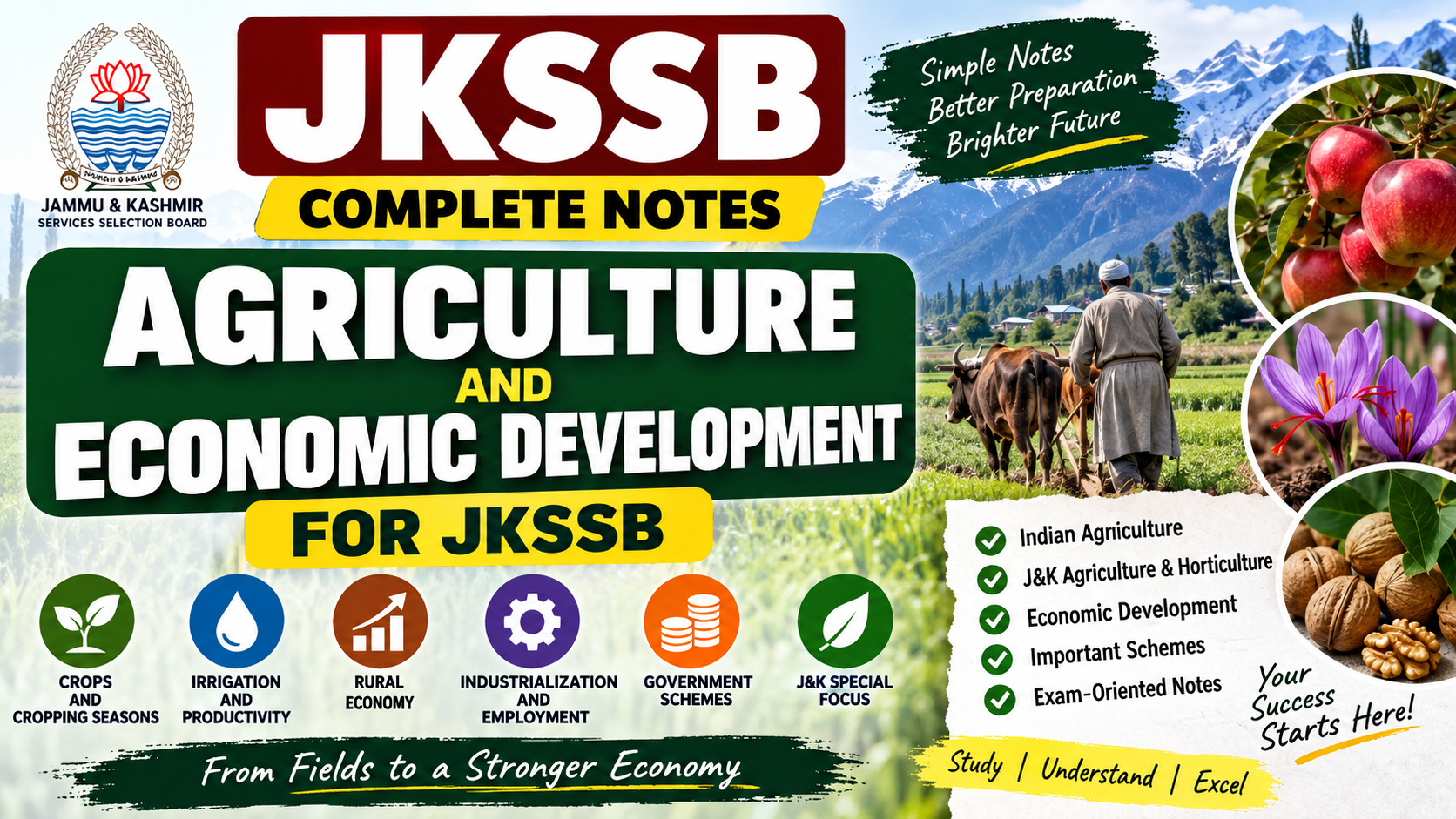
Agriculture and Economic Development Notes for JKSSB
Agriculture and economic development is an important area for candidates preparing for JKSSB, JKPSC, SSC and other competitive examinations. Questions from this topic can be direct, conceptual as well as based on the economic importance of agriculture, major agricultural programmes, crops, irrigation, productivity, rural employment and the relationship between agriculture and overall economic development.
For JKSSB aspirants, it is particularly important to understand the topic from both the Indian perspective and the Jammu & Kashmir perspective. Agriculture and allied activities continue to have a major role in livelihoods and the rural economy of J&K. The latest J&K government data also highlights the continuing importance of the primary sector, while agriculture and allied activities remain central to food security and livelihood support.
These notes are designed in a simple, exam-oriented manner so that you can revise the concepts without getting lost in complicated economic terminology.
1. Meaning of Agriculture
Agriculture is the science, art and practice of cultivating land, growing crops and raising animals for food, raw materials and other economic purposes.
Agriculture includes several activities such as:
- Crop cultivation
- Horticulture
- Animal husbandry
- Dairy farming
- Poultry farming
- Fisheries
- Forestry
- Beekeeping
- Sericulture
Agriculture is therefore much broader than simply growing crops.
Importance of Agriculture
Agriculture plays an important role in economic development because it:
- Provides food to the population.
- Provides employment to millions of people.
- Supplies raw materials to industries.
- Generates income in rural areas.
- Supports the development of markets.
- Contributes to exports.
- Helps reduce poverty.
- Supports food security.
- Creates demand for industrial goods.
- Provides a livelihood to rural households.
2. Agriculture and Economic Development
Agriculture and economic development are closely connected, particularly in developing economies.
During the early stages of economic development, agriculture generally employs a large proportion of the population. As industrialization and modernization progress, labour gradually shifts towards manufacturing and services.
Agricultural development can contribute to economic development through:
A. Food Supply
A growing population requires a reliable supply of food. Increased agricultural production helps maintain food availability and supports food security.
B. Employment
Agriculture provides direct employment in farming and indirect employment in transportation, storage, processing, marketing and other activities.
C. Raw Materials
Many industries depend on agricultural products.
Examples:
| Agricultural Product | Related Industry |
|---|---|
| Cotton | Textile industry |
| Sugarcane | Sugar industry |
| Jute | Jute industry |
| Oilseeds | Edible oil industry |
| Rubber | Rubber products |
| Fruits | Food-processing industry |
D. Market for Industrial Goods
Farmers purchase tractors, pumps, fertilizers, pesticides, agricultural machinery, tools and consumer goods.
Therefore, increased agricultural income can increase demand for industrial products.
E. Capital Formation
Agricultural surpluses can contribute to savings and investment, particularly when agricultural productivity and farmers' incomes increase.
F. Foreign Exchange
Agricultural and horticultural products can generate export earnings.
3. Role of Agriculture in the Indian Economy
Agriculture remains a major part of India's economic and social structure.
Its importance can be understood through:
- Food security
- Employment
- Rural income
- Agricultural exports
- Industrial raw materials
- Rural development
- Poverty reduction
- Allied activities
Agriculture is also closely connected with India's monsoon, irrigation systems, rural credit, food processing and agricultural markets.
4. Features of Indian Agriculture
Indian agriculture has several distinctive characteristics.
1. Dependence on Monsoon
A significant portion of Indian agriculture has historically depended on rainfall. Irrigation has expanded substantially, but rainfall remains important in many agricultural regions.
2. Small and Fragmented Holdings
Many farmers operate relatively small landholdings. Fragmentation can make mechanization and efficient resource use more difficult.
3. Diversity of Crops
India grows a large variety of crops because of differences in climate, soil, rainfall and geographical conditions.
4. Multiple Cropping
In areas with favourable irrigation and climatic conditions, farmers can grow more than one crop during a year.
5. Regional Diversity
Different parts of India specialize in different crops.
For example:
- Punjab and Haryana – wheat and rice
- Gujarat – cotton and groundnut
- Assam – tea
- Maharashtra – sugarcane and cotton
- Kerala – rubber and spices
- Jammu & Kashmir – apples, walnuts, saffron and other horticultural products
5. Types of Agriculture
Subsistence Agriculture
Agriculture primarily undertaken to meet the needs of the farmer and family.
Characteristics:
- Small holdings
- Low marketable surplus
- Traditional methods
- Limited mechanization
Commercial Agriculture
Agriculture primarily undertaken for sale in the market.
Examples include:
- Cotton
- Sugarcane
- Tea
- Coffee
- Rubber
- Commercial horticulture
Intensive Agriculture
High use of labour and other inputs on a relatively small area of land to obtain higher production.
Extensive Agriculture
Agriculture practiced over relatively large areas with comparatively lower labour intensity per unit of land.
Plantation Agriculture
Large-scale commercial cultivation of crops such as tea, coffee and rubber.
6. Major Cropping Seasons in India
One of the most important areas for competitive examinations is the classification of crops according to agricultural seasons.
Kharif Crops
Kharif crops are generally sown with the arrival of the southwest monsoon and harvested later in the year.
Important Kharif crops include:
- Rice
- Maize
- Cotton
- Soybean
- Groundnut
- Millets
- Pulses
Rabi Crops
Rabi crops are generally sown during the winter season and harvested in spring.
Important Rabi crops include:
- Wheat
- Barley
- Gram
- Mustard
- Peas
Zaid Crops
Zaid crops are grown between the Rabi and Kharif seasons.
Examples:
- Watermelon
- Muskmelon
- Cucumber
- Some vegetables
- Fodder crops
Quick Revision
Kharif → Monsoon
Rabi → Winter
Zaid → Between Rabi and Kharif
7. Food Crops and Cash Crops
Food Crops
These crops are mainly cultivated for food.
Examples:
- Rice
- Wheat
- Maize
- Pulses
- Millets
Cash Crops
These are generally cultivated for commercial purposes.
Examples:
- Cotton
- Sugarcane
- Tobacco
- Tea
- Coffee
- Rubber
8. Irrigation
Irrigation means the artificial supply of water to agricultural land.
It is particularly important where rainfall is inadequate, uncertain or unevenly distributed.
Major Sources of Irrigation
- Canals
- Wells
- Tube wells
- Tanks
- Rivers
- Dams
- Groundwater
- Drip irrigation
- Sprinkler irrigation
Modern Irrigation Methods
Drip irrigation: Water is supplied directly near the roots of plants.
Sprinkler irrigation: Water is distributed through sprinklers, resembling rainfall.
These methods can improve water-use efficiency.
9. Agricultural Productivity
Agricultural productivity refers to the amount of agricultural output obtained from a given quantity of inputs or resources.
Productivity can be improved through:
- Better seeds
- Irrigation
- Fertilizers
- Mechanization
- Scientific farming
- Pest management
- Improved technology
- Soil management
- Agricultural research
- Better storage and marketing
Productivity vs Production
This is a common examination concept.
Production = total output.
Productivity = output in relation to the input/resource used.
10. Green Revolution
The Green Revolution refers to the introduction and widespread adoption of high-yielding varieties of seeds along with irrigation, fertilizers, pesticides and improved agricultural practices to increase crop production.
In India, the Green Revolution was particularly associated with:
- Wheat
- Rice
- Irrigation
- HYV seeds
- Fertilizers
- Pesticides
- Mechanization
Major Features
- High-yielding variety seeds
- Increased irrigation
- Greater fertilizer use
- Use of pesticides
- Mechanization
- Agricultural research
- Expansion of institutional support
Important Associated Name
Dr. M. S. Swaminathan is widely associated with India's Green Revolution and agricultural research.
Norman Borlaug played a major role in the global Green Revolution.
11. Effects of the Green Revolution
Positive Effects
- Increased food-grain production
- Improved food security
- Reduction in dependence on food imports
- Increased agricultural productivity
- Expansion of irrigation
- Greater use of modern agricultural technology
Limitations
The benefits were not equally distributed across all regions and crops. Intensive use of chemical inputs and groundwater also created environmental concerns in some areas.
12. Agricultural Diversification
Agricultural diversification means shifting from dependence on a limited number of crops towards a wider range of crops and allied activities.
Examples:
- Fruits
- Vegetables
- Flowers
- Spices
- Dairy
- Poultry
- Fisheries
- Beekeeping
- Medicinal plants
Diversification can help farmers reduce dependence on a single crop and create additional income opportunities.
13. Horticulture
Horticulture is the branch of agriculture dealing mainly with:
- Fruits
- Vegetables
- Flowers
- Plantation crops
- Spices
- Medicinal plants
Horticulture is particularly important for Jammu & Kashmir.
The J&K government identifies horticulture as a major economic activity. Official statistics record major production of apples, walnuts, pears and other fruits, while government sources highlight the sector's role in employment, exports and rural livelihoods.
Major Horticultural Products of J&K
- Apple
- Walnut
- Almond
- Pear
- Cherry
- Apricot
- Peach
- Plum
- Saffron
- Vegetables
- Flowers
The apple is particularly important to the horticultural economy of Kashmir.
14. Agriculture in Jammu & Kashmir
Agriculture has traditionally been an important part of the economy and livelihood system of J&K.
The geography and climate of the UT create different agricultural possibilities across Jammu, Kashmir and the higher-altitude areas.
Major Agricultural Activities
- Crop cultivation
- Horticulture
- Dairy
- Sheep and goat rearing
- Poultry
- Fisheries
- Sericulture
- Beekeeping
The latest J&K Economic Survey describes agriculture as a major livelihood sector and highlights initiatives involving crop diversification, productivity improvement, marketing infrastructure, organic crops, exotic vegetables, spices and high-value crops.
15. Major Crops of Jammu & Kashmir
Important crops include:
Cereals
- Rice
- Wheat
- Maize
- Barley
Pulses
- Rajma
- Gram
- Other pulses
Oilseeds
- Mustard
- Rapeseed
Commercial and High-Value Crops
- Saffron
- Tobacco in limited areas
- Oilseeds
- Spices
Horticultural Crops
- Apple
- Walnut
- Almond
- Pear
- Cherry
- Apricot
- Peach
- Plum
16. Saffron in Jammu & Kashmir
Saffron is one of the most important high-value crops associated with J&K.
Pampore in the Kashmir Valley is especially famous for saffron cultivation.
Saffron is valued because of:
- High market value
- Export potential
- Traditional importance
- Employment generation
- Unique geographical and climatic suitability
For examinations, remember:
Pampore → Saffron
17. Agriculture and Allied Activities
Agriculture should not be studied in isolation.
Important allied sectors include:
Animal Husbandry
Includes:
- Cattle
- Sheep
- Goats
- Buffaloes
- Poultry
Dairy
Milk production and dairy processing contribute to rural income.
Fisheries
Fish production provides food, employment and income.
Sericulture
Sericulture means the production of silk through silkworm rearing.
Apiculture
Apiculture means beekeeping.
These activities are especially important for diversification of rural income.
18. Economic Development
Economic development is broader than economic growth.
Economic Growth
Economic growth generally refers to an increase in the production of goods and services or real national income over time.
Economic Development
Economic development includes:
- Economic growth
- Better living standards
- Reduction in poverty
- Better health
- Better education
- Employment opportunities
- Infrastructure development
- Social development
- Reduction in inequality
Therefore:
Growth is mainly quantitative, while development is broader and includes qualitative improvements.
19. Agriculture as an Engine of Economic Development
Agriculture can promote development through a number of channels.
Agriculture → Food
Higher agricultural production improves food availability.
Agriculture → Income
Higher productivity can raise rural income.
Agriculture → Demand
Higher rural incomes can increase demand for manufactured goods and services.
Agriculture → Industry
Agriculture supplies raw materials to industries.
Agriculture → Employment
Agricultural development creates direct and indirect employment.
Agriculture → Exports
High-value agricultural products can generate export earnings.
20. Structural Transformation
Economic development often involves a transformation in the structure of employment and production.
A typical development process involves movement of labour and resources:
Agriculture → Industry → Services
However, agriculture continues to remain important even as the service and industrial sectors expand.
21. Industrialization and Economic Development
Industrialization refers to the development and expansion of industries and manufacturing activities.
Industrialization contributes to economic development by:
- Creating employment
- Increasing production
- Promoting technological development
- Increasing exports
- Improving infrastructure
- Encouraging urbanization
- Increasing productivity
- Creating demand for raw materials
Agriculture and Industry: Two-Way Relationship
Agriculture supplies raw materials to industries.
Industry supplies agriculture with:
- Tractors
- Pumps
- Fertilizers
- Pesticides
- Machinery
- Storage equipment
- Processing technology
Thus, agriculture and industry are complementary sectors.
22. Rural Economy
The rural economy includes economic activities taking place in rural areas.
It includes:
- Agriculture
- Dairy
- Poultry
- Fisheries
- Handicrafts
- Small businesses
- Rural industries
- Transport
- Trading
- Food processing
Development of the rural economy can help improve employment and income opportunities.
23. Agricultural Marketing
Agricultural marketing refers to the activities involved in moving agricultural produce from farmers to consumers.
It includes:
- Collection
- Transportation
- Storage
- Grading
- Processing
- Packaging
- Wholesale
- Retail
Problems in Agricultural Marketing
Farmers may face:
- Lack of storage
- Poor transportation
- Price fluctuations
- Limited market information
- Dependence on intermediaries
- Inadequate processing facilities
Better market infrastructure can reduce post-harvest losses and improve farmers' access to markets.
24. Agricultural Credit
Farmers require credit for:
- Seeds
- Fertilizers
- Machinery
- Irrigation
- Labour
- Livestock
- Storage
- Other farm investments
Sources of agricultural credit include:
Institutional Sources
- Commercial banks
- Regional Rural Banks
- Cooperative banks
- NABARD-linked institutional systems
Non-Institutional Sources
- Moneylenders
- Traders
- Relatives and friends
Institutional credit is important because it can provide more organized access to agricultural finance.
25. Food Security
Food security means ensuring that people have adequate access to sufficient, safe and nutritious food.
Food security has three major dimensions:
- Availability
- Accessibility
- Affordability
Agriculture plays a fundamental role in maintaining food security.
26. Poverty and Agriculture
Agriculture has an important relationship with poverty reduction because a significant portion of rural households depend directly or indirectly on agricultural activities.
Increasing:
- Productivity
- Farm income
- Rural employment
- Agricultural diversification
- Access to markets
can contribute to reducing rural poverty.
27. Sustainable Agriculture
Sustainable agriculture aims to meet present agricultural needs without damaging the ability of future generations to meet their needs.
Important principles include:
- Efficient water use
- Soil conservation
- Balanced fertilizer use
- Reduced environmental damage
- Crop diversification
- Organic and natural farming practices where appropriate
- Protection of biodiversity
28. Problems of Indian Agriculture
Important challenges include:
- Small landholdings
- Dependence on rainfall in some regions
- Low productivity in certain areas
- Soil degradation
- Water scarcity
- Inadequate storage
- Market fluctuations
- Post-harvest losses
- Limited access to technology
- Agricultural indebtedness
- Climate-related risks
29. Problems of Agriculture in J&K
For JKSSB, the J&K-specific perspective is particularly important.
Major challenges include:
1. Small and Fragmented Landholdings
Small holdings can limit economies of scale and mechanization.
2. Difficult Terrain
Mountainous and hilly terrain creates challenges for mechanization, transportation and market connectivity.
3. Limited Irrigation in Some Areas
Agricultural productivity in rain-dependent areas can be affected by irregular rainfall.
4. Storage and Cold-Chain Requirements
Horticultural products are perishable and require appropriate storage and transportation.
5. Market Access
Farmers need efficient links with domestic and external markets.
6. Climate Risks
Changes in temperature, precipitation and extreme weather can affect agricultural production.
7. Post-Harvest Losses
Poor handling, storage and transportation can reduce farmers' returns.
30. Economic Development and Agriculture in J&K
Agriculture and horticulture are important components of J&K's rural economy.
The Directorate of Economics & Statistics publishes the Economic Survey and Digest of Statistics, which provide official information on agriculture, horticulture, livestock, fisheries, irrigation, industry and other sectors.
Recent official data also show the continued importance of the primary sector: the J&K Planning Department estimates the primary sector at 20.45% of GSVA in 2025-26 (Advance Estimates) and reports that agriculture and allied activities account for the largest employment share among the broad sectors, based on PLFS 2023-24.
31. Important Government Initiatives Related to Agriculture
Competitive examinations may ask about agricultural development programmes and initiatives.
Important areas to understand include:
- Agricultural modernization
- Crop diversification
- Irrigation development
- Agricultural mechanization
- Farmer credit
- Soil health
- Agricultural insurance
- Food processing
- Agricultural marketing
- Horticulture development
- Organic farming
- Digital agriculture
In J&K, the government is also promoting initiatives connected with horticulture, packaging, grading, marketing, e-NAM and food processing.
32. Holistic Agriculture Development Programme — J&K
The Holistic Agriculture Development Programme (HADP) is an important J&K-specific initiative that JKSSB aspirants should be aware of.
Its broader objective is to strengthen agriculture and allied sectors, improve productivity and create better income opportunities for farmers.
For exam preparation, remember the connection:
HADP → Agriculture & Allied Sectors → J&K
33. e-NAM
e-NAM stands for National Agriculture Market.
It is a pan-India electronic trading platform intended to improve agricultural marketing by connecting agricultural markets electronically.
Its broad objectives include:
- Better price discovery
- Greater market access
- Transparency
- Online trading
- Integration of agricultural markets
34. Agricultural Mechanization
Agricultural mechanization refers to the use of machinery and modern equipment in agricultural operations.
Examples:
- Tractors
- Harvesters
- Seed drills
- Threshers
- Irrigation pumps
- Sprayers
Benefits include:
- Reduction in labour requirements
- Timely farm operations
- Increased efficiency
- Potential improvement in productivity
35. Crop Diversification in J&K
Crop diversification is particularly relevant to J&K because farmers can move beyond traditional crops towards:
- Fruits
- Vegetables
- Spices
- Saffron
- Medicinal plants
- High-value crops
- Floriculture
The J&K Economic Survey specifically discusses diversification and expansion of high-value agricultural activities.
36. Agriculture, Horticulture and Exports
J&K's horticultural products have significant market potential.
Important products include:
- Apples
- Walnuts
- Almonds
- Saffron
- Cherries
- Pears
Official J&K statistics maintain detailed information on horticultural production, exports, mandis, e-NAM-linked markets and cold-storage infrastructure.
The latest horticulture data also show that fruit cultivation occupies a substantial area across the UT, with apple representing the largest individual fruit-crop area in the reported series.
37. Agriculture and Employment
Agriculture creates employment at multiple levels.
Direct Employment
- Farmers
- Agricultural labourers
- Farm workers
Indirect Employment
- Transporters
- Traders
- Warehouse workers
- Food processors
- Agricultural equipment suppliers
- Packaging workers
Therefore, agricultural development has a multiplier effect on the rural economy.
38. Agriculture and Industrial Development
The relationship can be remembered through a simple chain:
Agriculture → Raw Materials → Industry → Employment → Income → Demand → Economic Development
At the same time:
Industry → Machinery + Fertilizers + Technology + Processing → Agricultural Productivity
This two-way relationship makes agriculture and industry complementary to each other.
39. Agriculture and Poverty Reduction
Agricultural development can reduce poverty through:
- Higher farm income
- Increased employment
- Better productivity
- Rural infrastructure
- Market access
- Diversification
- Food availability
However, agricultural development alone is not sufficient for comprehensive economic development. Education, healthcare, infrastructure, industrialization and services also play major roles.
40. Important One-Liners for JKSSB
- Agriculture is a major component of the primary sector.
- Agriculture provides food and raw materials.
- Kharif crops are generally associated with the monsoon season.
- Rabi crops are generally associated with the winter season.
- Zaid crops are grown between Rabi and Kharif.
- Wheat is an important Rabi crop.
- Rice is an important Kharif crop.
- Green Revolution is associated with high-yielding varieties and modern agricultural inputs.
- Dr. M. S. Swaminathan is closely associated with India's Green Revolution.
- Norman Borlaug is associated with the global Green Revolution.
- Irrigation reduces dependence on rainfall.
- Horticulture includes fruits, vegetables, flowers and related high-value crops.
- Pampore is famous for saffron cultivation.
- Apple is one of the most important horticultural crops of J&K.
- Walnut is an important dry-fruit crop of J&K.
- Agriculture supports rural employment.
- Agriculture supplies raw materials to industries.
- Industry supplies machinery and inputs to agriculture.
- e-NAM stands for National Agriculture Market.
- Apiculture means beekeeping.
- Sericulture means silk production through silkworm rearing.
- Agriculture and allied activities are important for J&K's rural economy.
- Economic development is broader than economic growth.
- Economic development includes improvements in living standards.
- Industrialization contributes to employment and productivity.
- Food security is closely connected with agricultural production.
- Crop diversification can reduce dependence on a single crop.
- Sustainable agriculture aims to protect natural resources while maintaining production.
41. JKSSB Exam-Focused Revision
When preparing this chapter, do not try to memorize every paragraph. Focus on the concept + fact + J&K connection.
Must-Remember Topics
Agriculture
- Meaning
- Importance
- Types
- Cropping seasons
- Major crops
- Irrigation
- Productivity
Indian Agriculture
- Features
- Green Revolution
- Agricultural marketing
- Agricultural credit
- Food security
- Agricultural diversification
- Sustainable agriculture
Economic Development
- Growth vs development
- Agriculture and development
- Industrialization
- Rural economy
- Employment
- Poverty
- Food security
J&K Agriculture
- Major crops
- Horticulture
- Apple
- Walnut
- Saffron
- Agriculture and allied activities
- Agricultural challenges
- Crop diversification
- HADP
- e-NAM
- Agricultural marketing
ALSO READ: JKSSB CLASS IV MTS COMPLETE COURSE NOTES
Final Revision Note
For JKSSB, Agriculture and Economic Development should not be treated as a purely theoretical topic. Questions can combine basic economics with practical knowledge of Indian agriculture and specific facts about Jammu & Kashmir.
The most useful approach is to remember the relationship between the concepts:
Agriculture → Food Security → Employment → Rural Income → Industry → Markets → Economic Development
And for J&K:
Agriculture + Horticulture + Livestock + Fisheries + Allied Activities → Rural Livelihoods → Income & Employment → Economic Development
The official J&K statistical system regularly publishes updated Economic Surveys and Digests of Statistics, so candidates preparing for exams should revise numerical and scheme-related facts from the latest official publications whenever a question specifically asks for current figures.
These notes cover the core concepts required to build a strong foundation for the Agriculture and Economic Development portion of the JKSSB syllabus, while keeping the language simple enough for repeated revision before the examination.