JKP Constable Syllabus 2026 PDF Download - Complete Subject Wise Syllabus
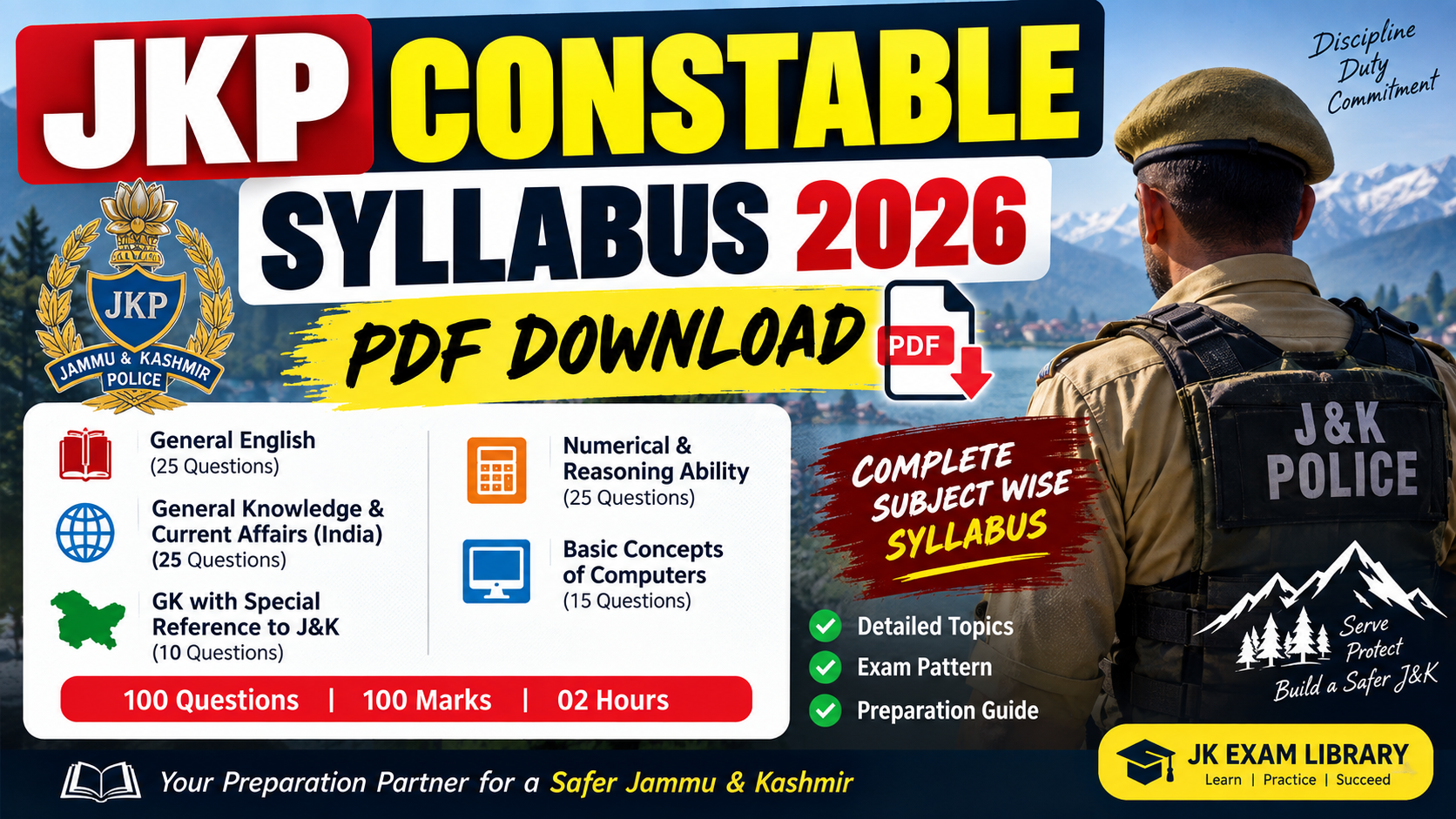
Candidates preparing for the Jammu and Kashmir Police Constable recruitment should have a clear understanding of the official written examination syllabus before starting their preparation. The JKP Constable written test covers General English, General Knowledge and Current Affairs, General Knowledge with special reference to Jammu and Kashmir, Numerical and Reasoning Ability, and Basic Concepts of Computers.
The written examination is designed to test a candidate's basic knowledge, general awareness, mathematical ability, reasoning skills, computer knowledge and understanding of important national and J&K specific topics.
In this article, you can check the complete JKP Constable Syllabus, subject wise distribution of questions, important topics and the detailed syllabus prescribed for the written test for Constables under Executive Police, Armed Police, IRP and SDRF.
JKP Constable Syllabus 2026 - Exam Pattern
The written examination consists of 100 questions carrying 100 marks. Candidates get 2 hours to complete the examination.
| Subject | Number of Questions |
|---|---|
| General English | 25 |
| General Knowledge and Current Affairs - India | 25 |
| General Knowledge with Special Reference to J&K | 10 |
| Numerical and Reasoning Ability | 25 |
| Basic Concepts of Computers | 15 |
| Total | 100 |
Total Marks: 100
Total Questions: 100
Time Duration: 02 Hours
Candidates should prepare all five sections because the paper covers both general awareness and aptitude based areas.
Download Complete Study material with full mocktests 20+ for jkp constable
JKP Constable Detailed Syllabus
1. General English
The General English section contains questions designed to test the candidate's basic understanding of English language and usage.
The important topics included in the syllabus are:
Articles
Clauses
Pronouns
Homonyms and Homophones
Tenses
Punctuation
Synonyms and Antonyms
Analogies
Idioms and Phrases
Uses of Prepositions
Candidates should focus on vocabulary, basic grammar rules, sentence usage and commonly tested English concepts. Regular practice of objective type questions can help improve accuracy in this section.
Important General English Topics
Articles: Questions based on the correct use of A, An and The.
Pronouns: Identification and correct usage of different types of pronouns.
Tenses: Basic forms and usage of present, past and future tenses.
Homonyms and Homophones: Words having similar pronunciation or spelling but different meanings.
Synonyms and Antonyms: Questions based on words with similar and opposite meanings.
Idioms and Phrases: Common expressions and their meanings.
Prepositions: Correct usage of words such as in, on, at, by, for, from, with and others.
Punctuation: Basic punctuation marks and their correct usage.
2. General Knowledge and Current Affairs - India
This section carries 25 questions and covers important areas of Indian general knowledge, current affairs, history, geography, polity, science, economy and international organizations.
The syllabus includes the following topics:
Important dates in Indian History
Indian Freedom Struggle
Important dates and events
First in the World
First in India
Adventure and Sports
Important discoveries
Popular names of personalities
Personalities associated with religion
Political personalities
Scientific discoveries
Geographical personalities and achievements
Sports personalities
Historical personalities
Newspapers of India
Current daily newspapers and weekly publications
Books and Authors
Famous Places in India
Languages
Capitals and Currencies
United Nations Organization
Veto Powers
Number of member countries in the United Nations
Principal organs of the United Nations
Functions of UN organs
SAARC
ASEAN
Everyday Science
World Famous Awards
Awards in Science
Awards in Literature
Awards in Sports
National Awards
National Awards in Science
National Awards in Literature
National Awards in Sports
World of Sports
Climate of India
Crops of India
Democratic Institutions
Constitution of India
Formation of the Indian Constitution
Fundamental Rights
Directive Principles of State Policy
Forms of Government
Political divisions of the world
Physical divisions of the world
Political divisions of India
Physical divisions of India
Important Rivers of India
Important Lakes of India
Current National Events
Current International Events
Agriculture in Economic Development
Industrialization and Economic Development
Centrally Sponsored Schemes
Guidelines and Objectives of Government Schemes
Indian Foreign Trade
Current Affairs Preparation
Candidates should regularly follow important national and international events. Special attention should be given to government schemes, appointments, awards, sports, important reports, books and authors, science and technology, national developments and major international events.
For the JKP Constable examination, current affairs should not be studied in isolation. Candidates should also revise static GK because many questions can be connected with historical, geographical, political and economic facts.
3. General Knowledge with Special Reference to J&K
The J&K specific section is an important part of the JKP Constable syllabus. Candidates should give special attention to Jammu and Kashmir history, geography, economy, important places, rivers, lakes, power projects and current affairs.
The detailed syllabus includes:
Abbreviations
Important dates
Popular names of personalities
Achievements of important personalities
Contributions of important personalities
National and international achievements
Weather of J&K
Climate of J&K
Crops of J&K
Means of Transport
Important Power Projects
Impact of Power Projects on J&K Economy
Rivers of J&K
Lakes of J&K
Important Tourist Destinations
History of J&K
Historical Places of J&K
Importance of Historical Places
Right to Information Act
Indus Water Treaty
Impact of Indus Water Treaty on the economy
Agriculture in Economic Development
Industrialization and Economic Development
Current Events of J&K
National Current Affairs
International Current Affairs
J&K GK Preparation
While preparing J&K General Knowledge, candidates should cover the history, geography, economy, culture, important personalities, tourist destinations, rivers and lakes of the region.
Important power projects and their economic significance should also be revised. Candidates should also keep themselves updated with current events related to Jammu and Kashmir.
The Indus Water Treaty, agriculture, industrial development and the economic importance of different sectors are specifically mentioned in the syllabus and should therefore receive proper attention.
4. Numerical and Reasoning Ability
The Numerical and Reasoning Ability section carries 25 questions. According to the syllabus, candidates will primarily be tested on fundamental mathematical concepts and application oriented reasoning.
This section contains two broad areas:
Basic Arithmetic
The important mathematical topics are:
Number System
Percentage
Average
Profit and Loss
Ratio and Proportion
Speed, Distance and Time
Mathematical Reasoning
Basic Algebra
Mensuration
Decimal Fractions
Simple Interest
Compound Interest
Trigonometry
Simplification
Candidates should understand the basic formulas and practice questions regularly. Speed and accuracy are important because numerical questions can consume considerable examination time if not practiced properly.
Number System
Prepare basic concepts related to natural numbers, whole numbers, integers, divisibility, factors, multiples and related arithmetic operations.
Percentage
Practice percentage conversion, percentage increase and decrease, comparison and application based questions.
Average
Focus on basic average calculations and application based problems.
Profit and Loss
Important concepts include cost price, selling price, profit, loss and percentage calculations.
Ratio and Proportion
Prepare basic ratio calculations, proportional relationships and application based questions.
Speed, Distance and Time
Candidates should understand the relationship between speed, distance and time and practice basic numerical problems.
Simple and Compound Interest
Prepare formulas and application based questions involving principal, rate, time, simple interest and compound interest.
Mensuration
Revise basic formulas related to perimeter, area and volume of common geometrical figures.
Trigonometry
Prepare basic trigonometric concepts and commonly used ratios and formulas.
Reasoning Ability
The reasoning portion tests logical thinking, analytical ability and the ability to identify patterns and relationships.
The syllabus includes:
Number Series
Letter Series
Coding and Decoding
Direction Sense
Blood Relations
Statements and Conclusions
Logical Reasoning
Mental Reasoning
Sequential Output Tracing
Assertions and Reasons
Arithmetical Operations
Number Series
Practice identifying missing numbers and patterns in numerical sequences.
Letter Series
Prepare alphabetical sequences, letter positions and pattern based questions.
Coding and Decoding
Questions may require candidates to identify the relationship between letters, numbers or words and apply the same pattern to another question.
Direction Sense
Practice questions involving north, south, east and west, distance and direction.
Blood Relations
Understand family relationships and solve family tree based questions.
Statements and Conclusions
Focus on identifying conclusions that logically follow from the given statements.
Logical and Mental Reasoning
Practice analytical and logical questions that require careful interpretation of information.
5. Basic Concepts of Computers
The Computer section consists of 15 questions. It focuses on fundamental computer concepts and their practical applications.
The syllabus includes:
Computer Terminology
Hardware
Software
Input Devices
Output Devices
MS Word
MS Excel
Storage
Operating Systems
Safety and Security
E-mail
Internet Usage
Search Engines
Computer Terminology
Prepare basic computer terms, commonly used abbreviations and fundamental concepts.
Hardware and Software
Understand the difference between hardware and software and learn about commonly used computer components.
Input and Output Devices
Important devices include keyboard, mouse, scanner, monitor, printer and other commonly used peripherals.
MS Word
Prepare basic features and functions of Microsoft Word, including document creation, formatting and commonly used tools.
MS Excel
Focus on basic spreadsheet concepts, cells, rows, columns, formulas and common functions.
Storage
Prepare primary and secondary storage concepts and commonly used storage devices.
Operating Systems
Understand the basic purpose and functions of operating systems and examples of commonly used operating systems.
Safety and Security
Study basic computer security concepts, passwords, malware, viruses, cyber safety and safe internet practices.
E-mail and Internet
Prepare basic concepts related to e-mail, internet browsing, websites, web addresses and online communication.
Search Engines
Understand the purpose and basic functioning of search engines used to find information on the internet.
JKP Constable Syllabus PDF Download
Candidates who want to keep the complete syllabus for offline preparation can download the JKP Constable Syllabus PDF and save it on their mobile phone, computer or tablet.
The PDF can be particularly useful while preparing a daily study schedule because candidates can tick off each topic after completing it.
JKP Constable Syllabus PDF
Download: [Add your official PDF download link here]
Before starting preparation, candidates should check the syllabus carefully and make a topic-wise study plan. Keeping the syllabus PDF available during preparation also helps prevent candidates from spending too much time on topics that are outside the prescribed syllabus.
How to Prepare for JKP Constable Written Examination
A good preparation strategy should combine concept study, revision and regular MCQ practice.
1. Start With the Syllabus
First understand all five sections and divide the topics into manageable study units.
2. Give Proper Attention to J&K GK
Jammu and Kashmir specific General Knowledge is directly relevant to the examination. Prepare history, geography, economy, important places, rivers, lakes, power projects, personalities and current affairs.
3. Practice Mathematics Regularly
Do not leave Numerical Ability for the last few weeks. Practice basic arithmetic every day and revise formulas regularly.
4. Practice Reasoning Questions
Reasoning improves with practice. Solve number series, coding-decoding, blood relations, direction sense and logical reasoning questions regularly.
5. Revise Computer Basics
The Computer section is based on fundamental concepts. Prepare terminology, hardware, software, MS Word, MS Excel, operating systems, storage, internet and security.
6. Follow Current Affairs
Keep a separate current affairs notebook and revise important national, international and J&K related events regularly.
7. Practice Previous Questions and MCQs
After completing a topic, solve objective questions based on that topic. This helps identify weak areas and improves speed and accuracy.
JKP Constable Syllabus - Subject Wise Weightage
The written examination has a total of 100 questions.
General English - 25 Questions
General Knowledge and Current Affairs India - 25 Questions
General Knowledge with Special Reference to J&K - 10 Questions
Numerical and Reasoning Ability - 25 Questions
Basic Concepts of Computers - 15 Questions
The highest number of questions are allocated to General English, General Knowledge and Current Affairs, and Numerical and Reasoning Ability. However, every section should be covered because the complete paper contains questions from all five subjects.
JKSSB Class IV MTS Free Notes & Mock Tests 2026Final Words
The JKP Constable syllabus provides a clear roadmap for candidates preparing for the written examination for Executive Police, Armed Police, IRP and SDRF posts. The syllabus covers a combination of English, Indian General Knowledge, Current Affairs, J&K General Knowledge, Mathematics, Reasoning and Computer Fundamentals.
Candidates should avoid studying randomly and instead prepare according to the prescribed syllabus. Start with the basic concepts, complete each topic systematically, revise regularly and solve sufficient MCQs after every topic.
For better preparation, keep the JKP Constable Syllabus PDF saved on your device and use it as a checklist throughout your preparation. Completing the syllabus topic by topic can make your preparation more organized and help you identify the areas that still need revision.
If you are preparing for the Jammu and Kashmir Police Constable written examination, you can also use subject-wise notes, previous year questions, practice MCQs and mock tests along with the syllabus to build stronger exam preparation.