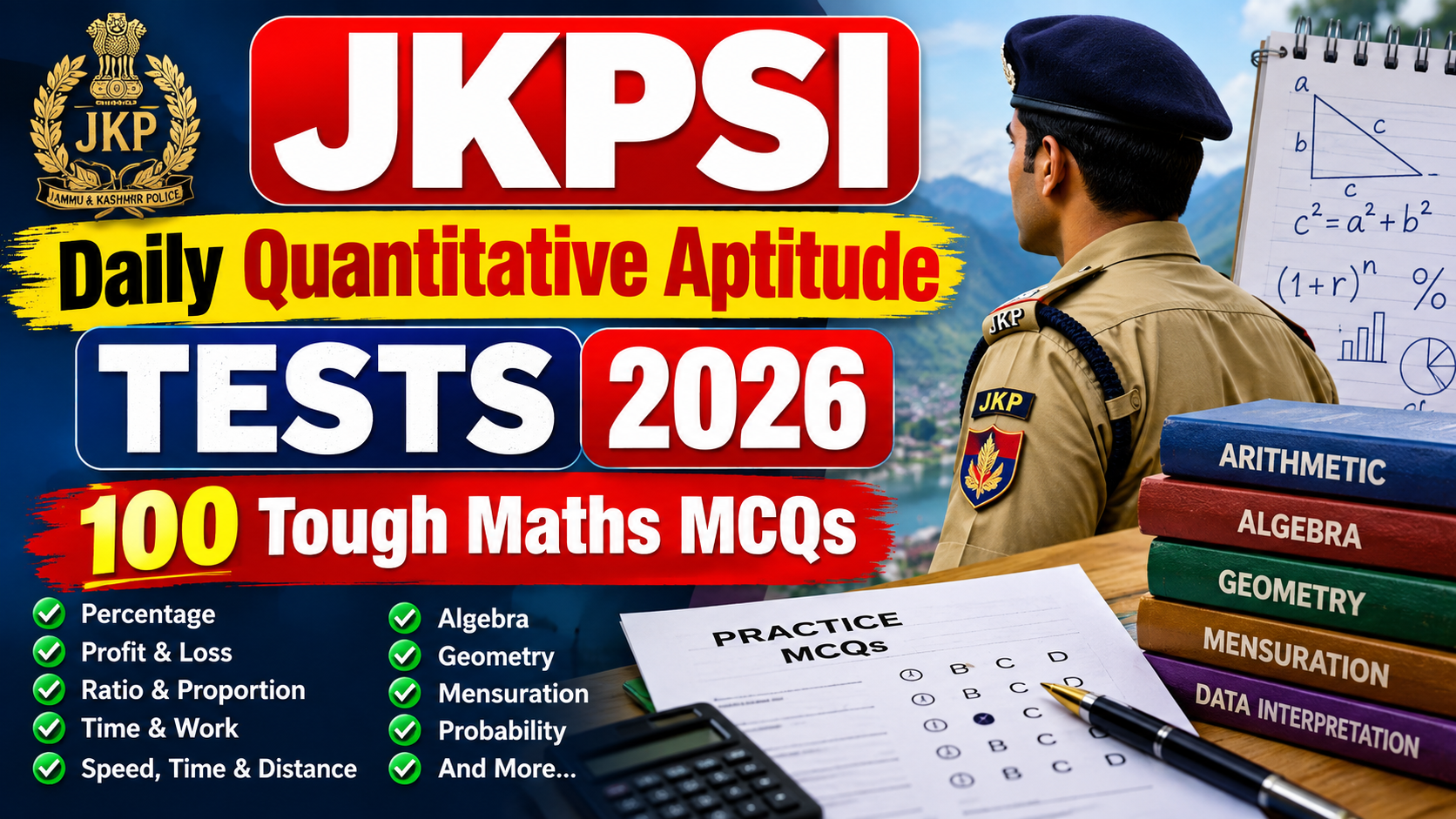
JKPSI Daily Quantitative Aptitude Tests 2026 – 100 Tough Maths MCQs
Quantitative Aptitude is one of those sections where preparation is not just about knowing formulas. For JKPSI aspirants, the real challenge is solving a question correctly within a limited amount of time. A candidate may know the formula for percentage, profit and loss, time and work, ratio or probability, but still lose marks because of calculation mistakes, poor time management or confusion between similar concepts.
That is exactly why daily Quantitative Aptitude practice is important.
Instead of studying Maths for several hours once a week, it is much more effective to solve a focused set of questions every day. Even 20–30 quality questions can improve calculation speed, accuracy and confidence when practiced consistently.
This page is designed for aspirants preparing for JKPSI, JKSSB, JKP, SSC, Banking, Railway and other competitive examinations where Quantitative Aptitude plays an important role.
Download Complete study Material with full mocktests, sectional tests , mindmaps for jkpsi
Why Daily Maths Practice Matters for JKPSI
Mathematics becomes easier when your brain becomes familiar with different question patterns. During an actual examination, you should not spend several minutes trying to understand a basic percentage or ratio question.
Daily practice helps you recognize patterns quickly.
For example, after solving enough questions on percentages, you start identifying whether a problem requires:
successive percentage change,
percentage increase or decrease,
comparison of quantities,
expenditure-based calculation,
population growth, or
profit and loss application.
The same principle applies to time and work, speed and distance, averages, mixtures, simple and compound interest, algebra, geometry and mensuration.
The purpose of these daily tests is therefore not simply to count how many questions you answered correctly. The bigger objective is to improve your speed + accuracy + question selection.
Important Topics for Quantitative Aptitude
A serious JKPSI aspirant should gradually build command over the following areas:
Arithmetic
Arithmetic usually forms the foundation of competitive-exam Mathematics. Important topics include:
Percentage
Ratio and Proportion
Average
Profit and Loss
Discount
Simple Interest
Compound Interest
Time and Work
Pipes and Cisterns
Time, Speed and Distance
Boats and Streams
Mixture and Alligation
Partnership
Ages
Number-Based Topics
Do not ignore number-based questions. Practice:
HCF and LCM
Divisibility
Remainders
Number series
Simplification
Fractions
Decimals
Surds and indices
Advanced Quantitative Aptitude
Once your arithmetic foundation is strong, move towards:
Algebra
Geometry
Mensuration
Probability
Permutation and Combination
Data Interpretation
How to Use Daily JKPSI Quantitative Aptitude Tests
Simply solving questions is not enough.
Try following a three-step approach.
Step 1 – Solve without looking at the answer.
Give yourself a reasonable time limit. Do not immediately check the solution whenever a question looks difficult.
Step 2 – Analyse your mistakes.
If your answer is wrong, identify why. Was it a calculation mistake? Did you use the wrong formula? Did you misunderstand the question? Or did you simply run out of time?
Step 3 – Reattempt difficult questions.
Questions that you initially got wrong should be solved again after some time. This is where real improvement happens.
Don't Ignore Calculation Speed
Many candidates focus heavily on formulas but ignore basic calculations. In a competitive examination, this can become a serious disadvantage.
Practice squares, cubes, fractions, percentage conversions and multiplication regularly.
For example, knowing that:
25% = 1/4
12.5% = 1/8
33.33% ≈ 1/3
16.67% ≈ 1/6
20% = 1/5
37.5% = 3/8
can save valuable seconds in many questions.
Accuracy Is More Important Than Guesswork
The goal of daily practice should not be to attempt every question blindly.
Suppose you solve 25 questions and get 22 correct. That is much more useful than rushing through 40 questions and making 15 mistakes.
Maintain a small Maths Error Notebook. Whenever you make a repeated mistake, write the concept or shortcut there.
Before the examination, this notebook can become one of your most useful revision resources.
JKPSI Daily Quantitative Aptitude Practice
The following 100 questions are intentionally mixed and challenging. They cover different concepts rather than repeating the same formula again and again.
Try solving them first without checking the answers.
Target: Aim for high accuracy first. Then gradually reduce your solving time.
100 Tough JKPSI Quantitative Aptitude MCQs
1.
A number is increased by 25% and then decreased by 20%. What is the net percentage change?
A) 5% increase
B) 5% decrease
C) No change
D) 2% increase
Answer: C
2.
A shopkeeper marks an article 40% above its cost price and allows a discount of 15%. If the cost price is ₹2,500, what is the selling price?
A) ₹2,850
B) ₹2,975
C) ₹2,950
D) ₹2,875
Answer: B
3.
The average of 12 numbers is 48. If two numbers 36 and 54 are removed, what will be the average of the remaining numbers?
A) 47
B) 48
C) 49
D) 50
Answer: B
4.
A sum becomes ₹14,400 in 2 years at 20% compound interest per annum. What was the principal?
A) ₹9,500
B) ₹10,000
C) ₹10,500
D) ₹11,000
Answer: B
5.
A can complete a work in 18 days and B can complete it in 24 days. If they work together for 6 days, what fraction of the work remains?
A) 5/12
B) 7/12
C) 1/3
D) 3/8
Answer: A
6.
A train 180 m long crosses a pole in 9 seconds. What is its speed in km/h?
A) 60
B) 72
C) 80
D) 90
Answer: B
7.
The ratio of incomes of A and B is 5:7, while their expenditures are in the ratio 3:5. If A saves ₹2,000 and B saves ₹1,000, what is B's income?
A) ₹7,000
B) ₹8,000
C) ₹9,000
D) ₹10,000
Answer: A
8.
A man spends 75% of his income. If his income increases by 20% and expenditure increases by 10%, his savings increase by ₹2,500. Find his original income.
A) ₹20,000
B) ₹22,000
C) ₹25,000
D) ₹30,000
Answer: C
9.
If 3x + 7 = 4x - 9, find x.
A) 14
B) 15
C) 16
D) 17
Answer: C
10.
The HCF of two numbers is 18 and their LCM is 540. If one number is 90, find the other.
A) 96
B) 108
C) 120
D) 126
Answer: B
11.
A sum of money is divided among A, B and C in the ratio 3:5:7. If C receives ₹2,800 more than A, find the total amount.
A) ₹8,400
B) ₹9,800
C) ₹10,500
D) ₹12,600
Answer: D
12.
A boat travels 30 km downstream in 2 hours and the same distance upstream in 3 hours. What is the speed of the boat in still water?
A) 10 km/h
B) 12 km/h
C) 12.5 km/h
D) 15 km/h
Answer: C
13.
A pipe can fill a tank in 12 hours, while another pipe can empty it in 18 hours. If both are opened together, how long will the tank take to fill?
A) 24 hours
B) 30 hours
C) 36 hours
D) 40 hours
Answer: C
14.
A man bought an article for ₹1,800 and sold it at a profit of 16⅔%. Find the selling price.
A) ₹2,050
B) ₹2,100
C) ₹2,125
D) ₹2,150
Answer: B
15.
If 40% of a number is 72, what is 75% of the same number?
A) 120
B) 125
C) 135
D) 145
Answer: C
16.
The difference between compound interest and simple interest on ₹8,000 for 2 years at 10% per annum is:
A) ₹60
B) ₹80
C) ₹100
D) ₹120
Answer: B
17.
A person covers half of a distance at 40 km/h and the remaining half at 60 km/h. What is his average speed?
A) 45 km/h
B) 48 km/h
C) 50 km/h
D) 52 km/h
Answer: B
18.
If x:y = 4:7 and y:z = 14:15, then x:z is:
A) 4:15
B) 8:15
C) 7:15
D) 8:21
Answer: B
19.
The perimeter of a rectangle is 100 cm and its length is 30 cm. Find its area.
A) 500 cm²
B) 550 cm²
C) 600 cm²
D) 650 cm²
Answer: C
20.
The radius of a circle is increased by 20%. By what percentage does its area increase?
A) 20%
B) 40%
C) 44%
D) 48%
Answer: C
21.
A number when divided by 7 leaves remainder 4. What remainder will be obtained when its square is divided by 7?
A) 1
B) 2
C) 3
D) 4
Answer: D
22.
The sum of three consecutive odd numbers is 147. Find the largest number.
A) 47
B) 49
C) 51
D) 53
Answer: C
23.
A person deposits ₹5,000 at 8% simple interest per annum. What amount will he receive after 3 years?
A) ₹6,000
B) ₹6,100
C) ₹6,200
D) ₹6,300
Answer: C
24.
A and B invest ₹12,000 and ₹18,000 respectively. After 4 months A doubles his investment. If the total profit is ₹15,000, what is B's share?
A) ₹7,500
B) ₹8,000
C) ₹8,500
D) ₹9,000
Answer: A
25.
A mixture contains milk and water in the ratio 7:3. If 20 litres of water are added, the ratio becomes 7:5. Find the original quantity of mixture.
A) 100 litres
B) 120 litres
C) 140 litres
D) 150 litres
Answer: A
26.
If 5 men can complete a work in 24 days, how many men are required to complete the same work in 10 days?
A) 10
B) 12
C) 14
D) 15
Answer: B
27.
A train travelling at 54 km/h crosses a bridge 240 m long in 28 seconds. Find the length of the train.
A) 160 m
B) 180 m
C) 200 m
D) 220 m
Answer: C
28.
The marked price of an article is ₹4,000. After successive discounts of 10% and 20%, what is its selling price?
A) ₹2,800
B) ₹2,880
C) ₹2,900
D) ₹3,000
Answer: B
29.
If the price of sugar increases by 25%, by what percentage should consumption be reduced to keep expenditure unchanged?
A) 15%
B) 18%
C) 20%
D) 25%
Answer: C
30.
A man walks at 5 km/h and reaches his destination 12 minutes late. If he walks at 6 km/h, he reaches 10 minutes early. Find the distance.
A) 10 km
B) 11 km
C) 12 km
D) 15 km
Answer: C
31.
The average age of 8 persons is 24 years. If a person aged 32 joins them, what is the new average?
A) 24⅘
B) 24⁸/₉
C) 25
D) 25⅓
Answer: B
32.
If 2x + 3y = 17 and x - y = 1, find x + y.
A) 5
B) 6
C) 7
D) 8
Answer: B
33.
The diagonal of a square is 14√2 cm. Find its area.
A) 196 cm²
B) 392 cm²
C) 98 cm²
D) 784 cm²
Answer: A
34.
The volume of a cube is 729 cm³. Find its total surface area.
A) 486 cm²
B) 500 cm²
C) 512 cm²
D) 540 cm²
Answer: A
35.
A cylinder has radius 7 cm and height 10 cm. Using π = 22/7, find its curved surface area.
A) 420 cm²
B) 440 cm²
C) 460 cm²
D) 480 cm²
Answer: B
36.
A sum becomes ₹12,100 in two years at 10% compound interest annually. Find the principal.
A) ₹9,000
B) ₹10,000
C) ₹10,500
D) ₹11,000
Answer: B
37.
If 15% of A = 20% of B, then A:B equals:
A) 3:4
B) 4:3
C) 5:4
D) 4:5
Answer: B
38.
A man sells an article at 20% profit. Had he bought it for 10% less and sold it for ₹30 less, his profit would have been 25%. Find the original cost price.
A) ₹400
B) ₹500
C) ₹600
D) ₹750
Answer: B
39.
The simple interest on a certain sum for 4 years at 7.5% is ₹1,800. Find the principal.
A) ₹5,000
B) ₹6,000
C) ₹7,000
D) ₹8,000
Answer: B
40.
Two numbers are in the ratio 5:8. If their difference is 39, find their sum.
A) 143
B) 156
C) 169
D) 182
Answer: C
41.
A can do a work in 15 days, B in 20 days and C in 30 days. Working together, they can complete it in:
A) 5 days
B) 6 days
C) 7 days
D) 8 days
Answer: B
42.
A pipe fills a tank in 20 minutes and a leak empties it in 30 minutes. If both operate simultaneously, how long will the tank take to fill?
A) 40 minutes
B) 50 minutes
C) 60 minutes
D) 70 minutes
Answer: C
43.
A car covers 360 km at a certain speed. If its speed is increased by 10 km/h, it takes 1 hour less. Find its original speed.
A) 50 km/h
B) 60 km/h
C) 70 km/h
D) 80 km/h
Answer: B
44.
A number is first increased by 30% and then increased by 20%. The total increase is:
A) 50%
B) 52%
C) 54%
D) 56%
Answer: B
45.
If 3/5 of a number exceeds 2/7 of the same number by 55, find the number.
A) 125
B) 140
C) 175
D) 210
Answer: C
46.
A shopkeeper gives 20% discount on marked price and still gains 25%. If the cost price is ₹800, find the marked price.
A) ₹1,000
B) ₹1,100
C) ₹1,200
D) ₹1,250
Answer: C
47.
The ratio of boys to girls in a class is 7:5. If 12 girls join, the ratio becomes 7:6. Find the original number of girls.
A) 48
B) 54
C) 60
D) 72
Answer: C
48.
A sum is divided into two parts in the ratio 4:5. If the larger part exceeds the smaller by ₹720, find the total sum.
A) ₹6,480
B) ₹7,200
C) ₹8,100
D) ₹9,000
Answer: B
49.
A 20% discount followed by a 10% discount is equivalent to a single discount of:
A) 26%
B) 28%
C) 30%
D) 32%
Answer: B
50.
The selling price of an article is ₹2,760 after a 15% discount. Find its marked price.
A) ₹3,000
B) ₹3,200
C) ₹3,250
D) ₹3,400
Answer: B
51.
A man invests ₹10,000 at 12% compound interest per annum. Find the interest earned in two years.
A) ₹2,400
B) ₹2,544
C) ₹2,600
D) ₹2,800
Answer: B
52.
If x² - 9x + 20 = 0, the values of x are:
A) 2 and 10
B) 4 and 5
C) 3 and 7
D) 1 and 20
Answer: B
53.
If the average of five consecutive integers is 42, what is the product of the smallest and largest integers?
A) 1,680
B) 1,720
C) 1,760
D) 1,800
Answer: C
54.
A rectangular field is 80 m long and 60 m wide. A path of width 5 m is constructed inside it along all four sides. Find the area of the path.
A) 1,200 m²
B) 1,300 m²
C) 1,400 m²
D) 1,500 m²
Answer: B
55.
The area of a triangle is 540 cm² and its base is 36 cm. Find its height.
A) 25 cm
B) 28 cm
C) 30 cm
D) 32 cm
Answer: C
56.
A ladder 25 m long reaches a window 24 m above the ground. How far is the foot of the ladder from the wall?
A) 5 m
B) 6 m
C) 7 m
D) 8 m
Answer: B
57.
A number leaves remainder 5 when divided by 8. What remainder will its cube leave when divided by 8?
A) 1
B) 3
C) 5
D) 7
Answer: C
58.
The LCM of 24, 36 and 54 is:
A) 108
B) 216
C) 324
D) 432
Answer: B
59.
A man spends 30% of his income on rent, 20% on food and 15% on education. If he saves ₹7,000, find his income.
A) ₹18,000
B) ₹20,000
C) ₹22,000
D) ₹25,000
Answer: B
60.
If 8 workers working 6 hours daily complete a work in 15 days, how many workers working 8 hours daily can complete it in 9 days?
A) 8
B) 9
C) 10
D) 12
Answer: C
61.
A train 250 m long travelling at 72 km/h crosses another train 350 m long travelling in the opposite direction at 54 km/h. How many seconds will they take to cross each other?
A) 15
B) 18
C) 20
D) 24
Answer: C
62.
A boat's speed in still water is 15 km/h and stream speed is 3 km/h. How much time will it take to travel 72 km downstream?
A) 4 hours
B) 4.5 hours
C) 5 hours
D) 6 hours
Answer: B
63.
A and B can complete a work in 12 and 18 days respectively. They work together for 4 days. What percentage of the work remains?
A) 44.44%
B) 50%
C) 55.56%
D) 60%
Answer: C
64.
A mixture contains alcohol and water in the ratio 5:3. If 16 litres of water are added, the ratio becomes 5:7. Find the original quantity of alcohol.
A) 10 litres
B) 15 litres
C) 20 litres
D) 25 litres
Answer: C
65.
A person purchases 15 articles for ₹1,200 and sells each article for ₹100. His profit percentage is:
A) 20%
B) 22.5%
C) 25%
D) 30%
Answer: C
66.
If the price of an article is reduced by 20%, a person can buy 5 more articles for ₹400. Find the original price per article.
A) ₹16
B) ₹20
C) ₹25
D) ₹30
Answer: C
67.
The present ages of A and B are in the ratio 4:5. After 6 years, their ages will be in the ratio 5:6. Find A's present age.
A) 18 years
B) 20 years
C) 24 years
D) 30 years
Answer: C
68.
Five years ago, the ratio of ages of A and B was 3:4. Five years from now, their ratio will be 4:5. Find their present ages.
A) 20, 25
B) 25, 30
C) 30, 35
D) 35, 40
Answer: C
69.
If 4x - 5 = 3x + 12, find 2x + 7.
A) 35
B) 39
C) 41
D) 45
Answer: C
70.
The roots of x² - 13x + 40 = 0 are:
A) 4 and 10
B) 5 and 8
C) 6 and 7
D) 3 and 10
Answer: B
71.
If √x = 12, find x²/144.
A) 12
B) 72
C) 144
D) 288
Answer: C
72.
A circle has circumference 88 cm. Using π = 22/7, find its area.
A) 616 cm²
B) 628 cm²
C) 640 cm²
D) 672 cm²
Answer: A
73.
The curved surface area of a cylinder is 440 cm² and its radius is 7 cm. Find its height.
A) 8 cm
B) 10 cm
C) 12 cm
D) 14 cm
Answer: B
74.
A cone has radius 7 cm and height 24 cm. Find its slant height.
A) 23 cm
B) 24 cm
C) 25 cm
D) 26 cm
Answer: C
75.
A cube has a total surface area of 864 cm². Find its volume.
A) 1,728 cm³
B) 1,944 cm³
C) 2,048 cm³
D) 2,160 cm³
Answer: A
76.
A person travels 120 km at 40 km/h and returns at 60 km/h. Find his average speed for the entire journey.
A) 45 km/h
B) 48 km/h
C) 50 km/h
D) 52 km/h
Answer: B
77.
Two numbers are in the ratio 3:5. If 8 is added to each, their ratio becomes 5:7. Find the smaller number.
A) 10
B) 12
C) 14
D) 16
Answer: B
78.
The average of 20 numbers is 35. If each number is increased by 7, what will be the new average?
A) 40
B) 42
C) 45
D) 49
Answer: B
79.
A student scores 72, 68, 75, 81 and 64 marks in five subjects. What marks must he score in the sixth subject to obtain an average of 75?
A) 80
B) 82
C) 85
D) 90
Answer: C
80.
A shopkeeper buys an article for ₹2,400. He marks it 25% above cost price and offers a discount of 8%. Find his profit.
A) ₹420
B) ₹440
C) ₹480
D) ₹500
Answer: B
81.
If a number is decreased by 15%, the result is 340. What was the original number?
A) 380
B) 400
C) 420
D) 450
Answer: B
82.
The difference between 35% and 20% of a number is 90. Find 45% of the number.
A) 240
B) 250
C) 270
D) 300
Answer: C
83.
A sum of ₹9,600 is divided among A, B and C such that A receives twice B and B receives three times C. Find C's share.
A) ₹800
B) ₹960
C) ₹1,000
D) ₹1,200
Answer: B
84.
If 12% of a number is 84, then 18% of that number is:
A) 108
B) 120
C) 126
D) 132
Answer: C
85.
A man sells two articles for ₹1,000 each. On one he gains 20% and on the other he loses 20%. What is his overall result?
A) 4% gain
B) 4% loss
C) No profit, no loss
D) 5% loss
Answer: B
86.
A trader mixes two varieties of rice costing ₹40/kg and ₹60/kg in the ratio 3:2. Find the average cost per kg.
A) ₹46
B) ₹48
C) ₹50
D) ₹52
Answer: B
87.
A tank contains 800 litres of water. 20% is removed and replaced with pure water. This process is repeated twice. How much of the original water remains?
A) 480 litres
B) 512 litres
C) 520 litres
D) 540 litres
Answer: B
88.
A man invests ₹15,000 for 8 months and another invests ₹20,000 for 6 months. Their profit-sharing ratio is:
A) 2:3
B) 1:1
C) 3:4
D) 4:5
Answer: B
89.
A can complete a work in 10 days and B in 15 days. They work together for 3 days. What percentage of work is completed?
A) 40%
B) 45%
C) 50%
D) 60%
Answer: C
90.
A pipe fills a tank in 15 hours, B in 20 hours and C empties it in 30 hours. If all three are opened together, how long will it take to fill the tank?
A) 8 hours
B) 9 hours
C) 10 hours
D) 12 hours
Answer: C
91.
A train running at 90 km/h crosses a 450 m platform in 30 seconds. Find the length of the train.
A) 250 m
B) 300 m
C) 350 m
D) 400 m
Answer: B
92.
The probability of drawing a king from a standard deck of 52 cards is:
A) 1/13
B) 1/26
C) 4/13
D) 1/4
Answer: A
93.
Two dice are thrown simultaneously. What is the probability that the sum is 9?
A) 1/6
B) 1/9
C) 1/12
D) 1/18
Answer: B
94.
How many different 3-digit numbers can be formed using the digits 1, 2, 3, 4 and 5 without repetition?
A) 30
B) 40
C) 50
D) 60
Answer: D
95.
A bag contains 5 red, 4 blue and 3 green balls. One ball is drawn at random. What is the probability that it is neither red nor green?
A) 1/3
B) 1/4
C) 1/5
D) 1/2
Answer: B
96.
If the arithmetic mean of two numbers is 25 and their geometric mean is 24, find the difference between the numbers.
A) 7
B) 10
C) 14
D) 18
Answer: C
97.
The sum of the first 20 natural numbers is:
A) 190
B) 200
C) 210
D) 220
Answer: C
98.
The sum of the first 15 odd natural numbers is:
A) 200
B) 215
C) 225
D) 240
Answer: C
99.
A two-digit number has its tens digit twice its units digit. If the number exceeds the number obtained by reversing its digits by 27, find the number.
A) 42
B) 63
C) 84
D) 86
Answer: C
100.
A number is increased by 20%, then decreased by 25%, and finally increased by 10%. What is the net percentage change?
A) 1% decrease
B) 1% increase
C) 2% decrease
D) 5% decrease
Answer: A
Also read: jkssb english practice questions
Final Strategy for JKPSI Quantitative Aptitude
Do not treat these 100 questions as a one-time test. Use them as a daily practice resource.
On the first attempt, concentrate on accuracy. On the second attempt, try to solve the questions faster. Questions that repeatedly cause mistakes should be marked and revised separately.
A good JKPSI Maths routine can be:
Daily Concept Revision → 20–30 MCQs → Mistake Analysis → Reattempt → Formula Revision
Remember, Quantitative Aptitude is a skill-based section. You do not become faster by simply reading formulas. You become faster by solving questions repeatedly and understanding why your answers are right or wrong.
For JKPSI aspirants, consistency matters more than studying hundreds of questions on a single day and then taking a long break. Even a focused daily practice session can gradually improve calculation speed and confidence.
Keep practising, maintain your accuracy, and gradually increase the difficulty level.
Practice every day. Analyse every mistake. Improve every attempt.
JKPSI preparation becomes much more manageable when Maths is converted from a difficult subject into a daily habit.