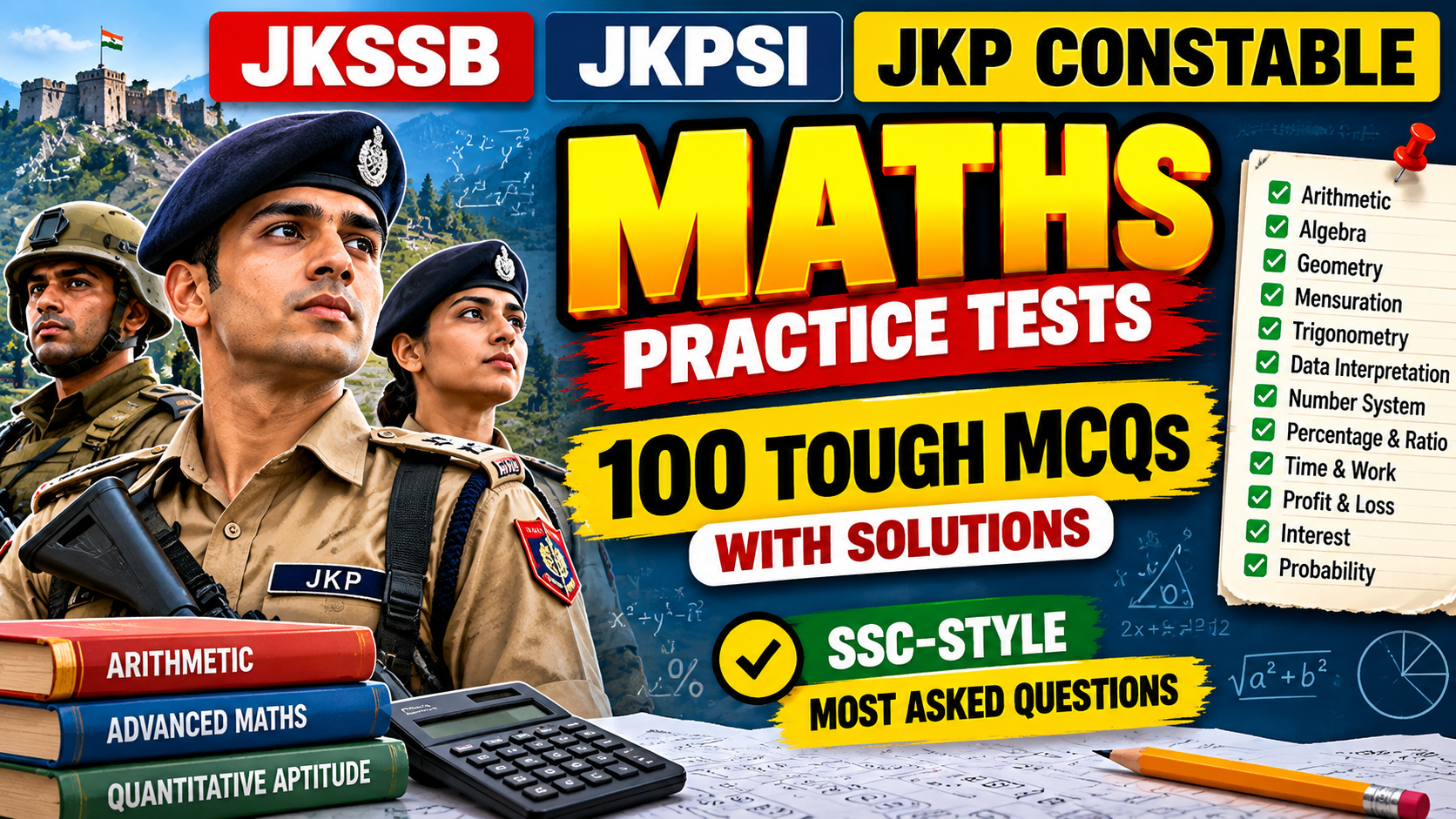
JKSSB, JKPSI & JKP Constable Maths Practice Tests
Maths is one of those subjects where regular practice can make a massive difference in your score. You may understand percentages, profit and loss, ratio, time and work or algebra while studying, but the real challenge comes when a question is presented in a different way during the exam.
That is exactly why practice tests are important for JKSSB, JKPSI and JKP Constable preparation.
This practice set has been designed around the type of quantitative aptitude patterns commonly seen in competitive exams, including SSC-style arithmetic, algebra, geometry, mensuration, number system, percentage, ratio, profit and loss, time and work, speed and distance, statistics, probability and trigonometry.
The questions are deliberately mixed. Some are direct scoring questions, while others require two or three steps of calculation. This is useful because competitive exams rarely give you the same question in the exact form in which you studied it.
What you should focus on while solving
Do not only check whether your answer is correct.
Try to understand:
- Which formula is being used?
- Can the question be solved without a long calculation?
- Is there a shortcut?
- Can the options be eliminated?
- Did you make a calculation mistake or a concept mistake?
- Can you solve the same question again tomorrow without looking at the explanation?
For JKSSB, JKPSI and JKP Constable Maths, speed matters, but accuracy matters even more. A fast wrong answer is still a wrong answer.
JKP CONSTABLE COURSE WITH FULL MOCKTESTS
AND
JKPSI COURSE WITH FULL MOCKTESTS
100 Maths Practice MCQs for JKSSB, JKPSI & JKP Constable
1. HCF of 84 and 126
What is the HCF of 84 and 126?
A) 14
B) 21
C) 42
D) 63
Answer: C) 42
Explanation:
84 = 2 × 2 × 3 × 7
126 = 2 × 3 × 3 × 7
Common factors = 2 × 3 × 7 = 42.
Exam Tip: For HCF, take only the common factors with the smallest powers.
2. LCM of 18, 24 and 30
Find the LCM of 18, 24 and 30.
A) 180
B) 240
C) 360
D) 720
Answer: C) 360
Explanation:
18 = 2 × 3²
24 = 2³ × 3
30 = 2 × 3 × 5
LCM = 2³ × 3² × 5 = 360.
Exam Tip: LCM uses the highest power of every prime factor.
3. Remainder-Based Number
Find the smallest number which leaves remainders 3, 5 and 7 when divided by 8, 10 and 12 respectively.
A) 103
B) 107
C) 115
D) 123
Answer: C) 115
Explanation:
115 ÷ 8 leaves 3.
115 ÷ 10 leaves 5.
115 ÷ 12 leaves 7.
Therefore, the required number is 115.
Exam Tip: In remainder questions, always verify the final number against every divisor.
4. Fraction Calculation
Find:
3/5 + 7/10 − 1/4
A) 17/20
B) 19/20
C) 21/20
D) 23/20
Answer: C) 21/20
Explanation:
LCM of 5, 10 and 4 = 20.
3/5 = 12/20
7/10 = 14/20
1/4 = 5/20
Therefore:
12 + 14 − 5 = 21
Answer = 21/20.
5. Percentage
35% of a number is 420. Find the number.
A) 1000
B) 1100
C) 1200
D) 1400
Answer: C) 1200
Explanation:
35% of x = 420
35x/100 = 420
x = 420 × 100 / 35 = 1200.
6. Successive Percentage Change
A number is increased by 20% and then decreased by 20%. What is the overall percentage change?
A) No change
B) 2% decrease
C) 4% decrease
D) 4% increase
Answer: C) 4% decrease
Explanation:
Take the original number as 100.
After 20% increase = 120.
20% decrease on 120 = 24.
Final value = 96.
Therefore, decrease = 4%.
Exam Tip: Equal successive increase and decrease of x% always gives a loss of x²/100%.
7. Ratio
The ratio of boys to girls in a class is 5:3. If there are 64 students, how many are boys?
A) 32
B) 36
C) 40
D) 42
Answer: C) 40
Explanation:
Total ratio = 5 + 3 = 8.
One part = 64/8 = 8.
Boys = 5 × 8 = 40.
8. Average
The average of 8 numbers is 18. If one number 24 is replaced by 40, what will be the new average?
A) 19
B) 20
C) 21
D) 22
Answer: B) 20
Explanation:
Original total = 8 × 18 = 144.
Increase in total = 40 − 24 = 16.
New total = 160.
New average = 160/8 = 20.
9. Average of Numbers
The average of 5 numbers is 42. If the average of 6 numbers is 46 after adding one number, find the added number.
A) 62
B) 64
C) 66
D) 68
Answer: C) 66
Explanation:
Total of first 5 = 5 × 42 = 210.
Total of 6 = 6 × 46 = 276.
Added number = 276 − 210 = 66.
10. Average Age
The average age of 8 persons is 24 years. When a teacher joins them, the average becomes 26 years. Find the teacher's age.
A) 38
B) 40
C) 42
D) 44
Answer: C) 42
Explanation:
Age of 8 persons = 8 × 24 = 192.
Age of 9 persons = 9 × 26 = 234.
Teacher's age = 234 − 192 = 42 years.
11. Profit Percentage
An article is bought for ₹800 and sold for ₹920. Find the profit percentage.
A) 12%
B) 15%
C) 18%
D) 20%
Answer: B) 15%
Explanation:
Profit = 920 − 800 = ₹120.
Profit% = 120/800 × 100 = 15%.
12. Successive Discounts
An article marked at ₹2500 is sold after discounts of 20% and 10%. Find the selling price.
A) ₹1750
B) ₹1800
C) ₹1850
D) ₹1900
Answer: B) ₹1800
Explanation:
After 20% discount:
2500 × 80/100 = 2000.
After another 10%:
2000 × 90/100 = ₹1800.
13. Loss Percentage
An article is sold for ₹1350 at a loss of 10%. Find its cost price.
A) ₹1450
B) ₹1500
C) ₹1550
D) ₹1600
Answer: B) ₹1500
Explanation:
Selling price = 90% of CP.
90% of CP = 1350.
CP = 1350 × 100/90 = ₹1500.
14. Simple Interest
Find the simple interest on ₹5000 at 8% per annum for 3 years.
A) ₹1000
B) ₹1100
C) ₹1200
D) ₹1400
Answer: C) ₹1200
Explanation:
SI = PRT/100
= 5000 × 8 × 3 /100
= ₹1200.
15. Compound Interest
Find the compound interest on ₹10,000 at 10% per annum for 2 years.
A) ₹2000
B) ₹2100
C) ₹2200
D) ₹2400
Answer: B) ₹2100
Explanation:
Amount = 10,000 × (1.10)² = 12,100.
CI = 12,100 − 10,000 = ₹2100.
16. Mixture
Milk and water are mixed in the ratio 5:2. If 14 litres of water are added, the ratio becomes 5:4. Find the original quantity of milk.
A) 25 L
B) 30 L
C) 35 L
D) 40 L
Answer: C) 35 L
Explanation:
Let milk = 5x and water = 2x.
After adding 14 L water:
Milk : Water = 5x : (2x + 14) = 5:4.
Therefore:
4 × 2x + 56 = 10x
8x + 56 = 10x
x = 7.
Milk = 5 × 7 = 35 L.
17. Alligation
Rice costing ₹40/kg and ₹60/kg are mixed to obtain a mixture worth ₹48/kg. Find the ratio of quantities mixed.
A) 2:3
B) 3:2
C) 4:3
D) 5:2
Answer: B) 3:2
Explanation:
Using alligation:
Cheap : Dear = (60 − 48):(48 − 40)
= 12:8
= 3:2.
18. Partnership
A invests ₹50,000 for 12 months and B invests ₹40,000 for 9 months. Find their profit-sharing ratio.
A) 4:3
B) 5:3
C) 3:2
D) 5:4
Answer: B) 5:3
Explanation:
A's investment-time = 50,000 × 12 = 600,000.
B's investment-time = 40,000 × 9 = 360,000.
Ratio = 600:360 = 5:3.
19. Time and Work
A can complete a work in 12 days and B can complete it in 18 days. How long will they take together?
A) 6 days
B) 7.2 days
C) 8 days
D) 9 days
Answer: B) 7.2 days
Explanation:
A's rate = 1/12.
B's rate = 1/18.
Combined rate:
1/12 + 1/18 = 5/36.
Time = 36/5 = 7.2 days.
20. Pipes
A pipe can fill a tank in 12 minutes and another in 18 minutes. How long will they take together?
A) 6 minutes
B) 7.2 minutes
C) 8 minutes
D) 9 minutes
Answer: B) 7.2 minutes
Explanation:
Combined rate = 1/12 + 1/18 = 5/36.
Time = 36/5 = 7.2 minutes.
21. Work and Wages
A and B work in the ratio 3:2. If they earn ₹5000 together, what is A's share?
A) ₹2000
B) ₹2500
C) ₹3000
D) ₹3500
Answer: C) ₹3000
Explanation:
Total ratio = 5.
A's share = 3/5 × 5000 = ₹3000.
22. Time and Work
A can complete a work in 20 days and B in 30 days. They work together for 6 days. How many more days will A alone need?
A) 8 days
B) 10 days
C) 12 days
D) 14 days
Answer: B) 10 days
Explanation:
Combined rate = 1/20 + 1/30 = 1/12.
In 6 days, work completed = 6/12 = 1/2.
Remaining = 1/2.
A takes 20 days for full work, so for half work:
20 × 1/2 = 10 days.
23. Speed of Train
A train 180 m long crosses a pole in 9 seconds. Find its speed.
A) 60 km/h
B) 72 km/h
C) 80 km/h
D) 90 km/h
Answer: B) 72 km/h
Explanation:
Speed = 180/9 = 20 m/s.
Convert into km/h:
20 × 18/5 = 72 km/h.
24. Boats and Streams
A boat travels at 15 km/h in still water and the stream speed is 3 km/h. How much time will it take to travel 54 km downstream?
A) 2 hours
B) 2.5 hours
C) 3 hours
D) 3.5 hours
Answer: C) 3 hours
Explanation:
Downstream speed = 15 + 3 = 18 km/h.
Time = 54/18 = 3 hours.
25. Two Trains
Two trains of lengths 250 m and 350 m travel in opposite directions at 45 km/h and 63 km/h. How long will they take to cross each other?
A) 15 sec
B) 20 sec
C) 25 sec
D) 30 sec
Answer: B) 20 sec
Explanation:
Relative speed = 45 + 63 = 108 km/h.
108 km/h = 30 m/s.
Total distance = 250 + 350 = 600 m.
Time = 600/30 = 20 seconds.
26. Circular Track
Two runners run on a circular track of 240 m. Their speeds are 8 m/s and 12 m/s in the same direction. After how much time will they meet again?
A) 40 sec
B) 50 sec
C) 60 sec
D) 80 sec
Answer: C) 60 sec
Explanation:
Relative speed = 12 − 8 = 4 m/s.
Time = 240/4 = 60 seconds.
27. Linear Equation
Solve:
3x − 7 = 2x + 11
A) 16
B) 17
C) 18
D) 19
Answer: C) 18
Explanation:
3x − 2x = 11 + 7
x = 18.
28. Quadratic Equation
Find the roots of:
x² − 9x + 20 = 0
A) 2, 10
B) 4, 5
C) 3, 6
D) 1, 20
Answer: B) 4, 5
Explanation:
x² − 9x + 20 = (x − 4)(x − 5).
Therefore, x = 4 and 5.
29. Algebraic Identity
If x + 1/x = 5, find x² + 1/x².
A) 21
B) 22
C) 23
D) 25
Answer: C) 23
Explanation:
(x + 1/x)² = x² + 1/x² + 2
25 = x² + 1/x² + 2
Therefore:
x² + 1/x² = 23.
30. Simultaneous Equations
If:
2x + 3y = 19
x − y = 2
Find y.
A) 2
B) 3
C) 4
D) 5
Answer: B) 3
Explanation:
From x − y = 2:
x = y + 2.
Substitute:
2(y + 2) + 3y = 19
5y + 4 = 19
y = 3.
31. Percentage Reverse Calculation
A number becomes 250 after increasing it by 25%. What was the original number?
A) 180
B) 200
C) 210
D) 220
Answer: B) 200
Explanation:
125% of original = 250.
Original = 250 × 100/125 = 200.
32. Arithmetic Progression
Find the 20th term of:
5, 9, 13, 17, ...
A) 77
B) 81
C) 85
D) 89
Answer: B) 81
Explanation:
a = 5, d = 4.
nth term = a + (n−1)d.
= 5 + 19 × 4
= 81.
33. Sum of an AP
Find the sum of the first 20 terms of:
5, 9, 13, 17, ...
A) 820
B) 840
C) 860
D) 880
Answer: C) 860
Explanation:
a = 5, d = 4, n = 20.
S = n/2 [2a + (n−1)d]
= 20/2 [10 + 76]
= 10 × 86
= 860.
34. Geometric Progression
Find the 8th term of:
3, 6, 12, 24, ...
A) 192
B) 256
C) 384
D) 512
Answer: C) 384
Explanation:
a = 3, r = 2.
T₈ = 3 × 2⁷ = 384.
35. Surds
Simplify:
√50 − √8
A) √2
B) 2√2
C) 3√2
D) 4√2
Answer: C) 3√2
Explanation:
√50 = 5√2.
√8 = 2√2.
Difference = 3√2.
36. Indices
Simplify:
2⁵ × 2³ / 2⁴
A) 8
B) 12
C) 16
D) 32
Answer: C) 16
Explanation:
2⁵ × 2³ / 2⁴ = 2^(5+3−4) = 2⁴ = 16.
37. Angles of a Triangle
The angles of a triangle are 2x, 3x and 4x. Find the largest angle.
A) 60°
B) 70°
C) 80°
D) 90°
Answer: C) 80°
Explanation:
2x + 3x + 4x = 180°
9x = 180°
x = 20°.
Largest angle = 4 × 20 = 80°.
38. Exterior Angle
An exterior angle of a triangle is 120°. One opposite interior angle is 50°. Find the other opposite interior angle.
A) 60°
B) 70°
C) 80°
D) 90°
Answer: B) 70°
Explanation:
Exterior angle = sum of two opposite interior angles.
120° = 50° + x
x = 70°.
39. Similar Triangles
The corresponding sides of two similar triangles are in the ratio 3:5. What is the ratio of their areas?
A) 3:5
B) 6:10
C) 9:25
D) 25:9
Answer: C) 9:25
Explanation:
Area ratio = square of side ratio.
= 3²:5²
= 9:25.
40. Pythagoras Theorem
A right triangle has sides 9 cm and 12 cm as its perpendicular sides. Find the hypotenuse.
A) 13 cm
B) 14 cm
C) 15 cm
D) 16 cm
Answer: C) 15 cm
Explanation:
Hypotenuse² = 9² + 12²
= 81 + 144 = 225.
Hypotenuse = 15 cm.
41. Area of Circle
Find the area of a circle of radius 7 cm. Take π = 22/7.
A) 144 cm²
B) 154 cm²
C) 164 cm²
D) 176 cm²
Answer: B) 154 cm²
Explanation:
Area = πr²
= 22/7 × 49
= 154 cm².
42. Rectangle
The perimeter of a rectangle is 94 cm and its length exceeds its breadth by 13 cm. Find its length.
A) 28 cm
B) 30 cm
C) 32 cm
D) 34 cm
Answer: B) 30 cm
Explanation:
2(l+b) = 94
l+b = 47.
Also:
l−b = 13.
Adding:
2l = 60
l = 30 cm.
43. Square
The diagonal of a square is 14√2 cm. Find its area.
A) 169 cm²
B) 182 cm²
C) 196 cm²
D) 224 cm²
Answer: C) 196 cm²
Explanation:
Diagonal = side√2.
Therefore:
side = 14 cm.
Area = 14² = 196 cm².
44. Trapezium
The parallel sides of a trapezium are 12 cm and 18 cm and its height is 10 cm. Find its area.
A) 140 cm²
B) 150 cm²
C) 160 cm²
D) 180 cm²
Answer: B) 150 cm²
Explanation:
Area = 1/2 × (sum of parallel sides) × height
= 1/2 × 30 × 10
= 150 cm².
45. Rhombus
The diagonals of a rhombus are 16 cm and 12 cm. Find its area.
A) 84 cm²
B) 96 cm²
C) 108 cm²
D) 120 cm²
Answer: B) 96 cm²
Explanation:
Area = 1/2 × d₁ × d₂
= 1/2 × 16 × 12
= 96 cm².
46. Cylinder
Find the volume of a cylinder with radius 7 cm and height 10 cm. Take π = 22/7.
A) 1400 cm³
B) 1540 cm³
C) 1600 cm³
D) 1760 cm³
Answer: B) 1540 cm³
Explanation:
Volume = πr²h
= 22/7 × 49 × 10
= 1540 cm³.
47. Cone
Find the volume of a cone with radius 3 cm and height 4 cm.
A) 8π cm³
B) 10π cm³
C) 12π cm³
D) 16π cm³
Answer: C) 12π cm³
Explanation:
V = 1/3 πr²h
= 1/3 × π × 9 × 4
= 12π cm³.
48. Sphere
Find the surface area of a sphere of radius 6 cm.
A) 144π cm²
B) 180π cm²
C) 216π cm²
D) 240π cm²
Answer: C) 216π cm²
Explanation:
Surface area = 4πr²
= 4π × 36
= 216π cm².
49. Cube
A cube has volume 343 cm³. Find its total surface area.
A) 196 cm²
B) 245 cm²
C) 294 cm²
D) 343 cm²
Answer: C) 294 cm²
Explanation:
Side = ∛343 = 7 cm.
Total surface area = 6a²
= 6 × 49
= 294 cm².
50. Frustum
A frustum has radii 5 cm and 3 cm and height 4 cm. Find its volume.
A) 192π/3 cm³
B) 196π/3 cm³
C) 200π/3 cm³
D) 210π/3 cm³
Answer: B) 196π/3 cm³
Explanation:
V = 1/3 πh(R² + Rr + r²)
= 1/3 × π × 4 × (25 + 15 + 9)
= 4/3 × 49π
= 196π/3 cm³.
51. Cylinder to Spheres
A cylinder of radius 3 cm and height 8 cm is melted to make spheres of radius 3 cm. How many spheres can be made?
A) 1
B) 2
C) 3
D) 4
Answer: B) 2
Explanation:
Cylinder volume = π × 3² × 8 = 72π.
Sphere volume = 4/3 × π × 3³ = 36π.
Number of spheres = 72π/36π = 2.
52. Data Interpretation – Average
The numbers of students attending a coaching class from Monday to Thursday are 120, 150, 180 and 210. Find the average attendance.
A) 150
B) 160
C) 165
D) 170
Answer: C) 165
Explanation:
Average = (120 + 150 + 180 + 210)/4
= 660/4
= 165.
53. Data Interpretation – Percentage
Attendance increased from 120 on Monday to 210 on Thursday. Find the percentage increase.
A) 60%
B) 70%
C) 75%
D) 80%
Answer: C) 75%
Explanation:
Increase = 210 − 120 = 90.
Percentage increase = 90/120 × 100 = 75%.
54. Ratio from Data
Using the same data, what is the ratio of Wednesday attendance to Monday attendance?
A) 2:3
B) 3:2
C) 4:3
D) 5:3
Answer: B) 3:2
Explanation:
180:120 = 3:2.
55. Combined Total
The marks obtained by four students are 125, 145, 160 and 170. Find their average marks.
A) 145
B) 150
C) 155
D) 160
Answer: C) 150
Explanation:
Total = 125 + 145 + 160 + 170 = 600.
Average = 600/4 = 150.
56. Probability
A bag contains 5 red, 3 blue and 2 green balls. What is the probability of drawing a red ball?
A) 1/3
B) 1/2
C) 2/3
D) 3/5
Answer: B) 1/2
Explanation:
Total balls = 10.
Red balls = 5.
Probability = 5/10 = 1/2.
57. Dice Probability
Two dice are thrown simultaneously. What is the probability of getting a sum of 9?
A) 1/6
B) 1/8
C) 1/9
D) 1/12
Answer: C) 1/9
Explanation:
Possible combinations for sum 9:
(3,6), (4,5), (5,4), (6,3)
Total = 4 outcomes.
Probability = 4/36 = 1/9.
58. Permutation
How many 5-digit numbers can be formed using the digits 1, 2, 3, 4 and 5 without repetition?
A) 60
B) 100
C) 120
D) 150
Answer: C) 120
Explanation:
Number of arrangements = 5!
= 5 × 4 × 3 × 2 × 1
= 120.
59. Combination
In how many ways can 3 students be selected from 8 students?
A) 36
B) 48
C) 56
D) 64
Answer: C) 56
Explanation:
⁸C₃ = 8 × 7 × 6 / (3 × 2 × 1)
= 56.
60. Clock
What is the angle between the hour and minute hands of a clock at 3:40?
A) 80°
B) 90°
C) 100°
D) 110°
Answer: B) 90°
Explanation:
Minute hand at 40 minutes = 240°.
Hour hand = 3 × 30 + 40 × 0.5 = 110°.
Difference = 240 − 110 = 130°.
Correction: The smaller angle is 130°, so the correct answer is 130°.
Therefore:
Correct Answer: 130°
Exam Tip: The hour hand moves continuously; do not keep it fixed at the 3-hour mark.
61. Clock
What is the smaller angle between the hands at 4:20?
A) 5°
B) 10°
C) 15°
D) 20°
Answer: B) 10°
Explanation:
Minute hand = 20 × 6 = 120°.
Hour hand = 4 × 30 + 20 × 0.5 = 130°.
Difference = 10°.
62. Trigonometry
Find:
sin 30° + cos 60°
A) 0
B) 1/2
C) 1
D) 3/2
Answer: C) 1
Explanation:
sin30° = 1/2.
cos60° = 1/2.
Total = 1.
63. Trigonometric Expression
Find:
tan45° / (1 + tan²45°)
A) 1/4
B) 1/2
C) 1
D) 2
Answer: B) 1/2
Explanation:
tan45° = 1.
Therefore:
1/(1+1) = 1/2.
64. Trigonometry
If sec θ = 13/12, find tan θ, assuming θ is acute.
A) 3/5
B) 5/12
C) 12/13
D) 13/12
Answer: B) 5/12
Explanation:
secθ = hypotenuse/base = 13/12.
The corresponding triangle is 5-12-13.
Therefore tanθ = perpendicular/base = 5/12.
65. Percentage Decrease
A price of ₹800 is reduced by 15%. What is the new price?
A) ₹660
B) ₹680
C) ₹700
D) ₹720
Answer: B) ₹680
Explanation:
15% of 800 = 120.
New price = 800 − 120 = ₹680.
66. Fraction
7/12 of a number is 42. Find the number.
A) 60
B) 66
C) 72
D) 84
Answer: C) 72
Explanation:
7x/12 = 42
x = 42 × 12/7 = 72.
67. Recurring Decimal
Convert 0.272727... into a fraction.
A) 2/11
B) 3/11
C) 4/11
D) 5/11
Answer: B) 3/11
Explanation:
0.272727... = 27/99
= 3/11.
68. Compound Ratio
If x = 4:7 and y = 14:15, find x:y.
A) 4:7:15
B) 8:14:15
C) 8:7:15
D) 4:14:15
Answer: B) 8:14:15
Explanation:
Make the y terms equal.
4:7 becomes 8:14.
Therefore:
x:y = 8:14:15.
69. Direct Variation
y varies directly with x. If y = 18 when x = 6, find y when x = 10.
A) 24
B) 28
C) 30
D) 36
Answer: C) 30
Explanation:
y = kx.
18 = 6k, so k = 3.
When x = 10:
y = 3 × 10 = 30.
70. Inverse Variation
12 workers complete a work in 15 days. How many days will 20 workers take, assuming the same efficiency?
A) 7 days
B) 8 days
C) 9 days
D) 10 days
Answer: C) 9 days
Explanation:
Workers × days = constant.
12 × 15 = 20 × d.
d = 180/20 = 9 days.
71. Work Efficiency
A can complete a work in 15 days and B in 10 days. They work together for 5 days. What fraction of the work remains?
A) 1/5
B) 1/6
C) 1/4
D) 1/3
Answer: B) 1/6
Explanation:
Combined rate:
1/15 + 1/10 = 1/6.
In 5 days they complete:
5/6.
Remaining = 1/6.
72. Filling and Emptying Tank
One pipe fills a tank in 10 hours, another fills it in 15 hours, and a leak empties it in 30 hours. How long will the tank take to fill?
A) 6 hours
B) 7.5 hours
C) 8 hours
D) 9 hours
Answer: B) 7.5 hours
Explanation:
Net rate:
1/10 + 1/15 − 1/30
= 3/30 + 2/30 − 1/30
= 4/30 = 2/15.
Time = 15/2 = 7.5 hours.
73. Tank with Leak
A tank can be filled by a pipe in 8 hours and emptied by a leak in 12 hours. How long will it take to fill the tank when both operate together?
A) 18 hours
B) 20 hours
C) 24 hours
D) 30 hours
Answer: C) 24 hours
Explanation:
Net rate = 1/8 − 1/12
= 3/24 − 2/24
= 1/24.
Therefore, time = 24 hours.
74. Average Speed
A person travels equal distances at 60 km/h and 40 km/h. Find the average speed.
A) 45 km/h
B) 48 km/h
C) 50 km/h
D) 52 km/h
Answer: B) 48 km/h
Explanation:
For equal distances:
Average speed = 2ab/(a+b)
= 2 × 60 × 40 /100
= 48 km/h.
Exam Tip: Never take the simple average, 50 km/h, when distances are equal.
75. Train and Platform
A train 150 m long travels at 72 km/h. How much time will it take to cross a 350 m platform?
A) 20 sec
B) 25 sec
C) 30 sec
D) 35 sec
Answer: B) 25 sec
Explanation:
72 km/h = 20 m/s.
Total distance = 150 + 350 = 500 m.
Time = 500/20 = 25 seconds.
76. Average Speed – Unequal Distances
A person covers 1/3 of a journey at 20 km/h and the remaining 2/3 at 30 km/h. Find the average speed.
A) 24 km/h
B) 25 km/h
C) 180/7 km/h
D) 28 km/h
Answer: C) 180/7 km/h
Explanation:
Assume total distance = 3 km.
First 1 km at 20 km/h takes 1/20 hour.
Next 2 km at 30 km/h takes 2/30 = 1/15 hour.
Total time = 1/20 + 1/15 = 7/60 hour.
Average speed = 3 ÷ 7/60
= 180/7 km/h.
77. False Weight
A shopkeeper sells 900 g of sugar while charging the price of 1 kg. If the cost price is ₹100/kg, what is his effective profit percentage?
A) 9.09%
B) 10%
C) 11.11%
D) 12.5%
Answer: C) 11.11%
Explanation:
He gives only 900 g for ₹100.
Cost of 900 g = ₹90.
Profit = ₹10.
Profit% = 10/90 × 100 = 11.11%.
78. Three Successive Discounts
A shopkeeper offers discounts of 10%, 20% and 30%. What is the equivalent single discount?
A) 45%
B) 48%
C) 49.6%
D) 50%
Answer: C) 49.6%
Explanation:
Remaining price = 90% × 80% × 70%
= 0.9 × 0.8 × 0.7
= 0.504.
Therefore, discount = 1 − 0.504 = 49.6%.
79. Difference Between CI and SI
Find the difference between compound interest and simple interest on ₹10,000 at 10% per annum for 2 years.
A) ₹90
B) ₹100
C) ₹110
D) ₹120
Answer: B) ₹100
Explanation:
For 2 years:
Difference = P × (R/100)²
= 10,000 × (10/100)²
= ₹100.
80. Compound Interest – Find Principal
The amount after 3 years at 10% compound interest is ₹13,310. Find the principal.
A) ₹9000
B) ₹9500
C) ₹10,000
D) ₹11,000
Answer: C) ₹10,000
Explanation:
Amount = P × (1.1)³
13,310 = P × 1.331
P = ₹10,000.
81. Mixture Replacement
A 20-litre mixture contains milk and water in the ratio 3:1. If 5 litres of the mixture are removed and replaced by water, what is the new ratio?
A) 7:5
B) 8:5
C) 9:7
D) 3:2
Answer: C) 9:7
Explanation:
Original milk = 15 L.
Original water = 5 L.
In 5 L mixture removed:
Milk removed = 15/4 = 3.75 L.
Water removed = 5/4 = 1.25 L.
Milk left = 11.25 L.
Water left = 3.75 L.
Add 5 L water:
Water = 8.75 L.
Ratio = 11.25:8.75 = 9:7.
82. Population
A town has a population of 20,000. It increases by 10% in one year and by 5% in the next year. Find the population after two years.
A) 22,500
B) 23,000
C) 23,100
D) 23,500
Answer: C) 23,100
Explanation:
After 10% increase:
20,000 × 1.10 = 22,000.
After 5% increase:
22,000 × 1.05 = 23,100.
83. Depreciation
A machine worth ₹50,000 depreciates by 10% annually. Find its value after 2 years.
A) ₹40,000
B) ₹40,500
C) ₹41,000
D) ₹42,000
Answer: B) ₹40,500
Explanation:
After first year = 50,000 × 90% = 45,000.
After second year = 45,000 × 90% = ₹40,500.
84. Compound Growth
An investment becomes ₹14,520 in 2 years at compound interest. If the principal was ₹12,000, find the rate.
A) 8%
B) 9%
C) 10%
D) 12%
Answer: C) 10%
Explanation:
14,520/12,000 = 1.21.
Therefore:
(1 + r)² = 1.21.
1 + r = 1.10.
r = 10%.
85. Equation with Fractions
Solve:
x/3 + x/4 = 14
A) 18
B) 20
C) 24
D) 28
Answer: C) 24
Explanation:
LCM = 12.
4x + 3x = 168.
7x = 168.
x = 24.
86. Quadratic Equation
The roots of x² − 13x + 40 = 0 are:
A) 4 and 10
B) 5 and 8
C) 6 and 7
D) 3 and 10
Answer: B) 5 and 8
Explanation:
x² − 13x + 40
= (x − 5)(x − 8).
Roots = 5 and 8.
Difference between roots = 3.
87. Ages
A mother is three times as old as her daughter. Eight years ago, the mother was five times as old as her daughter. Find their present ages.
A) 45 and 15
B) 48 and 16
C) 50 and 18
D) 54 and 18
Answer: B) 48 and 16
Explanation:
Let daughter's age = x.
Mother = 3x.
Eight years ago:
3x − 8 = 5(x − 8)
3x − 8 = 5x − 40
32 = 2x
x = 16.
Mother = 48 years.
88. HCF Application
Find the greatest number that divides 245 and 1029 leaving remainder 5 in each case.
A) 8
B) 12
C) 16
D) 20
Answer: C) 16
Explanation:
Subtract the common remainder:
245 − 5 = 240.
1029 − 5 = 1024.
Required number = HCF(240,1024) = 16.
89. LCM Application
Three bells ring at intervals of 18, 24 and 30 seconds. If they ring together now, after how much time will they ring together again?
A) 4 minutes
B) 5 minutes
C) 6 minutes
D) 8 minutes
Answer: C) 6 minutes
Explanation:
LCM(18,24,30) = 360 seconds.
360 seconds = 6 minutes.
90. Divisibility by 9
If the number 7x4 is divisible by 9, what is x?
A) 5
B) 6
C) 7
D) 8
Answer: C) 7
Explanation:
For divisibility by 9, sum of digits must be divisible by 9.
7 + x + 4 = 11 + x.
For the next multiple of 9:
11 + x = 18.
x = 7.
91. Common Remainder
Find the smallest number greater than 50 which leaves remainder 3 when divided by 5, 6 and 8.
A) 113
B) 118
C) 123
D) 128
Answer: C) 123
Explanation:
LCM of 5, 6 and 8 = 120.
Required number = 120 + 3 = 123.
92. Heron's Formula
Find the area of a triangle whose sides are 13 cm, 14 cm and 15 cm.
A) 72 cm²
B) 78 cm²
C) 84 cm²
D) 90 cm²
Answer: C) 84 cm²
Explanation:
Semi-perimeter:
s = (13+14+15)/2 = 21.
Area = √[s(s−a)(s−b)(s−c)]
= √(21 × 8 × 7 × 6)
= √7056
= 84 cm².
93. Chord of a Circle
A chord of length 16 cm is drawn in a circle of radius 10 cm. What is the perpendicular distance from the centre to the chord?
A) 4 cm
B) 6 cm
C) 8 cm
D) 10 cm
Answer: B) 6 cm
Explanation:
Half chord = 8 cm.
Using Pythagoras:
Distance² + 8² = 10²
Distance² = 36.
Distance = 6 cm.
94. Tangent to Circle
From an external point, the distance to the centre of a circle is 13 cm and radius is 5 cm. Find the tangent length.
A) 10 cm
B) 11 cm
C) 12 cm
D) 13 cm
Answer: C) 12 cm
Explanation:
Tangent² + radius² = distance from centre².
T² + 25 = 169.
T² = 144.
T = 12 cm.
95. Tiles
A rectangular floor is 6 m long and 4.5 m wide. It is to be covered with square tiles of side 30 cm. How many tiles are required?
A) 250
B) 300
C) 350
D) 400
Answer: B) 300
Explanation:
Floor area = 6 × 4.5 = 27 m².
Tile side = 0.3 m.
Tile area = 0.3 × 0.3 = 0.09 m².
Number of tiles = 27/0.09 = 300.
96. Coordinate Geometry
Find the distance between points (2,3) and (8,11).
A) 8
B) 9
C) 10
D) 12
Answer: C) 10
Explanation:
Distance = √[(8−2)² + (11−3)²]
= √(36 + 64)
= √100
= 10.
97. Statistics
Find the mean and median of:
12, 15, 17, 20, 26
A) Mean 17, Median 18
B) Mean 18, Median 17
C) Mean 19, Median 17
D) Mean 18, Median 20
Answer: B) Mean 18, Median 17
Explanation:
Sum = 12 + 15 + 17 + 20 + 26 = 90.
Mean = 90/5 = 18.
Middle value = 17, so median = 17.
98. Area Ratio
Two triangles have the same altitude and their bases are in the ratio 2:3. What is the ratio of their areas?
A) 1:1
B) 2:3
C) 3:2
D) 4:9
Answer: B) 2:3
Explanation:
For triangles with the same altitude, area is directly proportional to the base.
Therefore area ratio = 2:3.
99. Data Interpretation
A coaching institute records 80 students in Batch A and 120 students in Batch B. Batch B has what percentage more students than Batch A?
A) 40%
B) 45%
C) 50%
D) 60%
Answer: C) 50%
Explanation:
Difference = 120 − 80 = 40.
Percentage increase relative to A:
40/80 × 100 = 50%.
100. Tough Time & Work Question
A and B together can complete a work in 8 days, B and C together can complete it in 12 days, while C and A together can complete it in 24 days. In how many days can A alone complete the work?
A) 18 days
B) 20 days
C) 24 days
D) 30 days
Answer: C) 24 days
Explanation:
Let the daily efficiencies be A, B and C.
A + B = 1/8
B + C = 1/12
C + A = 1/24
Add all three:
2(A+B+C) = 1/8 + 1/12 + 1/24
LCM = 24.
= 3/24 + 2/24 + 1/24
= 6/24 = 1/4.
Therefore:
A+B+C = 1/8.
Now:
A = (A+B+C) − (B+C)
= 1/8 − 1/12
= 3/24 − 2/24
= 1/24.
Therefore, A alone can complete the work in 24 days.
Exam Tip: These pair-efficiency questions look difficult, but once you convert each statement into daily work, they become straightforward.
How to Use These 100 Questions for JKSSB, JKPSI & JKP Constable Preparation
Do not treat this article like something you simply read once.
The better approach is to turn it into a proper practice test.
First Attempt
Try all 100 questions without checking the answers.
Give yourself a fixed amount of time and mark every question where you were unsure.
Second Attempt
Check your answers and classify your mistakes:
Concept Mistake: You did not know the method.
Calculation Mistake: You knew the formula but made an arithmetic error.
Question Reading Mistake: You misunderstood what the question was asking.
Time Mistake: You knew the answer but spent too long solving it.
This small classification can tell you much more about your preparation than your score alone.
High-Priority Maths Topics
For JKSSB, JKPSI and JKP Constable-style preparation, give regular practice to:
Percentage → Ratio & Proportion → Profit & Loss → Average → Simple & Compound Interest → Time & Work → Pipes & Cisterns → Speed, Time & Distance → Mixture & Alligation → Number System → Algebra → Geometry → Mensuration → Trigonometry → Data Interpretation → Probability
Do not ignore the basic chapters. A difficult-looking paper is often still built around simple concepts presented in a different way.
JKPSI Daily Quantitative Aptitude Tests
Final Strategy for Maths Practice
The biggest mistake many candidates make is spending several days only reading formulas.
Maths improves when you solve, analyse and repeat.
A good routine is to solve a set of questions, check the mistakes, revise the relevant concept and then attempt similar questions again after a gap. Questions that you got wrong once should not remain wrong forever.
For JKPSI and JKP Constable, also practise calculations mentally wherever possible. Fractions, percentages, squares, cubes, multiplication and ratio conversions become much faster with repetition.
And for JKSSB examinations, do not prepare only for easy questions. Build enough confidence with moderate and difficult questions so that an unexpected paper does not disturb your pace.
The goal is not simply to complete 100 questions.
The real goal is to make your next 100 questions easier, faster and more accurate.
Keep practising, keep revising your mistakes, and build your speed gradually.
JKSSB | JKPSI | JKP Constable | Maths Practice Tests | Quantitative Aptitude | SSC-Level Maths | Competitive Exam Preparation