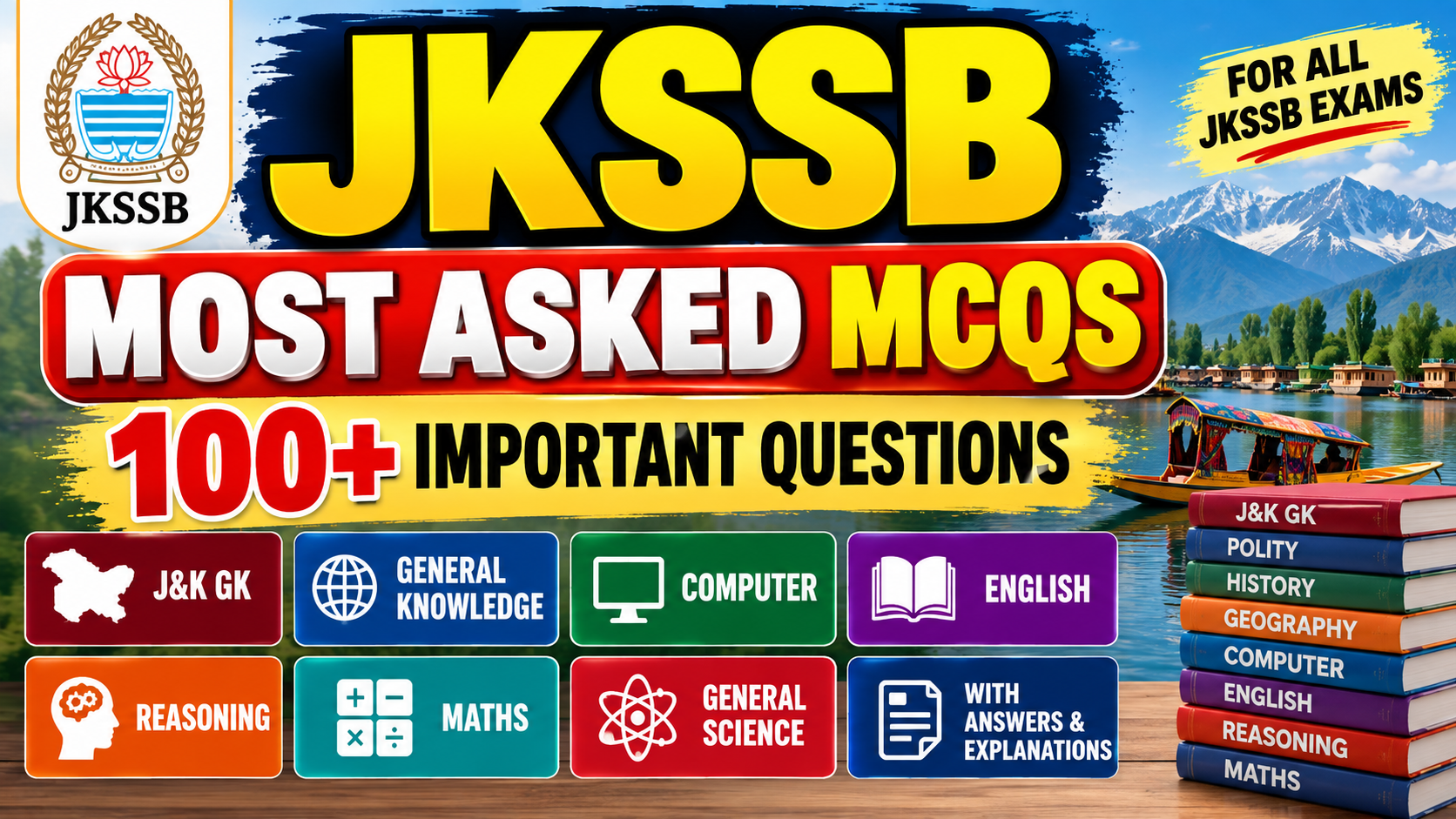
JKSSB Most Asked MCQs 2026 – 100+ Important Questions for JKSSB Exams
Preparing for a JKSSB examination is not only about reading long notes. The real difference often comes from how well you can identify the important facts, repeated concepts and question patterns that are commonly tested in objective examinations.
For JKSSB aspirants, subjects such as Jammu & Kashmir General Knowledge, Indian Polity, History, Geography, General Science, Computer, English, Reasoning and Mathematics require regular MCQ practice.
The Jammu and Kashmir Services Selection Board publishes post-wise syllabi and previous question papers through its official website. The Board's written examinations are conducted in an objective-type multiple-choice format, making regular question practice particularly important for candidates.
This article brings together 100+ high-yield JKSSB MCQs covering the subjects that repeatedly appear across different competitive examinations. These questions are designed for revision, self-practice and concept building.
Important: The questions below should be treated as high-priority practice questions based on recurring syllabus themes and commonly tested concepts, not as a claim that every question will repeat word-for-word.
D0wnload Complete Study material for JKSSB FAA
D0wnload Complete Study material for JKSSB class iv
Why JKSSB Aspirants Should Practice MCQs Daily
Reading a chapter once does not guarantee that you will remember the information during an examination. MCQ practice forces you to recall information quickly and identify the correct option under pressure.
For example, a candidate may know the basic facts about Jammu and Kashmir but still confuse:
Important rivers and tributaries
Lakes and geographical features
Historical personalities
Constitutional provisions
Important dates
Computer shortcuts
Mathematical formulas
Reasoning patterns
English vocabulary
This is why revision + MCQ practice should be a regular part of JKSSB preparation.
The official JKSSB website currently provides previous question papers for several posts, including Junior Assistant, Website Operator, Forest Department posts and other examinations.
How to Use These JKSSB Most Asked MCQs
Do not simply read the answers.
Try this method:
Step 1: Attempt the question without looking at the answer.
Step 2: Mark the questions you answered incorrectly.
Step 3: Read the explanation carefully.
Step 4: Revise the incorrect questions after 24–48 hours.
Step 5: Maintain a small notebook containing facts that you repeatedly forget.
This technique is especially useful for J&K GK, Indian Polity, Computer and General Science, where factual questions can be revised repeatedly.
JKSSB Most Asked MCQs – 100+ Important Questions
Section 1: Jammu & Kashmir GK
1. Which is the summer capital of Jammu and Kashmir?
A. Jammu
B. Srinagar
C. Leh
D. Anantnag
Answer: B. Srinagar
Explanation: Srinagar is traditionally regarded as the summer capital, while Jammu is the winter capital.
2. Which river is one of the major rivers flowing through the Kashmir Valley?
A. Godavari
B. Jhelum
C. Narmada
D. Tapi
Answer: B. Jhelum
Explanation: The Jhelum is a major river of the Kashmir Valley and originates at Verinag.
3. Verinag is associated with the source of which river?
A. Chenab
B. Ravi
C. Jhelum
D. Tawi
Answer: C. Jhelum
Exam Tip: Remember Verinag → Jhelum.
4. Which lake is famous for its houseboats and shikaras?
A. Dal Lake
B. Wular Lake
C. Mansar Lake
D. Surinsar Lake
Answer: A. Dal Lake
5. Wular Lake is located in which region?
A. Jammu
B. Kashmir
C. Ladakh
D. Delhi
Answer: B. Kashmir
6. Which pass connects the Kashmir Valley with Ladakh?
A. Banihal Pass
B. Zoji La
C. Nathu La
D. Shipki La
Answer: B. Zoji La
7. Which mountain range is prominently associated with Jammu and Kashmir?
A. Aravalli
B. Himalayas
C. Western Ghats
D. Satpura
Answer: B. Himalayas
8. Which river flows through Jammu city?
A. Tawi
B. Jhelum
C. Ravi
D. Beas
Answer: A. Tawi
9. Gulmarg is particularly famous for:
A. Desert tourism
B. Skiing and mountain tourism
C. Marine tourism
D. Tea plantations
Answer: B. Skiing and mountain tourism
10. Pashmina is primarily associated with:
A. Cotton
B. Fine wool
C. Silk only
D. Jute
Answer: B. Fine wool
11. Which crop is especially famous in Kashmir?
A. Saffron
B. Rubber
C. Coconut
D. Coffee
Answer: A. Saffron
12. Pampore is particularly famous for:
A. Tea
B. Saffron
C. Coffee
D. Rubber
Answer: B. Saffron
13. Which city is widely known as the City of Temples?
A. Jammu
B. Srinagar
C. Baramulla
D. Sopore
Answer: A. Jammu
14. The Mughal Road connects the Kashmir Valley with:
A. Poonch-Rajouri region
B. Leh
C. Delhi
D. Punjab only
Answer: A. Poonch-Rajouri region
15. Which is a famous garden in Srinagar?
A. Shalimar Bagh
B. Lodhi Garden
C. Cubbon Park
D. Lalbagh
Answer: A. Shalimar Bagh
Section 2: Indian Polity & General Knowledge
16. The Constitution of India was adopted on:
A. 15 August 1947
B. 26 November 1949
C. 26 January 1950
D. 2 October 1950
Answer: B. 26 November 1949
17. The Constitution of India came into force on:
A. 26 January 1950
B. 15 August 1947
C. 26 November 1949
D. 14 November 1949
Answer: A. 26 January 1950
18. Fundamental Rights are contained in:
A. Part I
B. Part II
C. Part III
D. Part IV
Answer: C. Part III
19. Directive Principles of State Policy are contained in:
A. Part III
B. Part IV
C. Part V
D. Part VI
Answer: B. Part IV
20. Fundamental Duties were added by which Constitutional Amendment?
A. 42nd Amendment
B. 44th Amendment
C. 52nd Amendment
D. 73rd Amendment
Answer: A. 42nd Amendment
21. Who is the constitutional head of the Union?
A. Prime Minister
B. President
C. Chief Justice of India
D. Home Minister
Answer: B. President
22. The minimum age required to become President of India is:
A. 25 years
B. 30 years
C. 35 years
D. 40 years
Answer: C. 35 years
23. Which Article deals with equality before law?
A. Article 12
B. Article 14
C. Article 19
D. Article 21
Answer: B. Article 14
24. Article 21 deals with:
A. Freedom of religion
B. Right to life and personal liberty
C. Equality of opportunity
D. Cultural rights
Answer: B. Right to life and personal liberty
25. The Supreme Court of India is established under:
A. Article 124
B. Article 148
C. Article 280
D. Article 324
Answer: A. Article 124
26. The Election Commission of India is mentioned under:
A. Article 280
B. Article 324
C. Article 356
D. Article 368
Answer: B. Article 324
27. The Finance Commission is constituted under:
A. Article 280
B. Article 324
C. Article 360
D. Article 370
Answer: A. Article 280
28. The constitutional amendment procedure is mainly provided under:
A. Article 32
B. Article 226
C. Article 368
D. Article 370
Answer: C. Article 368
29. Panchayati Raj institutions received constitutional status through:
A. 42nd Amendment
B. 61st Amendment
C. 73rd Amendment
D. 86th Amendment
Answer: C. 73rd Amendment
30. Municipalities received constitutional status through:
A. 72nd Amendment
B. 74th Amendment
C. 76th Amendment
D. 80th Amendment
Answer: B. 74th Amendment
Section 3: Indian History
31. Who founded the Mauryan Empire?
A. Ashoka
B. Chandragupta Maurya
C. Bindusara
D. Harsha
Answer: B. Chandragupta Maurya
32. Who wrote the Arthashastra?
A. Kalidasa
B. Kautilya
C. Banabhatta
D. Megasthenes
Answer: B. Kautilya
33. The Battle of Plassey was fought in:
A. 1757
B. 1761
C. 1764
D. 1857
Answer: A. 1757
34. The Revolt of 1857 began at:
A. Delhi
B. Meerut
C. Kanpur
D. Lucknow
Answer: B. Meerut
35. Who founded the Indian National Congress?
A. A.O. Hume
B. Mahatma Gandhi
C. Dadabhai Naoroji
D. Bal Gangadhar Tilak
Answer: A. A.O. Hume
36. The Non-Cooperation Movement was launched in:
A. 1919
B. 1920
C. 1930
D. 1942
Answer: B. 1920
37. The Quit India Movement was launched in:
A. 1930
B. 1935
C. 1940
D. 1942
Answer: D. 1942
38. Who gave the slogan “Do or Die”?
A. Subhas Chandra Bose
B. Mahatma Gandhi
C. Jawaharlal Nehru
D. Sardar Patel
Answer: B. Mahatma Gandhi
39. The Dandi March was associated with:
A. Salt Satyagraha
B. Non-Cooperation
C. Quit India
D. Swadeshi Movement
Answer: A. Salt Satyagraha
40. The Indian National Congress was founded in:
A. 1885
B. 1887
C. 1905
D. 1911
Answer: A. 1885
Section 4: Geography & Environment
41. Which is the largest planet in the Solar System?
A. Earth
B. Saturn
C. Jupiter
D. Neptune
Answer: C. Jupiter
42. The Tropic of Cancer passes through:
A. India
B. Sri Lanka
C. Nepal only
D. Bhutan only
Answer: A. India
43. Which is the longest river in India?
A. Yamuna
B. Ganga
C. Godavari
D. Narmada
Answer: B. Ganga
44. Black soil is particularly suitable for:
A. Cotton
B. Tea
C. Jute
D. Rubber
Answer: A. Cotton
45. The ozone layer is mainly found in:
A. Troposphere
B. Stratosphere
C. Mesosphere
D. Thermosphere
Answer: B. Stratosphere
46. Which gas is primarily responsible for the greenhouse effect among the following?
A. Carbon dioxide
B. Oxygen
C. Nitrogen
D. Helium
Answer: A. Carbon dioxide
47. The study of earthquakes is called:
A. Ecology
B. Seismology
C. Meteorology
D. Geology
Answer: B. Seismology
48. Which is the largest ocean?
A. Atlantic Ocean
B. Indian Ocean
C. Pacific Ocean
D. Arctic Ocean
Answer: C. Pacific Ocean
49. The imaginary line dividing Earth into Northern and Southern Hemispheres is:
A. Prime Meridian
B. Equator
C. Tropic of Cancer
D. Arctic Circle
Answer: B. Equator
50. The Prime Meridian passes through:
A. Paris
B. Greenwich
C. Rome
D. Delhi
Answer: B. Greenwich
Section 5: General Science
51. What is the basic unit of life?
A. Tissue
B. Cell
C. Organ
D. Nucleus
Answer: B. Cell
52. Which organelle is known as the powerhouse of the cell?
A. Ribosome
B. Nucleus
C. Mitochondria
D. Golgi body
Answer: C. Mitochondria
53. Which vitamin is produced in the skin in the presence of sunlight?
A. Vitamin A
B. Vitamin B
C. Vitamin C
D. Vitamin D
Answer: D. Vitamin D
54. Which blood group is commonly called the universal donor?
A. AB+
B. O−
C. A+
D. B+
Answer: B. O−
55. Which organ filters blood and produces urine?
A. Heart
B. Kidney
C. Liver
D. Lungs
Answer: B. Kidney
56. Photosynthesis mainly occurs in:
A. Mitochondria
B. Chloroplasts
C. Ribosomes
D. Nucleus
Answer: B. Chloroplasts
57. The chemical formula of water is:
A. CO₂
B. H₂O
C. O₂
D. H₂SO₄
Answer: B. H₂O
58. The SI unit of force is:
A. Joule
B. Watt
C. Newton
D. Pascal
Answer: C. Newton
59. The SI unit of power is:
A. Watt
B. Joule
C. Newton
D. Volt
Answer: A. Watt
60. Which metal is liquid at room temperature?
A. Iron
B. Mercury
C. Copper
D. Aluminium
Answer: B. Mercury
Section 6: Computer Awareness
61. CPU stands for:
A. Central Processing Unit
B. Central Program Utility
C. Computer Processing Utility
D. Central Power Unit
Answer: A. Central Processing Unit
62. Which memory is volatile?
A. ROM
B. RAM
C. Hard Disk
D. SSD
Answer: B. RAM
63. Which shortcut is used to copy selected text?
A. Ctrl + X
B. Ctrl + C
C. Ctrl + V
D. Ctrl + Z
Answer: B. Ctrl + C
64. Which shortcut is used to paste copied content?
A. Ctrl + P
B. Ctrl + V
C. Ctrl + C
D. Ctrl + A
Answer: B. Ctrl + V
65. Which shortcut is commonly used to undo an action?
A. Ctrl + U
B. Ctrl + Z
C. Ctrl + Y
D. Ctrl + D
Answer: B. Ctrl + Z
66. WWW stands for:
A. World Wide Web
B. World Web Window
C. Wide World Web
D. Web World Wide
Answer: A. World Wide Web
67. Which device is primarily used to connect a computer to a network?
A. Network Interface Card
B. Keyboard
C. Scanner
D. Printer
Answer: A. Network Interface Card
68. Which of the following is an operating system?
A. Windows
B. Google
C. HTML
D. CPU
Answer: A. Windows
69. Which file extension is commonly associated with Microsoft Excel workbooks?
A. .docx
B. .xlsx
C. .pptx
D. .txt
Answer: B. .xlsx
70. Which file extension is commonly associated with Microsoft Word documents?
A. .docx
B. .xlsx
C. .jpg
D. .mp3
Answer: A. .docx
Section 7: English
71. Choose the synonym of “Rapid”.
A. Slow
B. Quick
C. Weak
D. Late
Answer: B. Quick
72. Choose the antonym of “Ancient”.
A. Old
B. Modern
C. Historic
D. Former
Answer: B. Modern
73. Choose the correct spelling:
A. Necessary
B. Neccessary
C. Necesary
D. Necessery
Answer: A. Necessary
74. One who cannot read or write is called:
A. Literate
B. Scholar
C. Illiterate
D. Graduate
Answer: C. Illiterate
75. Choose the synonym of “Abundant”.
A. Scarce
B. Plenty
C. Rare
D. Empty
Answer: B. Plenty
76. Choose the antonym of “Expand”.
A. Increase
B. Extend
C. Contract
D. Develop
Answer: C. Contract
77. Identify the correctly spelled word:
A. Separate
B. Seperate
C. Separete
D. Seprate
Answer: A. Separate
78. “A blessing in disguise” means:
A. A visible problem
B. Something that appears bad but turns out beneficial
C. A religious ceremony
D. A serious punishment
Answer: B. Something that appears bad but turns out beneficial
79. The plural of “criterion” is:
A. Criterions
B. Criteria
C. Criteriones
D. Criterion
Answer: B. Criteria
80. The opposite of “Victory” is:
A. Success
B. Triumph
C. Defeat
D. Achievement
Answer: C. Defeat
Section 8: Reasoning
81. If 2, 4, 8, 16, ?, what comes next?
A. 20
B. 24
C. 32
D. 36
Answer: C. 32
82. Find the odd one out:
A. Apple
B. Mango
C. Potato
D. Banana
Answer: C. Potato
83. If CAT is coded as DBU, then DOG is coded as:
A. EPH
B. EOG
C. FPH
D. DPH
Answer: A. EPH
84. A person walks 5 km north and then 5 km east. In which direction is he from the starting point?
A. North-West
B. South-East
C. North-East
D. South-West
Answer: C. North-East
85. Find the next number: 3, 6, 12, 24, ?
A. 36
B. 42
C. 48
D. 54
Answer: C. 48
86. If all roses are flowers and some flowers are red, which statement is definitely true?
A. All roses are red
B. Some roses are red
C. Roses are flowers
D. No roses are red
Answer: C. Roses are flowers
87. A is the brother of B. B is the sister of C. How is A related to C?
A. Father
B. Brother
C. Uncle
D. Cousin
Answer: B. Brother
88. Complete the series: AZ, BY, CX, ?
A. DW
B. EV
C. DU
D. EX
Answer: A. DW
89. If today is Monday, what day will it be after 10 days?
A. Wednesday
B. Thursday
C. Friday
D. Saturday
Answer: B. Thursday
90. Find the odd number:
A. 16
B. 25
C. 36
D. 48
Answer: D. 48
Section 9: Mathematics
91. What is 25% of 200?
A. 25
B. 40
C. 50
D. 75
Answer: C. 50
92. If the cost price is ₹500 and selling price is ₹600, the profit is:
A. ₹50
B. ₹75
C. ₹100
D. ₹125
Answer: C. ₹100
93. What is the average of 10, 20 and 30?
A. 15
B. 20
C. 25
D. 30
Answer: B. 20
94. What is 15 × 12?
A. 150
B. 160
C. 180
D. 200
Answer: C. 180
95. If a number is divided by 5 and the answer is 12, the number is:
A. 50
B. 55
C. 60
D. 65
Answer: C. 60
96. What is the square of 15?
A. 125
B. 200
C. 225
D. 250
Answer: C. 225
97. What is the HCF of 12 and 18?
A. 3
B. 6
C. 9
D. 12
Answer: B. 6
98. What is the LCM of 4 and 6?
A. 8
B. 10
C. 12
D. 24
Answer: C. 12
99. A train travels 120 km in 3 hours. Its average speed is:
A. 30 km/h
B. 40 km/h
C. 50 km/h
D. 60 km/h
Answer: B. 40 km/h
100. If 3 workers complete a job in 12 days, assuming equal efficiency, how many worker-days are required?
A. 15
B. 24
C. 36
D. 48
Answer: C. 36 worker-days
101. What is 3/4 expressed as a percentage?
A. 25%
B. 50%
C. 75%
D. 80%
Answer: C. 75%
102. If the ratio of boys to girls is 2:3 and there are 20 boys, how many girls are there?
A. 25
B. 30
C. 35
D. 40
Answer: B. 30
103. What is the simple interest on ₹1,000 at 10% per annum for 2 years?
A. ₹100
B. ₹150
C. ₹200
D. ₹250
Answer: C. ₹200
104. A number increased by 20% becomes 120. What was the original number?
A. 80
B. 90
C. 100
D. 110
Answer: C. 100
105. What is the perimeter of a square with side 8 cm?
A. 16 cm
B. 24 cm
C. 32 cm
D. 64 cm
Answer: C. 32 cm
How to Prepare for JKSSB Using MCQs
The biggest mistake many aspirants make is solving hundreds of questions without revising their mistakes.
Instead, divide your preparation into three cycles.
Cycle 1 – Learn
Study the basic concept from your notes.
Cycle 2 – Practice
Solve MCQs related to that topic.
Cycle 3 – Revise
Return to the questions you got wrong.
For J&K GK, focus particularly on geography, history, culture, important personalities, rivers, lakes, passes, agriculture, administration and other J&K-specific facts.
For General Knowledge, revise Indian History, Geography, Polity, Economy, Science and important national and international developments.
For Computer, do not restrict yourself to basic definitions. Prepare operating systems, hardware, software, networking, internet, MS Office, shortcuts, cybersecurity and common computer terminology.
For Reasoning and Mathematics, speed matters. Regular practice helps you identify patterns and reduce calculation time.
For English, vocabulary, synonyms, antonyms, spelling, one-word substitutions, idioms and basic grammar-based questions should receive regular attention.
ALSO READ: JKSSB, JKPSI & JKP Constable Maths Practice Tests
Don't Ignore Previous Year Question Papers
Previous papers are among the most useful resources for understanding the level and style of questions. JKSSB maintains an official Previous Year Question Papers section containing papers for multiple posts and examination years.
Rather than memorising an entire paper, identify the concept behind each question.
If a question asks about a particular constitutional Article, learn related Articles too.
If a question asks about a J&K river, revise the major rivers, tributaries and geographical locations.
If a computer question asks about a keyboard shortcut, revise the important shortcut combinations together.
This turns one question into an entire revision topic.
Final Strategy for JKSSB Aspirants
A strong JKSSB preparation strategy should combine:
Concepts + Previous Papers + MCQs + Revision + Current Affairs
Do not wait until the final week to start MCQ practice.
Even 30–50 quality questions every day can create a significant question-solving habit over time. More importantly, maintain an error list. Your wrong answers are often more valuable than the questions you already know.
JKSSB regularly publishes recruitment notices, syllabi, examination information and question papers through its official website, so candidates should always verify the syllabus and recruitment-specific requirements against the latest official notification.
Final Takeaway
If you are preparing for JKSSB Junior Assistant, JKP Constable, JKPSI, FAA, Class IV, Stock Assistant, Health & Medical posts, Forest Department posts or other JKSSB examinations, make MCQ practice a daily part of your preparation.
The goal is not simply to solve 100 questions once.
The goal is to solve them, understand them, revise the mistakes and eventually reach the point where the concept becomes automatic.
Save this page, revise these questions regularly and continue practicing post-specific JKSSB MCQs and previous-year questions.
For the latest syllabus, recruitment notices and official question papers, always refer to the official JKSSB website.