JKSSB FMPHW Mock Test Series 2026 – Tough Statement-Based Questions
The JKSSB FMPHW examination requires much more than simple memorisation. A candidate may know the basic definition of a term and still lose marks when the same concept is presented through two or three confusing statements.
This is why statement-based MCQs are particularly useful during FMPHW preparation.
Instead of asking only a direct question, statement-based questions force you to examine each sentence independently. One statement may be completely correct, another may be partially correct, while the third may contain only one technically incorrect word. In a competitive examination, that small difference can decide whether the answer is right or wrong.
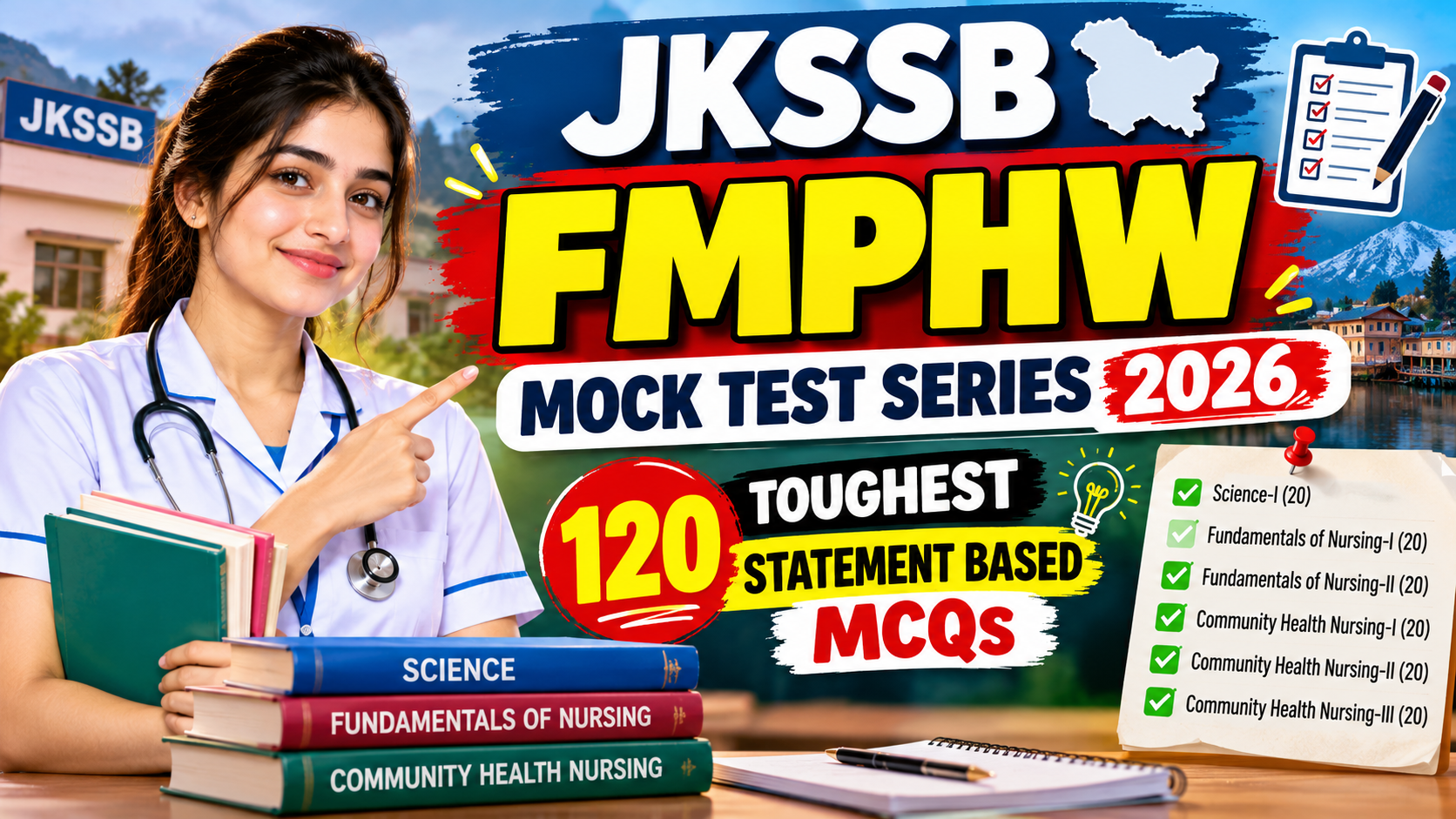
The syllabus provided for this FMPHW preparation is divided into six sections, with 20 marks allocated to each section:
| Subject | Marks | Practice Questions |
|---|---|---|
| Science-I | 20 | 20 |
| Fundamentals of Nursing-I | 20 | 20 |
| Fundamentals of Nursing-II | 20 | 20 |
| Community Health Nursing-I | 20 | 20 |
| Community Health Nursing-II | 20 | 20 |
| Community Health Nursing-III | 20 | 20 |
| Total | 120 | 120 |
This practice set follows the same structure and contains 120 difficult statement-based questions.
Download Complete FMPHW study material with full mocktests
Why Tough Statement-Based MCQs Matter
Many students prepare nursing subjects using direct one-line questions. That is useful during the first stage of preparation, but it is not enough for a competitive exam where question setters can change the wording.
For example, instead of asking:
“What is the function of haemoglobin?”
a difficult question may ask:
- Haemoglobin contributes to oxygen transport.
- Mature human RBCs contain mitochondria for aerobic respiration.
- Mature human RBCs normally lack a nucleus.
Now the candidate must separate the correct statements from the incorrect one.
The same approach applies to nursing procedures, infection prevention, medication administration, maternal health, immunization, child health and community health.
How to Attempt These Questions
Do not look at the answer immediately.
Read Statement 1 and decide whether it is completely correct. Then examine Statement 2 separately. Do the same for Statement 3.
Be especially careful with words such as:
always, never, only, all, completely, necessarily and exclusively.
Such words often turn an otherwise familiar statement into an incorrect one.
The best way to use this set is to first attempt all 120 questions without checking explanations. After completing the set, analyse your mistakes section by section.
SECTION A – SCIENCE-I
Q1. Consider the following statements about red blood cells:
- Mature human RBCs normally lack a nucleus.
- Haemoglobin is mainly responsible for oxygen transport.
- Mature RBCs contain numerous mitochondria for aerobic respiration.
Which of the above statements are correct?
A) 1 only
B) 1 and 2 only
C) 2 and 3 only
D) 1, 2 and 3
Answer: B
Explanation: Mature human RBCs lack nuclei and mitochondria. Haemoglobin carries most of the oxygen in blood.
Q2. Regarding the heart:
- The right ventricle pumps blood into pulmonary circulation.
- The left ventricle has a thicker muscular wall than the right ventricle.
- The pulmonary artery carries oxygenated blood from the heart to the lungs.
A) 1 and 3 only
B) 2 only
C) 1 only
D) 1 and 2 only
Answer: D
Explanation: The pulmonary artery carries deoxygenated blood. Statements 1 and 2 are correct.
Q3. Consider the following statements about blood glucose:
- Insulin generally lowers blood glucose.
- Glucagon generally lowers blood glucose.
- Both insulin and glucagon are produced by the pancreas.
A) 1 and 3 only
B) 1 only
C) 2 and 3 only
D) 1, 2 and 3
Answer: A
Explanation: Glucagon generally raises blood glucose, so statement 2 is false.
Q4. Regarding respiratory gas exchange:
- Gas exchange mainly occurs in alveoli.
- Oxygen normally diffuses from alveoli into pulmonary capillary blood.
- Carbon dioxide normally diffuses from blood into alveoli.
A) 1 and 2 only
B) 2 only
C) 1, 2 and 3
D) 1 only
Answer: C
Explanation: All three statements correctly describe normal pulmonary gas exchange.
Q5. Regarding the nephron:
- The glomerulus is involved in filtration.
- Tubular reabsorption returns useful substances to blood.
- Tubular secretion contributes to urine formation.
A) 1 and 2 only
B) 2 and 3 only
C) 1 only
D) 1, 2 and 3
Answer: D
Explanation: Filtration, reabsorption and secretion are all important renal processes.
Q6. Which statements are correct?
- Vitamin C deficiency may cause scurvy.
- Vitamin D deficiency can affect bone mineralization.
- Vitamin K has an important role in coagulation.
A) 1 and 3 only
B) 1, 2 and 3
C) 2 only
D) 1 and 2 only
Answer: B
Q7. Regarding microorganisms:
- Bacteria are prokaryotic organisms.
- Viruses require host cells for replication.
- Antibiotics are universally effective against viral infections.
A) 1 only
B) 2 and 3 only
C) 1 and 2 only
D) 1, 2 and 3
Answer: C
Q8. Regarding plasma:
- Plasma is the liquid component of blood.
- Plasma contains proteins such as albumin and fibrinogen.
- Plasma does not contain electrolytes.
A) 1 and 2 only
B) 1 only
C) 2 and 3 only
D) 1, 2 and 3
Answer: A
Q9. Regarding neurons:
- Dendrites generally receive signals.
- Axons generally conduct impulses away from the cell body.
- Every neuron is covered by myelin.
A) 1 only
B) 2 only
C) 1 and 3 only
D) 1 and 2 only
Answer: D
Q10. Consider fever:
- Fever involves an increase in the body's regulated temperature set point.
- Fever is always caused by bacterial infection.
- The hypothalamus participates in temperature regulation.
A) 2 and 3 only
B) 1 only
C) 1 and 3 only
D) 1, 2 and 3
Answer: C
Q11. Regarding digestion:
- Pepsin begins important protein digestion in the stomach.
- Most nutrient absorption occurs in the small intestine.
- Bile is produced by the pancreas.
A) 1 and 2 only
B) 1 only
C) 2 and 3 only
D) 1, 2 and 3
Answer: A
Q12. Regarding blood groups:
- ABO blood grouping is based on antigens on RBCs.
- Rh-positive blood has the D antigen.
- Compatibility testing is unnecessary if ABO group is known.
A) 1 only
B) 2 and 3 only
C) 1 and 2 only
D) 1, 2 and 3
Answer: C
Q13. Consider the following:
- Platelets contribute to haemostasis.
- White blood cells participate in immune defence.
- Haemoglobin is the major clotting protein.
A) 1 only
B) 1 and 2 only
C) 2 and 3 only
D) 1, 2 and 3
Answer: B
Q14. Regarding bones:
- Calcium contributes to bone strength.
- Bone marrow can be involved in blood-cell formation.
- Bones contain no marrow cavities.
A) 1 and 2 only
B) 1 only
C) 2 and 3 only
D) 1, 2 and 3
Answer: A
Q15. Regarding immunity:
- Plasma cells produce antibodies.
- Vaccination can produce active immunity.
- Passive immunity always produces lifelong immune memory.
A) 2 only
B) 1 and 3 only
C) 1 and 2 only
D) 1, 2 and 3
Answer: C
Q16. Regarding the endocrine system:
- Thyroxine influences metabolic activity.
- Adrenal glands produce hormones including cortisol.
- The pituitary gland has no functional relationship with other endocrine glands.
A) 1 and 2 only
B) 1 only
C) 2 and 3 only
D) 1, 2 and 3
Answer: A
Q17. Consider the following:
- Fungi are eukaryotic organisms.
- Protozoa are generally unicellular eukaryotes.
- Viruses are cellular organisms.
A) 1 only
B) 1 and 2 only
C) 2 and 3 only
D) 1, 2 and 3
Answer: B
Q18. Regarding anaemia:
- Anaemia reduces the oxygen-carrying capacity of blood.
- Iron deficiency is a common cause of nutritional anaemia.
- Every case of anaemia is caused by blood loss.
A) 1 only
B) 2 and 3 only
C) 1 and 3 only
D) 1 and 2 only
Answer: D
Q19. Regarding oxygen transport:
- Most oxygen is transported bound to haemoglobin.
- A small amount is dissolved in plasma.
- Carbon dioxide is transported only in dissolved form.
A) 1 and 2 only
B) 1 only
C) 2 and 3 only
D) 1, 2 and 3
Answer: A
Q20. Regarding the liver:
- The liver participates in metabolism.
- The liver produces bile.
- The liver is the primary organ where urine is formed.
A) 1 only
B) 1 and 2 only
C) 2 and 3 only
D) 1, 2 and 3
Answer: B
SECTION B – FUNDAMENTALS OF NURSING-I
Q21. Regarding the nursing process:
- Assessment precedes nursing diagnosis.
- Planning follows nursing diagnosis.
- Evaluation takes place only at the very end of treatment.
A) 1 only
B) 1 and 2 only
C) 2 and 3 only
D) 1, 2 and 3
Answer: B
Q22. Which are components of the nursing process?
- Assessment
- Diagnosis
- Planning
- Evaluation
A) 1 and 2 only
B) 2 and 4 only
C) 1, 2 and 4 only
D) 1, 2, 3 and 4
Answer: D
Q23. Regarding hand hygiene:
- It is required before touching a patient.
- It is required after body-fluid exposure risk.
- It is unnecessary after touching the patient's surroundings.
A) 1 and 3 only
B) 2 only
C) 1 and 2 only
D) 1, 2 and 3
Answer: C
Q24. Regarding asepsis:
- Medical asepsis reduces the number and spread of microorganisms.
- Surgical asepsis is used to maintain sterility.
- Medical and surgical asepsis are exactly identical.
A) 1 and 2 only
B) 1 only
C) 2 and 3 only
D) 1, 2 and 3
Answer: A
Q25. Regarding vital signs:
- Pulse is a vital sign.
- Respiratory rate is a vital sign.
- Blood pressure has no relevance to cardiovascular assessment.
A) 1 only
B) 2 and 3 only
C) 1 and 2 only
D) 1, 2 and 3
Answer: C
Q26. Regarding temperature:
- Temperature varies with measurement site.
- Oral and rectal temperatures may differ.
- Temperature is always identical regardless of measurement method.
A) 1 and 2 only
B) 1 only
C) 2 and 3 only
D) 1, 2 and 3
Answer: A
Q27. Regarding patient positioning:
- Fowler's position may assist patients with breathing difficulty.
- Sims' position can be useful for certain rectal procedures.
- Positioning has no relationship to pressure injuries.
A) 1 only
B) 1 and 2 only
C) 2 and 3 only
D) 1, 2 and 3
Answer: B
Q28. Regarding pressure injuries:
- Prolonged pressure can contribute to tissue ischemia.
- Repositioning can reduce risk.
- Persistent non-blanching redness should be ignored.
A) 1 only
B) 1 and 2 only
C) 2 and 3 only
D) 1, 2 and 3
Answer: B
Q29. Regarding nursing documentation:
- Documentation should be factual.
- Entries should be clear and timely.
- Incorrect information can simply be erased without following documentation policy.
A) 1 and 3 only
B) 2 only
C) 1 and 2 only
D) 1, 2 and 3
Answer: C
Q30. Regarding patient identification:
- Correct identification helps prevent medication errors.
- Bed number alone is sufficient identification.
- Institutional identification procedures should be followed.
A) 1 and 2 only
B) 1 and 3 only
C) 2 and 3 only
D) 1, 2 and 3
Answer: B
Q31. Regarding oxygen therapy:
- Oxygen is treated as a medication in clinical practice.
- Appropriate prescribed/protocol-based administration should be followed.
- Smoking is safe around oxygen if the cylinder is not open.
A) 1 only
B) 2 and 3 only
C) 1 and 2 only
D) 1, 2 and 3
Answer: C
Q32. Regarding standard precautions:
- They apply according to risk during patient care.
- Gloves completely eliminate the need for hand hygiene.
- PPE selection depends on anticipated exposure.
A) 1 and 3 only
B) 1 only
C) 2 and 3 only
D) 1, 2 and 3
Answer: A
Q33. Regarding nursing assessment:
- Assessment includes collection of information.
- Subjective data are generally reported by the patient.
- Objective data cannot be observed or measured.
A) 1 only
B) 1 and 2 only
C) 2 and 3 only
D) 1, 2 and 3
Answer: B
Q34. Regarding communication:
- Active listening is useful in therapeutic communication.
- Non-verbal behaviour can communicate information.
- Unnecessary medical terminology always improves understanding.
A) 1 only
B) 1 and 2 only
C) 2 and 3 only
D) 1, 2 and 3
Answer: B
Q35. Regarding bed making:
- The bed should preferably remain dry and wrinkle-free.
- Soiled linen should be handled carefully.
- Soiled linen should be shaken vigorously in the patient's room.
A) 1 and 2 only
B) 1 only
C) 2 and 3 only
D) 1, 2 and 3
Answer: A
Q36. Regarding patient safety:
- The call bell should be accessible to dependent patients.
- Frequently used items may be kept within easy reach.
- Young patients can never experience falls.
A) 1 only
B) 2 and 3 only
C) 1 and 2 only
D) 1, 2 and 3
Answer: C
Q37. Regarding patient privacy:
- Privacy should be maintained during nursing care.
- Proper draping can help preserve privacy.
- Privacy is irrelevant during minor procedures.
A) 1 and 2 only
B) 1 only
C) 2 and 3 only
D) 1, 2 and 3
Answer: A
Q38. Regarding sterile technique:
- Improper contact can contaminate a sterile field.
- Moisture may compromise sterility.
- Anything below waist level is considered sterile.
A) 1 only
B) 1 and 2 only
C) 2 and 3 only
D) 1, 2 and 3
Answer: B
Q39. Regarding nursing diagnosis:
- It describes patient responses to health conditions.
- It differs from a medical diagnosis.
- It is simply another name for a laboratory diagnosis.
A) 1 only
B) 2 and 3 only
C) 1 and 2 only
D) 1, 2 and 3
Answer: C
Q40. Regarding patient comfort:
- Position can influence comfort.
- Environmental noise can affect rest.
- Comfort has no relationship to nursing care.
A) 1 and 3 only
B) 2 only
C) 1 and 2 only
D) 1, 2 and 3
Answer: C
SECTION C – FUNDAMENTALS OF NURSING-II
Q41. Regarding medication administration:
- Correct patient identification is essential.
- Allergy history should be considered.
- Medication labels need not be checked if the package looks familiar.
A) 1 only
B) 1 and 2 only
C) 2 and 3 only
D) 1, 2 and 3
Answer: B
Q42. Regarding oral medication:
- The patient's ability to swallow should be considered.
- Some tablets should not be crushed.
- Every modified-release tablet can be crushed safely.
A) 1 and 2 only
B) 1 only
C) 2 and 3 only
D) 1, 2 and 3
Answer: A
Q43. Regarding intramuscular injections:
- Needle selection depends on patient and medication factors.
- Appropriate injection site selection is important.
- Any body site is suitable for every IM medication.
A) 1 only
B) 1 and 2 only
C) 2 and 3 only
D) 1, 2 and 3
Answer: B
Q44. Regarding intake and output:
- Oral and relevant parenteral fluids contribute to intake.
- Urine contributes to measurable output.
- Intake-output monitoring is unnecessary in critically ill patients.
A) 1 and 2 only
B) 1 only
C) 2 and 3 only
D) 1, 2 and 3
Answer: A
Q45. Regarding dehydration:
- Excessive fluid loss can cause dehydration.
- Thirst can occur with fluid deficit.
- Every dehydrated patient must develop hypertension.
A) 1 and 2 only
B) 1 only
C) 2 and 3 only
D) 1, 2 and 3
Answer: A
Q46. Regarding IV therapy:
- IV fluids can enter circulation rapidly.
- The IV site should be monitored.
- Swelling around the IV site never indicates a problem.
A) 1 and 2 only
B) 1 only
C) 2 and 3 only
D) 1, 2 and 3
Answer: A
Q47. Regarding blood transfusion:
- Patient identification is critical.
- Compatibility checking is essential.
- Any blood product may be administered without verification.
A) 1 only
B) 2 and 3 only
C) 1 and 2 only
D) 1, 2 and 3
Answer: C
Q48. Regarding enteral feeding:
- Tube position should be appropriately verified.
- Aspiration is a possible complication.
- Enteral feeding is the same as intravenous nutrition.
A) 1 only
B) 1 and 2 only
C) 2 and 3 only
D) 1, 2 and 3
Answer: B
Q49. Regarding pressure injury prevention:
- Repositioning may reduce prolonged pressure.
- Skin inspection is important in high-risk patients.
- Wet and soiled bedding protects the skin.
A) 1 only
B) 1 and 2 only
C) 2 and 3 only
D) 1, 2 and 3
Answer: B
Q50. Regarding pain:
- Pain is subjective.
- A patient's report should be taken seriously.
- Absence of visible distress proves absence of pain.
A) 1 and 2 only
B) 1 only
C) 2 and 3 only
D) 1, 2 and 3
Answer: A
Q51. Regarding wound care:
- Hand hygiene is important before wound care.
- Aseptic principles should be followed where required.
- Contaminated dressing material can routinely be reused.
A) 1 and 3 only
B) 1 and 2 only
C) 2 and 3 only
D) 1, 2 and 3
Answer: B
Q52. Regarding fever management:
- Hydration may be important depending on the patient.
- Temperature trends may provide useful information.
- Every fever automatically requires antibiotics.
A) 1 only
B) 1 and 3 only
C) 1 and 2 only
D) 1, 2 and 3
Answer: C
Q53. Regarding emergency care:
- Airway, breathing and circulation are key priorities.
- Life-threatening problems take priority over minor complaints.
- Documentation must always be completed before immediate stabilization.
A) 1 and 2 only
B) 1 only
C) 2 and 3 only
D) 1, 2 and 3
Answer: A
Q54. Regarding burns:
- Extent of burn injury is clinically important.
- Major burns may involve substantial fluid loss.
- Unknown household substances should always be applied as first aid.
A) 1 only
B) 1 and 2 only
C) 2 and 3 only
D) 1, 2 and 3
Answer: B
Q55. Regarding seizure care:
- The patient should be protected from injury.
- An object should routinely be inserted into the mouth.
- Breathing should be observed after the seizure.
A) 1 and 2 only
B) 1 only
C) 2 and 3 only
D) 1 and 3 only
Answer: D
Q56. Regarding constipation:
- Adequate fluids may help when not contraindicated.
- Physical activity may promote bowel function.
- Every constipation case requires surgery.
A) 1 only
B) 2 and 3 only
C) 1 and 2 only
D) 1, 2 and 3
Answer: C
Q57. Regarding urinary care:
- Urine output can provide information about fluid and renal status.
- Changes in urine characteristics can be clinically relevant.
- Urine output has no value in clinical assessment.
A) 1 only
B) 1 and 2 only
C) 2 and 3 only
D) 1, 2 and 3
Answer: B
Q58. Regarding immobility:
- Prolonged immobility can increase complication risk.
- Appropriate range-of-motion exercises may be useful.
- Immobility always improves circulation.
A) 1 and 2 only
B) 1 only
C) 2 and 3 only
D) 1, 2 and 3
Answer: A
Q59. Regarding oral hygiene:
- Oral care can improve comfort.
- It can help maintain oral cleanliness.
- Oral care has no significance in unconscious patients.
A) 1 and 2 only
B) 1 only
C) 2 and 3 only
D) 1, 2 and 3
Answer: A
Q60. Regarding patient education:
- Teaching should match the patient's level of understanding.
- Feedback can help evaluate understanding.
- Giving information once guarantees learning.
A) 1 only
B) 1 and 2 only
C) 2 and 3 only
D) 1, 2 and 3
Answer: B
SECTION D – COMMUNITY HEALTH NURSING-I
Q61. Regarding primary health care:
- It emphasizes accessible essential health services.
- Community participation is an important principle.
- Primary health care is restricted to hospital treatment.
A) 1 only
B) 2 and 3 only
C) 1 and 2 only
D) 1, 2 and 3
Answer: C
Q62. Regarding epidemiology:
- Incidence refers to new cases during a specified period.
- Prevalence includes existing cases.
- Incidence and prevalence are synonymous.
A) 1 and 2 only
B) 1 only
C) 2 and 3 only
D) 1, 2 and 3
Answer: A
Q63. Regarding health education:
- It should consider the needs of the target population.
- Two-way communication can improve effectiveness.
- A lecture delivered without considering the audience is always sufficient.
A) 1 only
B) 2 and 3 only
C) 1 and 2 only
D) 1, 2 and 3
Answer: C
Q64. Regarding community diagnosis:
- It identifies important health problems in a defined community.
- Community resources should be considered.
- It is based solely on hospital records.
A) 1 and 3 only
B) 1 and 2 only
C) 2 and 3 only
D) 1, 2 and 3
Answer: B
Q65. Regarding environmental sanitation:
- Safe water is important for health.
- Proper waste disposal reduces environmental hazards.
- Sanitation has no connection with communicable disease prevention.
A) 1 and 2 only
B) 1 only
C) 2 and 3 only
D) 1, 2 and 3
Answer: A
Q66. Consider incidence and prevalence:
- Incidence measures new disease occurrence.
- Prevalence can be affected by disease duration.
- A short-duration disease will always have very high prevalence.
A) 1 only
B) 1 and 2 only
C) 2 and 3 only
D) 1, 2 and 3
Answer: B
Q67. Regarding health promotion:
- It aims to improve people's control over health determinants.
- Lifestyle and environment can influence health.
- Health promotion is limited to treatment of disease.
A) 1 and 2 only
B) 1 only
C) 2 and 3 only
D) 1, 2 and 3
Answer: A
Q68. Regarding health surveillance:
- It includes systematic collection of health data.
- Analysis and interpretation are important.
- Findings should never be used for action.
A) 1 only
B) 1 and 2 only
C) 2 and 3 only
D) 1, 2 and 3
Answer: B
Q69. Regarding family planning:
- It supports informed reproductive choices.
- Counselling should respect individual circumstances.
- One contraceptive method is equally suitable for everyone.
A) 1 only
B) 1 and 2 only
C) 2 and 3 only
D) 1, 2 and 3
Answer: B
Q70. Regarding barrier methods:
- They can prevent pregnancy.
- Some can reduce transmission of certain STIs.
- Every contraceptive method provides identical STI protection.
A) 1 only
B) 1 and 2 only
C) 2 and 3 only
D) 1, 2 and 3
Answer: B
Q71. Regarding referral:
- Health workers should recognize conditions requiring higher-level care.
- Timely referral may prevent complications.
- Referral is needed only for unconscious patients.
A) 1 and 2 only
B) 1 only
C) 2 and 3 only
D) 1, 2 and 3
Answer: A
Q72. Regarding occupational health:
- Hazards may be physical, chemical, biological or ergonomic.
- Protective measures can reduce occupational risk.
- Occupational health is concerned only with accidents.
A) 1 only
B) 1 and 2 only
C) 2 and 3 only
D) 1, 2 and 3
Answer: B
Q73. Regarding communicable disease prevention:
- Breaking the chain of infection can reduce transmission.
- Hand hygiene can reduce transmission of some infections.
- Prevention is unnecessary when effective treatment exists.
A) 1 and 2 only
B) 1 only
C) 2 and 3 only
D) 1, 2 and 3
Answer: A
Q74. Regarding isolation precautions:
- Isolation can separate infected individuals when indicated.
- Precautions depend on the mode of transmission.
- Every infection requires identical isolation precautions.
A) 1 only
B) 1 and 2 only
C) 2 and 3 only
D) 1, 2 and 3
Answer: B
Q75. Regarding community participation:
- It may improve acceptance of health programmes.
- Cultural beliefs can influence health-seeking behaviour.
- Community health services should ignore cultural factors.
A) 1 only
B) 2 and 3 only
C) 1 and 2 only
D) 1, 2 and 3
Answer: C
Q76. Regarding nutrition:
- A balanced diet contains nutrients in appropriate proportions.
- Malnutrition includes forms of undernutrition and overnutrition.
- Malnutrition means only starvation.
A) 1 only
B) 1 and 2 only
C) 2 and 3 only
D) 1, 2 and 3
Answer: B
Q77. Regarding potable water:
- Safe water reduces risk of waterborne disease.
- Contamination can occur during collection or storage.
- Treated water can never become contaminated.
A) 1 and 2 only
B) 1 only
C) 2 and 3 only
D) 1, 2 and 3
Answer: A
Q78. Regarding waste management:
- Segregation at source is important.
- Improper disposal can create health hazards.
- All waste should be mixed together.
A) 1 and 2 only
B) 1 only
C) 2 and 3 only
D) 1, 2 and 3
Answer: A
Q79. Regarding community surveys:
- A clearly defined objective improves survey usefulness.
- Sampling can affect validity and representativeness.
- Standardized data collection is unnecessary.
A) 1 and 2 only
B) 1 only
C) 2 and 3 only
D) 1, 2 and 3
Answer: A
Q80. Regarding health indicators:
- Infant mortality is a population health indicator.
- Maternal mortality is relevant to maternal health assessment.
- Health indicators have no role in programme planning.
A) 1 only
B) 1 and 2 only
C) 2 and 3 only
D) 1, 2 and 3
Answer: B
SECTION E – COMMUNITY HEALTH NURSING-II
Q81. Regarding antenatal care:
- It helps identify pregnancy-related risks and complications.
- Health education is an important component.
- It is required only after symptoms develop.
A) 1 and 2 only
B) 1 only
C) 2 and 3 only
D) 1, 2 and 3
Answer: A
Q82. Regarding the WHO antenatal-care model:
- WHO recommends eight contacts in its current model.
- Antenatal care can include preventive and screening interventions.
- Antenatal care ends after the first visit.
A) 1 only
B) 1 and 2 only
C) 2 and 3 only
D) 1, 2 and 3
Answer: B
Q83. Regarding maternal nutrition:
- Iron and folic acid are important in maternal nutrition programmes.
- Maternal nutrition can affect pregnancy outcomes.
- Nutritional counselling has no role during pregnancy.
A) 1 and 2 only
B) 1 only
C) 2 and 3 only
D) 1, 2 and 3
Answer: A
Q84. Regarding breastfeeding:
- Initiation within the first hour is recommended.
- Exclusive breastfeeding is recommended for the first six months.
- Exclusive breastfeeding routinely includes additional water.
A) 1 only
B) 2 and 3 only
C) 1 and 2 only
D) 1, 2 and 3
Answer: C
Q85. Regarding complementary feeding:
- Complementary foods are introduced around six months.
- Breastfeeding can continue after complementary feeding begins.
- Breastfeeding should automatically stop at six months.
A) 1 only
B) 1 and 2 only
C) 2 and 3 only
D) 1, 2 and 3
Answer: B
Q86. Regarding newborn care:
- Maintaining warmth is important.
- Early breastfeeding is beneficial.
- A newborn never requires assessment for danger signs.
A) 1 and 2 only
B) 1 only
C) 2 and 3 only
D) 1, 2 and 3
Answer: A
Q87. Regarding newborn danger signs:
- Difficulty breathing can indicate serious illness.
- Poor feeding can be concerning.
- Danger signs should always be treated only at home.
A) 1 only
B) 1 and 2 only
C) 2 and 3 only
D) 1, 2 and 3
Answer: B
Q88. Regarding child health:
- Growth monitoring can identify growth problems.
- Nutrition assessment is part of child health.
- Growth monitoring is useful only after five years.
A) 1 and 2 only
B) 1 only
C) 2 and 3 only
D) 1, 2 and 3
Answer: A
Q89. Regarding immunization:
- Vaccination prevents certain vaccine-preventable diseases.
- Following the recommended schedule is important.
- A missed dose always means the whole series must be restarted.
A) 1 only
B) 1 and 2 only
C) 2 and 3 only
D) 1, 2 and 3
Answer: B
Q90. Regarding routine immunization:
- BCG is included as a birth dose.
- Hepatitis-B birth dose is included at birth.
- OPV-0 is administered orally.
A) 1 and 2 only
B) 1 only
C) 1, 2 and 3
D) 2 and 3 only
Answer: C
Q91. Regarding the vaccine cold chain:
- Appropriate vaccine storage temperature is important.
- Cold-chain maintenance helps preserve vaccine potency.
- Vaccines can tolerate any temperature indefinitely.
A) 1 only
B) 1 and 2 only
C) 2 and 3 only
D) 1, 2 and 3
Answer: B
Q92. Regarding vitamin A:
- Vitamin A has a role in normal vision.
- Deficiency can affect health and immunity.
- Diet is irrelevant to vitamin A status.
A) 1 and 2 only
B) 1 only
C) 2 and 3 only
D) 1, 2 and 3
Answer: A
Q93. Regarding childhood diarrhoea:
- ORS helps replace fluid and electrolytes.
- Continued feeding is generally encouraged.
- Every episode requires antibiotics.
A) 1 only
B) 1 and 2 only
C) 2 and 3 only
D) 1, 2 and 3
Answer: B
Q94. Regarding childhood pneumonia:
- Fast breathing may be significant in assessment.
- Chest indrawing can indicate serious disease.
- Duration of cough is never relevant.
A) 1 only
B) 1 and 2 only
C) 2 and 3 only
D) 1, 2 and 3
Answer: B
Q95. Regarding maternal danger signs:
- Severe bleeding requires urgent attention.
- Convulsions in pregnancy can indicate serious disease.
- Both should be managed only with routine home advice.
A) 1 only
B) 1 and 2 only
C) 2 and 3 only
D) 1, 2 and 3
Answer: B
Q96. Regarding postnatal care:
- Maternal condition should be assessed after childbirth.
- Newborn health should also be monitored.
- The postpartum period carries no risk of complications.
A) 1 only
B) 1 and 2 only
C) 2 and 3 only
D) 1, 2 and 3
Answer: B
Q97. Regarding family-planning counselling:
- Informed choice is important.
- Relevant benefits, risks and method information should be discussed.
- The health worker should select the method regardless of patient preference.
A) 1 only
B) 2 and 3 only
C) 1 and 2 only
D) 1, 2 and 3
Answer: C
Q98. Regarding exclusive breastfeeding:
- It means no additional food or drink during the first six months.
- Water is also excluded from exclusive breastfeeding.
- Complementary foods should begin at birth.
A) 1 only
B) 1 and 2 only
C) 2 and 3 only
D) 1, 2 and 3
Answer: B
Q99. Regarding infant feeding:
- Complementary foods should be nutritionally adequate and safe.
- Dietary diversity should increase as the child grows.
- Breastfeeding must always stop at six months.
A) 1 and 2 only
B) 1 only
C) 2 and 3 only
D) 1, 2 and 3
Answer: A
Q100. Regarding maternal and child health services:
- Health education is an important component.
- Early identification can support timely referral.
- Maternal-child health services should focus only on treatment.
A) 1 only
B) 1 and 2 only
C) 2 and 3 only
D) 1, 2 and 3
Answer: B
SECTION F – COMMUNITY HEALTH NURSING-III
Q101. Regarding tuberculosis:
- Tuberculosis is caused by organisms of the Mycobacterium tuberculosis complex.
- Persistent cough may prompt evaluation.
- Tuberculosis occurs only in the lungs.
A) 1 only
B) 2 and 3 only
C) 1 and 2 only
D) 1, 2 and 3
Answer: C
Q102. Regarding TB control:
- Early diagnosis and appropriate treatment help control transmission.
- Respiratory hygiene can be relevant.
- Contact investigation has no public-health value.
A) 1 and 2 only
B) 1 only
C) 2 and 3 only
D) 1, 2 and 3
Answer: A
Q103. Regarding malaria:
- Malaria is caused by Plasmodium parasites.
- Female Anopheles mosquitoes transmit human malaria.
- Every fever in a malaria-endemic area is necessarily malaria.
A) 1 only
B) 2 only
C) 1 and 2 only
D) 1, 2 and 3
Answer: C
Q104. Regarding mosquito control:
- Eliminating breeding sites can reduce mosquito populations.
- Insecticide-treated nets can help protect against malaria vectors.
- Vector control is useless if treatment exists.
A) 1 only
B) 1 and 2 only
C) 2 and 3 only
D) 1, 2 and 3
Answer: B
Q105. Regarding diarrhoeal disease prevention:
- Contaminated water can contribute to transmission.
- Hand hygiene can reduce transmission.
- Dehydration is not a concern in diarrhoeal illness.
A) 1 only
B) 1 and 2 only
C) 2 and 3 only
D) 1, 2 and 3
Answer: B
Q106. Regarding the chain of infection:
- It includes an infectious agent and other links involved in transmission.
- Breaking an important link can help control spread.
- Environmental conditions never affect transmission.
A) 1 and 2 only
B) 1 only
C) 2 and 3 only
D) 1, 2 and 3
Answer: A
Q107. Regarding HIV:
- HIV attacks the immune system.
- Transmission can occur through certain infected body fluids.
- HIV can be diagnosed reliably from appearance alone.
A) 1 and 2 only
B) 1 only
C) 2 and 3 only
D) 1, 2 and 3
Answer: A
Q108. Regarding sexually transmitted infections:
- Some STIs can be asymptomatic.
- Management of sexual partners may be important.
- Absence of symptoms always excludes an STI.
A) 1 only
B) 1 and 2 only
C) 2 and 3 only
D) 1, 2 and 3
Answer: B
Q109. Regarding hypertension:
- Hypertension can remain asymptomatic.
- Blood-pressure measurement is important for diagnosis and follow-up.
- A normal reading on one day guarantees lifelong normal blood pressure.
A) 1 only
B) 2 and 3 only
C) 1 and 2 only
D) 1, 2 and 3
Answer: C
Q110. Regarding diabetes:
- Diabetes involves abnormal regulation of blood glucose.
- Long-term uncontrolled diabetes can damage multiple organs.
- Diabetes is always caused by eating sugar.
A) 1 and 2 only
B) 1 only
C) 2 and 3 only
D) 1, 2 and 3
Answer: A
Q111. Regarding screening:
- Screening generally identifies possible disease or risk before obvious symptoms.
- Positive screening findings may require diagnostic confirmation.
- Every screening test is a definitive diagnostic test.
A) 1 only
B) 2 only
C) 1 and 2 only
D) 1, 2 and 3
Answer: C
Q112. Regarding sensitivity and specificity:
- Sensitivity relates to identifying people who have the disease.
- Specificity relates to identifying people who do not have the disease.
- A highly sensitive test necessarily has 100% specificity.
A) 1 and 3 only
B) 1 and 2 only
C) 2 and 3 only
D) 1, 2 and 3
Answer: B
Q113. Regarding disaster management:
- Preparedness occurs before a disaster.
- Response includes actions during and immediately after a disaster.
- Disaster management starts only when victims reach hospital.
A) 1 only
B) 1 and 2 only
C) 2 and 3 only
D) 1, 2 and 3
Answer: B
Q114. Regarding triage:
- Triage prioritizes patients according to urgency.
- The most critically ill patient should always be seen last.
- Triage is especially important in mass-casualty situations.
A) 1 and 3 only
B) 1 only
C) 2 and 3 only
D) 1, 2 and 3
Answer: A
Q115. Regarding occupational exposure:
- Needle-stick injuries can expose healthcare workers to blood-borne infections.
- Sharps must be disposed of safely.
- Recapping contaminated needles with bare hands is always recommended.
A) 1 only
B) 1 and 2 only
C) 2 and 3 only
D) 1, 2 and 3
Answer: B
Q116. Regarding health statistics:
- Rates relate health events to an appropriate population or denominator.
- Reliable data improve programme planning.
- Data quality has no effect on public-health decisions.
A) 1 only
B) 2 and 3 only
C) 1 and 2 only
D) 1, 2 and 3
Answer: C
Q117. Regarding school health:
- School health may include screening and health education.
- Nutrition is relevant to school-age child health.
- School health services are only for treating fractures.
A) 1 and 2 only
B) 1 only
C) 2 and 3 only
D) 1, 2 and 3
Answer: A
Q118. Regarding elderly health:
- Older adults may have increased fall risk.
- Medication review can be important.
- Every older adult develops exactly the same disease pattern.
A) 1 only
B) 2 only
C) 1 and 2 only
D) 1, 2 and 3
Answer: C
Q119. Regarding rehabilitation:
- Rehabilitation aims to improve functional ability and participation.
- Family involvement may be useful.
- Rehabilitation begins only after all medical treatment has completely ended.
A) 1 and 2 only
B) 1 only
C) 2 and 3 only
D) 1, 2 and 3
Answer: A
Q120. Regarding community-based nursing:
- Prevention is an important component of community health nursing.
- Health education and timely referral can reduce avoidable complications.
- Community nursing is limited to giving medicines at home.
A) 1 only
B) 1 and 2 only
C) 2 and 3 only
D) 1, 2 and 3
Answer: B
How to Use This FMPHW Mock Test
Do not use these 120 questions only to check your score. Use them to identify weak concepts.
A candidate who gets a question wrong because of a forgotten fact can revise that fact. But a candidate who gets a statement-based question wrong because they failed to understand the concept needs a different kind of revision.
For example, if you repeatedly confuse incidence and prevalence, do not simply memorize their definitions. Understand what “new cases” means and how existing cases relate to the duration of disease.
Similarly, in nursing fundamentals, do not only memorize that hand hygiene is important. Understand the different clinical situations in which it is required. In maternal and child health, do not memorize isolated vaccine names. Learn the sequence, purpose and basic principles behind immunization.
This approach makes preparation much more reliable because even when the exact wording changes, the underlying concept remains familiar.
JKSSB Most Asked MCQs 2026 – 100+ Important Questions for JKSSB Exams
FMPHW Revision Plan
A practical revision cycle can be built around these six sections.
Start with Science-I, then move through Fundamentals of Nursing-I and II. Once the nursing foundation is strong, devote serious revision time to Community Health Nursing-I, II and III.
Try solving 20 questions from one section at a time. After completing them, check every wrong answer and write down the underlying concept in one line.
For example:
Wrong MCQ → Correct concept → One-line revision point
This creates a compact revision notebook that becomes extremely useful before the examination.
The objective is not merely to get 120 questions correct once.
The objective is to develop enough conceptual clarity that when JKSSB presents a familiar topic in an unfamiliar statement-based format, you can still identify the correct answer confidently.
For FMPHW preparation, concepts + repeated MCQ practice + statement-based revision can make a significant difference.