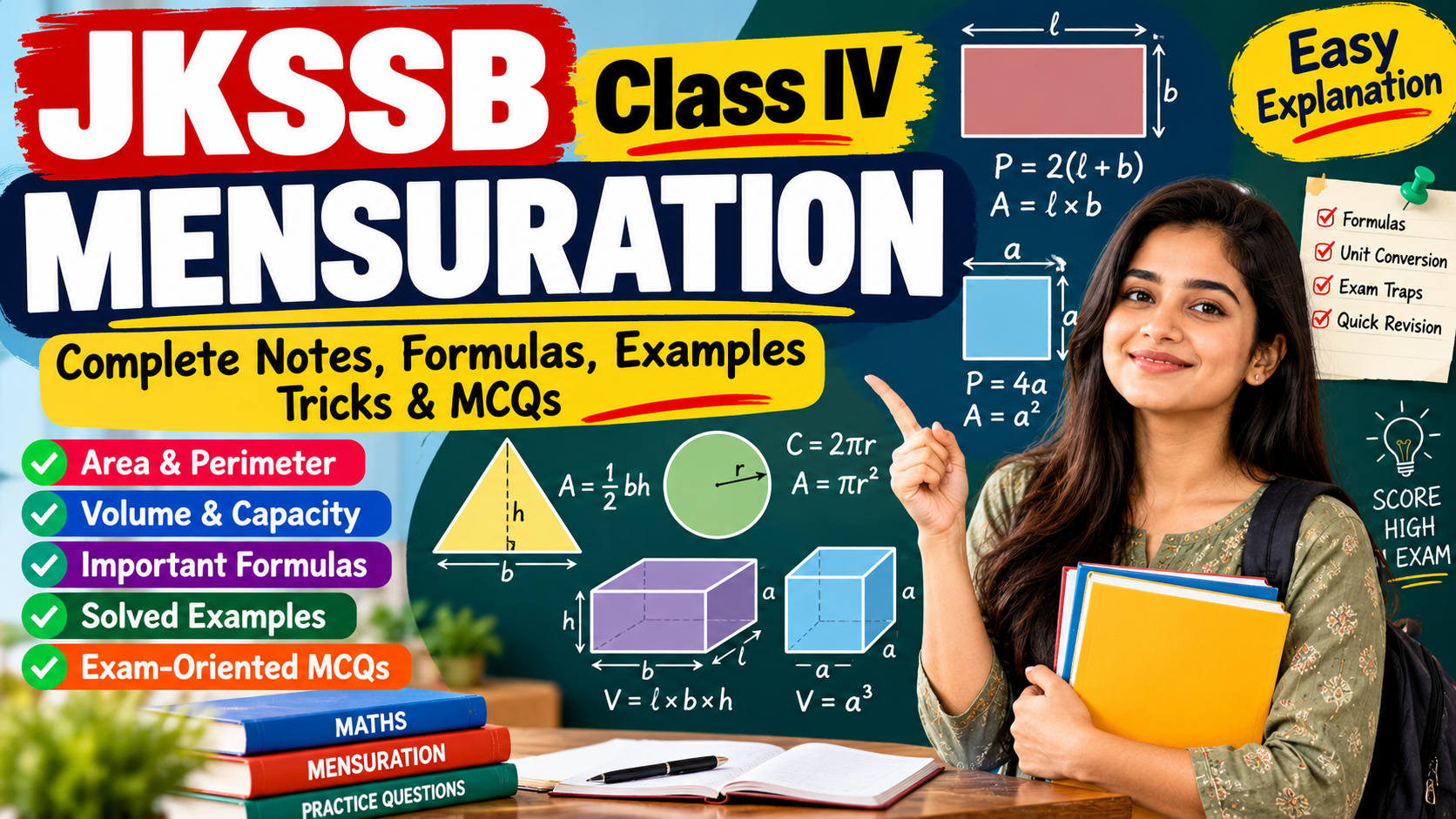
Mensuration for JKSSB Class IV
Mensuration is one of those mathematics topics that looks formula-based at first, but becomes much easier once you understand what the question is actually asking.
A question may mention a field, room, floor, wall, garden, boundary, tank, box, square, rectangle, circle or rectangular plot, and your job is to identify what quantity is required:
- Perimeter → boundary or distance around a figure
- Area → surface covered by a two-dimensional figure
- Volume → space occupied by a three-dimensional object
- Capacity → amount a container can hold
- Cost → quantity × rate
Read: JKPSI Quantitative Aptitude Tests
This distinction is extremely important for competitive examinations. Many questions do not directly say “find the perimeter” or “find the area.” Instead, they use everyday language such as:
A man walks around a rectangular field.
That means perimeter.
A farmer wants to fence a rectangular field.
That also means perimeter.
A room is to be tiled.
That normally means area of the floor.
A wall is to be painted.
That means area of the wall.
A water tank is 2 m long, 1.5 m wide and 1 m high.
That means volume/capacity.
So, before memorising formulas, learn to identify the mathematical quantity hidden inside the language of the question.
For JKSSB preparation, this is especially useful because objective questions often test whether the candidate can select the correct formula quickly rather than merely perform a long calculation.
1. What Is Mensuration?
Mensuration is the branch of mathematics concerned with the measurement of geometric quantities such as:
- length
- perimeter
- area
- volume
- surface area
- capacity
In simple words:
Mensuration tells us how much boundary, surface or space a geometrical object has.
There are two broad categories.
| Type | Meaning | Examples |
|---|---|---|
| 2D figures | Flat figures having length and breadth | Square, rectangle, triangle, circle |
| 3D figures | Solid objects having length, breadth and height/depth | Cube, cuboid, cylinder |
This distinction is fundamental.
A rectangle drawn on paper is a 2D figure.
A rectangular box is a 3D object.
The rectangle has:
- length
- breadth
The cuboid has:
- length
- breadth
- height
Therefore:
Rectangle → area
Cuboid → volume
That simple distinction solves many basic mensuration questions.
2. Why Mensuration Matters in JKSSB Exams
Mensuration is not only about memorising formulas. It tests several mathematical skills at once:
- understanding the question,
- recognising the correct figure,
- selecting the correct formula,
- maintaining correct units,
- performing arithmetic accurately.
A question can therefore look simple but still contain a trap.
For example:
Question
A rectangular field is 25 m long and 15 m broad. Find the cost of fencing it at ₹8 per metre.
A student who calculates:
[
25 \times 15 = 375
]
has found the area, not the quantity required for fencing.
The correct quantity is the perimeter:
[
2(l+b)
]
[
=2(25+15)=80m
]
Cost:
[
80\times8=₹640
]
This is an excellent example of why concept first, formula second is the correct approach.
3. The Three Most Important Questions in Mensuration
Whenever you see a mensuration problem, ask yourself:
Question 1: Am I measuring the boundary?
If yes → Perimeter
Question 2: Am I measuring the surface covered?
If yes → Area
Question 3: Am I measuring the space occupied?
If yes → Volume
A very useful memory line is:
Boundary = Perimeter
Surface = Area
Space = Volume
Remember these three words before remembering dozens of formulas.
4. Perimeter – The Boundary of a Figure
The perimeter is the total distance around a closed two-dimensional figure.
Imagine walking around the boundary of a rectangular field. The total distance covered by you is the perimeter of the field.
Similarly:
- fencing a field → perimeter
- putting a wire around a garden → perimeter
- walking around a park → perimeter
- framing a rectangular photo → perimeter
Important idea
Perimeter is a measurement of length, so its units are ordinary length units:
- mm
- cm
- m
- km
It is not measured in square units.
This is a common exam trap.
| Quantity | Unit |
|---|---|
| Length | cm, m, km |
| Perimeter | cm, m, km |
| Area | cm², m², km² |
| Volume | cm³, m³ |
| Capacity | L, mL |
5. Rectangle
A rectangle is a four-sided figure in which:
- opposite sides are equal
- all four angles are right angles
For a rectangle:
- Length = (l)
- Breadth = (b)
Perimeter of Rectangle
[
P=2(l+b)
]
Why?
A rectangle has two lengths and two breadths:
[
P=l+b+l+b
]
Therefore:
[
P=2l+2b
]
or
[
\boxed{P=2(l+b)}
]
Example
Length = 14 cm
Breadth = 9 cm
[
P=2(14+9)
]
[
=2\times23
]
[
=46cm
]
Answer:
46 cm
6. Area of a Rectangle
Area means the amount of surface occupied by the rectangle.
The formula is:
[
\boxed{A=l\times b}
]
Example
Length = 16 m
Breadth = 7 m
[
A=16\times7
]
[
A=112m^2
]
Notice the unit.
The dimensions are measured in metres, but area is measured in square metres.
This is not a decoration. The square in (m^2) tells us that we are measuring a two-dimensional surface.
7. Perimeter vs Area of Rectangle
This distinction is among the most important things to master.
| Property | Perimeter | Area |
|---|---|---|
| Meaning | Boundary | Surface |
| Formula | (2(l+b)) | (l\times b) |
| Unit | m, cm, km | m², cm², km² |
| Used for | fencing, boundary | flooring, painting surface |
| Nature | one-dimensional measurement | two-dimensional measurement |
Example
A field is 20 m × 10 m.
Perimeter:
[
2(20+10)=60m
]
Area:
[
20\times10=200m^2
]
The answers are not interchangeable.
8. Square
A square is a special rectangle.
It has:
- four equal sides
- four right angles
If each side is (a):
Perimeter of Square
[
\boxed{P=4a}
]
Area of Square
[
\boxed{A=a^2}
]
Example
Side = 12 cm
Perimeter:
[
4\times12=48cm
]
Area:
[
12^2=144cm^2
]
9. An Important Relationship Between Square and Rectangle
Every square is a rectangle, but every rectangle is not a square.
Why?
Because a rectangle has opposite sides equal, while a square has all four sides equal.
This distinction frequently appears in reasoning-type questions as well as mathematics questions.
| Feature | Rectangle | Square |
|---|---|---|
| Number of sides | 4 | 4 |
| Opposite sides | Equal | Equal |
| All sides equal | Not necessarily | Yes |
| All angles | 90° | 90° |
| Perimeter | (2(l+b)) | (4a) |
| Area | (lb) | (a^2) |
10. Finding the Side of a Square from Its Perimeter
Suppose a square has perimeter 64 cm.
We know:
[
P=4a
]
Therefore:
[
a=\frac{P}{4}
]
[
a=\frac{64}{4}=16cm
]
Shortcut
For a square:
Side = Perimeter ÷ 4
11. Finding the Side of a Square from Its Area
Suppose area = 225 cm².
Since:
[
A=a^2
]
we take square root:
[
a=\sqrt{225}
]
[
a=15cm
]
Important Square Roots to Remember
| Number | Square |
|---|---|
| 1 | 1 |
| 2 | 4 |
| 3 | 9 |
| 4 | 16 |
| 5 | 25 |
| 6 | 36 |
| 7 | 49 |
| 8 | 64 |
| 9 | 81 |
| 10 | 100 |
| 11 | 121 |
| 12 | 144 |
| 13 | 169 |
| 14 | 196 |
| 15 | 225 |
| 16 | 256 |
| 17 | 289 |
| 18 | 324 |
| 19 | 361 |
| 20 | 400 |
These values are highly useful for speed calculations.
12. Triangle
A triangle is a closed figure with:
- three sides
- three angles
Triangles are important because many students remember the area formula but forget the meaning of the height.
Area of Triangle
[
\boxed{A=\frac12 bh}
]
where:
- (b) = base
- (h) = perpendicular height
Example
Base = 12 cm
Height = 8 cm
[
A=\frac12\times12\times8
]
[
A=48cm^2
]
13. Why Is There a Half in the Triangle Formula?
This is not a random formula.
Imagine a rectangle.
A diagonal line drawn from one corner to the opposite corner divides the rectangle into two equal triangles.
Therefore, each triangle occupies half the area of the rectangle.
Rectangle area:
[
b\times h
]
Triangle area:
[
\frac12\times b\times h
]
So:
[
\boxed{\text{Triangle area}=\frac12 bh}
]
This conceptual understanding makes the formula much easier to remember.
14. Common Triangle Mistake
Students sometimes use a slanting side as the height.
That is not necessarily correct.
The height must be perpendicular to the base.
Therefore:
Base and perpendicular height are the pair used in the triangle area formula.
In an objective question, a diagram may deliberately provide several lengths. Do not automatically use the longest side.
15. Parallelogram
A parallelogram has:
- opposite sides parallel
- opposite sides equal
Its area is:
[
\boxed{A=bh}
]
where:
- (b) = base
- (h) = perpendicular height
Example
Base = 18 cm
Height = 7 cm
[
A=18\times7
]
[
=126cm^2
]
Important comparison
Triangle:
[
\frac12 bh
]
Parallelogram:
[
bh
]
Therefore, for the same base and height, a triangle has half the area of a parallelogram.
16. Rhombus
A rhombus is a four-sided figure in which all sides are equal.
Its area can be calculated using its diagonals:
[
\boxed{A=\frac12 d_1d_2}
]
where:
- (d_1) = first diagonal
- (d_2) = second diagonal
Example
Diagonal 1 = 10 cm
Diagonal 2 = 16 cm
[
A=\frac12\times10\times16
]
[
=80cm^2
]
Perimeter:
[
\boxed{4a}
]
because all four sides have equal length.
17. Trapezium
A trapezium has one pair of parallel sides.
If parallel sides are (a) and (b), and height is (h):
[
\boxed{A=\frac12(a+b)h}
]
Example
Parallel sides = 12 cm and 18 cm
Height = 6 cm
[
A=\frac12(12+18)\times6
]
[
=\frac12\times30\times6
]
[
=90cm^2
]
For basic JKSSB-level preparation, understand the structure of the formula rather than trying to memorise it without meaning.
18. Circle
A circle is a round figure in which every point on the boundary is at the same distance from the centre.
Important terms:
- Centre
- Radius
- Diameter
- Circumference
Radius
The distance from the centre to the boundary.
Represented by:
[
r
]
Diameter
A straight line passing through the centre and joining two points on the circle.
[
\boxed{d=2r}
]
Therefore:
[
\boxed{r=\frac d2}
]
This relationship should be memorised.
19. Circumference of a Circle
The boundary length of a circle is called its circumference.
Formula:
[
\boxed{C=2\pi r}
]
or
[
\boxed{C=\pi d}
]
Both forms are correct.
For many school-level competitive questions:
[
\pi=\frac{22}{7}
]
or sometimes:
[
\pi=3.14
]
Use the value specified in the question. If none is given and the numbers suggest 22/7, that value is often intended.
20. Area of a Circle
The area of a circle is:
[
\boxed{A=\pi r^2}
]
The radius is squared.
That means:
[
A=\pi\times r\times r
]
Example
Radius = 7 cm
Using:
[
\pi=\frac{22}{7}
]
[
A=\frac{22}{7}\times7\times7
]
[
=154cm^2
]
21. Circumference vs Area of Circle
| Quantity | Formula | Unit |
|---|---|---|
| Circumference | (2\pi r) | cm, m |
| Area | (\pi r^2) | cm², m² |
This is another common objective-question trap.
A boundary question involving a circular track usually points toward circumference.
A question asking how much land is covered by the circle points toward area.
22. Semicircle
A semicircle is half of a circle.
Area
[
\boxed{A=\frac12\pi r^2}
]
However, the perimeter requires special care.
The boundary of a semicircle consists of:
- the curved half of the circle
- the diameter
Therefore:
[
\boxed{\text{Perimeter of semicircle}=\pi r+2r}
]
A common mistake is to write only (\pi r).
That is only the curved portion, not the complete boundary.
23. Quarter Circle
A quarter circle is one-fourth of a circle.
Area:
[
\boxed{A=\frac14\pi r^2}
]
The complete boundary depends on what exactly the question asks, because a quarter-circle boundary contains:
- one-fourth of the circumference
- two radii
Therefore the perimeter is:
[
\boxed{\frac{\pi r}{2}+2r}
]
This is more useful for advanced practice than for routine basic questions, but understanding the logic prevents mistakes.
24. Circumference and Diameter: A Useful Relationship
Since:
[
d=2r
]
and
[
C=2\pi r
]
we can write:
[
C=\pi d
]
This is especially convenient if the question gives the diameter directly.
Example
Diameter = 14 cm.
[
C=\pi d
]
[
=\frac{22}{7}\times14
]
[
=44cm
]
There was no need to first find the radius.
25. Units of Measurement
Unit conversion is one of the most neglected parts of mensuration.
Suppose:
Length = 2 m
Breadth = 50 cm
You cannot directly multiply:
[
2\times50
]
until the units are made the same.
Convert:
[
2m=200cm
]
Then:
[
Area=200\times50=10000cm^2
]
Or convert 50 cm into metres:
[
50cm=0.5m
]
Then:
[
Area=2\times0.5=1m^2
]
Both answers represent the same physical area.
26. Important Length Conversions
| Conversion | Value |
|---|---|
| 1 cm | 10 mm |
| 1 m | 100 cm |
| 1 m | 1000 mm |
| 1 km | 1000 m |
| 1 km | 100,000 cm |
The most important chain is:
[
1km=1000m=100000cm
]
27. Important Area Conversions
This is where many candidates make mistakes.
Because area involves two dimensions, the conversion factor is squared.
Since:
[
1m=100cm
]
therefore:
[
1m^2=100\times100cm^2
]
So:
[
\boxed{1m^2=10000cm^2}
]
Similarly:
[
1km^2=(1000m)^2
]
[
=1,000,000m^2
]
Thus:
[
\boxed{1km^2=10^6m^2}
]
28. Important Volume Conversions
Because volume has three dimensions:
[
1m=100cm
]
Therefore:
[
1m^3=100\times100\times100cm^3
]
[
\boxed{1m^3=1,000,000cm^3}
]
This “power rule” is useful:
- length → factor 100
- area → factor (100^2)
- volume → factor (100^3)
29. Quick Unit Revision Table
| Quantity | Basic Conversion |
|---|---|
| 1 m | 100 cm |
| 1 m² | 10,000 cm² |
| 1 m³ | 10,00,000 cm³ |
| 1 km | 1000 m |
| 1 km² | 10,00,000 m² |
| 1 litre | 1000 mL |
| 1 m³ | 1000 litres |
| 1 litre | 1000 cm³ |
| 1 hectare | 10,000 m² |
Very Important
Do not write:
[
1m^2=100cm^2
]
That is wrong.
Correct:
[
1m^2=10000cm^2
]
30. Hectare and Square Metre
Agricultural-land questions may use hectare.
[
\boxed{1 hectare=10,000m^2}
]
Therefore:
[
2ha=20,000m^2
]
and:
[
0.5ha=5,000m^2
]
A hectare is a unit of area, not length.
31. Three-Dimensional Figures
Now we move from measuring flat surfaces to measuring solid objects.
A three-dimensional object has depth as well as length and breadth.
Common solids:
- cube
- cuboid
- cylinder
For the basic level, cube and cuboid deserve special attention.
32. Cuboid
A cuboid is a box-like solid.
Examples:
- brick
- rectangular box
- room
- cupboard
- water tank
Its dimensions are:
- length (l)
- breadth (b)
- height (h)
33. Volume of Cuboid
Volume means the amount of space occupied by the solid.
Formula:
[
\boxed{V=lbh}
]
Example
Length = 10 cm
Breadth = 6 cm
Height = 4 cm
[
V=10\times6\times4
]
[
=240cm^3
]
Notice that the unit is cubic centimetres.
34. Why Is Cuboid Volume (lbh)?
Imagine a cuboid as a stack of identical rectangular layers.
One layer has:
[
l\times b
]
area.
If there are (h) units of height:
[
Volume=Area\ of\ base\times Height
]
Therefore:
[
V=lbh
]
This relationship is important enough to remember:
Volume = Base Area × Height
For a cuboid:
[
Base\ Area=l\times b
]
so:
[
V=lbh
]
35. Capacity of a Cuboidal Tank
Suppose a water tank measures:
- 2 m × 1.5 m × 1 m
Volume:
[
2\times1.5\times1=3m^3
]
Since:
[
1m^3=1000L
]
therefore:
[
3m^3=3000L
]
Answer:
3000 litres
This type of question combines:
- volume
- multiplication
- unit conversion
and is a useful competitive-exam pattern.
36. Surface Area of a Cuboid
A cuboid has six rectangular faces.
The total surface area is:
[
\boxed{TSA=2(lb+bh+hl)}
]
Why?
The six faces occur in three pairs:
- top and bottom → (lb)
- front and back → (lh)
- left and right → (bh)
Thus:
[
2lb+2lh+2bh
]
or:
[
2(lb+bh+hl)
]
37. Lateral Surface Area of a Cuboid
The lateral surface area excludes the top and bottom.
Therefore:
[
\boxed{LSA=2h(l+b)}
]
This represents the four vertical faces.
Such questions can become slightly more advanced, so read the wording carefully.
If the question says:
Find the area of the four walls of a room.
You generally need the lateral surface area, not the total surface area.
38. Cube
A cube is a special cuboid in which:
- length = breadth = height
- all six faces are squares
- all edges are equal
If edge = (a):
Volume
[
\boxed{V=a^3}
]
Total Surface Area
[
\boxed{TSA=6a^2}
]
Lateral Surface Area
[
\boxed{LSA=4a^2}
]
Perimeter of one face
Since one face is a square:
[
4a
]
39. Cube Example
Edge = 5 cm
Volume:
[
5^3=125cm^3
]
TSA:
[
6(5^2)
]
[
=6\times25
]
[
=150cm^2
]
LSA:
[
4(5^2)
]
[
=100cm^2
]
40. Formula Master Table
This table is worth saving for revision.
| Figure | Quantity | Formula |
|---|---|---|
| Rectangle | Perimeter | (2(l+b)) |
| Rectangle | Area | (lb) |
| Square | Perimeter | (4a) |
| Square | Area | (a^2) |
| Triangle | Area | (\frac12bh) |
| Parallelogram | Area | (bh) |
| Rhombus | Area | (\frac12d_1d_2) |
| Trapezium | Area | (\frac12(a+b)h) |
| Circle | Circumference | (2\pi r) |
| Circle | Area | (\pi r^2) |
| Semicircle | Area | (\frac12\pi r^2) |
| Cuboid | Volume | (lbh) |
| Cuboid | TSA | (2(lb+bh+hl)) |
| Cuboid | LSA | (2h(l+b)) |
| Cube | Volume | (a^3) |
| Cube | TSA | (6a^2) |
| Cube | LSA | (4a^2) |
41. The Most Important Language Clues in Mensuration
Examiners often hide the mathematical operation inside ordinary language.
| Wording in Question | Usually Means |
|---|---|
| Around a field | Perimeter |
| Fence a field | Perimeter |
| Boundary of a garden | Perimeter |
| Walking around a park | Perimeter |
| Flooring a room | Area |
| Tiling a floor | Area |
| Painting a wall | Area |
| Carpet required | Area |
| Land covered | Area |
| Space occupied | Volume |
| Water a tank can hold | Volume/Capacity |
| Capacity of container | Volume/Capacity |
| Four walls of room | Lateral surface area |
Teacher's Tip
Do not rush into calculation.
First underline the word that tells you what is being measured.
42. Cost-Based Mensuration Questions
Many exam problems combine measurement with money.
The general idea is:
[
\boxed{Cost=Quantity\times Rate}
]
The difficult part is identifying the correct quantity.
Fencing
[
Cost=Perimeter\times Rate
]
Flooring
[
Cost=Area\times Rate
]
Painting
[
Cost=Area\times Rate
]
Filling a tank
You may need volume/capacity first.
43. Example: Cost of Fencing
A rectangular field is 30 m long and 20 m wide. Find the cost of fencing it at ₹15 per metre.
First find perimeter:
[
P=2(30+20)
]
[
=100m
]
Now cost:
[
100\times15=₹1500
]
Answer
₹1500
44. Example: Cost of Flooring
A room is 8 m long and 6 m wide. Flooring costs ₹120 per square metre.
Area:
[
8\times6=48m^2
]
Cost:
[
48\times120
]
[
=₹5760
]
The common mistake would be calculating the perimeter.
Remember:
Flooring covers the surface, therefore use area.
45. Example: Painting a Wall
A wall is 10 m long and 4 m high. Find the area to be painted.
[
A=10\times4
]
[
=40m^2
]
If painting costs ₹25 per square metre:
[
40\times25=₹1000
]
If the question says there are doors/windows and asks for the paintable area, subtract their areas from the total wall area.
46. Composite Figures
A composite figure is a shape made of two or more simple figures.
For example, an irregular shape may be formed by:
- a rectangle + rectangle
- rectangle + square
- rectangle + semicircle
Do not become frightened when the shape looks unfamiliar.
The best approach is:
Step 1
Break the figure into familiar shapes.
Step 2
Find the area of each part.
Step 3
Add the areas if the parts are joined.
Step 4
Subtract areas when there is a cut-out.
A useful mental rule:
Unknown shape = known shapes combined.
47. Example of Composite Area
Suppose a shape can be divided into:
- Rectangle 1: 10 × 5
- Rectangle 2: 4 × 3
Area of rectangle 1:
[
10\times5=50
]
Area of rectangle 2:
[
4\times3=12
]
Total:
[
50+12=62
]
So the composite area is:
[
\boxed{62\text{ square units}}
]
The important lesson is not the arithmetic. It is the decomposition of the shape.
48. Finding Missing Dimensions
Mensuration questions often give area or perimeter and ask for a missing side.
Suppose a rectangle has area 180 cm² and length 15 cm.
Using:
[
A=lb
]
we have:
[
180=15b
]
Therefore:
[
b=\frac{180}{15}
]
[
b=12cm
]
Formula Rearrangement
For rectangle:
[
A=lb
]
therefore:
[
l=\frac Ab
]
and
[
b=\frac Al
]
Understanding rearrangement saves time.
49. Rectangle from Perimeter
Suppose:
Perimeter = 50 cm
Length = 15 cm
Formula:
[
P=2(l+b)
]
Substitute:
[
50=2(15+b)
]
Divide by 2:
[
25=15+b
]
Therefore:
[
b=10cm
]
This kind of question tests algebraic understanding along with mensuration.
50. If Perimeter Is Fixed, Area Can Change
This is a useful conceptual observation.
Take a rectangle with perimeter 40 cm.
Case 1
Length = 15 cm
Breadth = 5 cm
Area:
[
15\times5=75cm^2
]
Case 2
Length = 12 cm
Breadth = 8 cm
Area:
[
12\times8=96cm^2
]
Both have perimeter:
[
2(15+5)=40
]
and:
[
2(12+8)=40
]
But their areas are different.
This teaches an important point:
Same perimeter does not necessarily mean same area.
In contrast, among rectangles with the same perimeter, the square has the greatest area.
For basic competitive exams, this is a useful conceptual fact.
51. Same Area Does Not Necessarily Mean Same Perimeter
Consider:
Rectangle A
10 × 6
Area:
[
60
]
Perimeter:
[
32
]
Rectangle B
12 × 5
Area:
[
60
]
Perimeter:
[
34
]
Both have the same area but different perimeters.
This is another common conceptual trap.
52. Square vs Rectangle – Important Concept
If a square and a rectangle have equal perimeter, their areas need not be equal.
If a square and rectangle have equal area, their perimeters need not be equal.
Therefore:
Area and perimeter measure different properties and cannot be treated as interchangeable.
53. Ratio-Based Mensuration
Mensuration may also be tested through ratios.
Suppose the sides of two squares are in the ratio:
[
2:3
]
Their areas are in the ratio:
[
2^2:3^2
]
[
=4:9
]
This gives a very important general principle:
When linear dimensions are in ratio (a), corresponding areas are often in ratio (a^2^2).
Similarly, corresponding volumes are in ratio:
[
a^3^3
]
This is more advanced but useful for difficult objective questions.
54. Scaling Rule
If the side of a square is doubled:
Original area:
[
a^2
]
New side:
[
2a
]
New area:
[
(2a)^2=4a^2
]
So doubling the side makes the area four times, not two times.
Similarly:
If all three dimensions of a cuboid are doubled:
[
(2l)(2b)(2h)=8lbh
]
Therefore its volume becomes 8 times.
Memory Rule
| Dimension Change | Effect on Area | Effect on Volume |
|---|---|---|
| Double | 4× | 8× |
| Triple | 9× | 27× |
| Half | 1/4× | 1/8× |
55. A Very Common Trap: Radius vs Diameter
Suppose diameter is 14 cm.
Some students directly use 14 in:
[
A=\pi r^2
]
This is wrong because the formula requires radius.
First:
[
r=\frac{14}{2}=7cm
]
Then:
[
A=\frac{22}{7}\times7^2
]
[
=154cm^2
]
Memory Line
Diameter is double the radius.
Never put the diameter directly into (πr^2).
56. Another Common Trap: Squaring the Entire Expression
Suppose:
[
r=7
]
Area:
[
\pi r^2
]
This means:
[
\pi\times7^2
]
not:
[
(\pi\times7)^2
]
Keep the formula exactly as written.
57. Choosing (\pi)
Common values:
[
\pi=\frac{22}{7}
]
and
[
\pi=3.14
]
When the radius or diameter is a multiple of 7, (22/7) often makes the calculation easier.
Example:
[
r=14
]
[
A=\frac{22}{7}\times14\times14
]
Cancel 14 with 7:
[
=22\times2\times14
]
[
=616cm^2
]
The exact arithmetic depends on the question, but the strategic principle is:
Choose the permitted value of (\pi) that makes calculation convenient, unless the question specifies otherwise.
58. Area of Four Walls of a Room
Suppose a room has:
- length = (l)
- breadth = (b)
- height = (h)
The area of the four walls is:
[
2h(l+b)
]
Why?
There are two walls of dimensions:
[
l\times h
]
and two walls of dimensions:
[
b\times h
]
Therefore:
[
2lh+2bh
]
[
=2h(l+b)
]
Important
If the question asks for four walls, do not include the floor and ceiling.
59. Flooring a Room
Floor area:
[
l\times b
]
You do not include height.
Example:
Room:
10 m × 8 m × 4 m
Floor area:
[
10\times8=80m^2
]
Four walls:
[
2(4)(10+8)=144m^2
]
The dimensions are the same room, but the required area depends on the wording.
60. Painting Four Walls
If a room is:
- 12 m long
- 8 m broad
- 4 m high
Area of four walls:
[
2h(l+b)
]
[
=2(4)(12+8)
]
[
=8\times20
]
[
=160m^2
]
If the room has doors and windows, subtract their combined area if the question asks for actual paintable area.
61. Open and Closed Boxes
A cuboid may have:
- all six surfaces
- top open
- bottom open
- one side open
This changes the required surface area.
For a completely closed cuboid:
[
TSA=2(lb+bh+hl)
]
But an open-top box excludes the top face.
Therefore the top-face area (lb) must be subtracted.
This is a useful concept for tougher practice.
62. Difference Between Area, Surface Area and Volume
| Term | Meaning |
|---|---|
| Area | Surface occupied by a 2D figure |
| Surface Area | Total outer surface of a 3D object |
| Volume | Space inside/occupied by a 3D object |
For example:
A rectangular room floor → area
A cube's six outer faces together → surface area
A water tank's internal space → volume/capacity
63. The “What Exactly Is Being Asked?” Method
Before solving any question, silently ask:
Step A – Identify the object
Is it:
- square?
- rectangle?
- triangle?
- circle?
- cube?
- cuboid?
Step B – Identify the quantity
Is the question asking for:
- perimeter?
- area?
- circumference?
- surface area?
- volume?
Step C – Check units
Are all dimensions in the same unit?
Step D – Calculate
Only now use the formula.
This four-step process greatly reduces careless mistakes.
64. Solved Problem 1 – Rectangle Perimeter
A rectangular playground has length 32 m and breadth 18 m. Find its perimeter.
[
P=2(l+b)
]
[
=2(32+18)
]
[
=2(50)
]
[
=100m
]
Answer: 100 m
65. Solved Problem 2 – Rectangle Area
A rectangular field is 45 m long and 20 m wide.
[
A=l\times b
]
[
=45\times20
]
[
=900m^2
]
Answer: 900 m²
66. Solved Problem 3 – Square Perimeter
Side of square = 18 cm.
[
P=4a
]
[
=4\times18
]
[
=72cm
]
Answer: 72 cm
67. Solved Problem 4 – Square Area
Side = 16 m.
[
A=a^2
]
[
=16^2
]
[
=256m^2
]
Answer: 256 m²
68. Solved Problem 5 – Triangle Area
Base = 24 cm
Height = 15 cm
[
A=\frac12bh
]
[
=\frac12\times24\times15
]
[
=12\times15
]
[
=180cm^2
]
Answer: 180 cm²
69. Solved Problem 6 – Circle Circumference
Radius = 14 cm.
[
C=2\pi r
]
[
=2\times\frac{22}{7}\times14
]
[
=88cm
]
Answer: 88 cm
70. Solved Problem 7 – Circle Area
Radius = 14 cm.
[
A=\pi r^2
]
[
=\frac{22}{7}\times14\times14
]
[
=616cm^2
]
Answer: 616 cm²
71. Solved Problem 8 – Cuboid Volume
Length = 12 cm
Breadth = 8 cm
Height = 5 cm
[
V=lbh
]
[
=12\times8\times5
]
[
=480cm^3
]
Answer: 480 cm³
72. Solved Problem 9 – Cost of Fencing
Length = 25 m
Breadth = 16 m
Rate = ₹12 per metre
Perimeter:
[
2(25+16)=82m
]
Cost:
[
82\times12
]
[
=₹984
]
Answer: ₹984
73. Solved Problem 10 – Cost of Flooring
Length = 12 m
Breadth = 9 m
Rate = ₹50/m²
Area:
[
12\times9=108m^2
]
Cost:
[
108\times50
]
[
=₹5400
]
Answer: ₹5,400
74. Solved Problem 11 – Missing Breadth
Area = 360 m²
Length = 24 m
[
A=lb
]
Therefore:
[
b=\frac{A}{l}
]
[
=\frac{360}{24}
]
[
=15m
]
Answer: 15 m
75. Solved Problem 12 – Missing Side from Perimeter
Perimeter of square = 92 cm.
[
4a=92
]
[
a=23cm
]
Answer: 23 cm
76. Solved Problem 13 – Tank Capacity
A cuboidal tank measures 3 m × 2 m × 1.5 m.
Volume:
[
3\times2\times1.5=9m^3
]
Since:
[
1m^3=1000L
]
therefore:
[
9m^3=9000L
]
Answer: 9,000 litres
77. Solved Problem 14 – Unit Conversion
A rectangle is 2 m long and 75 cm wide. Find the area in square metres.
Convert 75 cm:
[
75cm=0.75m
]
Area:
[
2\times0.75=1.5m^2
]
Answer: 1.5 m²
78. Solved Problem 15 – Semicircle Area
Radius = 14 cm.
[
A=\frac12\pi r^2
]
[
=\frac12\times\frac{22}{7}\times14\times14
]
Full circle area:
[
616cm^2
]
Half:
[
308cm^2
]
Answer: 308 cm²
79. Solved Problem 16 – Semicircle Perimeter
Radius = 7 cm.
[
P=\pi r+2r
]
[
=\frac{22}{7}\times7+14
]
[
=22+14
]
[
=36cm
]
Answer: 36 cm
80. Solved Problem 17 – Painting Four Walls
A room is 8 m long, 6 m broad and 4 m high. Find the area of its four walls.
[
2h(l+b)
]
[
=2(4)(8+6)
]
[
=8\times14
]
[
=112m^2
]
Answer: 112 m²
81. Solved Problem 18 – Area of Rhombus
Diagonals are 18 cm and 12 cm.
[
A=\frac12d_1d_2
]
[
=\frac12\times18\times12
]
[
=108cm^2
]
Answer: 108 cm²
82. Solved Problem 19 – Trapezium
Parallel sides are 14 cm and 20 cm and height is 8 cm.
[
A=\frac12(a+b)h
]
[
=\frac12(14+20)\times8
]
[
=17\times8
]
[
=136cm^2
]
Answer: 136 cm²
83. Solved Problem 20 – Same Perimeter, Different Shapes
A square has perimeter 40 cm. Find its area.
Side:
[
a=\frac{40}{4}=10cm
]
Area:
[
10^2=100cm^2
]
Answer: 100 cm²
Now compare with a rectangle of length 15 cm and breadth 5 cm.
Perimeter:
[
2(15+5)=40cm
]
Area:
[
15\times5=75cm^2
]
So equal perimeter does not mean equal area.
84. Quick Concept Map
Think about mensuration as:
Shape
↓
What is being measured?
↓
Boundary → Perimeter
Surface → Area
Curved boundary → Circumference
Outer surface of solid → Surface Area
Space occupied → Volume
↓
Add unit correctly
This single mental map can prevent many mistakes.
85. Students Often Confuse These
| Students Confuse | Correct Difference |
|---|---|
| Area and perimeter | Area covers surface; perimeter covers boundary |
| Radius and diameter | Diameter = 2 × radius |
| (m) and (m^2) | (m) is length; (m^2) is area |
| (m^2) and (m^3) | (m^2) is area; (m^3) is volume |
| Circumference and area of circle | Circumference is boundary; area is surface |
| Area of triangle and rectangle | Triangle = half of base × height |
| Semicircle area and perimeter | Perimeter includes diameter |
| Cuboid surface area and volume | Surface is outer covering; volume is space |
| Diameter used as radius | Convert diameter to radius first |
86. Most Important Exam Traps
Trap 1: “Fencing”
Fencing means boundary.
Use perimeter.
Trap 2: “Tiling”
Tiling covers a surface.
Use area.
Trap 3: “Capacity”
Capacity of a tank generally requires volume followed by unit conversion.
Trap 4: Diameter Given
Use:
[
r=\frac d2
]
before using:
[
\pi r^2
]
Trap 5: Mixed Units
Convert all dimensions to the same unit first.
Trap 6: Area Units
Do not forget the square.
Trap 7: Volume Units
Do not forget the cube.
Trap 8: Four Walls
Do not include floor and ceiling unless specifically asked.
87. Fast Calculation Techniques
Competitive examinations reward speed, but speed should come from understanding.
Technique 1 – Simplify before multiplying
Instead of:
[
\frac{22}{7}\times14
]
first cancel:
[
14\div7=2
]
so:
[
22\times2=44
]
Technique 2 – Use familiar multiplication
For rectangle:
[
25\times16
]
think:
[
25\times(8\times2)
]
or use:
[
25\times100/4=625
]
Technique 3 – Memorise squares
Knowing squares up to 20 is extremely useful.
Technique 4 – Check the unit
A quick unit check often catches formula errors.
88. Estimation as a Safety Check
Suppose you calculate that a 20 m × 10 m field has area 2000 m².
Pause.
20 × 10 is approximately 200, not 2000.
So the calculation is obviously wrong.
This habit of estimating the answer before finalising it is excellent for competitive examinations.
89. Reverse-Checking Answers
Suppose:
Area = 240 cm²
Length = 20 cm
You calculate breadth = 12 cm.
Check:
[
20\times12=240
]
Correct.
Reverse-checking takes only a few seconds but can save a negative-marking mistake in an exam.
90. One-Look Formula Revision
| Topic | Formula |
|---|---|
| Rectangle perimeter | (2(l+b)) |
| Rectangle area | (lb) |
| Square perimeter | (4a) |
| Square area | (a^2) |
| Triangle area | (\frac12bh) |
| Parallelogram area | (bh) |
| Rhombus area | (\frac12d_1d_2) |
| Trapezium area | (\frac12(a+b)h) |
| Circle circumference | (2πr) |
| Circle area | (πr^2) |
| Semicircle area | (\frac12πr^2) |
| Cuboid volume | (lbh) |
| Cuboid LSA | (2h(l+b)) |
| Cuboid TSA | (2(lb+bh+hl)) |
| Cube volume | (a^3) |
| Cube LSA | (4a^2) |
| Cube TSA | (6a^2) |
91. Super-Fast Memory Tricks
Rectangle
P = twice the sum
[
2(l+b)
]
A = length × breadth
[
lb
]
Square
P = 4 sides
[
4a
]
A = side × side
[
a^2
]
Triangle
Half base × height
[
\frac12bh
]
Circle
Boundary = 2πr
Area = πr²
Cuboid
Volume = three dimensions multiplied
[
lbh
]
Cube
Volume = edge three times
[
a^3
]
92. Mensuration Memory Map
MENSURATION
│
├── 2D FIGURES
│   ├── Rectangle
│   │   ├── P = 2(l+b)
│   │   └── A = lb
│   │
│   ├── Square
│   │   ├── P = 4a
│   │   └── A = a²
│   │
│   ├── Triangle
│   │   └── A = ½bh
│   │
│   └── Circle
│       ├── C = 2πr
│       └── A = πr²
│
└── 3D FIGURES
    ├── Cuboid
    │   └── V = lbh
    │
    └── Cube
        └── V = a³
93. Important Mensuration Facts for JKSSB Revision
Memorise these facts as one-liners:
- Perimeter measures the boundary of a closed figure.
- Area measures the surface occupied by a 2D figure.
- Volume measures the space occupied by a solid.
- Perimeter is expressed in linear units.
- Area is expressed in square units.
- Volume is expressed in cubic units.
- Diameter is twice the radius.
- Radius is half the diameter.
- Area of rectangle = length × breadth.
- Perimeter of rectangle = (2(l+b)).
- Area of square = side².
- Perimeter of square = 4 × side.
- Area of triangle = half × base × perpendicular height.
- Area of circle = πr².
- Circumference of circle = 2πr.
- (1m=100cm).
- (1m²=10,000cm²).
- (1m³=10,00,000cm³).
- (1m³=1000L).
- (1L=1000mL).
- (1L=1000cm³).
- (1 hectare=10,000m²).
- Fencing normally requires perimeter.
- Flooring normally requires area.
- Painting a wall requires wall area.
- Capacity of a cuboidal tank comes from volume.
- Four walls of a room require lateral surface area.
- A square is a special rectangle.
- Equal perimeter does not guarantee equal area.
- Equal area does not guarantee equal perimeter.
94. Important Comparison Table
| Quantity | What to Imagine | Formula Example | Unit |
|---|---|---|---|
| Perimeter | Walking around boundary | (2(l+b)) | m |
| Area | Covering surface | (lb) | m² |
| Circumference | Going around circle | (2πr) | m |
| Surface Area | Covering outside of solid | (6a²) for cube | m² |
| Volume | Filling inside/space | (lbh) | m³ |
| Capacity | Liquid a container holds | volume conversion | L |
95. Practical Applications of Mensuration
Mensuration is not artificial mathematics. It appears in everyday life.
Agriculture
Farmers may need to calculate:
- field area
- fencing length
- irrigation tank capacity
- land measurements
Construction
Builders calculate:
- floor area
- wall area
- room dimensions
- material requirements
Flooring
Tiles are purchased based on:
[
\text{Area to be covered}
]
Painting
Paint quantity is related to:
[
\text{Surface area}
]
Fencing
Wire or fencing material depends on:
[
\text{Perimeter}
]
Water Storage
Tank capacity depends on:
[
\text{Volume}
]
This real-life connection is exactly why mensuration is a recurring mathematical concept.
96. Conceptual Relationship Between Area and Volume
There is a useful hierarchy:
1D
Length
2D
Length × breadth
3D
Length × breadth × height
This can be remembered as:
[
\boxed{L}
]
[
\boxed{L^2}
]
[
\boxed{L^3}
]
where (L) represents a unit of length.
Therefore:
- length → one dimension
- area → two dimensions
- volume → three dimensions
This explains why their units have different powers.
97. Why Unit Conversion Becomes Squared or Cubed
Suppose:
[
1m=100cm
]
For area:
[
1m^2=100cm\times100cm
]
[
=10000cm^2
]
For volume:
[
1m^3=100\times100\times100
]
[
=1,000,000cm^3
]
So the powers are not arbitrary. They come directly from the number of dimensions being measured.
98. Advanced but Useful Concept: Diagonal of Rectangle
Although not always required in a basic mensuration question, a rectangle's diagonal follows the Pythagorean theorem:
[
\boxed{d=\sqrt{l^2+b^2}}
]
Example:
Length = 3 cm
Breadth = 4 cm
[
d=\sqrt{3^2+4^2}
]
[
=\sqrt{9+16}
]
[
=\sqrt{25}
]
[
=5cm
]
This famous 3-4-5 relationship is useful for quick calculations.
99. Advanced but Useful Concept: Diagonal of a Square
For a square of side (a):
[
\boxed{d=a\sqrt2}
]
This comes from Pythagoras:
[
d^2=a^2+a^2
]
[
d^2=2a^2
]
[
d=a\sqrt2
]
This may be beyond a simple Class-IV-focused question, but it is useful knowledge when solving mixed-level competitive questions.
100. Common Mistakes to Avoid
Mistake 1
Using area when the question asks for fencing.
Mistake 2
Using perimeter when the question asks for flooring.
Mistake 3
Forgetting to convert cm to m.
Mistake 4
Writing (m) instead of (m²) for area.
Mistake 5
Writing (m²) instead of (m³) for volume.
Mistake 6
Using diameter as radius.
Mistake 7
Using slant height as triangle's perpendicular height.
Mistake 8
Forgetting the diameter in semicircle perimeter.
Mistake 9
Using total surface area when only four walls are required.
Mistake 10
Doing arithmetic before understanding the figure.
101. JKSSB Exam Strategy for Mensuration
For a serious JKSSB aspirant, the best strategy is not to memorise 30 formulas in isolation.
Instead, master the topic in this order:
Stage 1 – Basics
Learn:
- units
- perimeter
- area
- volume
Stage 2 – Core Shapes
Master:
- square
- rectangle
- triangle
- circle
Stage 3 – Solids
Master:
- cube
- cuboid
Stage 4 – Application
Practise:
- fencing
- flooring
- painting
- tank capacity
- missing dimensions
- unit conversion
Stage 5 – Objective Practice
Solve mixed MCQs where the figure is not explicitly named.
That final stage is important because exam questions rarely announce:
“This is a perimeter question.”
They expect you to recognise it from the wording.
102. How to Revise Mensuration in the Last Few Days
During final revision, create four columns mentally:
| Remember | Understand | Watch | Practise |
|---|---|---|---|
| Formulas | Meaning of formula | Units | MCQs |
| Conversions | Boundary vs surface | Radius vs diameter | Word problems |
| Squares | Area vs volume | Semicircle perimeter | Mixed questions |
| Cubes | Four walls | Cost questions | Previous-style questions |
A good final revision cycle is:
Formula → Example → Trap → MCQ
For every formula you learn, solve at least one question involving it.
103. Most Important “Exam Language” Decoder
This is worth revising immediately before a test.
| Phrase | Think |
|---|---|
| Around | Perimeter |
| Boundary | Perimeter |
| Fence | Perimeter |
| Wire around | Perimeter |
| Cover | Area |
| Paint | Area |
| Tile | Area |
| Carpet | Area |
| Floor | Area |
| Land | Area |
| Surface | Area |
| Outside of solid | Surface area |
| Four walls | Lateral surface area |
| Space occupied | Volume |
| Filled with water | Volume/capacity |
| Holds | Capacity |
| Container | Volume/capacity |
104. 40 JKSSB-Style Mensuration MCQs
MCQ 1
A rectangle has length 18 cm and breadth 7 cm. What is its area?
A. 25 cm²
B. 50 cm²
C. 126 cm²
D. 252 cm²
Answer: C. 126 cm²
Explanation:
[
A=l\times b=18\times7=126cm^2
]
MCQ 2
The perimeter of a square whose side is 15 cm is:
A. 30 cm
B. 45 cm
C. 60 cm
D. 225 cm
Answer: C. 60 cm
Explanation:
[
P=4a=4\times15=60cm
]
MCQ 3
A rectangular field is 30 m long and 20 m wide. Its perimeter is:
A. 50 m
B. 100 m
C. 600 m
D. 1200 m
Answer: B. 100 m
Explanation:
[
P=2(30+20)=100m
]
MCQ 4
The area of a square with side 12 m is:
A. 24 m²
B. 48 m²
C. 120 m²
D. 144 m²
Answer: D. 144 m²
Explanation:
[
A=12^2=144m^2
]
MCQ 5
The area of a triangle with base 16 cm and height 10 cm is:
A. 80 cm²
B. 160 cm²
C. 26 cm²
D. 320 cm²
Answer: A. 80 cm²
Explanation:
[
A=\frac12\times16\times10=80cm^2
]
MCQ 6
The diameter of a circle is 18 cm. Its radius is:
A. 36 cm
B. 9 cm
C. 6 cm
D. 3 cm
Answer: B. 9 cm
Explanation:
[
r=\frac d2=\frac{18}{2}=9cm
]
MCQ 7
The circumference of a circle is calculated using:
A. (\pi r^2)
B. (2πr)
C. (l\times b)
D. (a^2)
Answer: B. (2πr)
Explanation: Circumference is the boundary length of a circle.
MCQ 8
The area of a circle of radius 7 cm, using (π=22/7), is:
A. 44 cm²
B. 88 cm²
C. 154 cm²
D. 308 cm²
Answer: C. 154 cm²
Explanation:
[
A=\frac{22}{7}\times7^2=154cm^2
]
MCQ 9
1 metre is equal to:
A. 10 cm
B. 100 cm
C. 1000 cm
D. 10,000 cm
Answer: B. 100 cm
MCQ 10
1 square metre is equal to:
A. 100 cm²
B. 1000 cm²
C. 10,000 cm²
D. 1,00,000 cm²
Answer: C. 10,000 cm²
MCQ 11
1 cubic metre is equal to:
A. 1000 cm³
B. 10,000 cm³
C. 1,00,000 cm³
D. 10,00,000 cm³
Answer: D. 10,00,000 cm³
MCQ 12
The volume of a cuboid 8 cm long, 5 cm wide and 3 cm high is:
A. 16 cm³
B. 40 cm³
C. 120 cm³
D. 240 cm³
Answer: C. 120 cm³
Explanation:
[
V=8\times5\times3=120cm^3
]
MCQ 13
The area of a rectangular floor is generally required when calculating:
A. Fencing cost
B. Flooring cost
C. Boundary length
D. Walking distance
Answer: B. Flooring cost
MCQ 14
The cost of fencing a rectangular field is calculated using:
A. Area × rate
B. Perimeter × rate
C. Volume × rate
D. Side × side
Answer: B. Perimeter × rate
MCQ 15
A square has perimeter 48 cm. Its side is:
A. 8 cm
B. 10 cm
C. 12 cm
D. 16 cm
Answer: C. 12 cm
MCQ 16
A rectangle has area 200 cm² and length 20 cm. Its breadth is:
A. 5 cm
B. 10 cm
C. 20 cm
D. 40 cm
Answer: B. 10 cm
MCQ 17
Which of the following is a unit of area?
A. metre
B. centimetre
C. square metre
D. litre
Answer: C. square metre
MCQ 18
Which of the following is a unit of volume?
A. m
B. m²
C. m³
D. km
Answer: C. m³
MCQ 19
The perimeter of a rectangle with length 12 cm and breadth 8 cm is:
A. 20 cm
B. 40 cm
C. 96 cm
D. 192 cm
Answer: B. 40 cm
MCQ 20
The area of a rectangle with length 12 cm and breadth 8 cm is:
A. 20 cm²
B. 40 cm²
C. 96 cm²
D. 192 cm²
Answer: C. 96 cm²
MCQ 21
The area of a parallelogram with base 15 cm and perpendicular height 8 cm is:
A. 60 cm²
B. 120 cm²
C. 180 cm²
D. 240 cm²
Answer: B. 120 cm²
MCQ 22
The area of a rhombus with diagonals 10 cm and 14 cm is:
A. 24 cm²
B. 50 cm²
C. 70 cm²
D. 140 cm²
Answer: C. 70 cm²
MCQ 23
The area of a trapezium with parallel sides 10 cm and 16 cm and height 5 cm is:
A. 26 cm²
B. 52 cm²
C. 65 cm²
D. 130 cm²
Answer: C. 65 cm²
Explanation:
[
A=\frac12(10+16)\times5
]
[
=\frac12\times26\times5=65cm^2
]
MCQ 24
Which quantity is measured in litres?
A. Perimeter
B. Area
C. Capacity
D. Length
Answer: C. Capacity
MCQ 25
1 litre is equal to:
A. 100 mL
B. 500 mL
C. 1000 mL
D. 10,000 mL
Answer: C. 1000 mL
MCQ 26
A cuboid tank has dimensions 2 m × 1 m × 1 m. Its capacity is:
A. 20 L
B. 200 L
C. 2000 L
D. 20,000 L
Answer: C. 2000 L
Explanation:
[
V=2m^3
]
and:
[
1m^3=1000L
]
Therefore:
[
2m^3=2000L
]
MCQ 27
Which formula gives the area of a square?
A. (4a)
B. (2a)
C. (a^2)
D. (a^3)
Answer: C. (a^2)
MCQ 28
Which formula gives the volume of a cube?
A. (6a^2)
B. (4a)
C. (a^2)
D. (a^3)
Answer: D. (a^3)
MCQ 29
A room is 10 m long, 5 m wide and 4 m high. The floor area is:
A. 40 m²
B. 50 m²
C. 100 m²
D. 200 m²
Answer: B. 50 m²
MCQ 30
The area of four walls of a room depends on:
A. Only length
B. Only breadth
C. Length, breadth and height
D. Only floor area
Answer: C. Length, breadth and height
MCQ 31
If the radius of a circle is doubled, its area becomes:
A. 2 times
B. 3 times
C. 4 times
D. 8 times
Answer: C. 4 times
Explanation:
[
A=πr^2
]
Replacing (r) by (2r):
[
A'=π(2r)^2=4πr^2
]
MCQ 32
If the side of a square is doubled, its area becomes:
A. 2 times
B. 3 times
C. 4 times
D. 8 times
Answer: C. 4 times
MCQ 33
If all dimensions of a cuboid are doubled, its volume becomes:
A. 2 times
B. 4 times
C. 6 times
D. 8 times
Answer: D. 8 times
MCQ 34
A semicircle has radius 7 cm. Its area is:
A. 77 cm²
B. 154 cm²
C. 44 cm²
D. 22 cm²
Answer: A. 77 cm²
Explanation:
Full circle area:
[
154cm^2
]
Half:
[
77cm^2
]
MCQ 35
The perimeter of a semicircle includes:
A. Only curved part
B. Only diameter
C. Curved part and diameter
D. Radius only
Answer: C. Curved part and diameter
MCQ 36
A farmer wants to put fencing around a square field. Which measurement is required first?
A. Area
B. Perimeter
C. Volume
D. Height
Answer: B. Perimeter
MCQ 37
A floor is to be covered with tiles. Which quantity is most directly required?
A. Perimeter
B. Area
C. Circumference
D. Volume
Answer: B. Area
MCQ 38
A tank is filled with water. Which quantity determines how much water it can hold?
A. Perimeter
B. Area only
C. Volume/capacity
D. Circumference
Answer: C. Volume/capacity
MCQ 39
Which statement is correct?
A. Area is measured in metres
B. Perimeter is measured in square metres
C. Volume is measured in cubic units
D. Circumference is measured in litres
Answer: C. Volume is measured in cubic units
MCQ 40
The diameter of a circle is:
A. Half its radius
B. Equal to its radius
C. Twice its radius
D. Three times its radius
Answer: C. Twice its radius
105. Extra Challenge MCQs
MCQ 41
A rectangular field has perimeter 100 m and length 30 m. Its breadth is:
A. 10 m
B. 20 m
C. 30 m
D. 40 m
Answer: B. 20 m
Explanation:
[
100=2(30+b)
]
[
50=30+b
]
[
b=20m
]
MCQ 42
A square and a rectangle have the same perimeter of 40 cm. The square has side:
A. 5 cm
B. 8 cm
C. 10 cm
D. 20 cm
Answer: C. 10 cm
MCQ 43
A circle has diameter 28 cm. Its circumference is:
A. 44 cm
B. 66 cm
C. 88 cm
D. 154 cm
Answer: C. 88 cm
Explanation:
[
C=\pi d
]
[
=\frac{22}{7}\times28=88cm
]
MCQ 44
A rectangular plot is 50 m × 40 m. What is its area in hectares?
A. 0.02 hectare
B. 0.2 hectare
C. 2 hectares
D. 20 hectares
Answer: B. 0.2 hectare
Explanation:
Area:
[
50\times40=2000m^2
]
Since:
[
1ha=10000m^2
]
[
2000/10000=0.2ha
]
MCQ 45
A cube has edge 4 cm. Its volume is:
A. 16 cm³
B. 32 cm³
C. 64 cm³
D. 96 cm³
Answer: C. 64 cm³
MCQ 46
The total surface area of a cube of side 5 cm is:
A. 25 cm²
B. 50 cm²
C. 100 cm²
D. 150 cm²
Answer: D. 150 cm²
[
TSA=6a^2=6(25)=150cm^2
]
MCQ 47
A room measures 8 m × 5 m. The cost of flooring is ₹100 per square metre. Total cost is:
A. ₹4000
B. ₹5000
C. ₹8000
D. ₹13,000
Answer: B. ₹4000
Correction check:
Area:
[
8\times5=40m^2
]
Cost:
[
40\times100=₹4000
]
Therefore the correct answer is A. ₹4000.
This illustrates why checking the arithmetic is important even after selecting the correct method.
MCQ 48
A rectangular field is 20 m × 15 m. Fencing costs ₹10 per metre. Total fencing cost is:
A. ₹350
B. ₹500
C. ₹700
D. ₹3000
Answer: C. ₹700
Perimeter:
[
2(20+15)=70m
]
Cost:
[
70\times10=₹700
]
MCQ 49
The breadth of a rectangle is 10 cm and its area is 250 cm². The length is:
A. 15 cm
B. 20 cm
C. 25 cm
D. 30 cm
Answer: C. 25 cm
MCQ 50
Which one is correctly matched?
A. Fencing — Area
B. Flooring — Volume
C. Tank capacity — Volume
D. Wall painting — Perimeter
Answer: C. Tank capacity — Volume
106. Frequently Asked Conceptual Questions
Q1. What is mensuration?
Mensuration is the branch of mathematics dealing with the measurement of length, perimeter, area, surface area, volume and related quantities.
Q2. What is the difference between perimeter and area?
Perimeter is the total boundary length of a figure, whereas area is the surface covered by the figure.
Q3. What is the area formula of a rectangle?
[
A=l\times b
]
Q4. What is the perimeter formula of a rectangle?
[
P=2(l+b)
]
Q5. What is the area of a square?
[
A=a^2
]
Q6. What is the perimeter of a square?
[
P=4a
]
Q7. What is the area of a triangle?
[
A=\frac12bh
]
where (h) is the perpendicular height.
Q8. What is the circumference of a circle?
[
C=2πr
]
Q9. What is the area of a circle?
[
A=πr^2
]
Q10. What is the volume of a cuboid?
[
V=lbh
]
Q11. What is the volume of a cube?
[
V=a^3
]
Q12. How many centimetres are in one metre?
[
100cm
]
Q13. How many square centimetres are in one square metre?
[
10,000cm^2
]
Q14. How many litres are in one cubic metre?
[
1000L
]
Q15. What is the relation between radius and diameter?
[
d=2r
]
107. Students Often Confuse: Formula vs Meaning
| Formula | Meaning |
|---|---|
| (2(l+b)) | Boundary of rectangle |
| (lb) | Surface of rectangle |
| (4a) | Boundary of square |
| (a^2) | Surface of square |
| (\frac12bh) | Surface of triangle |
| (2πr) | Boundary of circle |
| (πr^2) | Surface of circle |
| (lbh) | Space of cuboid |
| (a^3) | Space of cube |
This table is more useful than memorising formulas in random order.
108. One-Look Revision Before the Exam
RECTANGLE
[
P=2(l+b)
]
[
A=lb
]
SQUARE
[
P=4a
]
[
A=a^2
]
TRIANGLE
[
A=\frac12bh
]
CIRCLE
[
C=2πr
]
[
A=πr^2
]
CUBOID
[
V=lbh
]
[
LSA=2h(l+b)
]
[
TSA=2(lb+bh+hl)
]
CUBE
[
V=a^3
]
[
LSA=4a^2
]
[
TSA=6a^2
]
UNIT FACTS
[
1m=100cm
]
[
1m^2=10,000cm^2
]
[
1m^3=10,00,000cm^3
]
[
1m^3=1000L
]
[
1L=1000mL
]
[
1ha=10,000m^2
]
109. Final JKSSB Mensuration Revision Sheet
Before the examination, make sure you can answer these without hesitation:
Basic Concepts
- What is perimeter?
- What is area?
- What is volume?
- What is capacity?
- What is surface area?
Rectangle
- perimeter
- area
- missing length
- missing breadth
Square
- perimeter
- area
- missing side
Triangle
- base
- perpendicular height
- area
Circle
- radius
- diameter
- circumference
- area
- semicircle
Solid Figures
- cube
- cuboid
- volume
- surface area
- tank capacity
Applications
- fencing
- flooring
- painting
- carpeting
- land measurement
- water tanks
- cost calculations
Units
- length
- square units
- cubic units
- litres
- millilitres
- hectare
If all of these are comfortable, the foundation of mensuration is strong.