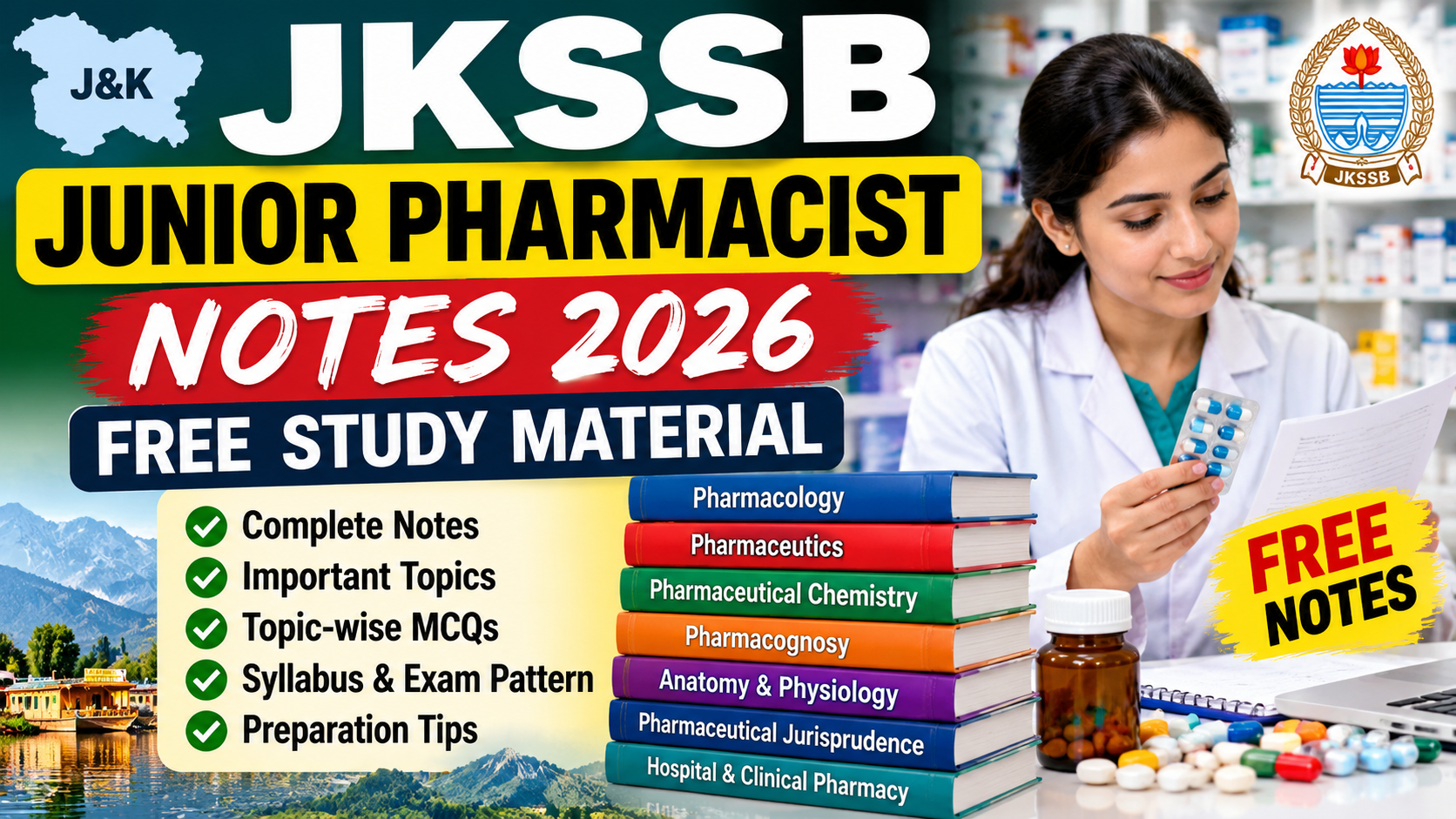
JKSSB Junior Pharmacist Notes 2026 – Free Study Material & Preparation Guide
If you are preparing for the JKSSB Junior Pharmacist exam, one thing becomes clear very quickly — having the right study material matters a lot. The syllabus is not something you can finish properly by simply reading random PDFs or watching a few videos. You need notes that explain the important concepts, help you revise quickly, and most importantly, keep your preparation focused on the type of questions asked in competitive pharmacy examinations.
For students preparing from Jammu & Kashmir, finding properly organized JKSSB Junior Pharmacist notes can sometimes be difficult. You may find hundreds of PDFs online, but the real problem is knowing which topics are important, what to study first, and how much detail is actually required.
That is why we have made this page for students looking for free Junior Pharmacist study material, notes, important topics and MCQs in one place.
Download Complete notes for Junior Pharmacist jkssb with full mocktests
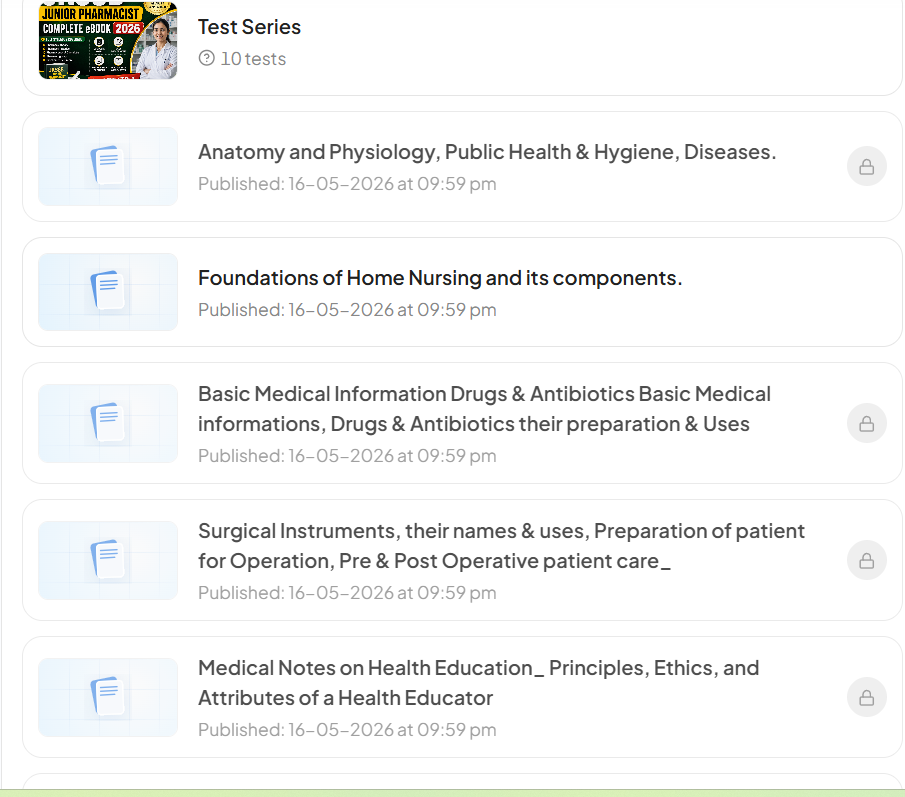
Free JKSSB Junior Pharmacist Notes
If you are currently searching for JKSSB Junior Pharmacist free notes, you can start your preparation without spending money on expensive study material.
Our aim is simple: provide useful, exam-oriented material that a student can actually revise before the examination.
The notes are designed around important pharmacy concepts and common competitive-exam topics. Instead of filling pages with unnecessary information, the focus should be on definitions, classifications, mechanisms, uses, adverse effects, important drugs, pharmaceutical calculations, pharmacology concepts and other areas that can be tested through MCQs.
You can use the free notes during your first reading and then return to them during revision.
Free notes are especially useful when you are building your preparation from scratch. Once your concepts become stronger, you can move towards MCQs and previous-year questions.
What Should You Study for JKSSB Junior Pharmacist?
Junior Pharmacist preparation requires a combination of pharmacy knowledge and general competitive-exam preparation.
Some students make the mistake of spending too much time on one subject while ignoring other areas. A better approach is to divide your preparation topic-wise and keep revising everything regularly.
Important pharmacy areas generally include topics such as:
- Pharmaceutics
- Pharmacology
- Pharmaceutical Chemistry
- Pharmacognosy
- Human Anatomy & Physiology
- Biochemistry
- Microbiology
- Hospital & Clinical Pharmacy
- Drug Store Management
- Pharmaceutical Jurisprudence
- Community Pharmacy
- Pharmacy-related calculations
- Important drugs and their uses
Apart from these, candidates should also carefully check the official JKSSB notification and syllabus whenever the recruitment notification is released or updated. The exact syllabus, qualification requirements and examination pattern should always be confirmed from the official notification.
Pharmacology – Give It Proper Attention
If you are preparing for Junior Pharmacist, Pharmacology deserves serious attention.
There are many facts that can be converted directly into MCQs. For example, questions may test drug classes, mechanisms of action, therapeutic uses, adverse effects, contraindications or examples of particular drugs.
Don't try to memorize the entire textbook line by line.
Instead, make small connections.
For example:
Drug → Class → Mechanism → Main Use → Important Side Effect
This simple method makes revision much easier.
While preparing Pharmacology, pay attention to commonly studied areas such as antibiotics, cardiovascular drugs, CNS drugs, antidiabetic drugs, antihypertensive drugs, analgesics, anti-inflammatory drugs and gastrointestinal medicines.
The goal is not just to remember a drug name. You should understand where that drug belongs and why it is used.
Pharmaceutics Notes for Revision
Pharmaceutics is another important area for pharmacy students.
Topics related to dosage forms, tablets, capsules, suspensions, emulsions, solutions, ointments, creams, powders and pharmaceutical preparations should be studied carefully.
You should also understand basic concepts rather than only memorizing definitions.
For example, when studying tablets, don't stop at the definition. Learn the different types, manufacturing concepts, excipients, advantages and common evaluation parameters.
The same approach can be applied to other dosage forms.
When you study a topic properly once, revision becomes much faster later.
Pharmaceutical Chemistry
Pharmaceutical Chemistry can feel difficult because there are many chemical names, structures and properties to remember.
Don't let that discourage you.
Start with the basic concepts and gradually move towards important medicinal compounds and their properties.
Make short revision lists wherever possible.
For example:
Drug name → Chemical class → Important property → Therapeutic use
These small tables can become extremely useful during the final days of preparation.
You don't need to carry your entire textbook into your final revision. You need concise notes that allow you to revise important information quickly.
Human Anatomy & Physiology
A good understanding of Human Anatomy and Physiology also helps in pharmacy preparation.
Focus on the major systems of the human body and understand their basic functions.
Important areas can include:
- Cardiovascular system
- Respiratory system
- Digestive system
- Nervous system
- Endocrine system
- Urinary system
- Reproductive system
- Skeletal system
- Muscular system
- Blood and lymphatic system
Questions from these topics can often be factual, so repeated revision is useful.
Don't read the same chapter five times without testing yourself. Read it once carefully, make short notes and then solve MCQs.
Pharmacognosy
For Pharmacognosy, students should focus on medicinal plants, crude drugs, biological sources, chemical constituents and therapeutic uses.
This subject contains many names and facts, which means revision becomes very important.
One practical method is to prepare small tables.
For example:
| Drug | Biological Source | Important Constituent | Use |
|---|---|---|---|
| Digitalis | Digitalis species | Cardiac glycosides | Cardiac conditions |
| Senna | Senna species | Sennosides | Laxative |
| Clove | Syzygium aromaticum | Eugenol | Various pharmaceutical uses |
The exact details should always be checked against your prescribed syllabus and standard pharmacy references.
Pharmaceutical Jurisprudence
Don't ignore Pharmaceutical Jurisprudence simply because it appears smaller compared with subjects like Pharmacology.
Legal and regulatory questions can be highly factual.
Prepare important pharmacy laws, schedules, rules, definitions and regulatory concepts included in your syllabus.
This is one of those subjects where short notes can make revision much easier.
Instead of repeatedly reading long chapters, create concise points and revise them regularly.
Practice MCQs After Every Topic
This is probably one of the most important parts of Junior Pharmacist preparation.
Reading notes gives you information.
MCQs tell you whether you can actually use that information.
Suppose you finish a topic on antibiotics. Don't immediately jump to another chapter.
Solve 20–30 questions related to that topic.
Check your mistakes.
If you repeatedly get the same concept wrong, return to your notes and revise that particular point.
This creates a very useful cycle:
Study → Practice → Find Mistakes → Revise → Practice Again
Over time, your weak areas become much easier to identify.
Don't Depend Only on Previous-Year Questions
Previous-year questions are extremely useful, but they shouldn't become your entire preparation strategy.
A student who memorizes only previous questions may struggle if the examiner changes the wording or asks the same concept in a different way.
Use previous-year questions to understand the question style and important areas.
Then use your notes to understand the underlying concept.
That way, even when a question is presented differently, you have a better chance of solving it.
How to Use Our Free Notes
If you are using the free JKSSB Junior Pharmacist notes, don't try to complete everything in one sitting.
Take one subject at a time.
Read the topic.
Underline or note important facts.
Solve MCQs.
Mark your mistakes.
Then come back for revision after a few days.
During the final stage of preparation, your notes should become a revision tool rather than something you are reading for the first time.
A good study material collection is valuable only when you actually use it consistently.
ALSO READ: JKSSB CSSD Attendant & Nursing Aid G-3 Study Material 2026
Final Words for JKSSB Junior Pharmacist Aspirants
Preparing for the JKSSB Junior Pharmacist examination can definitely feel overwhelming in the beginning. There are many pharmacy subjects, numerous drug names and a lot of factual information to remember.
But you don't have to finish everything in one day.
Start with the basics.
Build your concepts.
Use free JKSSB Junior Pharmacist notes for your first preparation and revision. Practice topic-wise MCQs regularly and keep a separate list of questions you get wrong.
Most importantly, don't keep changing your study material every few days. Pick reliable notes, follow the syllabus, practice questions and revise what you have already studied.
Your preparation doesn't need to be complicated. What matters is consistency.
If you are preparing for JKSSB Junior Pharmacist, use the available free notes, revise important pharmacy topics, practice MCQs and keep checking the latest official JKSSB recruitment information for the applicable examination.
Study smart, revise regularly, and keep your preparation focused on the syllabus.