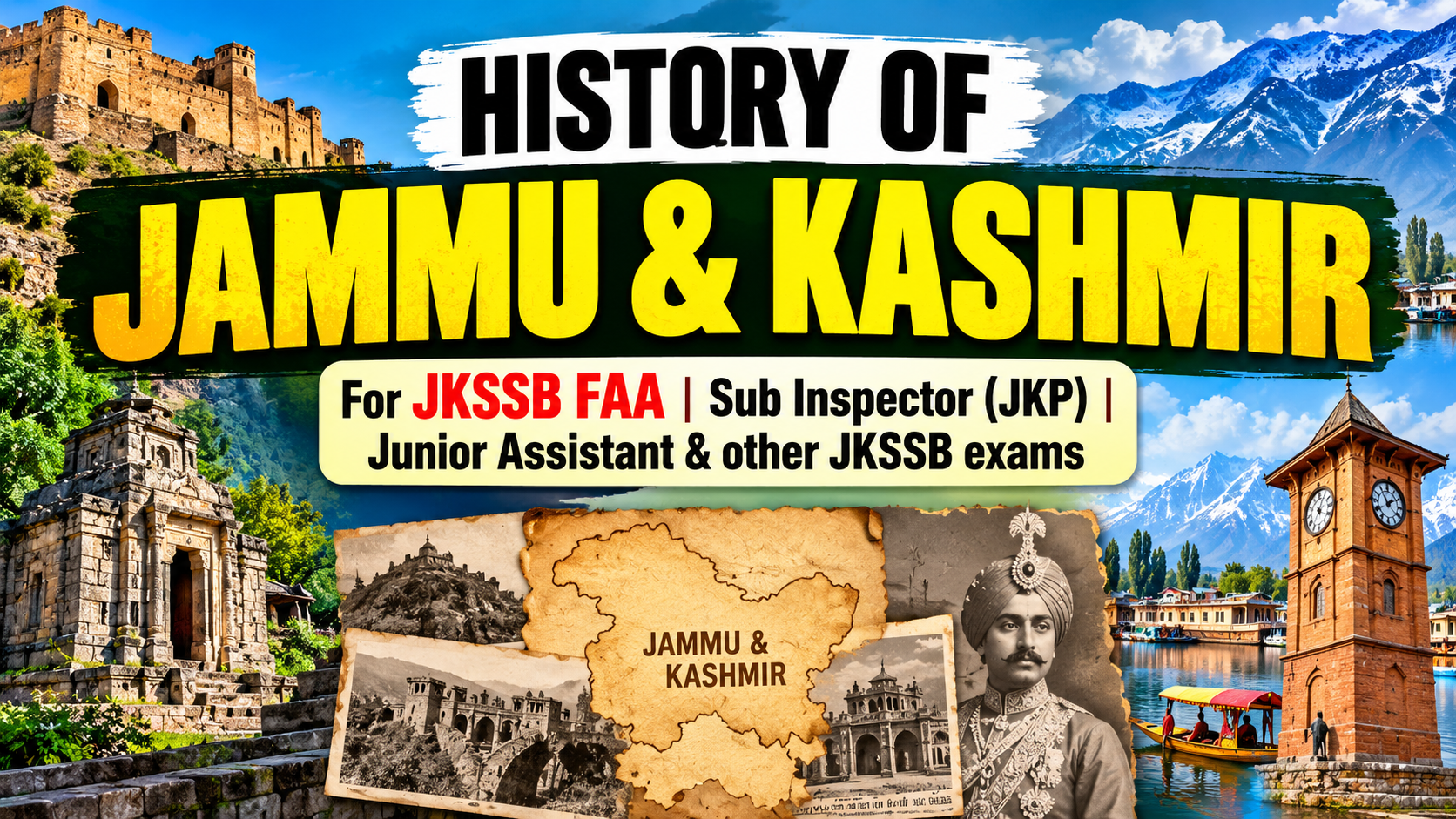
HISTORY OF JAMMU & KASHMIR
Concise Notes + PYQ-Pattern MCQs + Statement-Based MCQs
For JKSSB FAA | Sub Inspector (JKP) | Junior Assistant & other JKSSB exams
Part | Contents |
A | Chronological notes: Ancient to 2019 with quick tables |
B | 37 PYQ-pattern MCQs (frequently tested facts) |
C | 26 statement-based MCQs (1 & 2 / chronology / match / assertion-reason) |
D | Answer keys with explanations + 60-second revision sheet |
Note: The "PYQ-pattern" questions are built on facts and formats that JKSSB and JKP papers repeatedly test. They are not verbatim copies of past papers. Cross-check dates once with the official J&K history textbook (Class XI/XII JKBOSE) or your coaching notes.
Download Complete Notes for All jkssb exams
PART A: NOTES
1. Sources of J&K History
Source | Key Points |
Rajatarangini (Kalhana) | Sanskrit, c. 1148-49 CE, 8 Tarangas; written in Jayasimha's reign. Oldest historical chronicle of India. |
Neelmat Purana | Legend: Kashmir was the lake Satisar drained by sage Kashyap; describes festivals and rituals. |
Later chronicles | Jonaraja (Dvitiya Rajatarangini), Srivara, Prajyabhatta, Suka; Persian: Baharistan-i-Shahi, Tarikh-i-Rashidi (Mirza Haidar Dughlat). |
Foreign travellers | Hiuen Tsang (631 CE), Al-Biruni, Bernier (Mughal period), Moorcroft, Vigne. |
Literary figures | Bilhana (Vikramankadevacharita), Kshemendra (Brihatkathamanjari), Lal Ded, Nund Rishi, Habba Khatoon. |
2. Ancient Period
Dynasty / Ruler | Key Facts |
Gonanda dynasty | Legendary early rulers; Pravarasena II founded Pravarapura (Srinagar). |
Maurya: Ashoka | Spread Buddhism; per Kalhana he founded Srinagari (Pandrethan area). |
Kushan: Kanishka | Fourth Buddhist Council at Kundalvana (Harwan); Vasumitra presided, Ashvaghosha deputy; Nagarjuna was present. |
Karkota (c. 625-855) | Founder Durlabhvardhana. Lalitaditya Muktapida (724-760): Martand Sun Temple, Parihaspora; expansions to Central Asia/Kannauj. Jayapida also notable. Hiuen Tsang visited in 631 CE. |
Utpala (855-939) | Avantivarman: Avantipora temples; minister Suyya: flood control, irrigation, drainage of Vitasta (Jhelum). |
Lohara (1003-1171) | Queen Didda (980-1003) strong ruler; Harsha (1089-1101) "Nero of Kashmir"; Jayasimha (1128-55), Kalhana's patron. |
End of Hindu rule | Suhadeva (1301-20), Dulucha's invasion (1320), Rinchana's brief rule; Kota Rani last Hindu ruler (d. 1339). |
Exam Tip: Karkota = Lalitaditya = Martand. Utpala = Avantivarman = Avantipora. Lohara = Didda/Harsha/Jayasimha.
3. Medieval Period
3.1 Sultanate (1339-1561)
- Rinchana (1320-23): Ladakhi/Tibetan Buddhist prince; converted by Bulbul Shah (Sayyid Sharfuddin); Sultan Sadruddin.
- Shamsuddin Shah Mir (1339): founded Shah Mir dynasty, ended Hindu rule.
- Shihabuddin (1354-73): military expansion.
- Mir Syed Ali Hamdani (Shah-e-Hamdan): came from Hamadan (Persia) in 1381 with followers; introduced crafts; Khanqah-e-Mualla; work *Zakhirat-ul-Muluk*.
- Sikandar (1389-1413) "Butshikan": Jamia Masjid Srinagar began 1394; conversion drive and temple destruction.
- Zain-ul-Abidin "Budshah" (1420-70): abolished jizya, banned cow slaughter, promoted Hindu-Muslim harmony; Zaina Kadal, Zainagir canal, Zaina Lank; introduced paper-making, shawl-weaving, carpet-making, papier-mache; patronised translation of Mahabharata and Rajatarangini.
- Sufi/Rishi movement: Lal Ded (Lalleshwari), Sheikh Nooruddin Noorani (Nund Rishi, 1377-1438), Rishi order (Kashmiriyat).
- Chak dynasty (1561-86): Ghazi Shah Chak; Yusuf Shah Chak (wife Habba Khatoon); Yaqub Shah Chak, the last; Akbar's general Qasim Khan Mir Bahr conquered Kashmir in 1586.
3.2 Mughal Rule (1586-1753)
- Akbar: Hari Parbat fort and Nagar Nagar.
- Jahangir: Shalimar Bagh (1619), Verinag, Achabal; died en route from Kashmir in 1627.
- Shah Jahan era: Nishat Bagh (Asaf Khan, 1633), Chashma Shahi (Ali Mardan Khan, 1632). Dara Shikoh: Pari Mahal.
- Aurangzeb: Bernier visited Kashmir with the emperor; later Mughal decline led to Afghan takeover.
3.3 Afghan Rule (1753-1819)
- Ahmad Shah Abdali's governor Sukh Jiwan Mal first; Afghan governors including Azad Khan and Jabbar Khan (last) were harsh; heavy taxation and cruelty, especially on Pandits and Shias.
3.4 Sikh Rule (1819-1846)
- Ranjit Singh's army under Misr Diwan Chand defeated Jabbar Khan in 1819.
- Governors: Diwan Moti Ram, Hari Singh Nalwa (1820-21), Mihan Singh, Sheikh Ghulam Mohiuddin, Sheikh Imam-ud-din.
- Gulab Singh was made Raja of Jammu (1822) by Ranjit Singh.
4. Dogra Period (1846-1947)
Ruler | Reign | Key Events |
Gulab Singh | 1846-57 | Founder. Treaty of Amritsar (16 Mar 1846), 75 lakh Nanakshahi rupees. Zorawar Singh: Ladakh (1834-35), Baltistan (1840), killed 1841. Treaty of Chushul (1842) with Tibet. |
Ranbir Singh | 1857-85 | Ranbir Penal Code; Dharmarth Trust; patron of Sanskrit and Persian learning; Raghunath temple (Jammu); extended influence over Hunza/Gilgit; famine 1877-79. |
Pratap Singh | 1885-1925 | British Resident posted (1885); State Council (1889); Lawrence Land Settlement (1887-89); Jhelum Valley road; Mohora hydroelectric project (1905); Gilgit Agency (1889) set up by the British. |
Hari Singh | 1925-47 | State Subject Notification (1927); Reading Room Party (1930); Martyrs' Day (13 July 1931); Glancy Commission (1931); Praja Sabha (1934); Constitution Act (1939); J&K Bank (1938); Accession (1947). |
4.1 Political Awakening (1930-47)
Year | Event |
1930 | Reading Room Party (Srinagar); educated Muslim youth, including Sheikh Abdullah, raised public issues. |
13 July 1931 | Firing near Central Jail on crowds demanding Abdul Qadeer's release; 22 killed. Observed as Martyrs' Day. |
1931 | Glancy Commission; Maharaja concedes some demands. |
Oct 1932 | All J&K Muslim Conference formed (Sheikh Abdullah, Ch. Ghulam Abbas; Mirwaiz Yusuf Shah). |
1932 | Dalal (Franchise) Commission; Temple Entry proclamation. |
1934 | Praja Sabha created (75 members, with elected seats). First elections. |
June 1939 | Muslim Conference renamed National Conference (secular platform). |
1939 | J&K Constitution Act: Praja Sabha strengthened, some responsible government features. |
1944 | Naya Kashmir manifesto (land to the tiller, rights, welfare). |
May 1946 | Quit Kashmir Movement against the Treaty of Amritsar; Sheikh Abdullah arrested. |
Exam Tip: 1931 (Martyrs) -> 1932 (Muslim Conference) -> 1934 (Praja Sabha) -> 1939 (NC + Constitution Act) -> 1944 (Naya Kashmir) -> 1946 (Quit Kashmir).
4.2 Gilgit
- British Gilgit Agency: 1889; Gilgit Wazarat leased for 60 years in 1935; returned to the Maharaja on 1 Aug 1947.
- Gilgit Scouts' revolt on 1 Nov 1947 (Major William Brown); Gilgit joined Pakistan.
5. Accession and 1947-48
Date | Event |
15 Aug 1947 | Partition; J&K had option of joining India/Pakistan or remaining independent. Standstill Agreement offered to both: Pakistan accepted, India did not sign. |
Prime Ministers before accession | Ram Chandra Kak (1945-47), then Janak Singh; Mehr Chand Mahajan became PM on 15 Oct 1947. |
22 Oct 1947 | Tribal raiders (backed by Pakistan) attacked Muzaffarabad. |
26 Oct 1947 | Hari Singh signed the Instrument of Accession; V.P. Menon carried it. |
27 Oct 1947 | Mountbatten accepted; Indian troops airlifted to Srinagar (Sikh Regiment). |
Oct 1947 | Sheikh Abdullah heads the Emergency Administration; PM from March 1948. |
1 Jan 1948 | India refers issue to the UN under Article 35. |
Aug 1948 | UNCIP resolution; ceasefire on 1 Jan 1949; Karachi Agreement (July 1949) fixed the CFL. |
6. Post-Accession: Constitutional Developments
Year | Development |
June 1949 | Karan Singh made Regent. |
17 Oct 1949 | Article 370 adopted (Part XXI: temporary, transitional and special provisions). |
1950 | Constitution of India extended to J&K only to the extent of Article 370 (Constitution (Application to J&K) Order 1950). |
1951 | Constituent Assembly of J&K elected (75 seats; National Conference won all); first met 31 Oct 1951. |
1952 | Delhi Agreement (Nehru and Sheikh Abdullah): flag, citizenship, Sadr-i-Riyasat. Karan Singh elected first Sadr-i-Riyasat. |
9 Aug 1953 | Sheikh Abdullah dismissed and arrested; Bakshi Ghulam Mohammad PM. |
1954 | Presidential Order extends many Union powers; Article 35A added. |
17 Nov 1956 / 26 Jan 1957 | Constitution of J&K adopted / came into force. |
1965 | Seventh Amendment: PM becomes Chief Minister; Sadr-i-Riyasat becomes Governor (Karan Singh first Governor). |
1975 | Indira-Sheikh Accord; Sheikh Abdullah returns as CM. |
1986-87 | Governor's rule (1986); Rajiv-Farooq Accord (Nov 1986); 1987 elections. |
Jan 1990 | Governor's rule (Jagmohan); militancy rises. |
5 Aug 2019 | Article 370 abrogated; J&K Reorganisation Act 2019. |
31 Oct 2019 | J&K (with legislature) and Ladakh (without) become UTs. |
6.1 Heads of Government
Head | Tenure / Note |
Sheikh Abdullah | PM 1948-53; CM 1975-82 (died 8 Sept 1982) |
Bakshi Ghulam Mohammad | PM 1953-63 |
Khwaja Shamsuddin | PM 1963-64 |
G.M. Sadiq | PM 1964-65, then first CM (1965-71) |
Mir Qasim | CM 1971-75 |
Farooq Abdullah | CM 1982-84; 1986-90; 1996-2002 |
G.M. Shah | CM 1984-86 |
Mufti Mohammad Sayeed | CM 2002-05; 2015-16 |
Ghulam Nabi Azad | CM 2005-08 |
Omar Abdullah | CM 2009-15; again from Oct 2024 (UT with legislature) |
Mehbooba Mufti | CM 2016-18 |
Exam Tip: Wars to know: 1947-48, 1965 (Tashkent Declaration 1966), 1971 (Simla Agreement 1972), 1999 Kargil.
ALSO READ: Current affairs september 2026 for jkssb exams
7. 60-Second Revision Sheet
- Rajatarangini = Kalhana = 12th century = 8 Tarangas.
- Kanishka = 4th Buddhist Council at Kundalvana.
- Karkota: Durlabhvardhana (founder), Lalitaditya (Martand).
- Avantivarman = Avantipora; Suyya = irrigation engineer.
- Shah Mir 1339; Rinchana converted by Bulbul Shah.
- Sikandar = Butshikan; Zain-ul-Abidin = Budshah.
- Akbar annexed Kashmir in 1586 (Yaqub Shah Chak last Chak).
- Afghan rule 1753-1819; Sikh rule 1819-1846.
- Treaty of Amritsar: 16 March 1846; 75 lakh.
- Dogra order: Gulab - Ranbir - Pratap - Hari.
- 13 July 1931: Martyrs' Day. 1932 Muslim Conference. 1939 National Conference.
- 26 Oct 1947 Accession; 27 Oct troops landed; 1 Jan 1948 UN referral.
- Karan Singh: Regent 1949, Sadr-i-Riyasat 1952, Governor 1965.
- J&K Constitution: adopted 17 Nov 1956, in force 26 Jan 1957.
- Article 370 abrogated 5 Aug 2019; UT status effective 31 Oct 2019.
PART B: PYQ-PATTERN MCQs (Q1-Q37)
Choose the correct option. Answers and explanations are in Part D.
Q1. Who wrote the Rajatarangini, the chronicle of the kings of Kashmir?
(A) Bilhana
(B) Kalhana
(C) Kshemendra
(D) Jonaraja
Q2. Rajatarangini consists of how many Tarangas (chapters)?
(A) 6
(B) 7
(C) 8
(D) 9
Q3. The Fourth Buddhist Council was held at Kundalvana (Kashmir) during the reign of:
(A) Ashoka
(B) Kanishka
(C) Harsha
(D) Lalitaditya
Q4. Which Chinese pilgrim visited Kashmir in 631 CE?
(A) Fa-Hien
(B) I-Tsing
(C) Hiuen Tsang
(D) Sung Yun
Q5. The Karkota dynasty of Kashmir was founded by:
(A) Durlabhvardhana
(B) Lalitaditya
(C) Avantivarman
(D) Pravarasena
Q6. The famous Martand Sun Temple (Mattan, Anantnag) was built by:
(A) Avantivarman
(B) Lalitaditya Muktapida
(C) Zain-ul-Abidin
(D) Jayasimha
Q7. Avantipora temples (Avantiswami and Avantisvara) were built by:
(A) Avantivarman
(B) Harsha
(C) Sangramaraja
(D) Jayapida
Q8. Who is called the "Nero of Kashmir" in Kalhana's account?
(A) Harsha
(B) Jayasimha
(C) Sikandar
(D) Didda
Q9. The first Muslim ruler of Kashmir (Rinchana) was converted to Islam by:
(A) Mir Syed Ali Hamdani
(B) Bulbul Shah
(C) Nund Rishi
(D) Shah Mir
Q10. The Shah Mir dynasty in Kashmir was established in:
(A) 1320
(B) 1339
(C) 1389
(D) 1420
Q11. "Butshikan" (idol breaker) is the title of which Sultan of Kashmir?
(A) Shihabuddin
(B) Sikandar
(C) Zain-ul-Abidin
(D) Ali Shah
Q12. Who is known as "Budshah" (the Great King) of Kashmir?
(A) Sikandar
(B) Shihabuddin
(C) Zain-ul-Abidin
(D) Yusuf Shah Chak
Q13. Who was the wife of the last independent Chak ruler Yusuf Shah Chak and a famous poetess?
(A) Lal Ded
(B) Kota Rani
(C) Habba Khatoon
(D) Arnimal
Q14. Kashmir was annexed to the Mughal Empire by Akbar in:
(A) 1556
(B) 1572
(C) 1586
(D) 1605
Q15. Shalimar Bagh (Srinagar) was built by:
(A) Akbar
(B) Jahangir
(C) Shah Jahan
(D) Dara Shikoh
Q16. Nishat Bagh in Srinagar was laid out by:
(A) Asaf Khan
(B) Ali Mardan Khan
(C) Nur Jahan
(D) Dara Shikoh
Q17. Afghan (Durrani) rule in Kashmir began in:
(A) 1739
(B) 1753
(C) 1780
(D) 1819
Q18. Sikh rule in Kashmir began in:
(A) 1799
(B) 1809
(C) 1819
(D) 1846
Q19. The Treaty of Amritsar was signed on:
(A) 9 March 1846
(B) 16 March 1846
(C) 26 Oct 1947
(D) 1 Jan 1948
Q20. Under the Treaty of Amritsar, Gulab Singh paid how much to the British?
(A) 50 lakh
(B) 75 lakh
(C) 1 crore
(D) 25 lakh
Q21. Which Dogra general conquered Ladakh (1834-35) and Baltistan (1840)?
(A) Hari Singh Nalwa
(B) Zorawar Singh
(C) Dewan Jawala Sahai
(D) Mehr Chand Mahajan
Q22. Ranbir Penal Code (RPC) of J&K was introduced by:
(A) Gulab Singh
(B) Ranbir Singh
(C) Pratap Singh
(D) Hari Singh
Q23. Land settlement of Kashmir (1889) was carried out under the Dogra ruler Pratap Singh by:
(A) Sir Walter Lawrence
(B) B.J. Glancy
(C) Barjor Dalal
(D) Sir Albion Banerji
Q24. The Hereditary State Subject Notification was issued in:
(A) 1912
(B) 1927
(C) 1932
(D) 1939
Q25. Martyrs' Day in J&K commemorates the events of:
(A) 13 July 1931
(B) 13 July 1946
(C) 5 Dec 1947
(D) 9 Aug 1953
Q26. Which Commission (1931) was appointed to look into Muslim grievances after the 1931 agitation?
(A) Glancy Commission
(B) Dalal Commission
(C) Lawrence Commission
(D) Simon Commission
Q27. Muslim Conference was founded in:
(A) 1930
(B) 1932
(C) 1939
(D) 1944
Q28. The "Naya Kashmir" manifesto of the National Conference was adopted in:
(A) 1939
(B) 1944
(C) 1946
(D) 1950
Q29. "Quit Kashmir" movement was launched in:
(A) 1931
(B) 1939
(C) 1946
(D) 1947
Q30. Praja Sabha (first legislature of J&K) was established in:
(A) 1927
(B) 1934
(C) 1939
(D) 1947
Q31. Tribal invasion of Kashmir began on:
(A) 15 Aug 1947
(B) 22 Oct 1947
(C) 26 Oct 1947
(D) 27 Oct 1947
Q32. Who headed the Emergency Administration of J&K in October 1947?
(A) Mehr Chand Mahajan
(B) Sheikh Abdullah
(C) Karan Singh
(D) Bakshi G. Mohammad
Q33. India referred the Kashmir issue to the UN on:
(A) 1 Jan 1948
(B) 1 Jan 1949
(C) 15 Aug 1948
(D) 26 Jan 1950
Q34. The Constitution of J&K came into force on:
(A) 17 Nov 1956
(B) 26 Jan 1957
(C) 26 Jan 1950
(D) 31 Oct 1951
Q35. First Sadr-i-Riyasat of J&K was:
(A) Karan Singh
(B) Hari Singh
(C) G.M. Sadiq
(D) Sheikh Abdullah
Q36. Article 370 of the Constitution of India was abrogated on:
(A) 31 Oct 2019
(B) 5 Aug 2019
(C) 9 Aug 2019
(D) 14 Feb 2019
Q37. Simla Agreement (turning the Cease-Fire Line into the LoC) was signed in:
(A) 1965
(B) 1966
(C) 1972
(D) 1999
PART C: STATEMENT-BASED MCQs
Read each question carefully and select the correct option. Answers are in Part D.
Q38. Consider the statements about the Rajatarangini:
1. It was written by Kalhana in the 12th century CE.
2. It is divided into eight Tarangas.
(A) 1 only
(B) 2 only
(C) Both 1 and 2
(D) Neither 1 nor 2
Q39. Consider the statements about early Kashmir:
1. Durlabhvardhana founded the Karkota dynasty.
2. Lalitaditya Muktapida built the Martand Sun Temple.
3. Hiuen Tsang visited Kashmir during Karkota rule.
(A) 1 and 2 only
(B) 2 and 3 only
(C) 1 and 3 only
(D) 1, 2 and 3
Q40. Consider the statements:
1. Rinchana was the first Muslim ruler of Kashmir.
2. Shamsuddin Shah Mir founded the Shah Mir dynasty in 1339.
3. Shamsuddin Shah Mir was a Hindu ruler.
(A) 1 and 2 only
(B) 2 and 3 only
(C) 1 and 3 only
(D) 1, 2 and 3
Q41. Consider the statements on Zain-ul-Abidin:
1. He abolished the jizya tax.
2. He banned cow slaughter.
3. He founded the Shah Mir dynasty.
(A) 1 and 2 only
(B) 2 and 3 only
(C) 1 and 3 only
(D) 1, 2 and 3
Q42. Consider the statements on the Chak dynasty:
1. Yusuf Shah Chak was the husband of Habba Khatoon.
2. Kashmir lost its independence to the Mughals in 1586.
(A) 1 only
(B) 2 only
(C) Both 1 and 2
(D) Neither 1 nor 2
Q43. Consider the statements on Mughal gardens:
1. Shalimar Bagh was built by Jahangir.
2. Chashma Shahi was built by Ali Mardan Khan under Shah Jahan.
3. Nishat Bagh was built by Dara Shikoh.
(A) 1 and 2 only
(B) 2 and 3 only
(C) 1 and 3 only
(D) 1, 2 and 3
Q44. Consider the statements:
1. Afghan rule in Kashmir began in 1753.
2. It ended in 1819 with the Sikh conquest led by Ranjit Singh's forces.
(A) 1 only
(B) 2 only
(C) Both 1 and 2
(D) Neither 1 nor 2
Q45. Consider the statements on the Treaty of Amritsar:
1. It was signed on 16 March 1846.
2. Kashmir was transferred to Gulab Singh for 75 lakh Nanakshahi rupees.
3. It followed the Treaty of Lahore (9 March 1846).
(A) 1 and 2 only
(B) 2 and 3 only
(C) 1 and 3 only
(D) 1, 2 and 3
Q46. Consider the statements on Zorawar Singh:
1. He conquered Ladakh in 1834-35.
2. He died fighting the Tibetans in 1841.
3. He conquered Gilgit in 1840.
(A) 1 and 2 only
(B) 2 and 3 only
(C) 1 and 3 only
(D) 1, 2 and 3
Q47. Arrange the Dogra rulers in chronological order:
A. Pratap Singh B. Gulab Singh C. Hari Singh D. Ranbir Singh
(A) B-D-A-C
(B) B-A-D-C
(C) D-B-A-C
(D) B-D-C-A
Q48. Consider the statements on Ranbir Singh:
1. The Ranbir Penal Code was enacted in his reign.
2. The Dharmarth Trust was established in his reign.
3. The Lawrence Land Settlement was done in his reign.
(A) 1 and 2 only
(B) 2 and 3 only
(C) 1 and 3 only
(D) 1, 2 and 3
Q49. Consider the statements on 13 July 1931:
1. Firing took place outside Central Jail, Srinagar.
2. It was linked with the trial of Abdul Qadeer.
3. The day was observed as Martyrs' Day in J&K for decades.
(A) 1 and 2 only
(B) 2 and 3 only
(C) 1 and 3 only
(D) 1, 2 and 3
Q50. Consider the statements on the freedom movement:
1. Muslim Conference (1932) was founded by Sheikh Abdullah and Ch. Ghulam Abbas.
2. It was renamed National Conference in June 1939.
3. The Naya Kashmir manifesto was adopted in 1950.
(A) 1 and 2 only
(B) 2 and 3 only
(C) 1 and 3 only
(D) 1, 2 and 3
Q51. Consider the statements on Quit Kashmir Movement:
1. It was launched in 1946 by Sheikh Abdullah.
2. It demanded the annulment of the Treaty of Amritsar.
(A) 1 only
(B) 2 only
(C) Both 1 and 2
(D) Neither 1 nor 2
Q52. Consider the statements on Accession:
1. Hari Singh signed the Instrument of Accession on 26 Oct 1947.
2. Lord Mountbatten accepted it on 27 Oct 1947.
3. J&K signed a Standstill Agreement with India in August 1947.
(A) 1 and 2 only
(B) 2 and 3 only
(C) 1 and 3 only
(D) 1, 2 and 3
Q53. Consider the statements on Article 370:
1. It is in Part XXI of the Constitution (temporary, transitional and special provisions).
2. Article 35A was added by a Presidential Order in 1954.
3. It was abrogated on 5 August 2019.
(A) 1 and 2 only
(B) 2 and 3 only
(C) 1 and 3 only
(D) 1, 2 and 3
Q54. Consider the statements on the Constituent Assembly of J&K:
1. It had 100 members.
2. National Conference won all seats in the 1951 elections.
3. The Constitution was adopted on 17 Nov 1956.
(A) 1 and 2 only
(B) 2 and 3 only
(C) 1 and 3 only
(D) 1, 2 and 3
Q55. Consider the statements on Karan Singh:
1. He became Regent in June 1949.
2. He was the first Sadr-i-Riyasat (1952).
3. He became the first Chief Minister of J&K.
(A) 1 and 2 only
(B) 2 and 3 only
(C) 1 and 3 only
(D) 1, 2 and 3
Q56. Consider the statements on Sheikh Abdullah:
1. He was arrested on 9 August 1953.
2. Bakshi Ghulam Mohammad succeeded him as Prime Minister.
3. He died in 1992.
(A) 1 and 2 only
(B) 2 and 3 only
(C) 1 and 3 only
(D) 1, 2 and 3
Q57. Consider the statements:
1. India took the Kashmir issue to the UN on 1 Jan 1948.
2. A ceasefire came into effect on 1 Jan 1949.
3. The Simla Agreement (1972) converted the CFL into the LoC.
(A) 1 and 2 only
(B) 2 and 3 only
(C) 1 and 3 only
(D) 1, 2 and 3
Q58. Consider the statements on the J&K Reorganisation Act, 2019:
1. Ladakh became a UT without a legislature.
2. J&K became a UT with a legislature.
3. The Act came into effect on 31 October 2019.
(A) 1 and 2 only
(B) 2 and 3 only
(C) 1 and 3 only
(D) 1, 2 and 3
Q59. Arrange chronologically:
A. Muslim Conference formed B. Treaty of Amritsar C. Instrument of Accession D. Martyrs' Day events
(A) B-D-A-C
(B) B-A-D-C
(C) D-B-A-C
(D) B-D-C-A
Q60. Assertion (A): Zain-ul-Abidin is remembered as "Budshah".
Reason (R): He promoted religious tolerance and revived arts, crafts and agriculture.
(A) A and R true; R explains A
(B) A and R true; R does not explain A
(C) A true; R false
(D) A false; R true
Q61. Assertion (A): The Treaty of Amritsar (1846) is considered controversial in Kashmir's political history.
Reason (R): Kashmir was transferred to Gulab Singh for 75 lakh rupees.
(A) A and R true; R explains A
(B) A and R true; R does not explain A
(C) A true; R false
(D) A false; R true
Q62. Match the author with the work:
1. Kalhana 2. Bilhana 3. Kshemendra 4. Jonaraja
a. Brihatkathamanjari b. Dvitiya Rajatarangini c. Rajatarangini d. Vikramankadevacharita
(A) 1-c, 2-d, 3-a, 4-b
(B) 1-d, 2-c, 3-b, 4-a
(C) 1-c, 2-a, 3-d, 4-b
(D) 1-b, 2-d, 3-a, 4-c
Q63. Gilgit statements:
1. The British set up the Gilgit Agency in 1889.
2. The Gilgit Wazarat was leased to the British in 1935 for 60 years.
3. Gilgit Scouts revolted on 1 Nov 1947.
(A) 1 and 2 only
(B) 2 and 3 only
(C) 1 and 3 only
(D) 1, 2 and 3
PART D: ANSWER KEYS WITH EXPLANATIONS
Part B: PYQ-Pattern MCQs
Q | Ans | Explanation |
1 | B | Kalhana wrote it in Sanskrit (c. 1148-49 CE). Jonaraja continued it later. |
2 | C | 8 Tarangas, about 7,800+ verses. |
3 | B | Kushan king Kanishka; presided by Vasumitra with Ashvaghosha as deputy. |
4 | C | Hiuen Tsang stayed ~2 years in Kashmir during Karkota ruler Durlabhvardhana. |
5 | A | Durlabhvardhana, c. 625 CE. |
6 | B | Lalitaditya (724-760 CE) of the Karkota dynasty. |
7 | A | Utpala dynasty founder Avantivarman (855-883 CE); minister Suyya was the engineer. |
8 | A | Harsha of the Lohara dynasty (1089-1101 CE). |
9 | B | Sayyid Sharfuddin (Bulbul Shah); Rinchana took the name Sultan Sadruddin. |
10 | B | Shamsuddin Shah Mir, 1339. |
11 | B | Sultan Sikandar (1389-1413). Mir Syed Ali Hamdani arrived in his reign (1381). |
12 | C | Zain-ul-Abidin (1420-1470): abolished jizya, patronised art and crafts, built Zaina Kadal and Zainagir canal. |
13 | C | Habba Khatoon (Zoon), "Nightingale of Kashmir". |
14 | C | 1586, Yaqub Shah Chak was the last Chak ruler. |
15 | B | Jahangir, 1619, for Nur Jahan. Nishat Bagh by Asaf Khan (1633). |
16 | A | Asaf Khan, brother of Nur Jahan. Chashma Shahi: Ali Mardan Khan (1632). |
17 | B | Ahmad Shah Abdali; first governor Sukh Jiwan Mal. |
18 | C | Ranjit Singh's army under Misr Diwan Chand defeated Afghan governor Jabbar Khan. |
19 | B | 16 March 1846. Treaty of Lahore was 9 March 1846. |
20 | B | 75 lakh Nanakshahi rupees. |
21 | B | Zorawar Singh Kahluria; died at the Battle of To-yo (Tise), 1841. |
22 | B | Maharaja Ranbir Singh (1857-85); also set up the Dharmarth Trust. |
23 | A | Lawrence Settlement ended begar-linked abuses and fixed revenue in cash. |
24 | B | 1927 by Maharaja Hari Singh (notification of 31 Jan 1927). |
25 | A | Firing outside Central Jail, Srinagar during the trial of Abdul Qadeer; 22 killed. |
26 | A | Headed by B.J. Glancy; Dalal Commission (1932) dealt with franchise. |
27 | B | October 1932 by Sheikh Abdullah and Ch. Ghulam Abbas; renamed National Conference in June 1939. |
28 | B | 1944. It envisaged land reforms and social-economic rights. |
29 | C | May 1946, Sheikh Abdullah demanded annulment of the Treaty of Amritsar. |
30 | B | 1934 by Hari Singh; the 1939 Constitution Act expanded it. |
31 | B | 22 Oct 1947. Instrument of Accession: 26 Oct; Indian troops landed in Srinagar: 27 Oct. |
32 | B | Sheikh Abdullah; he became Prime Minister in March 1948. |
33 | A | Under Article 35 of the UN Charter. Ceasefire came into effect 1 Jan 1949. |
34 | B | Adopted 17 Nov 1956; in force 26 Jan 1957. |
35 | A | Karan Singh (1952-65), later first Governor. |
36 | B | Presidential Order C.O. 272 on 5 Aug 2019; J&K Reorganisation Act came into effect 31 Oct 2019. |
37 | C | 2 July 1972, Indira Gandhi and Z.A. Bhutto. |
Part C: Statement-Based MCQs
Q | Ans | Explanation |
38 | C | Both are correct. |
39 | D | All three are correct. |
40 | A | Shah Mir was a Muslim. Statement 3 is wrong. |
41 | A | Dynasty founder was Shamsuddin Shah Mir, not Zain-ul-Abidin. |
42 | C | Both are correct. |
43 | A | Nishat Bagh: Asaf Khan. Pari Mahal is associated with Dara Shikoh. |
44 | C | Both are correct. |
45 | D | All correct. |
46 | A | 1840 was Baltistan (Skardu). Statement 3 is wrong. |
47 | A | Gulab Singh (1846), Ranbir Singh (1857), Pratap Singh (1885), Hari Singh (1925). |
48 | A | Lawrence Settlement (1887-89) was under Pratap Singh. |
49 | D | All correct. |
50 | A | Naya Kashmir manifesto: 1944. |
51 | C | Both are correct. |
52 | A | Standstill Agreement was with Pakistan (accepted by Pakistan; India did not sign). |
53 | D | All three are correct. |
54 | B | It had 75 seats. Statement 1 is wrong. |
55 | A | He later became the first Governor (1965), not Chief Minister. |
56 | A | He died on 8 Sept 1982. |
57 | D | All are correct. |
58 | D | All are correct. |
59 | A | 1846, 1931, 1932, 1947. |
60 | A | His tolerant, welfare-oriented rule earned him the title. |
61 | A | The "sale" of Kashmir was the basis of the 1946 Quit Kashmir slogan. |
62 | A | Kalhana: Rajatarangini; Bilhana: Vikramankadevacharita; Kshemendra: Brihatkathamanjari; Jonaraja: Dvitiya Rajatarangini. |
63 | D | All correct. The lease was returned to Hari Singh on 1 Aug 1947. |
Exam Tip: Statement MCQs: eliminate on the most obvious wrong statement first. Watch for swapped rulers (Lawrence Settlement, Nishat Bagh, Naya Kashmir year) and swapped dates (1840 vs 1834).
— End of Notes —
Prepared by Zahid Hussain Malik