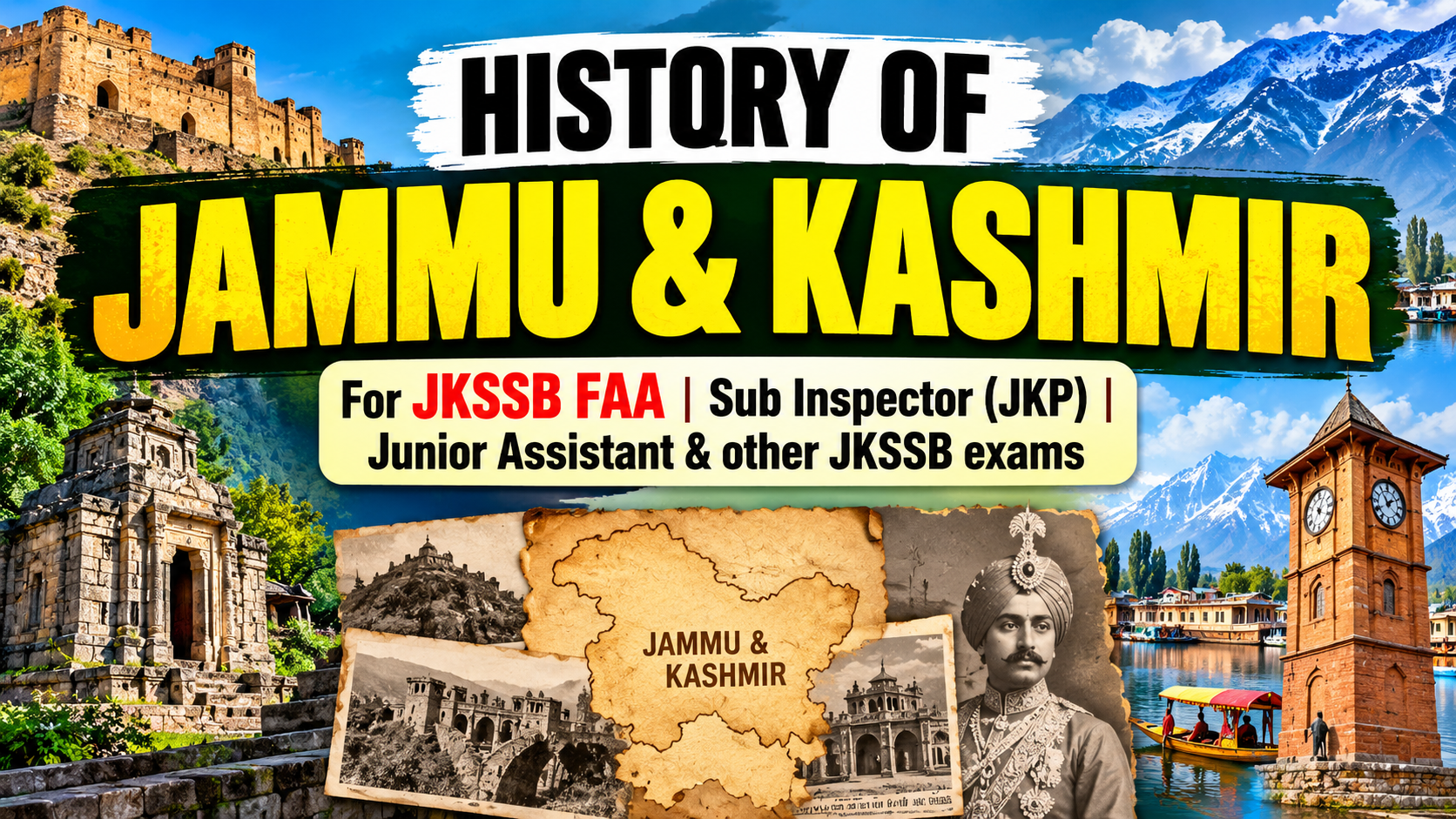
HISTORY OF JAMMU
Concise Notes + Statement-Based MCQs
For JKSSB Finance Accounts Assistant (FAA) & Sub-Inspector (SI) | J&K History
How to use these notes |
1) Read the notes once, then revise the Master Timeline and 'Common Exam Traps'. 2) Attempt all 43 MCQs without looking at answers. 3) Check the Answer Key and read every explanation, even for questions you got right. |
1. Jammu at a Glance
- Ancient names: Jambupura / Jamu; the wider hill-and-plain region is called Duggar (Durgara), hence the word Dogra.
- Tradition: Jammu was founded by Raja Jambu Lochan; his brother Bahu Lochan is linked with Bahu Fort. This is legend/tradition, not documented history.
- Rivers: Tawi (flows through Jammu city), Chenab (Akhnoor, Reasi, Doda), Ravi (Kathua border).
- Nicknames: 'City of Temples'; winter capital of J&K under the Darbar Move.
- Jammu Division today (10 districts): Jammu, Samba, Kathua, Udhampur, Reasi, Ramban, Doda, Kishtwar, Rajouri, Poonch.
- Dogra rule: 1846 to 1947 (about 101 years) under four Maharajas: Gulab Singh, Ranbir Singh, Pratap Singh, Hari Singh.
2. Ancient Jammu
- Manda (Akhnoor, on the Chenab): northernmost known Harappan (Indus Valley) site in the subcontinent.
- Ambaran (Akhnoor): Buddhist stupa and monastery remains (Kushan-Gupta era).
- Mauryas and Kushans: the region came under Ashoka's Buddhism; the Fourth Buddhist Council under Kanishka was held at Kundalvana (Harwan), Kashmir, not Jammu.
- Hiuen Tsang (Xuanzang): visited Kashmir in 631 AD during the Karkota king Durlabhavardhana; he also visited Rajapuri (Rajouri) and Punach (Poonch).
- Kalhana's Rajatarangini (c. 1148-49 AD): main source for early Kashmir and neighbouring hill states such as Rajapuri and Lohara.
- Krimchi temples (Udhampur): ancient group of Hindu temples, an important early-medieval heritage site.
3. Medieval Jammu and the Rajas of Jammu
- Jammu's hill chiefs paid tribute to the Delhi Sultans and later the Mughals (Lahore Subah).
- Jahangir died in 1627 near Rajouri (Chingas) while returning from Kashmir.
- Raja Ranjit Dev (c. 1728-1780): the high point of the old Jammu kingdom. Jammu was peaceful and prosperous and attracted artists, craftsmen and refugees.
- After Ranjit Dev, Jammu weakened. His successors lost ground to the Sukerchakia misl of the Sikhs.
- 1808: Maharaja Ranjit Singh of Lahore annexed Jammu.
4. Sikh Period and the Rise of the Dogras
Gulab Singh before 1846
- Born 1792 in Jammu; Jamwal Rajput; son of Mian Kishore Singh.
- Served Ranjit Singh's army; installed as Raja of Jammu in 1822.
- Brothers: Dhian Singh (became Wazir/Prime Minister of the Lahore Darbar) and Suchet Singh (Ramnagar). Dhian Singh's line held Poonch.
- Ranjit Singh captured Kashmir in 1819 (Battle of Shopian) and died in 1839.
General Zorawar Singh (Kahluria)
- Dogra general of Gulab Singh; conquered Ladakh (1834-35 onward) and Baltistan/Skardu (1840).
- Killed in the Tibet campaign (Battle of Toyo, Dec 1841).
- Treaty of Chushul (1842) with Tibet fixed the Ladakh-Tibet arrangement.
- Often nicknamed the 'Napoleon of India' by admirers.
5. First Anglo-Sikh War and the Treaties of 1846
Treaty | Date | Key points |
Treaty of Lahore | 9 March 1846 | Ended the First Anglo-Sikh War (after Sobraon, Feb 1846). Sikhs ceded the Jalandhar Doab and had to pay a heavy indemnity; Kashmir and hill areas were ceded to the British in lieu. |
Treaty of Amritsar | 16 March 1846 | British transferred all hill territory east of the Indus and west of the Ravi (including Kashmir) to Gulab Singh for 75 lakh Nanakshahi rupees. Signed for the British by Frederick Currie and Henry Lawrence (Governor-General: Lord Hardinge). |
Tribute | Annual | One horse, twelve shawl goats (six male, six female) and three pairs of Kashmir shawls. |
- Gulab Singh acted as intermediary between the British and the Lahore Darbar.
- The Treaty of Amritsar is often called the 'sale deed' of Kashmir. It created the princely state of J&K with Gulab Singh as Maharaja.
6. The Dogra Maharajas
Ruler | Period | Important facts |
Gulab Singh | 1846-1857 | Founder of the Dogra dynasty and the J&K state. Consolidated Ladakh, Baltistan and Gilgit approaches. Began the Raghunath Temple (1835). Died 1857. |
Ranbir Singh | 1857-1885 | Darbar Move started 1872 (Srinagar in summer, Jammu in winter). Completed Raghunath Temple (1860). Built Ranbireshwar Temple (1883). Patron of Sanskrit and learning. The Ranbir Penal Code (RPC) is named after him (enforced 1932). |
Pratap Singh | 1885-1925 | British Resident posted at Srinagar. Powers handed to a State Council in 1889; fully restored in 1905. Jammu-Sialkot railway (1890). Amar Mahal Palace built 1890 for his brother Raja Amar Singh by a French architect. Modernisation of roads and power. |
Hari Singh | 1925-1947 (formally to 1949) | Nephew of Pratap Singh (son of Raja Amar Singh). State Subject law (1927). Praja Sabha (1934). Leased Gilgit to the British (1935, for 60 years). Signed the Instrument of Accession on 26 Oct 1947. Died in Bombay in 1961. |
7. Political Awakening, 1925-1947
Year | Event |
1927 | State Subject Notification defined who is a permanent resident of the state. |
1930 | Reading Room Party formed in Srinagar by educated Kashmiri Muslim youth. |
1931 | Unrest in July; the Glancy Commission was set up to examine grievances. |
1932 | All J&K Muslim Conference founded (Sheikh Abdullah, Ch. Ghulam Abbas). The Ranbir Penal Code came into force. |
1934 | Praja Sabha (legislative assembly) created under the Constitution Act, 1934. |
1935 | Gilgit Agency leased to the British for 60 years. |
1939 | Muslim Conference was converted into the National Conference (June 1939). |
1946 | National Conference launched the 'Quit Kashmir' movement against Dogra rule. |
1947 | Praja Parishad formed in Jammu under Prem Nath Dogra. |
8. Accession of 1947
- 15 Aug 1947: Hari Singh signed a Standstill Agreement with Pakistan.
- 15 Oct 1947: Mehr Chand Mahajan became Prime Minister (earlier PM: Ram Chandra Kak).
- 22 Oct 1947: Pakistani tribal raiders entered the state.
- 26 Oct 1947: Hari Singh signed the Instrument of Accession; Lord Mountbatten accepted it on 27 Oct 1947.
- 30 Oct 1947: Sheikh Abdullah headed the emergency administration.
9. After 1947
- 20 June 1949: Karan Singh became Regent (Hari Singh left the state).
- 1951: Constituent Assembly elected; first met in Srinagar (31 Oct 1951).
- 1952: Karan Singh elected Sadr-i-Riyasat.
- 1952-53 Praja Parishad agitation: slogan 'Ek Vidhan, Ek Pradhan, Ek Nishan'. Syama Prasad Mookerjee was arrested at Lakhanpur and died in custody in Srinagar on 23 June 1953.
- 17 Nov 1956: J&K Constitution adopted; in force from 26 Jan 1957.
- 2003: Dogri added to the Eighth Schedule (92nd Amendment).
- 5 Aug 2019: Presidential Order effectively ended Article 370; J&K Reorganisation Act 2019; 31 Oct 2019: J&K and Ladakh became separate Union Territories.
10. Monuments and Places of Jammu
Place | Key fact |
Bahu Fort | Rocky hill above the Tawi; traditionally linked to Bahu Lochan; rebuilt by Dogra rulers; contains the Bawe Wali Mata temple. |
Raghunath Temple | Begun 1835 by Gulab Singh, completed 1860 by Ranbir Singh. |
Ranbireshwar Temple | Built 1883 by Ranbir Singh; known for large Shivlings. |
Mubarak Mandi Palace | Old royal palace complex of the Dogra rulers in Jammu. |
Amar Mahal Palace | Built 1890 for Raja Amar Singh by a French architect. |
Manda and Ambaran (Akhnoor) | Harappan site and Buddhist site respectively. |
Krimchi (Udhampur) | Ancient temple group. |
Rajouri (Rajapuri) | Ancient hill state; Jahangir died near here (1627). |
11. Master Timeline
Year | Event |
Tradition | Raja Jambu Lochan founds Jammu |
631 AD | Hiuen Tsang in Kashmir; visits Rajapuri and Punach |
1148-49 | Rajatarangini by Kalhana |
1627 | Jahangir dies near Rajouri |
c. 1728-1780 | Raja Ranjit Dev of Jammu |
1808 | Ranjit Singh annexes Jammu |
1819 | Sikhs capture Kashmir |
1822 | Gulab Singh made Raja of Jammu |
1834-35 | Zorawar Singh begins conquest of Ladakh |
1840 | Baltistan conquered |
1841 | Zorawar Singh dies in Tibet |
1842 | Treaty of Chushul |
9 and 16 Mar 1846 | Treaties of Lahore and Amritsar |
1857 | Gulab Singh dies; Ranbir Singh succeeds |
1872 | Darbar Move begins |
1885 | Pratap Singh becomes Maharaja |
1889 / 1905 | State Council formed / powers restored |
1890 | Jammu-Sialkot railway; Amar Mahal |
1925 | Hari Singh becomes Maharaja |
1927 | State Subject notification |
1931 / 1932 / 1934 | Glancy Commission / Muslim Conference / Praja Sabha |
1939 / 1946 | National Conference / Quit Kashmir |
26 Oct 1947 | Instrument of Accession |
1957 | J&K Constitution comes into force |
2019 | Reorganisation into two UTs |
12. Common Exam Traps
- Fourth Buddhist Council was at Kundalvana, Kashmir, not Jammu.
- Treaty of Lahore (9 March) comes before Treaty of Amritsar (16 March).
- Gulab Singh paid 75 lakh Nanakshahi rupees (not 75 crore).
- Governor-General in 1846 was Lord Hardinge, not Dalhousie.
- Ranbir Penal Code is named after Ranbir Singh but was enforced in 1932.
- Hari Singh was nephew of Pratap Singh, not his son.
- Mountbatten accepted accession on 27 Oct; Hari Singh signed on 26 Oct.
- Mookerjee died in Srinagar custody, not Jammu.
- Muslim Conference (1932) became National Conference (1939).
- Gilgit was leased for 60 years in 1935.
MCQ Practice: Statement-Based (43 Questions)
Choose the correct option for each question. Answers and explanations follow after the last question.
Q1. Consider the following statements about the origin of Jammu:
1. Jammu is traditionally believed to have been founded by Raja Jambu Lochan.
2. The ancient name of Jammu was Kashyapamar.
Which of the statements given above is/are correct?
(a) 1 only
(b) 2 only
(c) Both 1 and 2
(d) Neither 1 nor 2
Q2. Consider the following statements about Duggar and Dogra:
1. The word Dogra is derived from Duggar (Durgara).
2. The Duggar land covers the Jammu region and adjoining hills.
3. Bahu Fort is traditionally linked with Raja Bahu Lochan, brother of Jambu Lochan.
Which of the statements given above is/are correct?
(a) 2 only
(b) 1, 2 and 3
(c) 1 and 2 only
(d) 1 and 3 only
Q3. Consider the following statements about Manda:
1. Manda near Akhnoor is the northernmost known Harappan site in the subcontinent.
2. Manda is located on the banks of the Jhelum.
Which of the statements given above is/are correct?
(a) 1 only
(b) 2 only
(c) Both 1 and 2
(d) Neither 1 nor 2
Q4. Consider the following statements about Hiuen Tsang:
1. Hiuen Tsang visited Kashmir in 631 AD.
2. He also visited Rajapuri (Rajouri) and Punach (Poonch).
3. He visited during the reign of Lalitaditya Muktapida.
Which of the statements given above is/are correct?
(a) 2 and 3 only
(b) 1, 2 and 3
(c) 2 only
(d) 1 and 2 only
Q5. Consider the following statements about Rajatarangini:
1. Rajatarangini was composed by Kalhana in the 12th century AD.
2. Rajatarangini was composed by Bilhana.
Which of the statements given above is/are correct?
(a) 1 only
(b) 2 only
(c) Both 1 and 2
(d) Neither 1 nor 2
Q6. Consider the following statements about Buddhism in the region:
1. Ambaran near Akhnoor has Buddhist stupa remains.
2. The Fourth Buddhist Council under Kanishka was held at Kundalvana in Kashmir.
3. The Fourth Buddhist Council was held at Jammu.
Which of the statements given above is/are correct?
(a) 1, 2 and 3
(b) 1 and 2 only
(c) 2 only
(d) 2 and 3 only
Q7. Consider the following statements about Jahangir:
1. Jahangir died in 1627 near Rajouri while returning from Kashmir.
2. Jahangir died in Srinagar.
Which of the statements given above is/are correct?
(a) 1 only
(b) 2 only
(c) Both 1 and 2
(d) Neither 1 nor 2
Q8. Consider the following statements about Rajouri:
1. Rajouri was anciently known as Rajapuri.
2. Rajapuri finds mention in Kalhana's Rajatarangini.
3. Rajouri was the capital of the Dogra Maharajas.
Which of the statements given above is/are correct?
(a) 2 only
(b) 2 and 3 only
(c) 1, 2 and 3
(d) 1 and 2 only
Q9. Consider the following statements about Raja Ranjit Dev of Jammu:
1. Ranjit Dev ruled Jammu roughly from 1728 to 1780.
2. His reign brought peace and prosperity, attracting artists and refugees to Jammu.
3. He was defeated and killed by Maharaja Ranjit Singh of Lahore.
Which of the statements given above is/are correct?
(a) 1 and 2 only
(b) 3 only
(c) 1 and 3 only
(d) 1 only
Q10. Consider the following statements about Annexation of Jammu:
1. Maharaja Ranjit Singh annexed Jammu in 1808.
2. Jammu was annexed by the British in 1846.
Which of the statements given above is/are correct?
(a) 1 only
(b) 2 only
(c) Both 1 and 2
(d) Neither 1 nor 2
Q11. Consider the following statements about Gulab Singh:
1. Gulab Singh was born in 1792.
2. He was installed as Raja of Jammu by Ranjit Singh in 1822.
3. His father was Mian Kishore Singh.
Which of the statements given above is/are correct?
(a) 2 and 3 only
(b) 1 only
(c) 1, 2 and 3
(d) 3 only
Q12. Consider the following statements about Gulab Singh's brothers:
1. Dhian Singh became Wazir (Prime Minister) of the Lahore Darbar.
2. Suchet Singh was made Raja of Poonch.
Which of the statements given above is/are correct?
(a) 1 only
(b) 2 only
(c) Both 1 and 2
(d) Neither 1 nor 2
Q13. Consider the following statements about Zorawar Singh:
1. Zorawar Singh conquered Ladakh from 1834-35 onwards.
2. He conquered Baltistan (Skardu) in 1840.
3. He was killed in 1846 while fighting the British.
Which of the statements given above is/are correct?
(a) 1 and 2 only
(b) 1 only
(c) 3 only
(d) 1 and 3 only
Q14. Consider the following statements about Zorawar Singh and Tibet:
1. Zorawar Singh was killed in the Tibet campaign in 1841.
2. The Treaty of Chushul (1842) was signed between the Dogras and the British.
Which of the statements given above is/are correct?
(a) 1 only
(b) 2 only
(c) Both 1 and 2
(d) Neither 1 nor 2
Q15. Consider the following statements about Treaty of Amritsar:
1. It was signed on 16 March 1846.
2. Gulab Singh paid 75 lakh Nanakshahi rupees under it.
3. It was signed by Gulab Singh and Lord Dalhousie.
Which of the statements given above is/are correct?
(a) 3 only
(b) 1 and 3 only
(c) 1 and 2 only
(d) 1 only
Q16. Consider the following statements about Treaties of 1846:
1. The Treaty of Lahore (9 March 1846) ended the First Anglo-Sikh War.
2. The Treaty of Amritsar was signed before the Treaty of Lahore.
Which of the statements given above is/are correct?
(a) 1 only
(b) 2 only
(c) Both 1 and 2
(d) Neither 1 nor 2
Q17. Consider the following statements about Terms of 1846:
1. Gulab Singh agreed to an annual tribute of one horse, twelve shawl goats and three pairs of Kashmir shawls.
2. The territory transferred was east of the Indus and west of the Ravi.
3. The Kashmir Valley was directly given to Gulab Singh through the Treaty of Lahore.
Which of the statements given above is/are correct?
(a) 1 and 2 only
(b) 1 and 3 only
(c) 1 only
(d) 3 only
Q18. Consider the following statements about Succession in 1857:
1. Gulab Singh died in 1857.
2. Gulab Singh was succeeded by Maharaja Pratap Singh.
Which of the statements given above is/are correct?
(a) 1 only
(b) 2 only
(c) Both 1 and 2
(d) Neither 1 nor 2
Q19. Consider the following statements about Ranbir Singh:
1. The Darbar Move began in 1872 during his reign.
2. He built the Ranbireshwar Temple in Jammu in 1883.
3. The Raghunath Temple was begun by Gulab Singh in 1835 and completed in 1860 under Ranbir Singh.
Which of the statements given above is/are correct?
(a) 1 only
(b) 3 only
(c) 1, 2 and 3
(d) 2 and 3 only
Q20. Consider the following statements about Pratap Singh and Amar Mahal:
1. Pratap Singh ruled from 1885 to 1925.
2. Amar Mahal Palace was built by Maharaja Gulab Singh.
Which of the statements given above is/are correct?
(a) 1 only
(b) 2 only
(c) Both 1 and 2
(d) Neither 1 nor 2
Q21. Consider the following statements about Pratap Singh's reign:
1. The Jammu-Sialkot railway line opened in 1890.
2. His powers were transferred to a State Council in 1889.
3. His powers were fully restored in 1905.
Which of the statements given above is/are correct?
(a) 1, 2 and 3
(b) 3 only
(c) 2 and 3 only
(d) 1 only
Q22. Consider the following statements about Hari Singh:
1. Hari Singh was crowned Maharaja in 1926 after succeeding in 1925.
2. Hari Singh was the son of Maharaja Pratap Singh.
Which of the statements given above is/are correct?
(a) 1 only
(b) 2 only
(c) Both 1 and 2
(d) Neither 1 nor 2
Q23. Consider the following statements about Hari Singh's reforms:
1. The State Subject notification was issued in 1927.
2. The Praja Sabha was established in 1934.
3. Gilgit was leased to the British in 1935 for 99 years.
Which of the statements given above is/are correct?
(a) 1 and 3 only
(b) 1 only
(c) 1 and 2 only
(d) 3 only
Q24. Consider the following statements about political developments:
1. The Glancy Commission was appointed in 1931.
2. The Muslim Conference was founded in 1932.
3. The Muslim Conference was renamed National Conference in 1939.
4. The Reading Room Party was founded in 1940.
How many of the above statements are correct?
(a) Only one
(b) Only two
(c) Only three
(d) All four
Q25. Consider the following statements about Praja Parishad:
1. The Praja Parishad was formed in Jammu in 1947 under Prem Nath Dogra.
2. The Praja Parishad agitation of 1952-53 used the slogan 'Ek Vidhan, Ek Pradhan, Ek Nishan'.
Which of the statements given above is/are correct?
(a) 1 only
(b) 2 only
(c) Both 1 and 2
(d) Neither 1 nor 2
Q26. Consider the following statements about Syama Prasad Mookerjee:
1. He was arrested in 1953 while entering J&K without a permit.
2. He died in custody on 23 June 1953.
3. He died in custody at Jammu.
Which of the statements given above is/are correct?
(a) 2 only
(b) 1 and 2 only
(c) 2 and 3 only
(d) 1, 2 and 3
Q27. Consider the following statements about Instrument of Accession:
1. Hari Singh signed the Instrument of Accession on 26 October 1947.
2. Lord Mountbatten accepted it on 26 October 1947.
Which of the statements given above is/are correct?
(a) 1 only
(b) 2 only
(c) Both 1 and 2
(d) Neither 1 nor 2
Q28. Consider the following statements about events of 1947:
1. Hari Singh signed a Standstill Agreement with Pakistan in August 1947.
2. Pakistani tribal raiders entered the state on 22 October 1947.
3. Sheikh Abdullah was the Prime Minister when Hari Singh signed the accession.
Which of the statements given above is/are correct?
(a) 2 and 3 only
(b) 1, 2 and 3
(c) 2 only
(d) 1 and 2 only
Q29. Consider the following statements about Karan Singh and Hari Singh:
1. Karan Singh became Regent on 20 June 1949.
2. Hari Singh died in Jammu in 1961.
Which of the statements given above is/are correct?
(a) 1 only
(b) 2 only
(c) Both 1 and 2
(d) Neither 1 nor 2
Q30. Consider the following statements about J&K Constitution:
1. The Constitution of J&K was adopted on 17 November 1956.
2. It came into force on 26 January 1957.
3. The Constituent Assembly first met in Jammu.
Which of the statements given above is/are correct?
(a) 1, 2 and 3
(b) 1 and 2 only
(c) 2 only
(d) 2 and 3 only
Q31. Consider the following statements about the 2019 reorganisation:
1. The J&K Reorganisation Act was passed in August 2019.
2. Ladakh became a Union Territory on 31 October 2019.
3. A Presidential Order on 5 August 2019 effectively ended Article 370.
4. J&K became a Union Territory with a legislature.
How many of the above statements are correct?
(a) Only one
(b) Only two
(c) Only three
(d) All four
Q32. Consider the following statements about Bahu Fort:
1. Bahu Fort stands on a rocky hill overlooking the Tawi.
2. The Bawe Wali Mata temple is inside the fort complex.
3. The fort was built by Maharaja Hari Singh in 1925.
Which of the statements given above is/are correct?
(a) 2 only
(b) 2 and 3 only
(c) 1, 2 and 3
(d) 1 and 2 only
Q33. Consider the following statements about Mubarak Mandi:
1. Mubarak Mandi was the royal palace complex of the Dogra rulers in Jammu.
2. Mubarak Mandi was built by Mughal Emperor Akbar.
Which of the statements given above is/are correct?
(a) 1 only
(b) 2 only
(c) Both 1 and 2
(d) Neither 1 nor 2
Q34. Consider the following statements about Dogri language:
1. Dogri was added to the Eighth Schedule in 2003.
2. It was added through the 92nd Constitutional Amendment.
Which of the statements given above is/are correct?
(a) 1 only
(b) 2 only
(c) Both 1 and 2
(d) Neither 1 nor 2
Q35. Consider the following statements about Jammu city:
1. Jammu is known as the 'City of Temples'.
2. The Tawi river flows through Jammu city.
3. The Raghunath Temple was begun by Ranbir Singh in 1860 and completed by Pratap Singh.
Which of the statements given above is/are correct?
(a) 1 and 3 only
(b) 1 only
(c) 1 and 2 only
(d) 3 only
Q36. Consider the following statements about Ranbir Penal Code:
1. The Ranbir Penal Code came into force in 1932.
2. It is named after Maharaja Pratap Singh.
Which of the statements given above is/are correct?
(a) 1 only
(b) 2 only
(c) Both 1 and 2
(d) Neither 1 nor 2
Q37. Consider the following statements about National Conference:
1. The National Conference launched the 'Quit Kashmir' movement in 1946.
2. The Muslim Conference was founded in 1939.
Which of the statements given above is/are correct?
(a) 1 only
(b) 2 only
(c) Both 1 and 2
(d) Neither 1 nor 2
Q38. Consider the following statements about Sikh rule:
1. Ranjit Singh's forces captured Kashmir in 1819.
2. The Battle of Shopian was fought in 1819.
3. Ranjit Singh died in 1839.
Which of the statements given above is/are correct?
(a) 2 only
(b) 1, 2 and 3
(c) 1 and 2 only
(d) 1 and 3 only
Q39. Consider the following statements about First Anglo-Sikh War:
1. Gulab Singh acted as an intermediary between the British and the Lahore Darbar.
2. The Battle of Sobraon was fought in February 1846.
3. The Battle of Sobraon was fought in 1849.
Which of the statements given above is/are correct?
(a) 3 only
(b) 1 and 3 only
(c) 1 and 2 only
(d) 1 only
Q40. Consider the following statements about Jammu Division:
1. Jammu Division has 10 districts.
2. Reasi district was created in 2006.
3. Kishtwar district is part of Kashmir Division.
Which of the statements given above is/are correct?
(a) 2 and 3 only
(b) 1, 2 and 3
(c) 2 only
(d) 1 and 2 only
Q41. Consider the following statements about Dogra clan:
1. The Dogra Maharajas belonged to the Jamwal clan of Rajputs.
2. Gulab Singh belonged to the Katoch clan.
Which of the statements given above is/are correct?
(a) 1 only
(b) 2 only
(c) Both 1 and 2
(d) Neither 1 nor 2
Q42. Consider the following statements about Dogra dynasty duration:
1. Dogra rule in J&K lasted from 1846 to 1947.
2. The Dogra dynasty was founded by Ranbir Singh.
Which of the statements given above is/are correct?
(a) 1 only
(b) 2 only
(c) Both 1 and 2
(d) Neither 1 nor 2
Q43. Consider the following statements about the Dogra Maharajas:
1. Gulab Singh ruled from 1846 to 1857.
2. Ranbir Singh ruled from 1857 to 1885.
3. Pratap Singh ruled from 1885 to 1925.
4. Ranbir Singh succeeded Pratap Singh.
How many of the above statements are correct?
(a) Only one
(b) Only two
(c) Only three
(d) All four
Answer Key and Explanations
No. | Ans | Correct option and explanation |
Q1 | (a) | 1 only. Kashyapamar/Kashyapapura refers to Kashmir. Jammu's name is traditionally linked with Raja Jambu Lochan (Jambupura). |
Q2 | (b) | 1, 2 and 3. All three are correct as per standard accounts and tradition. |
Q3 | (a) | 1 only. Manda lies on the Chenab at Akhnoor, not on the Jhelum. |
Q4 | (d) | 1 and 2 only. He visited in the reign of Durlabhavardhana (Karkota dynasty), before Lalitaditya. |
Q5 | (a) | 1 only. Kalhana wrote the Rajatarangini (c. 1148-49 AD). Bilhana wrote Vikramankadevacharita. |
Q6 | (b) | 1 and 2 only. The council was held at Kundalvana (Harwan), Kashmir, not Jammu. |
Q7 | (a) | 1 only. He died en route near Rajouri (Chingas), not in Srinagar. |
Q8 | (d) | 1 and 2 only. The Dogra capitals were Jammu (winter) and Srinagar (summer). |
Q9 | (a) | 1 and 2 only. Maharaja Ranjit Singh was born in 1780; Jammu fell to the Sikhs after Ranjit Dev's time. |
Q10 | (a) | 1 only. Jammu came under Ranjit Singh in 1808. In 1846 the British transferred J&K to Gulab Singh. |
Q11 | (c) | 1, 2 and 3. All three statements are correct. |
Q12 | (a) | 1 only. Poonch went to Dhian Singh's line; Suchet Singh is associated with Ramnagar. |
Q13 | (a) | 1 and 2 only. He was killed in the Tibet campaign (Battle of Toyo) in December 1841. |
Q14 | (a) | 1 only. The Treaty of Chushul (1842) was with Tibet, not the British. |
Q15 | (c) | 1 and 2 only. The Governor-General in 1846 was Lord Hardinge. Dalhousie came later (1848). |
Q16 | (a) | 1 only. Lahore (9 March) came first, Amritsar (16 March) afterwards. |
Q17 | (a) | 1 and 2 only. The Valley was transferred to Gulab Singh through the Treaty of Amritsar. |
Q18 | (a) | 1 only. He was succeeded by his son Ranbir Singh (1857-1885). |
Q19 | (c) | 1, 2 and 3. All three are correct. |
Q20 | (a) | 1 only. Amar Mahal was built in 1890 for Raja Amar Singh (brother of Pratap Singh) by a French architect. |
Q21 | (a) | 1, 2 and 3. All three are correct. |
Q22 | (a) | 1 only. Hari Singh was Pratap Singh's nephew (son of Raja Amar Singh). |
Q23 | (c) | 1 and 2 only. The Gilgit lease was for 60 years. |
Q24 | (c) | Only three. The Reading Room Party was formed in 1930. So three are correct. |
Q25 | (c) | Both 1 and 2. Both statements are correct. |
Q26 | (b) | 1 and 2 only. He died in custody in Srinagar. |
Q27 | (a) | 1 only. Mountbatten accepted it on 27 October 1947. |
Q28 | (d) | 1 and 2 only. Mehr Chand Mahajan was the Prime Minister at the time. Sheikh Abdullah led the emergency administration from 30 Oct 1947. |
Q29 | (a) | 1 only. Hari Singh died in Bombay (Mumbai) in 1961. |
Q30 | (b) | 1 and 2 only. The Constituent Assembly first met in Srinagar on 31 October 1951. |
Q31 | (d) | All four. All four statements are correct. |
Q32 | (d) | 1 and 2 only. The fort is ancient by tradition and was rebuilt by the Dogra rulers. It is not a 1925 construction. |
Q33 | (a) | 1 only. It is a Dogra-era complex, not a Mughal one. |
Q34 | (c) | Both 1 and 2. Both are correct. |
Q35 | (c) | 1 and 2 only. It was begun by Gulab Singh (1835) and completed by Ranbir Singh (1860). |
Q36 | (a) | 1 only. It is named after Maharaja Ranbir Singh. |
Q37 | (a) | 1 only. The Muslim Conference was founded in 1932. In 1939 it became the National Conference. |
Q38 | (b) | 1, 2 and 3. All three are correct. |
Q39 | (c) | 1 and 2 only. Sobraon was in 1846. 1849 was the end of the Second Anglo-Sikh War. |
Q40 | (d) | 1 and 2 only. Kishtwar is in Jammu Division. |
Q41 | (a) | 1 only. Gulab Singh was a Jamwal Rajput. The Katoch are the Kangra rulers. |
Q42 | (a) | 1 only. Gulab Singh founded the dynasty. |
Q43 | (c) | Only three. Ranbir Singh preceded Pratap Singh. Three statements are correct. |
Tip: for 'which statements are correct' questions, test each statement separately. Dates, names of treaties and who signed or accepted them are the traps.
— End of Notes —
Prepared by Zahid Hussain Malik
for any query dm @7006392314