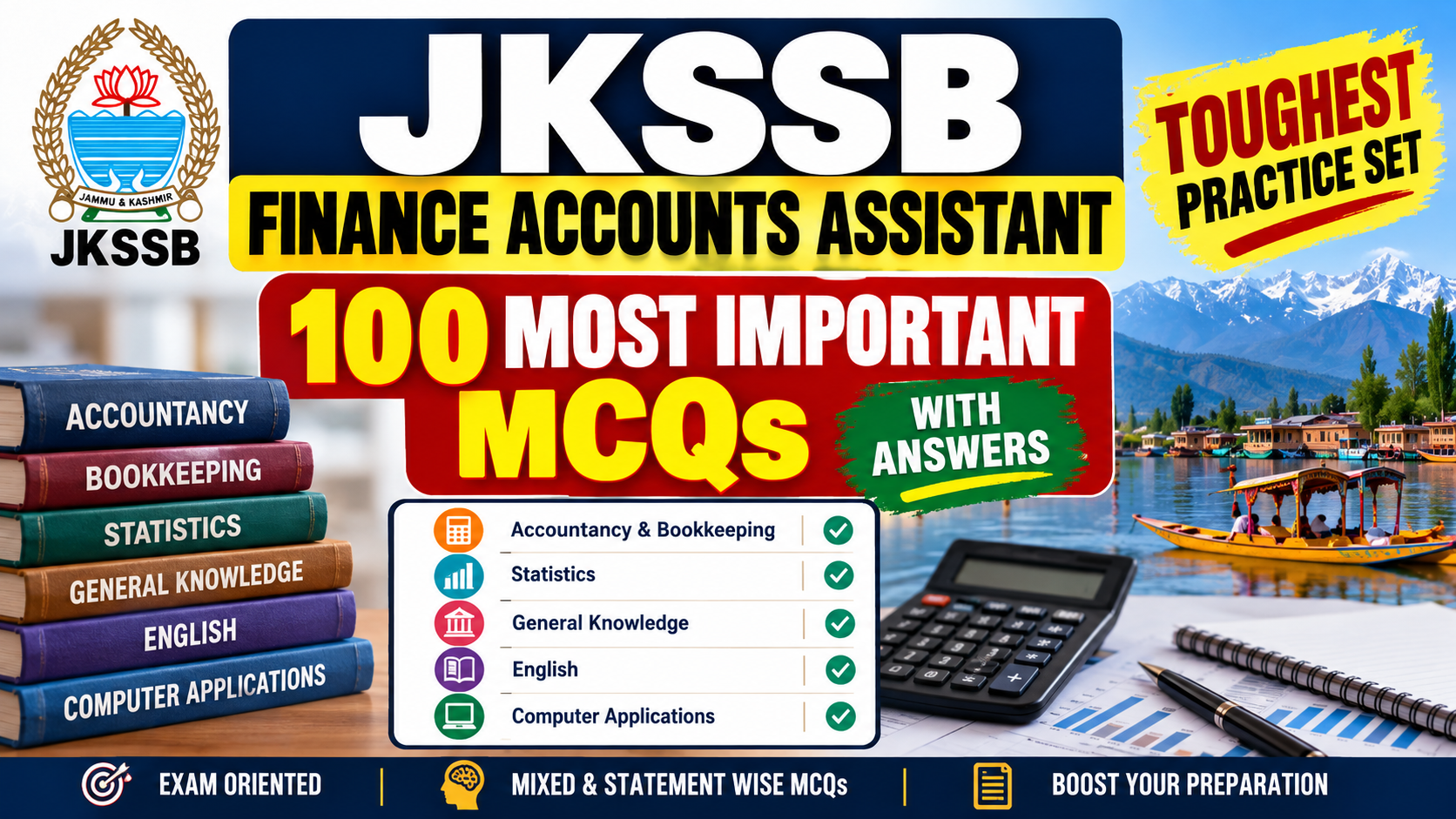
JKSSB Finance Accounts Assistant 2026: 100 Important MCQs with Answers
Preparing for the Jammu and Kashmir Services Selection Board (JKSSB) Finance Accounts Assistant examination requires a strong understanding of accounting principles, bookkeeping, statistics, general knowledge, English and computer applications. Candidates should focus not only on remembering facts but also on solving numerical problems, interpreting statements and applying concepts accurately.
In this practice set, JK Exam Library presents 100 challenging multiple-choice questions covering six important subject areas. The questions include conceptual accounting problems, statement-based questions, numerical calculations, grammar applications, computer fundamentals and general awareness.
These questions are designed for exam-oriented practice. They are original practice questions, not a claim that they appeared in an actual JKSSB examination. Candidates should also consult the latest official notification and syllabus before finalising their preparation.
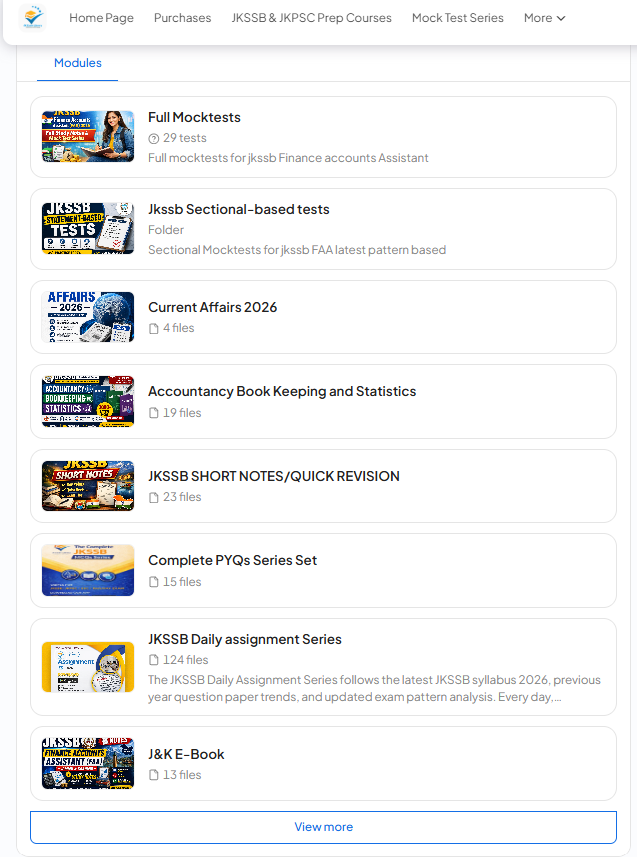
Download Complete FAA Study material with full mocktests
How to Prepare with This FAA MCQ Set
Attempt each question before checking the answer.
Pay particular attention to accounting adjustments, depreciation, trial balance and financial statements.
Practise statistics formulas and numerical calculations without relying on guesswork.
Revise computer shortcuts, networking, databases and cybersecurity concepts.
Review incorrect answers and understand why the other options are incorrect.
Section 1: Accountancy and Bookkeeping MCQs (1–35)
Q1. A business purchases machinery for ₹2,00,000 and pays ₹10,000 for installation. Under the historical cost principle, what amount should initially be capitalised?
A) ₹2,00,000 B) ₹2,10,000 C) ₹1,90,000 D) ₹2,20,000
Answer: B) ₹2,10,000. Installation expenditure necessary to make the machinery operational is included in its acquisition cost.
Q2. Which of the following errors will not affect the agreement of a trial balance?
A) Posting ₹5,000 on the debit side instead of the credit side B) Complete omission of a transaction from the books C) Posting a debit of ₹4,000 as ₹400 D) Posting an entry to the wrong side of an account
Answer: B) Complete omission of a transaction from the books. Both debit and credit aspects are omitted, so the trial balance may still agree.
Q3. A firm purchases goods on credit from Mohan for ₹25,000. Which entry is correct?
A) Purchases A/c Dr. ₹25,000; To Mohan A/c ₹25,000 B) Mohan A/c Dr. ₹25,000; To Purchases A/c ₹25,000 C) Cash A/c Dr. ₹25,000; To Purchases A/c ₹25,000 D) Purchases A/c Dr. ₹25,000; To Cash A/c ₹25,000
Answer: A) Purchases A/c Dr.; To Mohan A/c. Purchases increase, and the creditor's balance increases.
Q4. A machine costing ₹1,00,000 has a residual value of ₹10,000 and a useful life of five years. Under the straight-line method, annual depreciation is:
A) ₹20,000 B) ₹18,000 C) ₹22,000 D) ₹15,000
Answer: B) ₹18,000. Depreciation = (₹1,00,000 − ₹10,000) ÷ 5.
Q5. Which account normally carries a debit balance?
A) Outstanding salary B) Capital C) Accumulated depreciation D) Prepaid insurance
Answer: D) Prepaid insurance. It represents an asset and normally carries a debit balance.
Q6. Goods costing ₹8,000 are withdrawn by the proprietor for personal use. Which account should be debited?
A) Purchases A/c B) Drawings A/c C) Sales A/c D) Capital A/c
Answer: B) Drawings A/c. The transaction reduces goods available for business and is treated as drawings.
Q7. Under the accrual basis of accounting, revenue is generally recognised when:
A) Cash is received in every case B) The accounting period ends C) It is earned, subject to the applicable recognition requirements D) The owner withdraws money
Answer: C) It is earned, subject to the applicable recognition requirements.
Q8. A bank overdraft appearing in the cash book is generally shown as:
A) A current asset B) A current liability C) Capital expenditure D) Revenue income
Answer: B) A current liability. It represents an amount owed to the bank.
Q9. If closing inventory is overstated by ₹10,000, assuming all other figures are correct, the effect on current-period gross profit is:
A) Understated by ₹10,000 B) Overstated by ₹10,000 C) Unchanged D) Overstated by ₹20,000
Answer: B) Overstated by ₹10,000. Closing inventory is deducted in calculating cost of goods sold.
Q10. Which concept requires similar accounting methods to be applied consistently from period to period unless a justified change is made?
A) Going concern B) Consistency C) Money measurement D) Dual aspect
Answer: B) Consistency.
Q11. A debtor owing ₹20,000 becomes insolvent, and only 40% is expected to be recovered. The expected bad debt is:
A) ₹8,000 B) ₹12,000 C) ₹20,000 D) ₹16,000
Answer: B) ₹12,000. Expected recovery is ₹8,000; the unrecoverable balance is ₹12,000.
Q12. Which book is commonly called the book of original entry for transactions recorded chronologically?
A) Ledger B) Trial balance C) Journal D) Balance sheet
Answer: C) Journal.
Q13. Salaries of ₹15,000 remain unpaid at year-end. Under accrual accounting, the adjustment is:
A) Salaries A/c Dr.; To Outstanding Salaries A/c B) Outstanding Salaries A/c Dr.; To Salaries A/c C) Cash A/c Dr.; To Salaries A/c D) Capital A/c Dr.; To Cash A/c
Answer: A) Salaries A/c Dr.; To Outstanding Salaries A/c. The expense and liability must both be recognised.
Q14. Which of the following is a capital expenditure?
A) Routine machinery servicing B) Monthly office rent C) Purchase of a delivery vehicle D) Electricity charges
Answer: C) Purchase of a delivery vehicle.
Q15. A business has current assets of ₹1,80,000 and current liabilities of ₹90,000. Its current ratio is:
A) 0.5:1 B) 1:1 C) 2:1 D) 3:1
Answer: C) 2:1. Current ratio = Current assets ÷ Current liabilities.
Q16. Which account is credited when cash is received from a debtor in full settlement of an outstanding amount?
A) Debtor's account B) Cash account C) Purchases account D) Drawings account
Answer: A) Debtor's account. The debtor's receivable balance decreases.
Q17. Under the diminishing balance method, depreciation is calculated on:
A) Original cost every year B) Residual value only C) Written-down value at the beginning of the period D) Total sales of the year
Answer: C) Written-down value at the beginning of the period.
Q18. Which financial statement primarily reports assets, liabilities and equity at a particular date?
A) Trading account B) Profit and loss account C) Balance sheet D) Cash book
Answer: C) Balance sheet.
Q19. A suspense account may be opened when:
A) All transactions are correctly recorded B) The trial balance does not agree and the difference requires temporary placement C) The business earns a profit D) Closing inventory is valued correctly
Answer: B) The trial balance does not agree and the difference requires temporary placement.
Q20. Which of the following is a nominal account?
A) Building B) Debtors C) Salary expense D) Capital
Answer: C) Salary expense.
Q21. A cheque issued to a creditor has not yet been presented to the bank. When preparing a bank reconciliation statement starting with the cash book balance, the unpresented cheque is generally:
A) Added to the cash book balance B) Deducted from the cash book balance C) Ignored in every case D) Recorded as bank interest
Answer: A) Added to the cash book balance. This applies when reconciling the cash book balance to the bank statement balance.
Q22. Which inventory valuation method assumes that the earliest purchased goods are issued first?
A) LIFO B) FIFO C) Weighted average only D) Specific identification only
Answer: B) FIFO.
Q23. A firm sells goods for ₹50,000 that originally cost ₹35,000. Ignoring other expenses, the gross profit is:
A) ₹15,000 B) ₹35,000 C) ₹50,000 D) ₹85,000
Answer: A) ₹15,000.
Q24. The accounting equation is:
A) Assets = Liabilities − Capital B) Assets = Capital − Liabilities C) Assets = Liabilities + Capital D) Capital = Assets + Liabilities
Answer: C) Assets = Liabilities + Capital.
Q25. Which of the following is an example of a contra-asset account?
A) Sales B) Accumulated depreciation C) Accounts payable D) Capital
Answer: B) Accumulated depreciation.
Q26. A provision for doubtful debts is primarily created to:
A) Increase sales B) Recognise expected credit losses on receivables C) Increase cash in hand D) Record additional capital
Answer: B) Recognise expected credit losses on receivables.
Q27. Under double-entry bookkeeping, every transaction has:
A) Only a debit entry B) Only a credit entry C) Equal total debit and credit effects D) No effect on the accounting equation
Answer: C) Equal total debit and credit effects.
Q28. Which of the following is normally treated as a revenue receipt?
A) Capital introduced by the proprietor B) Proceeds from issuing shares C) Cash received from customers for sales D) Loan obtained from a bank
Answer: C) Cash received from customers for sales.
Q29. If opening inventory is ₹20,000, net purchases are ₹80,000 and closing inventory is ₹25,000, cost of goods sold is:
A) ₹75,000 B) ₹85,000 C) ₹1,05,000 D) ₹1,25,000
Answer: B) ₹75,000. Cost of goods sold = Opening inventory + Net purchases − Closing inventory = ₹20,000 + ₹80,000 − ₹25,000.
Q30. Which principle supports charging expenses to the period in which the related revenue is recognised, where applicable?
A) Matching principle B) Money measurement concept C) Business entity concept D) Dual citizenship principle
Answer: A) Matching principle.
Q31. A bill of exchange is accepted by a debtor. For the drawer, the accepted bill generally represents:
A) Bills payable B) Bills receivable C) Capital reserve D) Outstanding wages
Answer: B) Bills receivable.
Q32. Which of the following errors is an error of principle?
A) Recording a purchase of machinery in the purchases account B) Adding a ledger column incorrectly C) Omitting a transaction entirely D) Posting the same amount correctly to both accounts
Answer: A) Recording a purchase of machinery in the purchases account. It violates the distinction between capital and revenue expenditure.
Q33. A business earns net profit of ₹60,000. The proprietor withdraws ₹10,000 for personal use. Ignoring other changes, the effect on closing capital is:
A) Increase of ₹70,000 B) Increase of ₹60,000 C) Increase of ₹50,000 D) Decrease of ₹10,000
Answer: C) Increase of ₹50,000. Profit increases capital, while drawings reduce it.
Q34. Which statement about a trial balance is correct?
A) It guarantees that no accounting errors exist B) It proves the business is profitable C) It checks the arithmetical agreement of ledger balances D) It replaces the balance sheet
Answer: C) It checks the arithmetical agreement of ledger balances.
Q35. Statement I: A credit purchase of goods increases purchases and creditors. Statement II: A cash purchase of goods increases cash and creditors.
A) Both statements are true B) Both statements are false C) Statement I is true; Statement II is false D) Statement I is false; Statement II is true
Answer: C) Statement I is true; Statement II is false. A cash purchase reduces cash, not increases it, and does not create a creditor.
Section 2: Statistics MCQs (36–50)
Q36. The arithmetic mean of 12, 18, 20, 25 and 25 is:
A) 18 B) 20 C) 22 D) 25
Answer: B) 20. The sum is 100, divided by 5.
Q37. The median of 7, 3, 9, 11, 5 and 15 is:
A) 6 B) 7 C) 8 D) 9
Answer: C) 8. In ascending order, the middle observations are 7 and 9; their average is 8.
Q38. If the variance of a dataset is 64, its standard deviation is:
A) 4 B) 8 C) 16 D) 32
Answer: B) 8.
Q39. If the correlation coefficient between two variables is −0.92, it indicates:
A) Strong positive linear correlation B) Weak positive linear correlation C) Strong negative linear correlation D) No linear correlation
Answer: C) Strong negative linear correlation.
Q40. Which measure of central tendency is generally most suitable for describing the most common shoe size sold in a shop?
A) Mean B) Median C) Mode D) Standard deviation
Answer: C) Mode.
Q41. A fair die is rolled once. The probability of obtaining a prime number is:
A) \(1/6\) B) \(1/3\) C) \(1/2\) D) \(2/3\)
Answer: C) \(1/2\). The prime outcomes are 2, 3 and 5.
Q42. If every observation in a dataset is increased by 5, the variance:
A) Increases by 5 B) Increases by 25 C) Remains unchanged D) Becomes zero
Answer: C) Remains unchanged. Adding a constant changes the mean but not the spread around the mean.
Q43. The range of 14, 22, 9, 31 and 18 is:
A) 18 B) 22 C) 31 D) 40
Answer: B) 22. Range = 31 − 9.
Q44. A dataset contains 40 observations with a mean of 25. If one additional observation of 45 is included, the new mean is:
A) 25 B) 25.25 C) Approximately 25.49 D) 26
Answer: C) Approximately 25.49. New mean = (40 × 25 + 45) ÷ 41 = 1045 ÷ 41.
Q45. In a normal distribution, approximately what percentage of observations lies within one standard deviation of the mean?
A) 50% B) 68.27% C) 95.45% D) 99.73%
Answer: B) 68.27%.
Q46. If two events are mutually exclusive, then:
A) They must always occur together B) Their intersection is empty C) They are necessarily independent D) Their probabilities must be equal
Answer: B) Their intersection is empty.
Q47. Statement I: The median is less affected by extreme values than the arithmetic mean. Statement II: The mode is always unique.
A) Both are true B) Both are false C) Statement I is true; Statement II is false D) Statement I is false; Statement II is true
Answer: C) Statement I is true; Statement II is false. A distribution can have more than one mode.
Q48. The coefficient of variation is calculated as:
A) Mean ÷ Standard deviation × 100 B) Standard deviation ÷ Mean × 100 C) Variance ÷ Mean D) Range ÷ Median × 100
Answer: B) Standard deviation ÷ Mean × 100. It is commonly used to compare relative variability when the mean is positive and meaningful.
Q49. A population is divided into distinct groups, and a random sample is drawn separately from each group. This technique is:
A) Convenience sampling B) Stratified random sampling C) Snowball sampling D) Judgment sampling
Answer: B) Stratified random sampling.
Q50. Statement I: Correlation proves causation. Statement II: A sample statistic is used to estimate a population parameter.
A) Both statements are true B) Both statements are false C) Statement I is true; Statement II is false D) Statement I is false; Statement II is true
Answer: D) Statement I is false; Statement II is true.
Section 3: General Knowledge and Current Affairs-Oriented GK (51–65)
Q51. Which Article of the Indian Constitution provides for the Comptroller and Auditor General of India?
A) Article 148 B) Article 280 C) Article 324 D) Article 356
Answer: A) Article 148.
Q52. The Finance Commission of India is constituted under:
A) Article 110 B) Article 123 C) Article 280 D) Article 368
Answer: C) Article 280.
Q53. Which institution is primarily responsible for conducting monetary policy in India?
A) SEBI B) Reserve Bank of India C) NITI Aayog D) Comptroller and Auditor General
Answer: B) Reserve Bank of India.
Q54. The GST Council is provided for under which constitutional article?
A) Article 246A B) Article 269A C) Article 279A D) Article 300A
Answer: C) Article 279A.
Q55. Which schedule of the Indian Constitution contains the allocation of seats in the Rajya Sabha to states and union territories?
A) Second Schedule B) Fourth Schedule C) Seventh Schedule D) Tenth Schedule
Answer: B) Fourth Schedule.
Q56. The Indus Waters Treaty of 1960 was concluded between India and:
A) China B) Nepal C) Pakistan D) Bangladesh
Answer: C) Pakistan.
Q57. Which river is commonly known as the lifeline of Kashmir Valley?
A) Ravi B) Jhelum C) Beas D) Sutlej
Answer: B) Jhelum.
Q58. The headquarters of the Securities and Exchange Board of India is located in:
A) New Delhi B) Mumbai C) Hyderabad D) Chennai
Answer: B) Mumbai.
Q59. Which body audits the accounts of the Union and state governments in India?
A) Election Commission B) UPSC C) Comptroller and Auditor General of India D) Finance Commission
Answer: C) Comptroller and Auditor General of India.
Q60. Which of the following is a constitutional body?
A) NITI Aayog B) National Human Rights Commission C) Election Commission of India D) Central Vigilance Commission
Answer: C) Election Commission of India.
Q61. The headquarters of the International Monetary Fund is in:
A) Geneva B) Washington, D.C. C) Paris D) London
Answer: B) Washington, D.C.
Q62. Which Indian constitutional amendment lowered the voting age from 21 to 18 years?
A) 42nd Amendment B) 44th Amendment C) 52nd Amendment D) 61st Amendment
Answer: D) 61st Amendment.
Q63. Which is the largest freshwater lake in Jammu and Kashmir by surface area among the following options?
A) Dal Lake B) Wular Lake C) Manasbal Lake D) Gangabal Lake
Answer: B) Wular Lake.
Q64. Which organisation publishes the World Economic Outlook?
A) World Bank B) International Monetary Fund C) World Trade Organization D) Asian Development Bank
Answer: B) International Monetary Fund.
Q65. Statement I: The CAG is appointed by the President of India. Statement II: The CAG can be removed in the same manner and on the same grounds as a Supreme Court judge.
A) Both statements are true B) Both statements are false C) Statement I is true; Statement II is false D) Statement I is false; Statement II is true
Answer: A) Both statements are true.
Section 4: General English MCQs (66–78)
Q66. Choose the grammatically correct sentence.
A) Neither of the candidates have submitted their form. B) Neither of the candidates has submitted the form. C) Neither candidates has submitted the form. D) Neither of candidates have submitted the form.
Answer: B) Neither of the candidates has submitted the form.
Q67. Choose the synonym of Prudent.
A) Reckless B) Cautious C) Careless D) Impulsive
Answer: B) Cautious.
Q68. Choose the antonym of Abundant.
A) Plentiful B) Ample C) Scarce D) Sufficient
Answer: C) Scarce.
Q69. Fill in the blank: The auditor insisted _____ examining the original vouchers.
A) at B) on C) for D) with
Answer: B) on. The correct expression is “insist on.”
Q70. Identify the correctly spelled word.
A) Accomodation B) Acommodation C) Accommodation D) Accommadation
Answer: C) Accommodation.
Q71. Choose the correct passive voice: “The accountant prepared the statement.”
A) The statement is prepared by the accountant. B) The statement was prepared by the accountant. C) The statement has prepare by the accountant. D) The accountant was prepared by the statement.
Answer: B) The statement was prepared by the accountant.
Q72. Choose the correct indirect speech: He said, “I have completed the audit.”
A) He said that he has completed the audit. B) He said that I had completed the audit. C) He said that he had completed the audit. D) He says that he completed the audit tomorrow.
Answer: C) He said that he had completed the audit.
Q73. Choose the correct meaning of the idiom To leave no stone unturned.
A) To avoid responsibility B) To make every possible effort C) To destroy property D) To postpone a decision
Answer: B) To make every possible effort.
Q74. Select the correct sentence.
A) Each of the files are important. B) Each of the files is important. C) Each files is important. D) Each of files are important.
Answer: B) Each of the files is important.
Q75. Choose the one-word substitution for “a person who examines financial accounts.”
A) Geologist B) Auditor C) Biographer D) Archaeologist
Answer: B) Auditor.
Q76. Fill in the blank: If the accounts _____ checked earlier, the error might have been detected.
A) were B) have been C) had been D) are
Answer: C) had been.
Q77. Statement I: “Stationary” means not moving. Statement II: “Stationery” refers to writing materials.
A) Both statements are correct B) Both statements are incorrect C) Only Statement I is correct D) Only Statement II is correct
Answer: A) Both statements are correct.
Q78. Choose the correct sentence.
A) The information provided by the officers are accurate. B) The informations provided by the officers are accurate. C) The information provided by the officers is accurate. D) The information provided by the officers were accurate.
Answer: C) The information provided by the officers is accurate. “Information” is generally an uncountable noun.
Section 5: Computer Applications MCQs (79–90)
Q79. Which protocol is commonly used to securely transfer web pages between a browser and a web server?
A) FTP B) HTTPS C) SMTP D) POP3
Answer: B) HTTPS.
Q80. Which SQL command is used to retrieve records from a database table?
A) INSERT B) UPDATE C) SELECT D) DELETE
Answer: C) SELECT.
Q81. In a relational database, a primary key must:
A) Contain duplicate values B) Uniquely identify each record and not contain NULL values C) Always be a text field D) Be identical to every foreign key
Answer: B) Uniquely identify each record and not contain NULL values.
Q82. Which of the following is volatile memory?
A) ROM B) SSD C) RAM D) DVD
Answer: C) RAM.
Q83. In Microsoft Excel, which formula calculates the arithmetic mean of cells A1 through A10?
A) =COUNT(A1:A10) B) =AVERAGE(A1:A10) C) =SUM(A1:A10) D) =MAX(A1:A10)
Answer: B) =AVERAGE(A1:A10).
Q84. Which type of malware can replicate itself across networks without necessarily attaching itself to a host file?
A) Worm B) Trojan horse C) Adware D) Keylogger only
Answer: A) Worm.
Q85. Which device forwards data packets between different IP networks?
A) Keyboard B) Router C) Scanner D) Plotter
Answer: B) Router.
Q86. Which binary number is equivalent to decimal 13?
A) 1010 B) 1100 C) 1101 D) 1110
Answer: C) 1101.
Q87. What is the primary purpose of a database foreign key?
A) To encrypt all records B) To establish a relationship between tables and support referential integrity C) To increase monitor resolution D) To replace all indexes
Answer: B) To establish a relationship between tables and support referential integrity.
Q88. Which of the following is an example of two-factor authentication?
A) Using the same password twice B) Using a password and a separate one-time code C) Using two identical passwords D) Sharing a password with a colleague
Answer: B) Using a password and a separate one-time code.
Q89. Statement I: An operating system manages computer hardware and system resources. Statement II: A compiler translates high-level source code into another form, commonly machine code or an intermediate representation.
A) Both statements are true B) Both statements are false C) Statement I is true; Statement II is false D) Statement I is false; Statement II is true
Answer: A) Both statements are true.
Q90. Which shortcut commonly opens the Task Manager directly in modern Windows systems?
A) Ctrl + Shift + Esc B) Ctrl + P C) Alt + F4 D) Ctrl + S
Answer: A) Ctrl + Shift + Esc.
Section 6: Mixed Advanced and Statement-Based MCQs (91–100)
Q91. A trader marks an item 25% above its cost price and allows a discount of 10% on the marked price. The profit percentage is:
A) 10% B) 12.5% C) 15% D) 25%
Answer: B) 12.5%.
Explanation: Assume cost price = ₹100. Marked price = ₹125. Selling price after discount = ₹125 × 0.90 = ₹112.50. Profit = ₹12.50.
Q92. A sum of ₹10,000 earns simple interest at 8% per annum for three years. The total amount is:
A) ₹12,000 B) ₹12,400 C) ₹12,500 D) ₹13,000
Answer: B) ₹12,400. Simple interest = ₹10,000 × 8 × 3 ÷ 100 = ₹2,400.
Q93. Statement I: The balance sheet is prepared to show financial position at a particular date. Statement II: The profit and loss account measures the operating result over an accounting period.
A) Both statements are true B) Both statements are false C) Only Statement I is true D) Only Statement II is true
Answer: A) Both statements are true.
Q94. A company's current ratio is 2:1 and its current liabilities are ₹50,000. If it pays ₹10,000 of current liabilities using cash, what will its new current ratio be, assuming no other changes?
A) 2:1 B) 2.25:1 C) 2.5:1 D) 3:1
Answer: C) 2.5:1.
Explanation: Initially, current assets are ₹1,00,000. After payment, current assets are ₹90,000 and current liabilities are ₹40,000. The new ratio is 90,000 ÷ 40,000 = 2.25:1.
Correction: The correct option is B) 2.25:1.
Q95. If the average of five numbers is 24 and four of them are 18, 20, 25 and 27, the fifth number is:
A) 28 B) 30 C) 32 D) 35
Answer: B) 30. Total = 5 × 24 = 120; known sum = 90; missing value = 30.
Q96. Which statement about a computer spreadsheet is correct?
A) A formula can never reference another worksheet B) Relative cell references adjust when a formula is copied C) Absolute cell references always change when copied D) A spreadsheet cannot perform statistical calculations
Answer: B) Relative cell references adjust when a formula is copied.
Q97. Choose the correct sentence.
A) Had I knew about the error, I would have corrected it. B) Had I known about the error, I would have corrected it. C) Had I know about the error, I would corrected it. D) If I had knew about the error, I would correct it yesterday.
Answer: B) Had I known about the error, I would have corrected it.
Q98. Statement I: A higher standard deviation generally indicates greater dispersion around the mean. Statement II: Two datasets with equal means must have equal standard deviations.
A) Both statements are true B) Both statements are false C) Statement I is true; Statement II is false D) Statement I is false; Statement II is true
Answer: C) Statement I is true; Statement II is false.
Q99. A business has total assets of ₹5,00,000 and total liabilities of ₹1,80,000. If the proprietor introduces additional capital of ₹20,000 in cash, the resulting capital is:
A) ₹3,00,000 B) ₹3,20,000 C) ₹3,40,000 D) ₹5,20,000
Answer: C) ₹3,40,000. Initial capital = ₹5,00,000 − ₹1,80,000 = ₹3,20,000. Additional capital increases it to ₹3,40,000.
Q100. Consider the following statements:
The mean is sensitive to extreme observations.
The median is always equal to the mode.
The range uses only the minimum and maximum observations.
Standard deviation is expressed in the same units as the original variable.
Which statements are correct?
A) 1 and 2 only B) 1, 3 and 4 only C) 2 and 3 only D) 1, 2, 3 and 4
Answer: B) 1, 3 and 4 only. The mean can be affected by outliers, the range depends on the two extreme observations, and standard deviation uses the original measurement units. The median is not necessarily equal to the mode.
Final Preparation Tips for JKSSB Finance Accounts Assistant
To perform well in the Finance Accounts Assistant examination, candidates should build a strong conceptual foundation instead of relying entirely on memorised answers.
Prioritise these areas:
Accountancy and bookkeeping: Journal entries, ledger posting, trial balance, depreciation, inventory valuation, bank reconciliation, final accounts and accounting adjustments.
Statistics: Mean, median, mode, variance, standard deviation, probability, correlation and sampling techniques.
General knowledge: Indian Constitution, economic institutions, Jammu and Kashmir geography, history and relevant current affairs.
English: Subject–verb agreement, tenses, voice, narration, vocabulary, idioms and sentence correction.
Computer applications: Excel formulas, databases, networking, cybersecurity, operating systems and common keyboard shortcuts.
Revise the concepts behind every incorrect answer and practise additional questions in your weaker areas. For current affairs, use updated material covering the period relevant to your examination.
ALSO READ: JAMMU & KASHMIR GEOGRAPHY Physiography · Climate · Drainage System
Conclusion
This set of 100 JKSSB Finance Accounts Assistant MCQs provides practice across accountancy, bookkeeping, statistics, general knowledge, English and computer applications. Use it as a diagnostic exercise to identify weak topics and improve accuracy before attempting full-length practice papers.
For more exam-focused notes, mock tests and study material, visit JK Exam Library and continue practising topic-wise questions alongside your syllabus revision.