JKSSB AHTO Important Topics 2026: Subject-Wise Preparation Guide with Tough MCQs
Preparing for the JKSSB AHTO examination requires more than collecting notes and solving random questions. Candidates need a clear understanding of the syllabus, regular practice, and a preparation strategy that gives enough attention to every section.
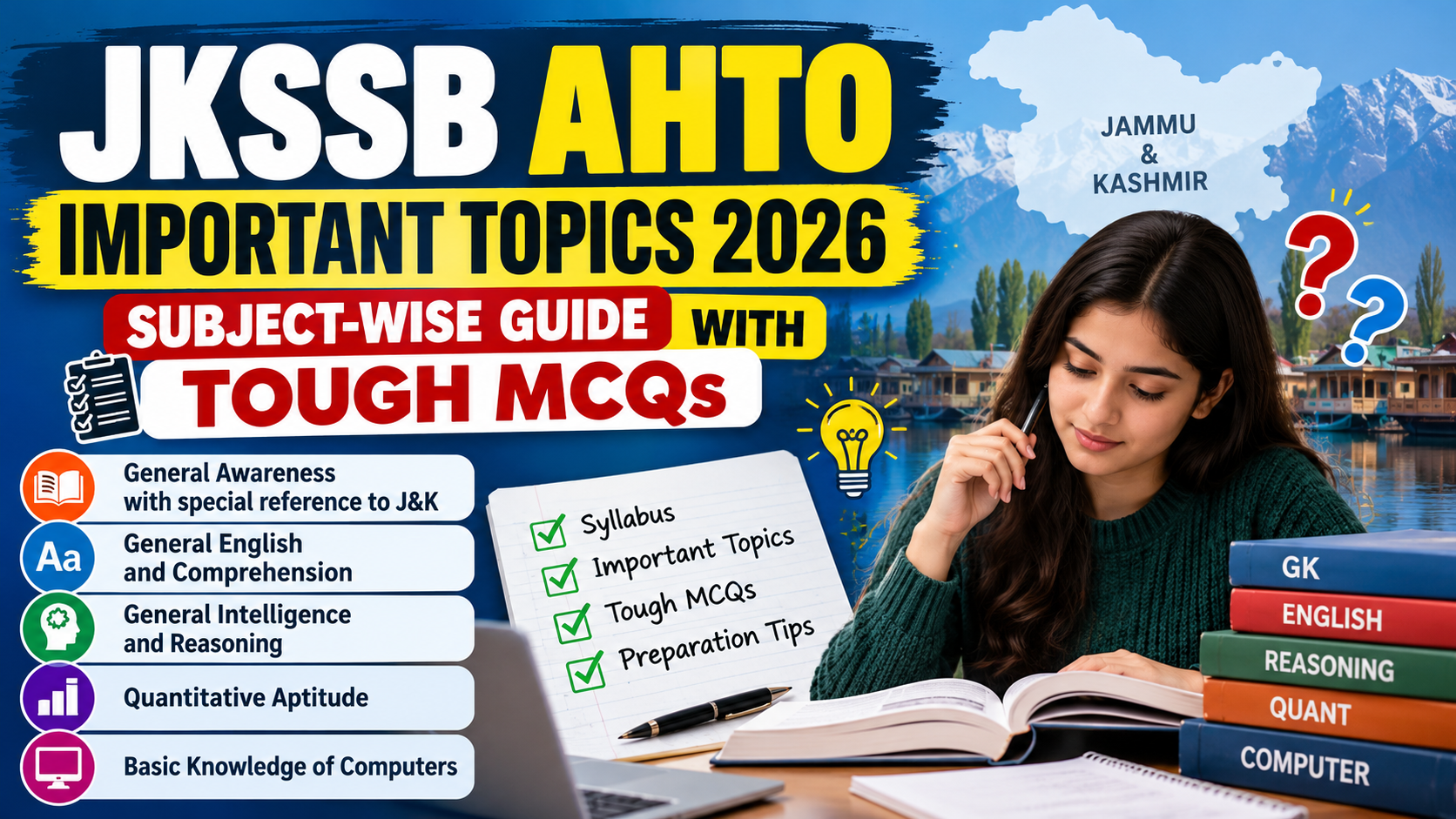
The Assistant Handicrafts Training Officer and Assistant Handlooms Training Officer (AHTO) examination conducted by the Jammu and Kashmir Services Selection Board covers General Awareness with special reference to J&K, General English and Comprehension, General Intelligence and Reasoning, Quantitative Aptitude, and Basic Knowledge of Computers.
For the current syllabus structure, the written examination carries 120 marks and has a duration of two hours. Computer Knowledge has the highest weightage, making it particularly important for candidates aiming for a strong overall score. Candidates should also check the official JKSSB syllabus page for any subsequent updates or corrections.
This guide covers the important topics to prioritise, practical preparation advice, and difficult sample MCQs designed to test your understanding.
Download JKSSB AHTO Complete Study Material and Test Series 2026
JKSSB AHTO Exam Pattern 2026
Before starting topic-wise preparation, familiarise yourself with the distribution of marks.
| Subject | Marks |
|---|---|
| General Awareness with special reference to J&K UT | 24 |
| General English and Comprehension | 24 |
| General Intelligence and Reasoning | 24 |
| Quantitative Aptitude | 18 |
| Basic Knowledge of Computers | 30 |
| Total | 120 |
The distribution makes one thing clear: no single subject should be ignored. Although Computer Knowledge carries 30 marks, the three sections carrying 24 marks each can significantly influence your final score.
1. General Awareness with Special Reference to Jammu and Kashmir
General Awareness is an important section because it combines national-level knowledge with topics specific to Jammu and Kashmir. Simply memorising a few current affairs questions is not enough; candidates should prepare both static GK and recent developments.
Important topics to study:
History of India, particularly the freedom movement.
Indian Constitution, its basic features, Fundamental Rights, Fundamental Duties and Directive Principles.
Physical and political divisions of India.
Indian rivers, lakes, climate, crops, transport and communication.
Indian economy, taxation, GST and basic economic terminology.
Indian culture, heritage, science and technology.
Environment, ecology and biodiversity.
Census concepts, demography and vital statistics.
History, geography, economy, culture and tourist destinations of Jammu and Kashmir.
Jammu and Kashmir Reorganisation Act, 2019.
Important national and international current affairs.
Relevant government schemes and other syllabus-listed topics.
For J&K-specific preparation, give particular attention to important rivers and lakes, traditional arts and crafts, cultural heritage, geographical features and major tourist destinations. These subjects are especially useful for building a strong foundation in regional General Awareness.
For current affairs, revise important events, government initiatives, awards, appointments, sports and major national developments from a suitable recent period before the examination.
Preparation tip: Make short revision notes and practise statement-based questions. These questions require you to identify precisely which statements are correct rather than relying on a familiar keyword.
2. General English and Comprehension
English carries 24 marks and deserves consistent practice. Candidates who focus exclusively on vocabulary while ignoring grammar and comprehension may miss straightforward scoring opportunities.
Concentrate on the following areas:
Tenses, articles and prepositions.
Subject-verb agreement.
Active and passive voice.
Direct and indirect speech.
Modals, clauses and conjunctions.
Error spotting and sentence correction.
Rearrangement of jumbled sentences.
Synonyms, antonyms and homonyms.
Idioms and phrases.
Fill-in-the-blanks questions.
Reading comprehension.
The most productive approach is to practise English in small, regular sessions. Learn a grammar rule, solve questions based on it, and then revise the mistakes.
Do not memorise vocabulary without understanding how words are used in sentences. In difficult questions, the surrounding context can change the meaning or determine which option fits grammatically.
3. General Intelligence and Reasoning
Reasoning rewards practice and familiarity with different question patterns. Candidates often understand the basic concepts but lose marks because they rush through a sequence, misread a relationship, or overlook a condition.
Prioritise these topics:
Number and alphabet series.
Analogy and classification.
Coding-decoding.
Blood relations.
Direction and distance.
Venn diagrams.
Logical reasoning and statement-based questions.
Syllogisms and drawing inferences.
Numerical and symbolic operations.
Verbal and non-verbal reasoning.
Figure classification, pattern completion and visualisation.
Relevant spatial reasoning and folding or unfolding questions.
Start by learning the underlying pattern in each question type. Once you can solve individual topics reliably, practise mixed question sets under a time limit.
A useful technique: When you make a mistake, write down the reasoning behind the correct answer. Repeating the same question without understanding its logic will not improve your performance significantly.
4. Quantitative Aptitude
Quantitative Aptitude carries 18 marks. Although its weightage is lower than that of the other major sections, it should not be left until the final days.
The syllabus includes arithmetic as well as geometry, mensuration, trigonometry and data interpretation.
Important topics include:
Whole numbers, decimals and fractions.
Percentages, ratio and proportion.
Average, profit and loss, and discount.
Simple and compound interest.
Partnership, mixture and alligation.
Time and work.
Time, speed and distance.
Square roots and basic algebra.
Triangles, circles, quadrilaterals and regular polygons.
Right prisms, cylinders, cones, spheres and hemispheres.
Heights and distances.
Trigonometric ratios, standard identities and complementary angles.
Histograms, frequency polygons, bar diagrams and pie charts.
Begin with arithmetic fundamentals before moving to more demanding geometry and trigonometry questions. Keep a separate formula sheet and revise it regularly.
For difficult questions, focus on identifying the shortest valid method. Excessive calculation can consume valuable time, even when your approach is correct.
5. Basic Knowledge of Computers
Computer Knowledge is the highest-weightage section, carrying 30 out of 120 marks. A thorough preparation of this section can support your overall score, particularly when combined with regular revision.
Study the following areas carefully:
Fundamentals of computers and their components.
Hardware, software and open-source technologies.
Input and output devices.
Memory, storage and basic computer terminology.
Operating system fundamentals.
MS Word, MS Excel, MS Access and MS PowerPoint.
PDF documents, internet and email.
Computer viruses, malware and antivirus software.
Basic information technology and its role in governance.
Do not limit computer preparation to definitions. Understand practical differences between related terms, common keyboard shortcuts, spreadsheet formulas, file formats and application features.
For example, Excel questions may test relative and absolute cell references, while Word questions may involve document formatting or mail merge. Understanding how these features work is more useful than merely memorising their names.
Tough JKSSB AHTO Demo MCQs with Answers and Explanations
The following questions are original practice questions created for demonstration purposes. They are not presented as official JKSSB questions or previous-year questions. Attempt them before checking the answers.
Question 1: Computer Knowledge — MS Excel
An Excel cell contains the formula =$B2+C$3. If the formula is copied two columns to the right and two rows down, what will the resulting formula be?
A. =$D4+E$5
B. =$B4+E$3
C. =B4+$E3
D. =$B2+E$3
Correct Answer: B. =$B4+E$3
Explanation: The dollar sign fixes the column in $B2, while its row changes from 2 to 4. In C$3, the row is fixed, but the column moves two positions from C to E. Therefore, the formula becomes =$B4+E$3.
Question 2: Quantitative Aptitude — Mixture
A vessel contains 40 litres of a milk-water mixture in the ratio 7:3. Ten litres of the mixture are removed and replaced with water. What percentage of the resulting mixture is milk?
A. 45%
B. 50%
C. 52.5%
D. 57.5%
Correct Answer: C. 52.5%
Explanation: Initially, the vessel contains 28 litres of milk and 12 litres of water. Removing 10 litres removes 7 litres of milk, leaving 21 litres. Adding 10 litres of water restores the total volume to 40 litres. Hence, the milk percentage is (21/40 \times 100 = 52.5%).
Question 3: General English — Subject-Verb Agreement
Choose the grammatically correct option:
“Neither the officer nor the assistants _____ informed that the report _____ been revised.”
A. was, have
B. were, had
C. was, had
D. were, has
Correct Answer: B. were, had
Explanation: With “neither…nor,” the verb generally agrees with the nearer subject. Here, “assistants” is plural, so “were” is appropriate. “Had been revised” correctly expresses the earlier revision in the reported situation.
Question 4: Reasoning — Number Series
Find the missing number:
4, 9, 19, 39, 79, ?
A. 149
B. 157
C. 159
D. 161
Correct Answer: C. 159
Explanation: Each term is obtained by multiplying the preceding term by 2 and adding 1.
(4 \times 2 + 1 = 9)
(9 \times 2 + 1 = 19)
(79 \times 2 + 1 = 159)
Question 5: J&K General Awareness — Reorganisation
Consider the following statements:
The Jammu and Kashmir Reorganisation Act, 2019, came into effect on 31 October 2019.
The reorganisation created the Union Territories of Jammu and Kashmir and Ladakh.
Both Union Territories were constituted with legislative assemblies under that reorganisation.
Which statements are correct?
A. 1 and 2 only
B. 2 and 3 only
C. 1 and 3 only
D. 1, 2 and 3
Correct Answer: A. 1 and 2 only
Explanation: The Act took effect on 31 October 2019, creating the Union Territories of Jammu and Kashmir and Ladakh. Jammu and Kashmir has a legislature, while Ladakh was constituted as a Union Territory without a legislature.
Question 6: Quantitative Aptitude — Interest
The difference between compound interest and simple interest on a sum for two years at 10% per annum, calculated annually, is ₹72. What is the principal?
A. ₹6,200
B. ₹7,000
C. ₹7,200
D. ₹8,000
Correct Answer: C. ₹7,200
Explanation: For two years with annual compounding, the difference is (P(r/100)^2). Therefore,
[
72=P\left(\frac{10}{100}\right)^2
]
[
72=0.01P \implies P=₹7,200
]
Question 7: Reasoning — Syllogism
Consider the following statements:
All shawls are textiles.
Some textiles are woollen.
No woollen items are synthetic.
Conclusions:
I. Some textiles are not synthetic.
II. Some shawls are woollen.
Choose the correct answer.
A. Only conclusion I follows.
B. Only conclusion II follows.
C. Both conclusions follow.
D. Neither conclusion follows.
Correct Answer: A. Only conclusion I follows.
Explanation: The textiles that are woollen cannot be synthetic, so conclusion I follows. However, the statements do not establish that any shawls belong to the woollen category; therefore, conclusion II does not necessarily follow.
Question 8: Quantitative Aptitude — Trigonometry
If (\tan\theta=3/4), where (\theta) is an acute angle, find (\sin\theta+\cos\theta).
A. (1)
B. (6/5)
C. (7/5)
D. (5/7)
Correct Answer: C. (7/5)
Explanation: Since the opposite and adjacent sides are in the ratio 3:4, the hypotenuse is 5 by the Pythagorean theorem. Thus, (\sin\theta=3/5) and (\cos\theta=4/5). Their sum is (7/5).
Question 9: J&K Geography — Lakes and Rivers
Consider the following statements:
The Jhelum flows through Srinagar.
Wular Lake is associated with the Jhelum river system.
Dal Lake is a high-altitude glacial lake.
Which statements are correct?
A. 1 and 2 only
B. 2 and 3 only
C. 1 and 3 only
D. All three
Correct Answer: A. 1 and 2 only
Explanation: The Jhelum flows through Srinagar, and Wular Lake forms part of the Jhelum river system. Dal Lake is a freshwater lake in Srinagar, not a high-altitude glacial lake.
Question 10: Computer Fundamentals — Memory
Consider the following statements:
RAM is generally volatile memory.
ROM generally retains its contents when the power is switched off.
RAM and secondary storage serve exactly the same purpose.
Which statements are correct?
A. 1 only
B. 1 and 2 only
C. 2 and 3 only
D. All three
Correct Answer: B. 1 and 2 only
Explanation: RAM normally loses its stored contents when power is removed, while ROM is non-volatile. Secondary storage, such as an SSD or hard drive, provides persistent storage and does not serve exactly the same purpose as RAM.
How to Prepare Effectively for JKSSB AHTO 2026
An effective preparation routine should combine learning, revision and question practice. Spending all your time reading notes may create familiarity with a topic without preparing you to solve exam-level questions independently.
Start with the high-weightage Computer Knowledge section and maintain regular practice in General Awareness, English and Reasoning. Give Quantitative Aptitude a consistent place in your routine, especially if calculations or geometry are weak areas.
A practical study cycle is:
Learn the concept → Solve MCQs → Check mistakes → Revise → Attempt a timed practice set.
After completing a topic, test yourself without looking at your notes. Record the questions you answered incorrectly and revisit the underlying concepts. This helps identify genuine gaps rather than simply repeating material you already know.
As the examination approaches, increase your focus on revision, mixed MCQ sets, important formulas, computer terminology and J&K-specific facts. Use mock tests to practise time management and identify which sections need more work.
Prepare with JKSSB AHTO Study Material and Mock Tests
A well-organised preparation resource can save time by bringing subject-wise notes, MCQs, sectional practice and full-length mock tests together.
Candidates preparing for the examination can explore the JKSSB AHTO Complete Study Material and Test Series 2026 on JK Exam Library for structured preparation and additional practice.
The objective is not to collect the largest number of PDFs. It is to understand the syllabus, revise consistently and become comfortable solving questions accurately under time pressure.
Final Words
The JKSSB AHTO examination demands balanced preparation, careful revision and a clear understanding of the syllabus. Computer Knowledge deserves special attention because of its 30-mark weightage, while General Awareness, English and Reasoning need consistent practice. Quantitative Aptitude should remain part of your routine rather than being postponed until the end.
Use the demo MCQs in this article to check your understanding, note the questions you found difficult and revise those concepts before moving forward.
Remember: strong preparation comes from understanding concepts, practising intelligently and learning from mistakes—not simply from finishing more study material.