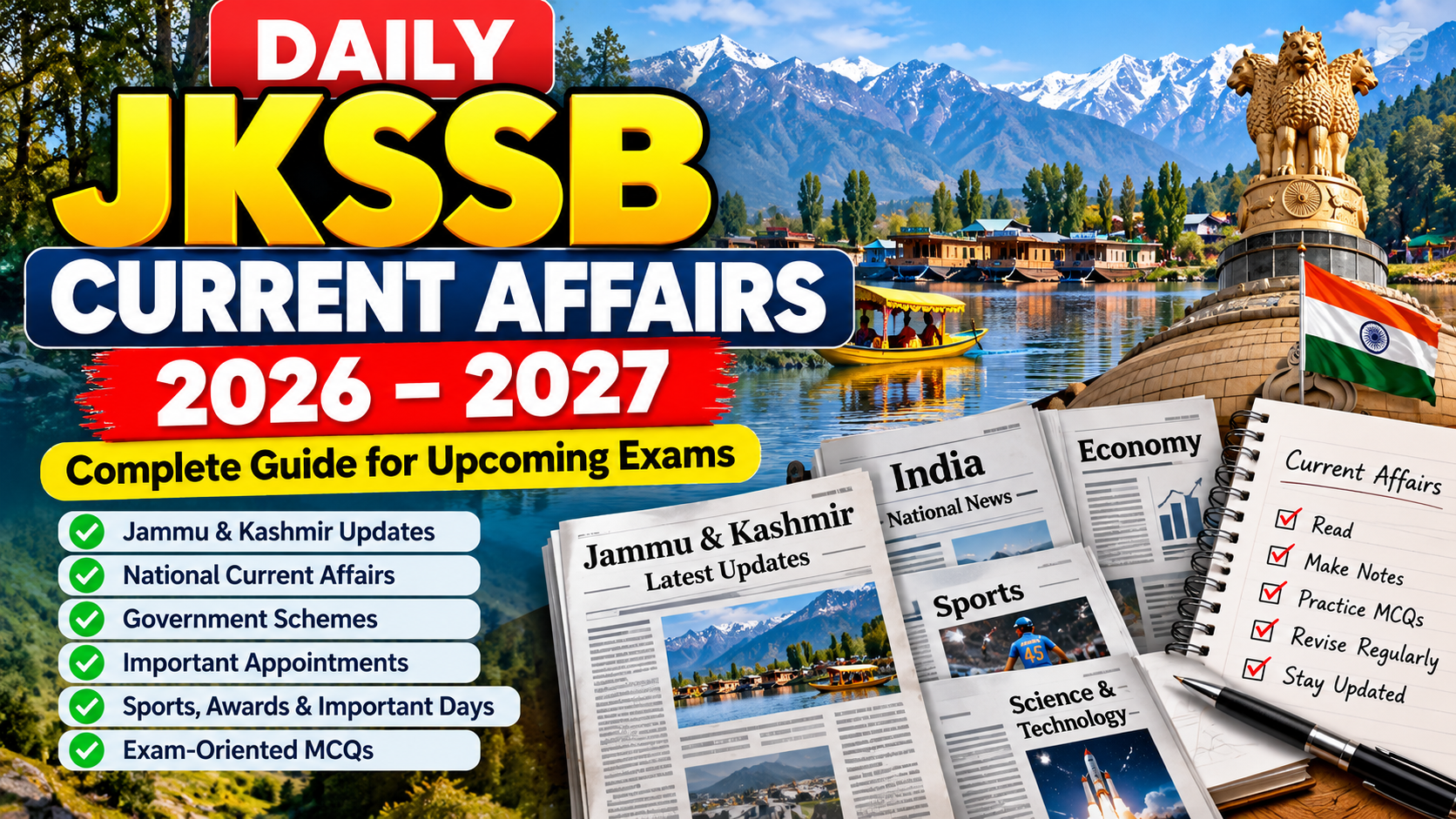
Daily JKSSB Current Affairs 2026–2027: Complete Preparation Guide for Upcoming Exams
Preparing for a JKSSB examination is not just about completing the syllabus. Candidates also need to stay updated with important events, revise factual information regularly, and understand which current affairs topics are relevant to their particular examination. This is where daily current affairs preparation becomes important.
Whether you are preparing for Finance Accounts Assistant (FAA), Junior Assistant, Patwari, Police Constable, Stock Assistant, Health Department posts, or other upcoming JKSSB examinations, current affairs can help you strengthen your General Knowledge preparation.
Many aspirants collect PDFs, save daily news updates, and watch current affairs videos, but still struggle to remember important facts during the examination. The problem is often not a lack of study material. It is the absence of a proper revision strategy.
For the upcoming JKSSB exams in 2026 and 2027, candidates should follow a consistent approach that combines Jammu and Kashmir current affairs, national news, government schemes, important appointments, sports, awards, science, and exam-oriented multiple-choice questions.
In this guide, we will explain how to prepare daily JKSSB current affairs, which topics deserve attention, and how you can make your preparation more effective.
Why Are Daily Current Affairs Important for JKSSB Exams?
Current affairs are an important part of competitive examination preparation because questions can be based on recent developments, government decisions, important personalities, national events, and developments related to Jammu and Kashmir.
The exact weightage and coverage depend on the post-specific syllabus and examination pattern. Therefore, candidates should always check the official notification and syllabus for their particular recruitment.
One major advantage of studying current affairs daily is that it reduces the pressure of last-minute preparation. Instead of trying to memorise several months of news shortly before the examination, you gradually build your knowledge over time.
For example, a candidate preparing for an examination in early 2027 should not wait until the final month to begin studying current affairs. Starting now allows sufficient time to learn, revise, and practise questions.
Daily preparation also helps candidates connect current events with static GK. A news item about a national park, government scheme, sports tournament, or constitutional development may help you revise related facts that could be useful in other questions.
Important Current Affairs Topics for JKSSB 2026–2027


6
Rather than reading every news story available online, focus on topics that are relevant to your examination syllabus and can be converted into objective questions.
1. Jammu and Kashmir Current Affairs
For aspirants appearing in JKSSB examinations, Jammu and Kashmir-related developments deserve special attention, particularly where the syllabus includes General Knowledge with special reference to J&K.
Important areas include:
Major decisions and notifications issued by the Jammu and Kashmir administration.
Government schemes, welfare programmes, and development initiatives.
Important appointments, administrative changes, and official committees.
Tourism, agriculture, horticulture, handicrafts, and the regional economy.
Important developments in education and healthcare.
Infrastructure projects, roads, tunnels, hydropower, and transport.
Sports achievements and cultural events in Jammu and Kashmir.
Important environmental developments, wildlife, and conservation projects.
Candidates should also revise static J&K GK alongside current affairs. This includes districts, rivers, lakes, mountain ranges, national parks, historical places, crops, and important geographical features.
The best approach is to understand the news first and then identify the facts that may be asked in an examination.
ALSO READ:JKSSB AHTO Important Topics 2026: Syllabus & Tough MCQs
2. National Current Affairs
National current affairs cover important developments from across India. These topics can be useful for examinations that include General Knowledge and Current Affairs.
Pay attention to:
Major government schemes and policy announcements.
Important decisions of the Union Cabinet.
New laws, constitutional developments, and major judgments.
Reports and indices released by recognised organisations.
Important national appointments and resignations.
Economic developments, budgets, and financial initiatives.
Infrastructure projects and major public-sector initiatives.
National awards, honours, and significant achievements.
Do not try to memorise every statement made by a public figure. Give priority to developments that have wider national importance or are connected with the syllabus.
3. Government Schemes and Welfare Programmes
Government schemes are a useful area for factual MCQ preparation. Questions may focus on the objective of a scheme, its target beneficiaries, the responsible ministry, or an important feature.
While preparing a scheme, make short notes containing:
Name of the scheme.
Main objective.
Ministry or department responsible.
Target beneficiaries.
Important benefits or features.
Recent development, if any.
For example, if a government announces a new initiative for farmers, do not simply memorise its name. Understand what it aims to achieve, whom it benefits, and which department implements it.
Use official government sources to verify scheme details, particularly when a news report contains incomplete or outdated information.
4. Economy, Budget and Financial Awareness
Economy-related current affairs can be particularly useful for candidates preparing for posts whose syllabi include financial or economic awareness.
Important topics include the Union Budget, Economic Survey, inflation, banking developments, taxation, government expenditure, employment initiatives, agriculture-related policies, and major economic indicators.
Candidates preparing for Finance Accounts Assistant should give particular attention to the financial and economic topics explicitly mentioned in their syllabus. However, they should not assume that every economy-related headline will appear in the paper.
Prepare concise notes and revise the meaning of important terms rather than memorising isolated figures without context.
5. Science, Technology and Environment
Science and technology current affairs can include space missions, scientific discoveries, digital initiatives, artificial intelligence, important research developments, and major achievements by Indian scientific institutions.
Environment-related preparation should cover climate change, biodiversity, protected areas, pollution control, conservation initiatives, and important environmental reports.
For Jammu and Kashmir, environmental developments can also be connected with Himalayan ecology, glaciers, wetlands, forests, wildlife, and local conservation efforts.
Where relevant, connect a current development with static GK. For example, when studying a newly reported conservation initiative, revise the location, species, or protected area associated with it.
6. Sports, Awards and Important Days
Sports and awards are often suitable for short factual revision sessions.
Keep track of major national and international tournaments, Indian medal winners, important records, recognised awards, and significant appointments in sports organisations.
Important days should be studied with their dates, official themes where relevant, and the reason for their observance.
Avoid spending excessive time on minor sporting results or routine celebrity news unless your syllabus or examination trend makes those areas relevant.
How to Study Daily JKSSB Current Affairs Effectively
The secret is not to read more material than everyone else. It is to retain the information you study and practise applying it to questions.
Follow this simple method.
Step 1: Read a daily current affairs update.
Choose a reliable source that covers J&K, national developments, and other examination-relevant topics. Focus on the important facts instead of reading every detail of each news report.
Step 2: Make short notes.
Write down the essential information in a few lines. Notes should be short enough to revise quickly before the examination.
Step 3: Practise MCQs.
After studying the daily updates, attempt questions based on the same topics. MCQs help you identify which facts you have understood and which ones need further revision.
Step 4: Revise previous days' topics.
Spend a few minutes revisiting earlier notes. Without revision, it is easy to forget dates, names, locations, and other factual details.
Step 5: Review mistakes.
Maintain a separate list of incorrect answers. Revise these questions regularly instead of repeatedly studying topics you already know well.
This method turns daily reading into an organised preparation routine rather than an endless collection of news PDFs.
Daily, Weekly and Monthly Revision Strategy
Candidates preparing for JKSSB 2026 and 2027 can divide their preparation into three levels.
Frequency | What to do |
|---|---|
Daily | Study important updates and solve topic-based MCQs. |
Weekly | Revise the week's notes and practise mixed questions. |
Monthly | Review the month's important events and attempt a monthly revision test. |
At the end of every month, prepare a consolidated revision sheet containing the most important developments from Jammu and Kashmir, India, and other relevant categories.
Do not keep postponing revision until you have completed an entire year of current affairs. Regular revision makes the material easier to recall and reduces the burden before the examination.
How Many Months of Current Affairs Should You Prepare?
There is no single fixed duration that is correct for every JKSSB examination. The appropriate coverage depends on the post, syllabus, examination date, and instructions provided by the recruiting authority.
For exams expected in late 2026 or during 2027, a practical strategy is to begin with current affairs from the recent months, continue studying daily, and expand coverage according to the examination's requirements.
For a 2027 examination, candidates should not ignore important developments from 2026 simply because a new calendar year has begun.
A useful approach is to maintain monthly notes throughout your preparation. When the official examination schedule becomes available, use the remaining time to prioritise revision based on the syllabus and the period of current affairs most relevant to the exam.
Remember that studying more months does not automatically guarantee a better score. The quality of your revision and your ability to answer questions accurately also matter.
Practise Daily JKSSB Current Affairs MCQs
Reading current affairs gives you information, but practising questions helps you test whether you can recall it under examination conditions.
Try to solve questions immediately after studying a topic. For example, after revising a government scheme, answer questions about its objective, implementing ministry, and beneficiaries.
You can also use mixed MCQ sets covering Jammu and Kashmir, national affairs, science, sports, awards, and government initiatives.
When checking answers, do not stop after seeing the correct option. Read the explanation and understand why the answer is correct. This is especially helpful when two options appear similar.
A good revision resource should offer clear questions, accurate answers, and explanations where necessary. Candidates should avoid relying entirely on random social media posts, unverified answer keys, or outdated PDFs.
Common Mistakes to Avoid During Current Affairs Preparation
Several common habits waste preparation time.
Collecting too many PDFs: Downloading material from multiple sources can create confusion and unnecessary duplication. Select a manageable set of reliable resources.
Ignoring Jammu and Kashmir-specific updates: Candidates preparing for J&K examinations should give adequate attention to local developments whenever these are included in the syllabus.
Memorising without understanding: Learning names and dates without understanding the context makes it difficult to answer questions framed differently from those in your notes.
Skipping revision: Reading a topic once does not mean you will remember it weeks later. Revisit important facts regularly.
Studying irrelevant news: Not every trending story is useful for a competitive examination. Prioritise relevance, factual importance, and syllabus coverage.
Ignoring official notifications: Preparation material cannot replace the official syllabus, examination notices, or final answer keys issued by the recruiting authority.
Prepare for Upcoming JKSSB Exams with JK Exam Library
For aspirants who want to organise their preparation in one place, JK Exam Library provides a platform focused on competitive exam preparation, including study material, practice questions, and mock tests.
You can explore the available resources and choose those that match your examination and preparation needs.
The most useful combination is straightforward: study current affairs regularly, revise Jammu and Kashmir GK, practise MCQs, and use mock tests to assess your preparation when you are ready.
Do not measure your progress only by the number of pages you have read. Measure it by how much information you can recall correctly and how consistently you can answer examination-oriented questions.
Frequently Asked Questions (FAQs)
1. Is daily current affairs important for JKSSB exams in 2026 and 2027?
Yes, current affairs can be an important part of preparation where they are included in the examination syllabus. Candidates should also prepare the other subjects specified for their particular post.
2. Which current affairs topics should JKSSB aspirants prioritise?
Jammu and Kashmir developments, national current affairs, government schemes, appointments, awards, sports, economy, science, and environment are useful areas to review according to the syllabus.
3. Should I study current affairs daily or monthly?
Daily study combined with weekly and monthly revision is a practical approach. It helps you keep up with new developments while retaining previously studied information.
4. Are current affairs MCQs enough for JKSSB preparation?
MCQs are useful for practice and revision, but they should be supported by concept learning, reliable notes, static GK, and the remaining subjects required by your examination.
5. Where should I check official JKSSB updates?
Visit the official JKSSB website for recruitment notices, examination schedules, admit cards, answer keys, and results. Always follow the relevant official notification for your post.
Final Words
Preparing for JKSSB examinations in 2026 and 2027 requires consistency, not last-minute pressure. A small amount of focused study every day, followed by regular revision and MCQ practice, can help you build a stronger foundation in current affairs.
Start with the important developments from Jammu and Kashmir, cover national and other syllabus-relevant topics, and keep your notes organised month by month. Most importantly, avoid waiting for the examination date to begin serious revision.
Study daily, revise regularly, practise honestly, and keep your preparation aligned with the official syllabus. That is a more dependable approach than collecting large amounts of material without revisiting it.