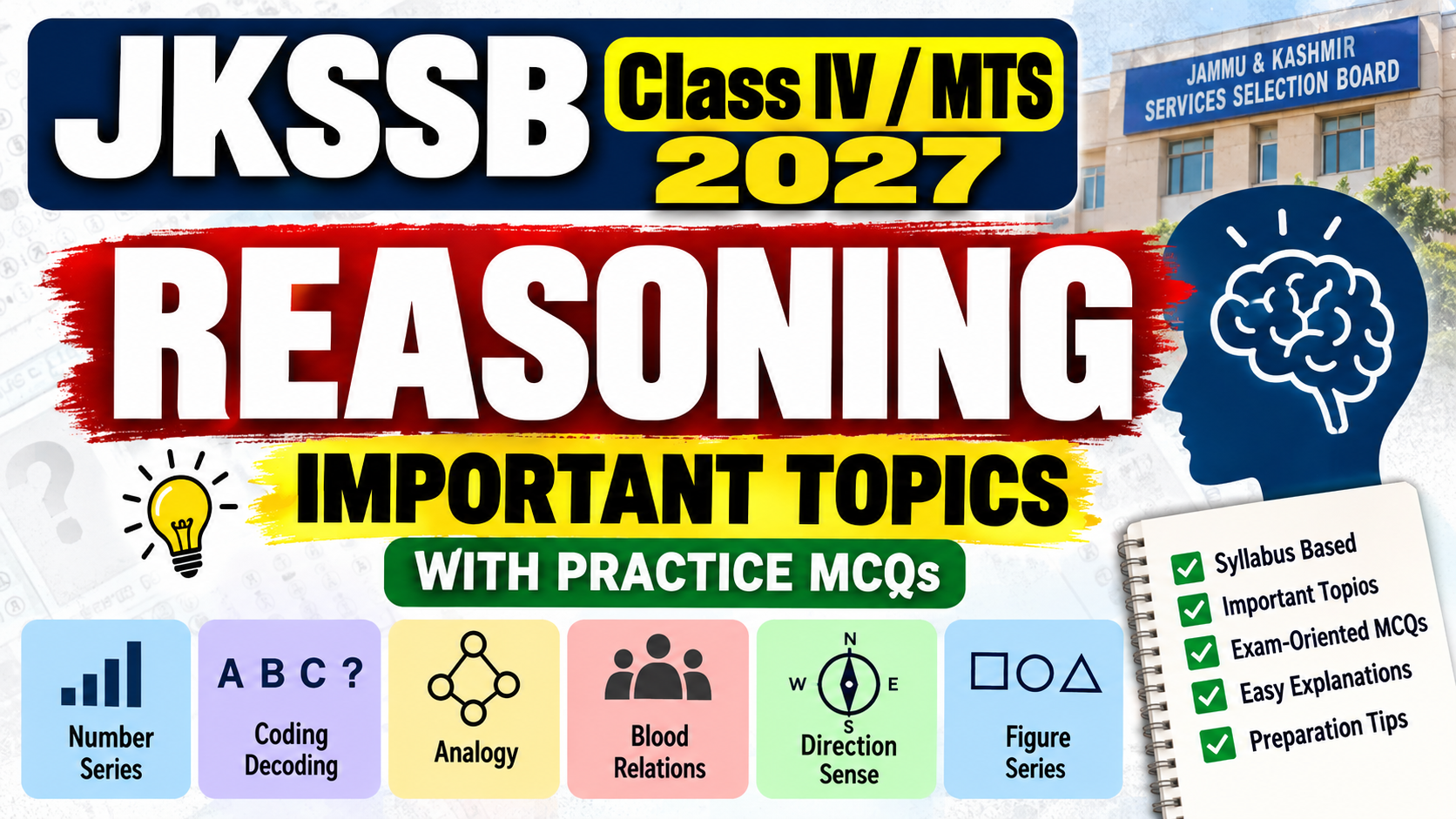
Why Reasoning Is Important for JKSSB Class IV MTS 2027
If you are preparing for the JKSSB Class IV or Multi-Tasking Staff (MTS) examination, reasoning is a subject you should not ignore. Many candidates spend most of their preparation time memorising General Knowledge, current affairs, and other factual topics. However, regular practice of reasoning questions can help improve logical thinking, accuracy, and question-solving speed.
The key to preparing for reasoning is understanding the pattern behind a question rather than memorising its answer. Once you understand how number series, coding-decoding, analogies, and relationships work, you can solve similar questions more confidently.
For the 2027 preparation cycle, candidates should use the latest available official syllabus as their starting point and practise fundamental reasoning concepts while waiting for any applicable 2027 notification.
Important syllabus note: The topics discussed below are recommended preparation areas, not a confirmed official 2027 topic list. Always check the official JKSSB website for the syllabus and examination scheme applicable to your recruitment notification.
Download Complete jkssb class iv mts study material and full mocktests
JKSSB Class IV MTS 2027: Important Reasoning Topics
1. Number Series
Number series is one of the first topics candidates should practise. You are given a sequence of numbers and must identify the next number or the missing term.
Common patterns include:
Addition and subtraction series
Multiplication and division series
Squares and cubes
Alternating number patterns
Differences between consecutive numbers
Example: 3, 7, 13, 21, 31, ?
The differences are +4, +6, +8, and +10. The next difference is +12, so the answer is 43.
Preparation tip: Check the differences first. If they do not form a clear pattern, examine multiplication, division, or alternating operations.
2. Coding and Decoding
In coding-decoding questions, letters, numbers, or words are transformed according to a particular rule. Your task is to identify the rule and apply it to a new word.
Important types include:
Alphabet-position coding
Forward and backward letter shifts
Word coding
Number coding
Reverse-alphabet patterns
For example, if CAT is coded as DBU, each letter moves one position forward in the alphabet. Following the same rule, DOG becomes EPH.
Preparation tip: Remember the positions of letters from A = 1 to Z = 26. Practise forward and backward shifts daily.
3. Analogy
Analogy questions test the relationship between two words, numbers, or figures. You must find another pair with a similar relationship.
Examples of relationships include:
Animal and its young one
Object and its function
Worker and workplace
Number and its square
Part and whole
For example, Book : Read :: Food : Eat.
The relationship is based on the action associated with each object.
Preparation tip: Identify the exact relationship between the first pair before looking at the options.
4. Blood Relations and Relationship Concepts
Blood-relation questions examine family relationships. You may need to determine whether someone is a person's brother, sister, father, mother, uncle, or another relative.
Read the statements carefully and avoid assuming that a person's gender or relationship has been provided when it has not.
Preparation tip: Draw a small family tree. Use separate symbols for males and females when the information is given. This makes longer questions easier to solve.
5. Direction Sense
Direction questions test your ability to follow movement and determine the final direction or distance from a starting point.
Important concepts include:
North, South, East, and West
Left and right turns
Final direction
Shortest distance
Movement in multiple directions
Preparation tip: Draw a simple compass and mark every movement. For shortest-distance questions, use the net horizontal and vertical movement rather than adding the entire route.
6. Odd One Out
In these questions, several words, numbers, or figures share a common characteristic, while one does not.
For example, 9, 16, 25, 27, 36 contains one number that is not a perfect square: 27.
Preparation tip: Check divisibility, parity, squares, cubes, categories, and common properties before selecting an answer.
7. Figure Series and Figure-Based Reasoning
Figure-based questions involve shapes, symbols, rotations, and visual patterns. They may ask you to complete a series or identify the figure that differs from the others.
Practise:
Rotation of shapes
Changes in the number of sides
Alternating figures
Movement of dots or arrows
Reflection and visual patterns
Preparation tip: Compare one feature at a time, such as direction, position, shape, or number of elements.
8. Venn Diagrams
Venn diagrams represent relationships between groups. Questions may involve overlapping categories or groups that are completely separate.
For example, a question may ask you to represent students who study Mathematics, Science, or both.
Preparation tip: Identify whether the groups overlap, whether one group is contained inside another, or whether the groups are completely separate.
9. Semantic Series and Word-Based Reasoning
Semantic reasoning focuses on the meaning and relationship of words. Questions may ask you to arrange words logically or identify a meaningful relationship.
Practise:
Dictionary order
Logical word sequences
Word classification
Semantic analogy
Word building
Preparation tip: Focus on meaning and logical order instead of guessing from the appearance of words.
10. Logical Reasoning and Statements
Basic logical reasoning asks you to evaluate information and draw conclusions that follow from it.
Practise:
Statements and conclusions
Simple syllogisms
Classification
Logical relationships
Numerical operations
Preparation tip: Use only the information given in the question. Do not introduce outside assumptions when deciding whether a conclusion follows.
Q1. Number Series
Find the missing number:
5, 11, 19, 29, 41, ?
A) 53
B) 55
C) 57
D) 59
Correct Answer: B) 55
Explanation: The differences are +6, +8, +10, and +12. The next difference is +14. Therefore, 41 + 14 = 55.
Q2. Coding-Decoding
If TABLE is coded as UBCMF, how will CHAIR be coded using the same rule?
A) DIBJS
B) DIBIR
C) DHCJS
D) EIBJS
Correct Answer: A) DIBJS
Explanation: Each letter is replaced by the next letter of the alphabet: C → D, H → I, A → B, I → J, and R → S.
Q3. Analogy
Bird : Nest :: Bee : ?
A) Cave
B) Hive
C) Burrow
D) Web
Correct Answer: B) Hive
Explanation: A nest is a bird's home, while a hive is a bee's home.
Q4. Blood Relations
Pointing to a boy, Riya says, “He is the son of my mother's only daughter.” How is the boy related to Riya?
A) Brother
B) Nephew
C) Son
D) Cousin
Correct Answer: C) Son
Explanation: Riya's mother's only daughter is Riya herself. Therefore, the boy is Riya's son.
Q5. Direction Sense
A person walks 8 metres north, turns right and walks 6 metres, then turns right again and walks 8 metres. How far and in which direction is the person from the starting point?
A) 6 metres east
B) 8 metres south
C) 14 metres east
D) 6 metres west
Correct Answer: A) 6 metres east
Explanation: The northward and southward movements cancel each other. The person remains 6 metres east of the starting point.
Q6. Odd One Out
Identify the number that does not belong to the group.
A) 16
B) 25
C) 49
D) 63
Correct Answer: D) 63
Explanation: 16, 25, and 49 are perfect squares. 63 is not a perfect square.
Q7. Alphabet Series
Find the next letter:
A, D, H, M, S, ?
A) X
B) Y
C) Z
D) W
Correct Answer: C) Z
Explanation: The alphabet positions are 1, 4, 8, 13, and 19. The increases are +3, +4, +5, and +6. The next increase is +7, giving position 26, or Z.
Q8. Number Analogy
7 : 49 :: 12 : ?
A) 124
B) 132
C) 144
D) 156
Correct Answer: C) 144
Explanation: \(7^2 = 49\). Applying the same rule, \(12^2 = 144\).
Q9. Logical Reasoning
Statements:
All pens are stationery items.
Some stationery items are expensive.
Conclusions:
I. All pens are stationery items.
II. Some pens are expensive.
A) Only conclusion I follows
B) Only conclusion II follows
C) Both conclusions follow
D) Neither conclusion follows
Correct Answer: A) Only conclusion I follows
Explanation: Conclusion I directly repeats the first statement. The second statement does not establish that any expensive stationery items are pens, so conclusion II does not necessarily follow.
Q10. Ranking
Aman is 12th from the top and 19th from the bottom in a class ranking. How many students are there in the class?
A) 29
B) 30
C) 31
D) 32
Correct Answer: B) 30
Explanation: Total students = rank from top + rank from bottom − 1.
\(12 + 19 - 1 = 30\).
Q11. Venn Diagram
Which relationship best represents the groups “Mammals,” “Dogs,” and “Animals”?
A) All three groups are separate.
B) All dogs are mammals, and all mammals are animals.
C) All animals are dogs.
D) All mammals are dogs.
Correct Answer: B) All dogs are mammals, and all mammals are animals.
Explanation: Dogs form a subgroup of mammals, and mammals form a subgroup of animals.
Q12. Mathematical Reasoning
If \(+\) means multiplication and \(\times\) means subtraction, what is the value of \(8 + 3 \times 4\)?
A) 12
B) 20
C) 28
D) 36
Correct Answer: B) 20
Explanation: Replace the symbols according to the question: \(8 \times 3 - 4 = 24 - 4 = 20\).
Q13. Word Classification
Which word is different from the others?
A) January
B) March
C) May
D) June
Correct Answer: D) June
Explanation: January, March, and May have 31 days, while June has 30 days.
Q14. Letter Coding
If the value of a word is the sum of the alphabetical positions of its letters, what is the value of CAT?
A) 22
B) 23
C) 24
D) 25
Correct Answer: C) 24
Explanation: C = 3, A = 1, and T = 20. Total = 3 + 1 + 20 = 24.
Q15. Number Series
Find the missing number:
2, 6, 18, 54, ?
A) 108
B) 126
C) 162
D) 216
Correct Answer: C) 162
Explanation: Each number is multiplied by 3 to obtain the next number. Therefore, 54 × 3 = 162.
How to Prepare Reasoning for JKSSB MTS 2027
A practical preparation routine is more useful than solving questions randomly.
Learn one topic at a time. Start with number series, analogy, coding-decoding, and direction sense.
Practise topic-wise MCQs. Solve 15–25 questions from the topic you have studied.
Maintain an error notebook. Record mistakes and write down the rule you missed.
Revise regularly. Revisit difficult questions after a day or two.
Improve speed gradually. First aim for correct answers, then work on reducing the time taken.
Practise mixed questions. Once you have covered the basics, combine several topics in a single practice session.
If you are balancing exam preparation with work, even 30–40 minutes of focused reasoning practice each day can help you maintain consistency.
ALSO READ:JKP Constable Mock Tests 2026: 30+ MockTests & Study Material
Common Mistakes to Avoid
Guessing a number-series pattern without checking the differences.
Applying the wrong letter shift in coding-decoding.
Losing track of left and right turns in direction questions.
Making assumptions in blood relations or logical conclusions.
Ignoring the wording of an odd-one-out question.
Repeating easy questions without reviewing mistakes.
The goal is not simply to solve a large number of questions. It is to understand why the correct option is correct and why the other options do not fit.
Final Advice for JKSSB Class IV MTS 2027 Aspirants
Start with basic concepts, practise consistently, and gradually move towards mixed and more challenging questions. Number series, coding-decoding, analogy, direction sense, relationship concepts, figure series, Venn diagrams, and logical reasoning are sensible areas to cover during preparation.
However, do not treat any unofficial list of important topics as a guarantee of what will appear in the examination. Confirm the final syllabus, marks distribution, and exam pattern through the relevant JKSSB notification.
To strengthen your preparation, attempt the practice questions below and review the explanations before moving to the next topic.