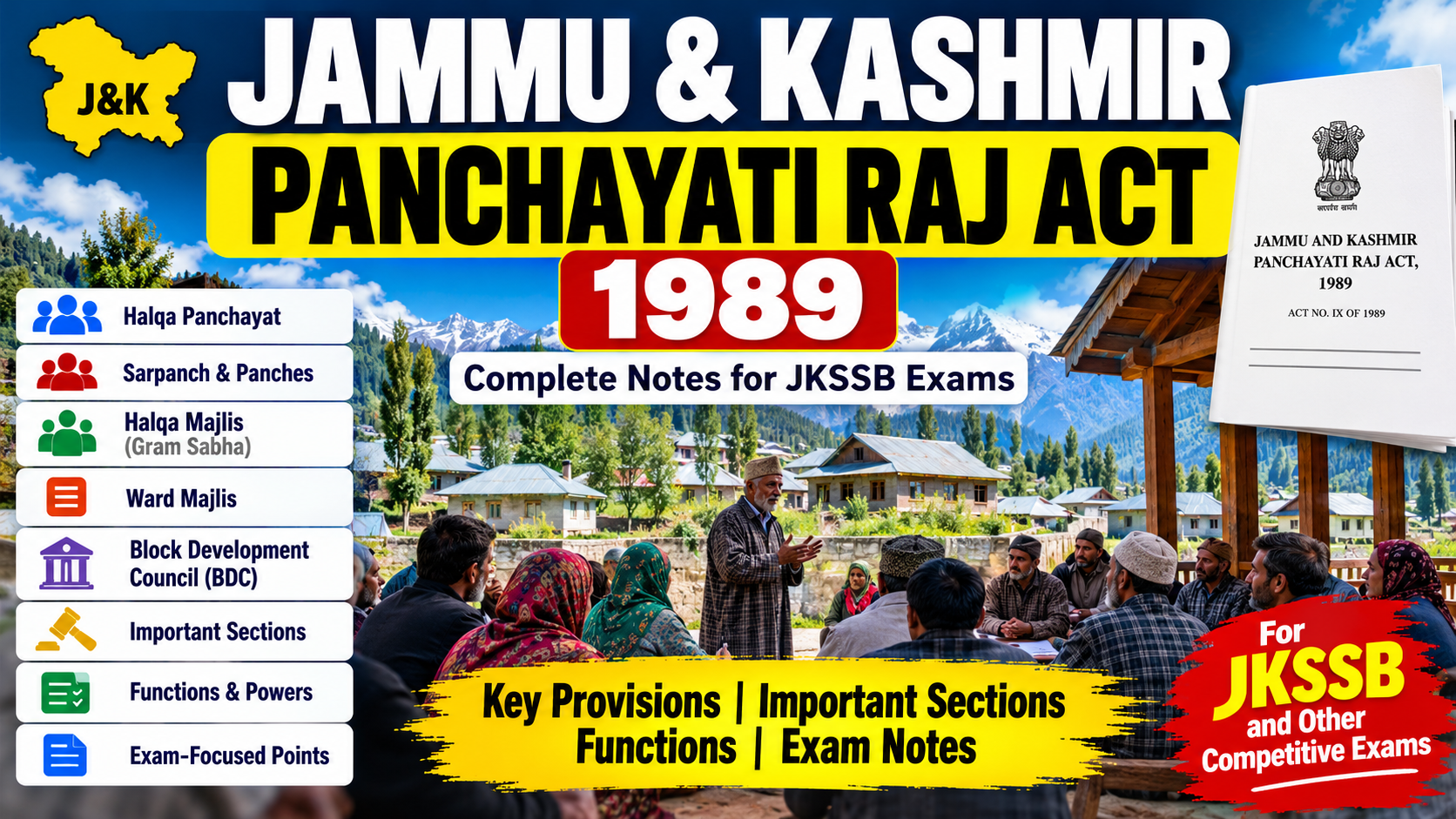
Jammu and Kashmir Panchayati Raj Act, 1989: Complete Notes for JKSSB Exams
Introduction
The Jammu and Kashmir Panchayati Raj Act, 1989 is an important law for understanding rural local self-government in Jammu and Kashmir. It provides the legal framework for the constitution of Halqa Panchayats, Block Development Councils and other institutions associated with local administration and rural development.
For JKSSB aspirants, this Act is an important topic under Jammu and Kashmir General Knowledge, especially for questions relating to Panchayati Raj institutions, rural governance, the powers of Sarpanches and Panches, and the role of local bodies in development.
In simple words, the Act aims to bring administration closer to the people. Instead of depending entirely on higher authorities for local development, villagers can participate in identifying their needs, prioritising projects and monitoring development work through Panchayati Raj institutions.
1. Important Facts About the J&K Panchayati Raj Act
The following facts are useful for quick examination revision:
Name of the Act: Jammu and Kashmir Panchayati Raj Act, 1989.
Act number: Act No. IX of 1989.
Date of enactment: 11 July 1989.
Main objective: To promote local self-government and public participation in rural development.
Important institutions: Halqa Panchayat, Block Development Council and District Planning and Development Board.
Important local bodies and terms: Halqa Majlis, Ward Majlis, Sarpanch, Naib-Sarpanch and Panch.
Important amendment for Panchayat functions: The 2018 amendments, including the changes introduced through Act No. 20 of 2018.
Exam tip: Do not confuse the year of enactment, 1989, with the commencement and implementation dates mentioned in historical versions of the Act. For legal questions, always consult the applicable official text.
2. Objectives of the Panchayati Raj Act
The Act aims to strengthen democracy at the village level. Its main objectives include:
Promoting democratic decentralisation.
Encouraging people to participate in local decision-making.
Identifying the development needs of rural areas.
Supporting the implementation of government development schemes.
Improving accountability in the use of public funds.
Encouraging social and economic development.
Giving local communities a role in monitoring development activities.
For example, if a village needs better drainage, improved sanitation or repairs to a public facility, the Panchayati Raj system provides a framework through which local needs can be discussed and development priorities can be identified.
Official Act PDF: Jammu and Kashmir Panchayati Raj Act, 1989 — J&K Law Department
JK Law
Ministry of Panchayati Raj: Official Act document
India
3. Halqa Panchayat
The Halqa Panchayat is the village-level institution under the Act. Section 4 deals with its establishment and constitution.
A Halqa may comprise a village or a group of contiguous villages as determined under the applicable law. A Halqa Panchayat is constituted for each Halqa.
Its membership includes the Sarpanch and Panches, with the number of Panches prescribed under the Act. The official text provides for not fewer than seven and not more than eleven Panches, excluding the Sarpanch.
Main functions of a Halqa Panchayat
Preparing development plans for its area.
Identifying local development requirements.
Supporting sanitation, health and welfare activities.
Promoting water management and environmental improvement.
Helping implement eligible government schemes.
Maintaining and supervising relevant local assets.
Identifying beneficiaries for development programmes in accordance with applicable rules.
Encouraging community participation in local development.
The powers of a Halqa Panchayat are governed by the Act, its schedules, applicable rules, government directions and the funds available for the relevant functions.
4. Sarpanch, Naib-Sarpanch and Panches
These three terms are particularly important for JKSSB examinations.
Sarpanch
The Sarpanch is the elected head of the Halqa Panchayat. The Sarpanch presides over Panchayat meetings and has responsibilities relating to administrative and financial management, maintenance of records and supervision of Panchayat activities, subject to the Act and applicable rules.
Naib-Sarpanch
The Naib-Sarpanch assists in local Panchayat leadership and performs the Sarpanch's functions when required under the law. The method of election and other responsibilities are governed by the applicable provisions.
Panches
Panches are members representing the constituencies of a Halqa Panchayat. They participate in Panchayat meetings, local decision-making and the identification of community development needs.
Quick revision:
Sarpanch — Head of the Halqa Panchayat.
Naib-Sarpanch — Deputy or substitute leader under the applicable provisions.
Panch — Member of the Halqa Panchayat.
5. Halqa Majlis (Gram Sabha)
Halqa Majlis is a key institution for people's participation in village governance. Under Section 3D, the Halqa Majlis has functions relating to development priorities, social audits and community participation.
It comprises persons whose names appear on the electoral roll for the relevant Halqa Panchayat, as specified by the Act.
Important functions of Halqa Majlis
Considering development plans and projects.
Helping prioritise village development works.
Participating in the identification of eligible beneficiaries.
Conducting social audits according to the prescribed procedure.
Seeking explanations about Panchayat activities, schemes, income and expenditure.
Promoting literacy, education, health and nutrition.
Encouraging community contributions and voluntary labour.
Supporting unity and harmony among different sections of society.
For example, if several development projects are proposed for a village, the Halqa Majlis provides a mechanism for discussing community priorities before projects are taken forward in accordance with the applicable process.
Remember: Halqa Majlis is associated with participation and oversight, whereas Halqa Panchayat is the village-level elected institution responsible for carrying out its statutory functions.
6. Ward Majlis (Ward Sabha)
Ward Majlis is another important institution introduced in the Act. Section 3A deals with Ward Majlis, while Section 3B describes its functions.
It provides a platform for participation at the ward level. It can help identify local problems and recommend development works and beneficiaries for consideration through the Panchayati Raj process.
The distinction is important:
Ward Majlis: Focuses on participation and needs at the ward level.
Halqa Majlis: Considers wider Halqa-level priorities and performs functions assigned by the Act.
Halqa Panchayat: Implements its statutory responsibilities for local governance and development.
7. Block Development Council (BDC)
The Block Development Council operates at the block level. Section 27 deals with its constitution.
The BDC provides a link between village-level Panchayats and wider development planning at the block level. Its role includes coordination and consolidation of local development plans in accordance with the Act.
Important points
A Block Development Council is constituted for a block under Section 27.
Section 28 deals with the Chairperson, Vice-Chairperson and Secretary.
The Chairperson is subject to the eligibility and election provisions specified by the Act.
The BDC helps coordinate development planning at the block level.
For examination purposes, remember that the Halqa Panchayat functions at the village or Halqa level, while the Block Development Council operates at the block level.
8. District Planning and Development Board
The District Planning and Development Board is associated with development planning at the district level under the statutory framework.
Its importance lies in the wider coordination of development priorities and plans. Village-level needs can be considered within broader block and district planning processes, subject to the relevant provisions and administrative arrangements.
A useful way to remember the levels is:
Halqa Panchayat — Village or Halqa level.
Block Development Council — Block level.
District-level planning institution — District level.
For current administrative and examination questions, distinguish the statutory framework of the Act from later changes in the names, composition or operation of district-level institutions.
9. Important Sections of the J&K Panchayati Raj Act, 1989
The following provisions are especially useful for exam preparation:
Section 1: Short title, extent and commencement.
Section 2: Definitions.
Section 3A: Ward Majlis.
Section 3B: Functions of Ward Majlis.
Section 3C: Halqa Majlis.
Section 3D: Functions of Halqa Majlis.
Section 4: Establishment and constitution of Halqa Panchayat.
Section 5: Term of office.
Section 6: Disqualification for membership.
Section 7: Removal of Sarpanch and Naib-Sarpanch.
Section 8: Filling vacancies in Halqa Panchayat.
Section 12: Powers and functions of Halqa Panchayat.
Section 24: Meetings of Halqa Panchayat.
Section 25: Functions of Sarpanch and Naib-Sarpanch.
Section 27: Constitution of Block Development Council.
Section 28: Chairperson, Vice-Chairperson and Secretary of BDC.
Section 36: State Election Commission-related provisions.
Section 47: Constitution of Panchayati Adalat.
Section 79A: Government's power to specify the role of Panchayats.
Important: This list is a revision guide, not a substitute for the current consolidated legislation. Amendments may change the wording or operation of individual provisions.
10. Term, Meetings and Removal
Term of office
Section 5 deals with the term of office. The statutory framework provides a five-year term for the relevant elected Panchayat office-bearers, subject to the applicable provisions and legal circumstances.
Meetings
Section 24 provides that every Halqa Panchayat shall hold a meeting at least once a month.
This is a useful fact-based question for competitive examinations.
Removal
Section 7 addresses the removal of the Sarpanch and Naib-Sarpanch through a no-confidence process on the grounds and according to the procedure specified by the Act.
The provision has been amended over time. Candidates should use the latest official text when preparing exact questions about voting thresholds, grounds for removal or attendance requirements.
11. Powers and Functions of Halqa Panchayat
Section 12 and Schedule I-A are important for understanding the responsibilities of a Halqa Panchayat.
These responsibilities include development planning, the implementation of eligible schemes and activities related to rural welfare.
Important areas include:
Agriculture and allied activities.
Soil conservation and water management.
Sanitation and public health.
Social forestry and environmental improvement.
Rural development and employment generation.
Maintenance of public assets.
Identification of beneficiaries for eligible schemes.
Community mobilisation and awareness.
Preparation of annual development plans and budgets.
The Act also provides a framework for Panchayat funds and the financial administration of local institutions.
The practical scope of these functions depends on the statutory schedules, scheme guidelines, government instructions and available resources.
12. Panchayati Adalat
Panchayati Adalat is another important term in the Act. Section 47 provides for its constitution.
The statutory framework assigns it a role in dealing with specified suits and cases within its jurisdiction. It should not be confused with the Halqa Panchayat's general development and administrative functions.
For examination preparation, remember the association between Panchayati Adalat and the relevant provisions governing specified local disputes and cases.
13. Importance of the Act in Jammu and Kashmir
The Panchayati Raj Act provides a framework for strengthening rural participation and local accountability.
Its importance can be understood through three main areas:
Democratic participation: Local residents have opportunities to participate in discussions and decision-making through the institutions established under the Act.
Rural development: Panchayats can help identify local needs and implement development activities assigned to them.
Accountability: Meetings, financial procedures, social audits and public participation can help improve transparency in local governance.
The Act is therefore relevant not only to constitutional and administrative studies but also to practical questions concerning rural development in Jammu and Kashmir.
14. Important Exam Revision Points
Before attempting a JKSSB examination, revise these facts:
The Act is known as the Jammu and Kashmir Panchayati Raj Act, 1989.
Its Act number is IX of 1989.
Section 4 deals with the constitution of Halqa Panchayats.
Section 12 deals with the powers and functions of Halqa Panchayats.
Section 24 concerns meetings of Halqa Panchayats.
Section 25 deals with the functions of the Sarpanch and Naib-Sarpanch.
Section 27 concerns the constitution of Block Development Councils.
Section 3A relates to Ward Majlis.
Section 3D relates to the functions of Halqa Majlis.
Section 47 concerns Panchayati Adalat.
Section 79A concerns the Government's power to specify the role of Panchayats.
These provisions are useful starting points for MCQ practice, but exact legal details should always be checked against the current official Act.
ALSO READ:JKSSB Daily Practice Telegram Channel – Daily MCQs, Mock Tests and Exam Preparation
Conclusion
The Jammu and Kashmir Panchayati Raj Act, 1989 is a fundamental topic for candidates preparing for JKSSB and other competitive examinations involving Jammu and Kashmir General Knowledge.
A strong understanding of the Act requires more than memorising section numbers. Candidates should also understand the difference between Halqa Panchayat, Halqa Majlis, Ward Majlis and Block Development Council, as well as the roles of the Sarpanch, Naib-Sarpanch and Panches.
For effective revision, study the important sections first, understand the functions of each institution and then practise topic-wise MCQs. This approach will help build conceptual clarity and improve accuracy in examination questions on Panchayati Raj in Jammu and Kashmir.
Prepare smarter with JK Exam Library: Follow JKSSB-focused notes, MCQs, mock tests and other study material to strengthen your preparation for competitive examinations.
Disclaimer: This article is intended for educational and examination-preparation purposes. For legal interpretation and the latest amendments, consult the official consolidated Act and applicable government notifications.