JKSSB Stock Assistant Updated Syllabus 2026: Complete Subject-Wise Syllabus and Marks Distribution
Candidates preparing for the JKSSB Stock Assistant examination should begin their preparation by understanding the latest syllabus and the marks allotted to each subject. A clear understanding of the syllabus helps candidates prioritise important topics, organise their study schedule, and avoid wasting time on subjects that are outside the prescribed examination scope.
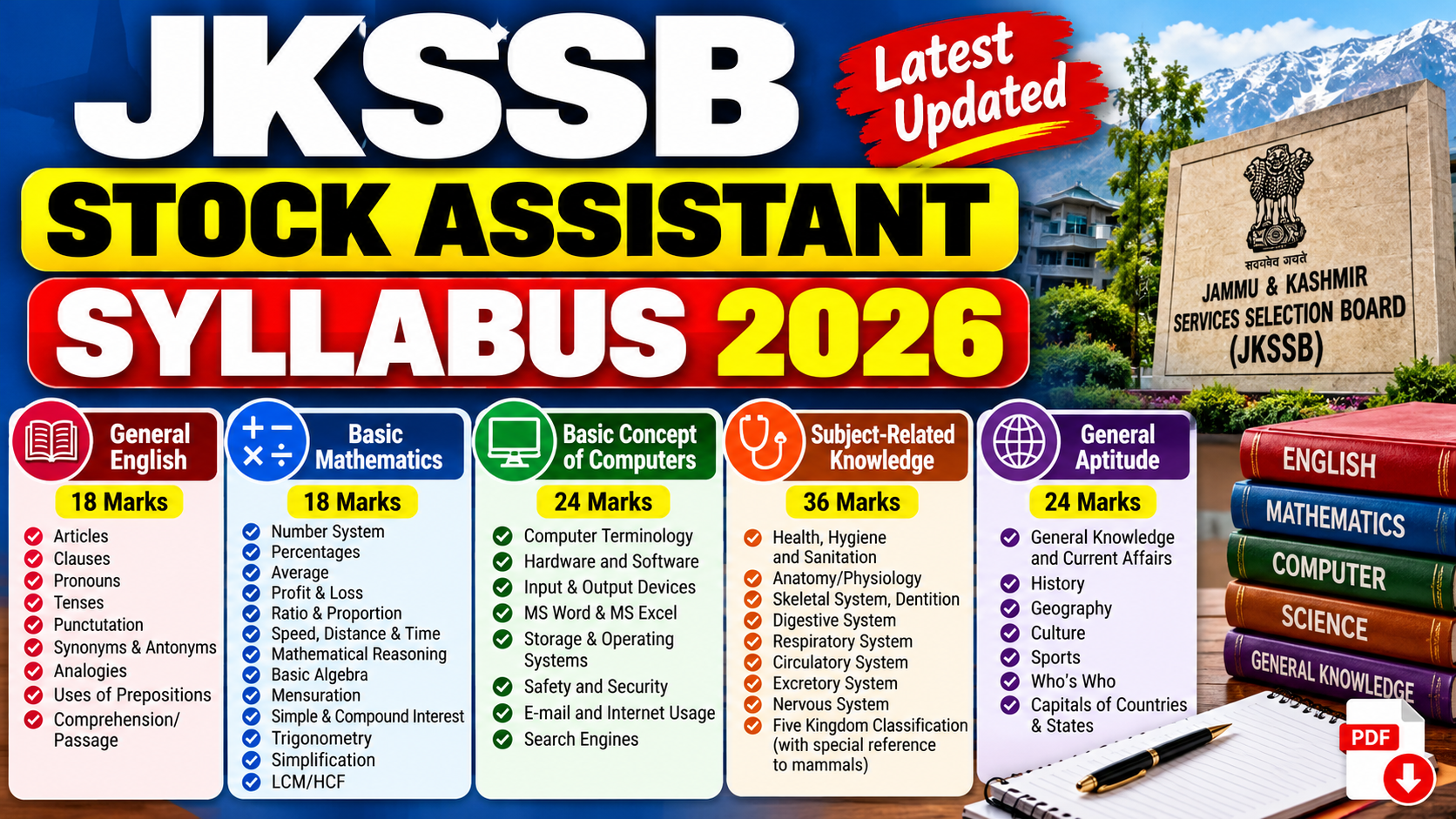
According to the syllabus document shown in the official JKSSB PDF, the examination syllabus is divided into five major sections: General English, Basic Mathematics, Basic Concept of Computers, Subject-Related Knowledge, and General Aptitude. The subject-related section carries the highest weightage, with 36 marks, while General English and Basic Mathematics carry 18 marks each.
In this article, we have explained the JKSSB Stock Assistant Updated Syllabus 2026 in a simple, exam-oriented format, including the subject-wise marks distribution, complete listed topics, and preparation tips for aspirants.
Download stock assistant complete notes with full mocktests
JKSSB Stock Assistant Syllabus 2026:
Candidates should first understand the basic structure of the syllabus before moving on to individual subjects.
| Particulars | Details |
|---|---|
| Recruiting body | Jammu and Kashmir Services Selection Board (JKSSB) |
| Post | Stock Assistant |
| Syllabus year | 2026 reference |
| Number of subject sections | 5 |
| General English | 18 marks |
| Basic Mathematics | 18 marks |
| Basic Concept of Computers | 24 marks |
| Subject-Related Knowledge | 36 marks |
| General Aptitude | 24 marks |
| Total marks represented by these sections | 120 marks |
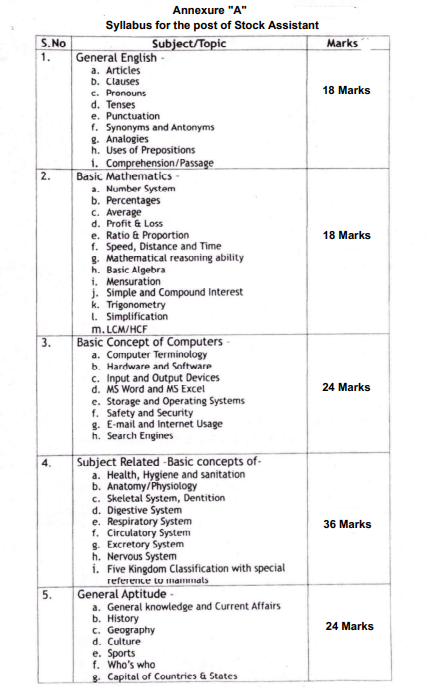 Important: The marks above are extracted from the uploaded syllabus page. Candidates should check the complete official notification for the applicable examination scheme, question count, duration, negative marking, and any subsequent amendments.
JKSSB Stock Assistant Syllabus 2026: Subject-Wise Marks Distribution
The syllabus shown in the document allocates different marks to five sections. Understanding this distribution can help candidates decide how to divide their preparation time.
| Subject | Marks | Priority |
|---|---|---|
| General English | 18 | Important |
| Basic Mathematics | 18 | Important |
| Basic Concept of Computers | 24 | High |
| Subject-Related Knowledge | 36 | Highest |
| General Aptitude | 24 | High |
| Total | 120 |
The Subject-Related Knowledge section accounts for 36 marks, making it the largest individual section. However, candidates should not ignore the other subjects because together they account for 84 marks.
1. General English – 18 Marks
General English is an important section for candidates who want to improve their overall score. The syllabus includes grammar, vocabulary, sentence-related concepts, and comprehension.
The following topics are listed in the syllabus:
Articles
Clauses
Pronouns
Tenses
Punctuation
Synonyms and Antonyms
Analogies
Uses of Prepositions
Comprehension/Passage
How to prepare General English
Start with articles, pronouns, tenses, and prepositions. These topics help develop a strong understanding of basic English grammar. After completing the rules, practise objective questions based on each topic.
For vocabulary, prepare synonyms and antonyms regularly. Analogy questions require an understanding of the relationship between words, while punctuation questions test the correct use of punctuation marks.
Reading comprehension should also receive regular attention. Practise short passages and answer questions based on their main idea, supporting details, and meaning.
Preparation tip: Maintain a notebook of grammar rules, commonly confused words, and mistakes from practice questions. Revise these notes regularly rather than studying each topic only once.
2. Basic Mathematics – 18 Marks
Basic Mathematics carries 18 marks and includes arithmetic, algebra, mensuration, mathematical reasoning, and other numerical concepts. Candidates should focus on understanding the methods used to solve questions accurately and efficiently.
The complete list of topics visible in the syllabus is:
Number System
Percentages
Average
Profit and Loss
Ratio and Proportion
Speed, Distance and Time
Mathematical Reasoning Ability
Basic Algebra
Mensuration
Simple and Compound Interest
Trigonometry
Simplification
LCM/HCF
How to prepare Basic Mathematics
Begin with simplification, the number system, percentages, averages, ratio and proportion, and profit and loss. These topics help build the foundation required for many arithmetic questions.
Next, practise speed, distance and time, simple and compound interest, and mensuration. Revise the formulas for algebra and trigonometry and solve questions of varying difficulty.
LCM and HCF questions become easier when you understand prime factorisation and divisibility. Mathematical reasoning requires you to identify patterns and apply logical steps instead of relying only on memorised formulas.
Preparation tip: Practise calculations daily and revise formulas regularly. After learning a concept, solve topic-wise MCQs to identify where you are making mistakes.
3. Basic Concept of Computers – 24 Marks
Basic Computer Knowledge carries 24 marks, making it one of the high-priority sections in the JKSSB Stock Assistant syllabus.
The syllabus lists the following topics:
Computer Terminology
Hardware and Software
Input and Output Devices
MS Word and MS Excel
Storage and Operating Systems
Safety and Security
E-mail and Internet Usage
Search Engines
How to prepare Computer Knowledge
Start with computer fundamentals and terminology. Understand the differences between hardware and software, the functions of input and output devices, and the basic components of a computer system.
Give particular attention to MS Word and MS Excel. Study their common features, basic operations, formatting options, and commonly used functions. Questions on these applications can test practical knowledge as well as terminology.
Storage and operating systems are also important. Learn about primary and secondary storage, common storage devices, operating system functions, files, and folders.
The safety and security topic should cover basic cybersecurity practices, passwords, malware, antivirus software, phishing, and safe internet use. For e-mail, understand attachments, CC, BCC, and the basic process of sending and receiving messages.
Finally, learn the purpose of search engines and distinguish them from web browsers.
Preparation tip: Prepare short notes containing definitions, differences, keyboard shortcuts, and important computer facts. Practise MCQs after completing each topic to improve recall.
4. Subject-Related Knowledge – 36 Marks
Subject-Related Knowledge is the highest-weightage section in the syllabus, carrying 36 marks. Candidates should give this section serious attention and study every listed topic systematically.
The syllabus specifies the following basic concepts:
Health, Hygiene and Sanitation
Anatomy/Physiology
Skeletal System, Dentition
Digestive System
Respiratory System
Circulatory System
Excretory System
Nervous System
Five Kingdom Classification with special reference to mammals
Health, Hygiene and Sanitation
Study the meaning and importance of personal hygiene, community hygiene, sanitation, cleanliness, safe drinking water, and disease prevention. Understand basic measures that help maintain a healthy environment.
Anatomy and Physiology
Learn the difference between anatomy and physiology. Anatomy deals with the structure of the body, whereas physiology deals with how the body and its organs function.
Skeletal System and Dentition
Prepare the major functions of the skeletal system, types of bones, major parts of the human skeleton, and the basic structure of teeth. Understand temporary and permanent dentition and the functions of different types of teeth.
Digestive System
Study the major organs of the digestive system and their functions. Understand the processes of digestion, absorption, and the role of digestive enzymes at a basic level.
Respiratory System
Focus on the organs involved in breathing, the pathway of air, the functions of the lungs, and the basic process of gaseous exchange.
Circulatory System
Learn the structure and functions of the heart, blood vessels, and blood. Understand the basic differences between arteries, veins, and capillaries, along with the circulation of blood through the body.
Excretory System
Study the major organs of the excretory system, especially the kidneys, ureters, urinary bladder, and urethra. Understand the basic process of urine formation and the role of the kidneys in maintaining the body's internal balance.
Nervous System
Prepare the main divisions of the nervous system, including the central and peripheral nervous systems. Learn the functions of the brain, spinal cord, and nerves, along with the basic role of neurons.
Five Kingdom Classification with Special Reference to Mammals
Study the five-kingdom classification of living organisms and the distinguishing characteristics of each kingdom. Pay particular attention to mammals, their identifying features, reproduction, body temperature regulation, and the characteristics that distinguish them from other vertebrates.
Preparation tip: Since this section carries 36 marks, prepare topic-wise notes, revise biological terminology, and practise factual as well as concept-based MCQs. Do not limit your preparation to memorising definitions; understanding the functions of body systems will help you answer conceptual questions.
5. General Aptitude – 24 Marks
General Aptitude carries 24 marks. The topics listed in the uploaded syllabus are:
General Knowledge and Current Affairs
History
Geography
Culture
Sports
Who's Who
Capitals of Countries and States
General Knowledge and Current Affairs
Prepare important national and international developments relevant to competitive examinations. Focus on major government initiatives, important appointments, awards, important events, and other significant developments.
History
Revise important historical periods, major events, movements, personalities, and developments in Indian history. Give attention to commonly tested factual information.
Geography
Study India's physical geography, rivers, mountains, climate, soils, agriculture, and other major geographical features. Basic world geography and important locations may also support your preparation.
Culture
Prepare important aspects of Indian culture, including festivals, traditions, art forms, heritage sites, and cultural personalities.
Sports
Study important tournaments, sporting achievements, trophies, major events, and notable sportspersons. Give special attention to relevant recent sports current affairs.
Who's Who
Prepare important personalities and their respective positions or fields of work. Verify current appointments from reliable and up-to-date sources because these details can change.
Capitals of Countries and States
Revise the capitals of Indian states and union territories, along with important countries and their capitals. Use regular revision and MCQs to improve recall.
Preparation tip: Divide General Aptitude into static GK and current affairs. Revise static topics regularly and update current affairs using reliable sources. For JKSSB aspirants, it is also sensible to review relevant Jammu and Kashmir general knowledge, while keeping in mind that the specific list shown on this syllabus page does not separately name a J&K GK topic.
How to Prepare for the JKSSB Stock Assistant Examination 2026
A practical preparation plan should cover all five sections instead of concentrating entirely on one subject.
Step 1: Understand the complete syllabus. Mark each topic as not started, in progress, or completed. This helps you track your preparation.
Step 2: Prioritise high-weightage subjects. Give substantial attention to Subject-Related Knowledge because it carries 36 marks. Also allocate sufficient time to Computer Knowledge and General Aptitude, which carry 24 marks each.
Step 3: Practise topic-wise MCQs. Solve questions immediately after completing a topic. Review incorrect answers and revisit the concepts you have misunderstood.
Step 4: Revise regularly. Keep short notes for English grammar, mathematics formulas, computer terminology, biological concepts, and static GK.
Step 5: Take timed practice tests. Once you have covered the fundamentals, use practice tests to assess accuracy, speed, and topic-wise performance. Follow the actual examination pattern specified in the official notification.
Where to Find JKSSB Stock Assistant Study Material
Candidates can organise their preparation with subject-wise notes, MCQs, revision material, and mock tests. JK Exam Library can be used to explore relevant competitive-exam preparation resources and practise objective questions.
Before relying on any test series, check whether its content matches the Stock Assistant syllabus and the applicable official examination scheme. Practising questions from unrelated subjects without a clear purpose can waste valuable preparation time.
ALSO READ:JKSSB Class IV MTS Free Mock Tests 2026 – Practice 50 Tests Online
Final Words
The JKSSB Stock Assistant Updated Syllabus 2026 shown in the uploaded document contains five sections totalling 120 marks: General English (18), Basic Mathematics (18), Basic Concept of Computers (24), Subject-Related Knowledge (36), and General Aptitude (24).
Candidates should prepare every listed topic, give appropriate priority to the 36-mark subject-related section, and practise MCQs regularly. A combination of concept building, revision, and timed practice can help improve performance.
Important notice: Always refer to the applicable official JKSSB notification and any subsequent corrigendum for confirmation of the final syllabus and examination rules before making your preparation plan.