J&K Bank Banking Associate Syllabus
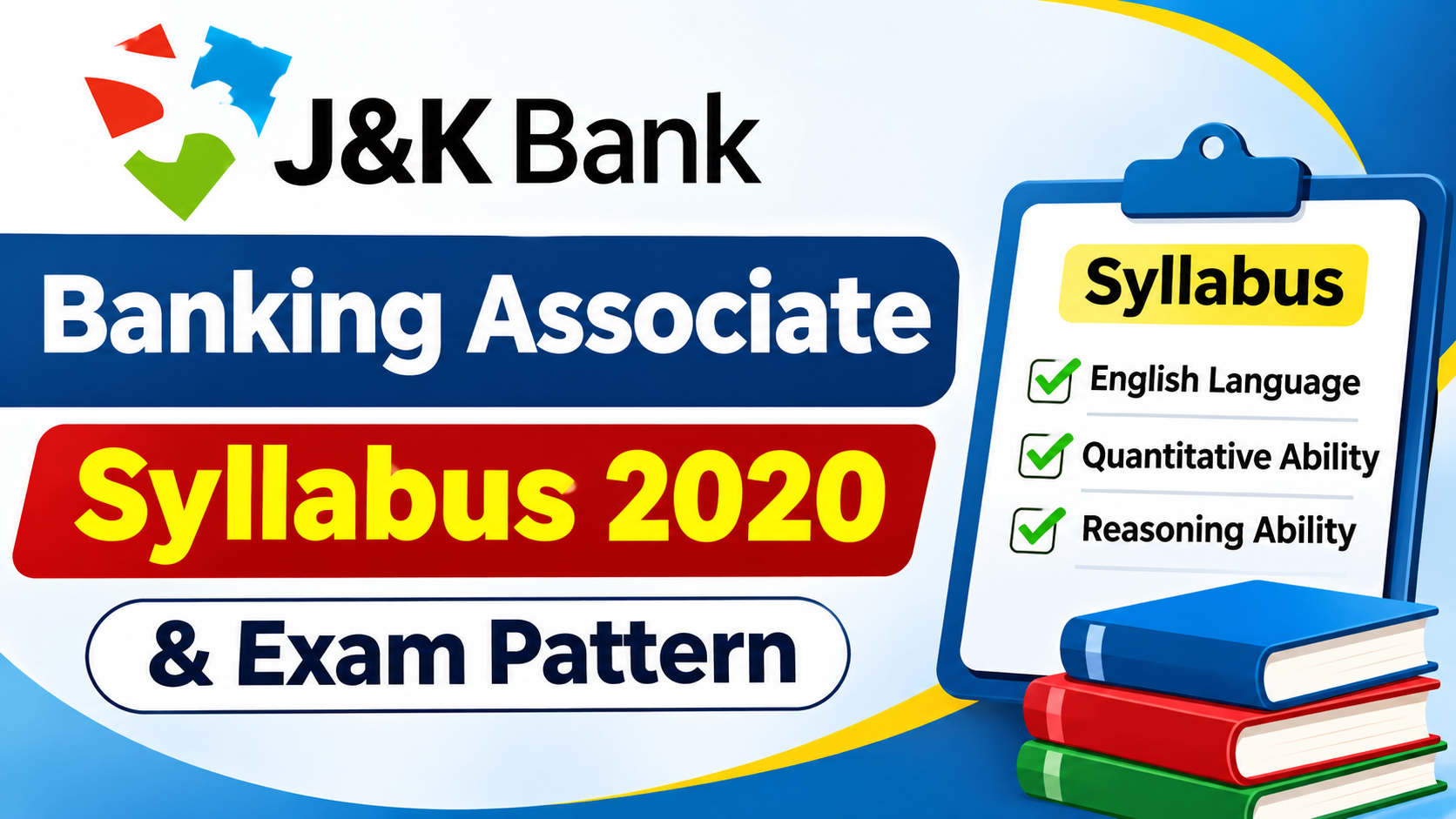
The selection process for the J&K Bank Banking Associate recruitment consists of a single online examination. The examination carries 100 marks and is divided into three sections. Candidates must secure the prescribed sectional cut-off marks in each section to qualify for inclusion in the merit list.
A thorough understanding of the syllabus is essential before beginning preparation. The complete section-wise syllabus, along with the expected number of questions from each topic, is given below.
Download JK Bank Syllabus banking associate
1. English Language Syllabus
The English Language section covers reading comprehension, grammar, vocabulary and verbal ability. The topic-wise expected weightage is provided below.
Topics | Expected Weightage |
|---|---|
Reading Comprehension | 5–10 Questions |
Grammar | 4–5 Questions |
One Word Substitution | 0–5 Questions |
Vocabulary | 10–15 Questions |
Synonyms and Antonyms | 0–3 Questions |
Spellings | 0–5 Questions |
Verbal Ability | 5–10 Questions |
1.1 Reading Comprehension
Weightage: 5–10 Questions
Question Types: Passages are generally based on subjects such as Banking and Economy, Business, Social Issues and other related topics. Questions may test both factual understanding and the ability to draw inferences from the given passage.
1.2 Grammar
Weightage: 4–5 Questions
Question Types:
Phrase Replacement
Error Spotting
Fill in the Blanks
1.3 One Word Substitution
- Weightage: 0–5 Questions
Questions are based on replacing a phrase or group of words with a single appropriate word.
1.4 Vocabulary
Weightage: 10–15 Questions
Question Types:
Fill in the Blanks
Phrase Replacement
Error Spotting
Meanings of Phrases and Idioms
Cloze Test
1.5 Synonyms and Antonyms
- Weightage: 0–3 Questions
Questions test knowledge of words having similar meanings (Synonyms) and opposite meanings (Antonyms).
1.6 Spellings
- Weightage: 0–5 Questions
Questions are designed to test correct word spellings and the identification of incorrectly spelt words.
1.7 Verbal Ability
Weightage: 5–10 Questions
Question Types:
Para Jumbles
Phrase Connector
Odd Man Out
Sentence Completion
Sentence Jumbles
2. Quantitative Ability Syllabus
The Quantitative Ability section evaluates numerical aptitude, calculation skills and the ability to solve mathematical problems. The expected topic-wise distribution is given below.
Topics | Expected Weightage |
|---|---|
Simplification | 10 Questions |
Average | 1 Question |
Percentage | 1 Question |
Ratio and Proportion | 1 Question |
Mixture Problems | 0–1 Question |
Algebra | 1–5 Questions |
Profit and Loss | 1–3 Questions |
Interest | 1–2 Questions |
Speed, Time and Distance | 2–3 Questions |
Time and Work | 1–2 Questions |
Mensuration | 0–1 Question |
Probability | 1 Question |
Data Interpretation | 5–10 Questions |
2.1 Simplification
Weightage: 10 Questions
Question Types:
BODMAS Rule
Approximation
Decimals
Fractions
Surds and Indices
Percentages
2.2 Average
Weightage: 1 Question
Question Types:
Questions may be based on the average of weight, height, age and marks. Other commonly covered areas include average money expenditure and average temperature.
The basic concept remains straightforward and is generally solved using the following formula:
Average = Sum of Quantities / Number of Quantities
2.3 Percentage
Weightage: 1 Question
Question Types: Basic percentage problems that mainly test calculation skills and the application of percentage concepts.
2.4 Ratio and Proportion
Weightage: 1 Question
Question Types:
Simple Ratios
Compound Ratios
Componendo and Dividendo
Direct Proportion
Indirect Proportion
2.5 Mixture Problems
Weightage: 0–1 Question
Question Types: Problems involving mixtures of two or more substances or different mixtures. Questions may also cover dishonest dealings.
2.6 Algebra
Weightage: 1–5 Questions
Question Types:
Linear Equations with One Variable
Linear Equations with Two Variables
Quadratic Equations
2.7 Profit and Loss
Weightage: 1–3 Questions
Question Types:
Successive Selling-Based Problems
Partnership
Discount and Marked Price (MP)
Dishonest Dealings
2.8 Interest
Weightage: 1–2 Questions
Question Types:
Simple Interest
Compound Interest
Installments
2.9 Speed, Time and Distance
Weightage: 2–3 Questions
Question Types:
Partial Speed
Relative Speed
Average Speed
Problems on Trains
Boats and Streams
2.10 Time and Work
Weightage: 1–2 Questions
Question Types:
Work Efficiency
Work and Wages
Pipes and Cisterns
2.11 Mensuration
Weightage: 0–1 Question
Question Types: Problems may be asked from geometrical figures such as:
Circle
Square
Rectangle
2.12 Probability
- Weightage: 1 Question
Questions are based on the fundamental concepts and applications of probability.
2.13 Data Interpretation
Weightage: 5–10 Questions
Question Types:
Line Graphs
Bar Graphs
Pie Charts
Tables
Miscellaneous Infographics
Missing Data-Type Caselets
3. Reasoning Ability Syllabus
The Reasoning Ability section tests logical thinking, analytical skills and problem-solving abilities. It includes arrangements, puzzles, coding-decoding, inequalities, syllogisms and other reasoning topics.
The expected weightage of each topic is listed below.
Topics | Expected Weightage |
|---|---|
Arrangement and Pattern | 5–8 Questions |
Series | 0–1 Question |
Coding-Decoding | 2–5 Questions |
Direction and Distances | 1–3 Questions |
Blood Relations | 2–3 Questions |
Analytical Decision Making | 0–3 Questions |
Mathematical Inequalities | 3–5 Questions |
Coded Inequalities | 0–3 Questions |
Syllogism | 2–3 Questions |
Input-Output | 0–4 Questions |
Order and Ranking | 1–3 Questions |
Seating Arrangement | 5–10 Questions |
Floor Puzzle | 5 Questions |
Double Lineup | 5 Questions |
Scheduling | 3–5 Questions |
Data Sufficiency | 0–2 Questions |
Verbal Reasoning | 0–1 Question |
3.1 Arrangement and Pattern
Weightage: 5–8 Questions
Question Types:
General Series of Alphabets
Random Sequence of Alphabets
Number Arrangement
Mixed Series
Dictionary-Based Questions
Alphabet-Based Questions
3.2 Series
Weightage: 0–1 Question
Question Types:
Number Series
Alphabet Series
Mixed Series
Complete the Series
Missing Term
Wrong Term
3.3 Coding-Decoding
Weightage: 2–5 Questions
Question Types:
Coding Through Letter Shifting
Coding in a Fictitious Language
3.4 Direction and Distances
- Weightage: 1–3 Questions
Questions may involve arranging individuals according to different parameters, including age, height, weight and rank. Problems related to determining positions and order in a row may also be included.
3.5 Blood Relations
Weightage: 2–3 Questions
Question Types:
Questions may involve family relationships across three generations. Puzzle-based problems containing one or two variables can also be expected.
3.6 Analytical Decision Making
Weightage: 0–3 Questions
Question Types:
Analytical Decision Making
Statement and Conclusion
Statement and Assumption
Statement and Inference
Cause and Effect
Course of Action
Critical Reasoning
3.7 Mathematical Inequalities
Weightage: 3–5 Questions
Question Types:
Direct questions containing two or three statements and two or three conclusions may be asked. Equation-insertion-type questions are also included in this topic.
3.8 Coded Inequalities
Weightage: 0–3 Questions
Question Types:
Questions involve coded relationships between different letters or symbols. Candidates must decode the given relationships and solve the resulting inequalities.
3.9 Syllogism
Weightage: 2–3 Questions
Question Types:
Direct Questions Based on 2–3 Statements and 2–3 Conclusions
Possibility-Based Questions
Negative Information-Based Questions
3.10 Input-Output
Weightage: 0–4 Questions
Question Types:
Number-Based Input-Output
Alphabet-Based Input-Output
Mixed Input-Output
Operation-Based Questions
3.11 Order and Ranking
Weightage: 1–3 Questions
Question Types:
Floor-Based Puzzles
Arrangements Based on Age
Arrangements Based on Height
Arrangements Based on Weight
Ranking-Based Problems
Order and Position in a Row
3.12 Seating Arrangement
Weightage: 5–10 Questions
Question Types:
Questions may be based on unidirectional and bidirectional arrangements, including seating around circular, square, rectangular and hexagonal tables.
Other possible formats include:
Single-row seating arrangements.
Double-row seating arrangements.
Individuals facing each other.
Individuals facing away from each other.
Individuals sitting in the same direction.
Seating arrangement problems may also be combined with additional information to create more complex questions based on Blood Relations or Double Lineup.
3.13 Floor Puzzle
Weightage: 5 Questions
Question Types:
Questions involve individuals living on different floors of a building. Additional variables may be introduced to increase the complexity of the puzzle.
3.14 Double Lineup
Weightage: 5 Questions
Question Types:
Questions generally follow a format involving one person and two or three additional variables. Candidates are required to arrange the given information correctly.
3.15 Scheduling
Weightage: 3–5 Questions
Question Types:
Age-Based Scheduling
Day-Based Scheduling
Year-Based Scheduling
Month-Based Scheduling
Scheduling questions may involve a maximum of one or two variables.
3.16 Data Sufficiency
Weightage: 0–2 Questions
Question Types:
Ordering and Ranking
Blood Relations
Coding in a Fictitious Language
Circular Arrangements
Directions and Distances
Ages and Birth Dates
3.17 Verbal Reasoning
Weightage: 0–1 Question
Question Types:
Statements and Conclusions
Statements and Inferences
Statements and Assumptions
Assertion and Reason
Cause and Effect
Critical Reasoning
4. J&K Bank Banking Associate 2020 Exam Pattern
After covering the complete syllabus of the J&K Bank Banking Associate examination, candidates should also understand its examination pattern.
Knowledge of the exam pattern helps candidates understand the distribution of marks, the number of questions, sectional time limits and the marking scheme. It also provides a clear idea of how the examination is structured.
The J&K Bank Banking Associate 2020 online examination follows the pattern given below.
4.1 Important Features of the Examination
The examination is conducted in online mode.
The question paper is objective-type.
The examination carries a total of 100 marks.
Every correct answer carries 1 mark.
A negative marking of 0.25 marks is applicable for every incorrect answer.
Candidates must qualify the prescribed cut-off in each individual section to clear the examination.
4.2 Section-Wise Exam Pattern
Sections | Number of Questions | Marks | Duration |
|---|---|---|---|
English Language | 30 | 30 | 20 Minutes |
Quantitative Ability | 35 | 35 | 20 Minutes |
Reasoning Ability | 35 | 35 | 20 Minutes |
Total | 100 | 100 | 1 Hour |
4.3 Examination Summary
The J&K Bank Banking Associate 2020 examination consists of three sections, with a total of 100 questions carrying 100 marks. Each section has a separate time limit of 20 minutes, making the overall examination duration 60 minutes (1 hour).
Candidates should prepare all three sections thoroughly, keeping in mind the sectional cut-off requirement and the negative marking of 0.25 marks for each wrong answer.