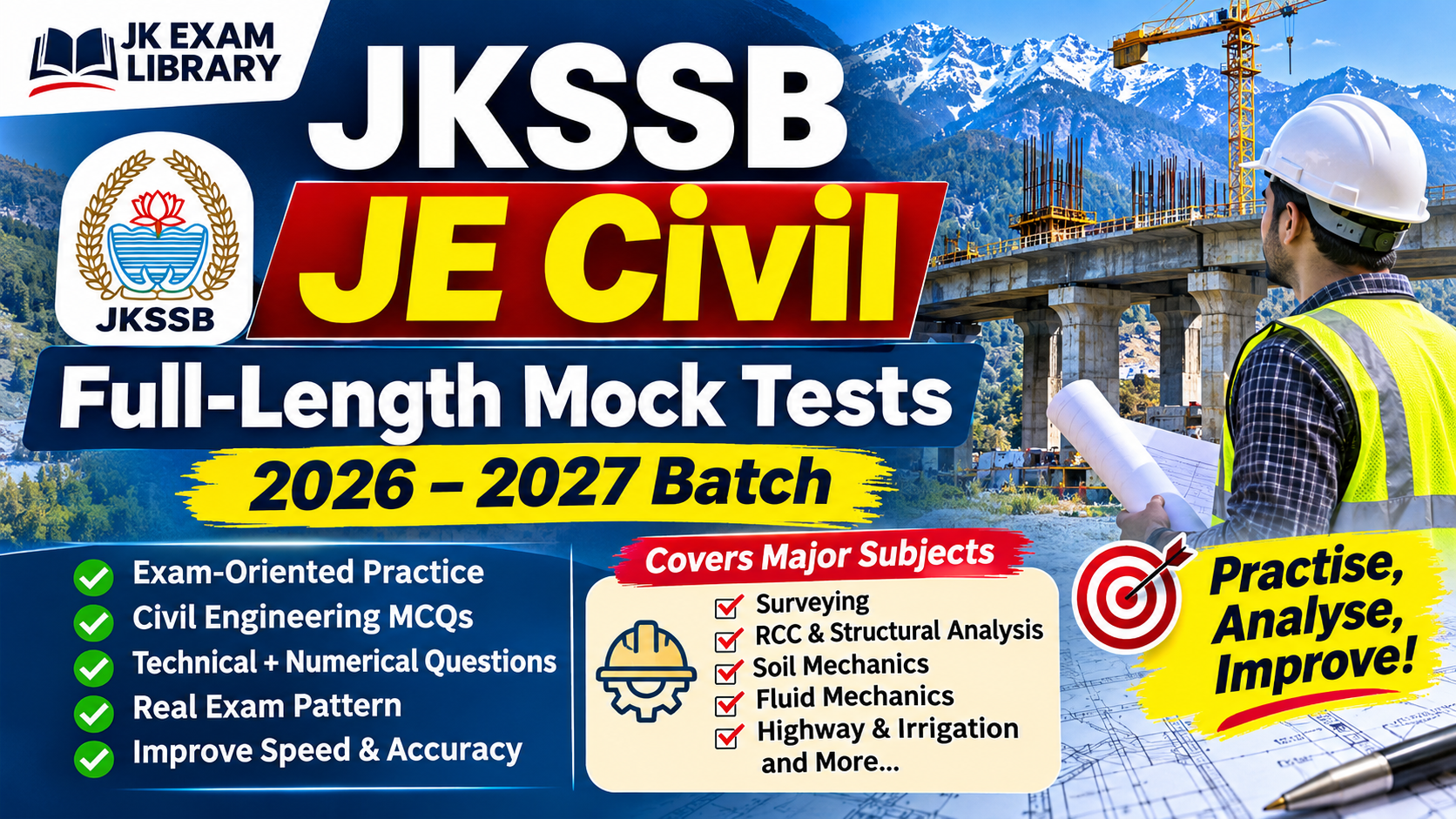
JKSSB JE Civil Full-Length Mock Tests 2026–2027 – Start Practising for Your Next Exam
Preparing for the JKSSB Junior Engineer (Civil) examination requires more than simply reading textbooks, memorising formulas and completing the syllabus. Civil Engineering is a technical subject where your understanding of concepts, numerical accuracy, problem-solving ability and time management all matter.
Whether you are a Diploma holder or a Civil Engineering graduate, regular practice can make a significant difference to your examination performance.
Keeping the preparation needs of aspiring candidates in mind, JK Exam Library brings you an exam-oriented practice platform for JKSSB JE Civil aspirants preparing for the 2026–2027 recruitment cycle. Candidates can use full-length mock tests, technical MCQs and subject-wise practice to strengthen their preparation and identify areas that need improvement.
If you are preparing for the upcoming JKSSB Junior Engineer Civil recruitment, this is the right time to make regular online practice a part of your study routine.
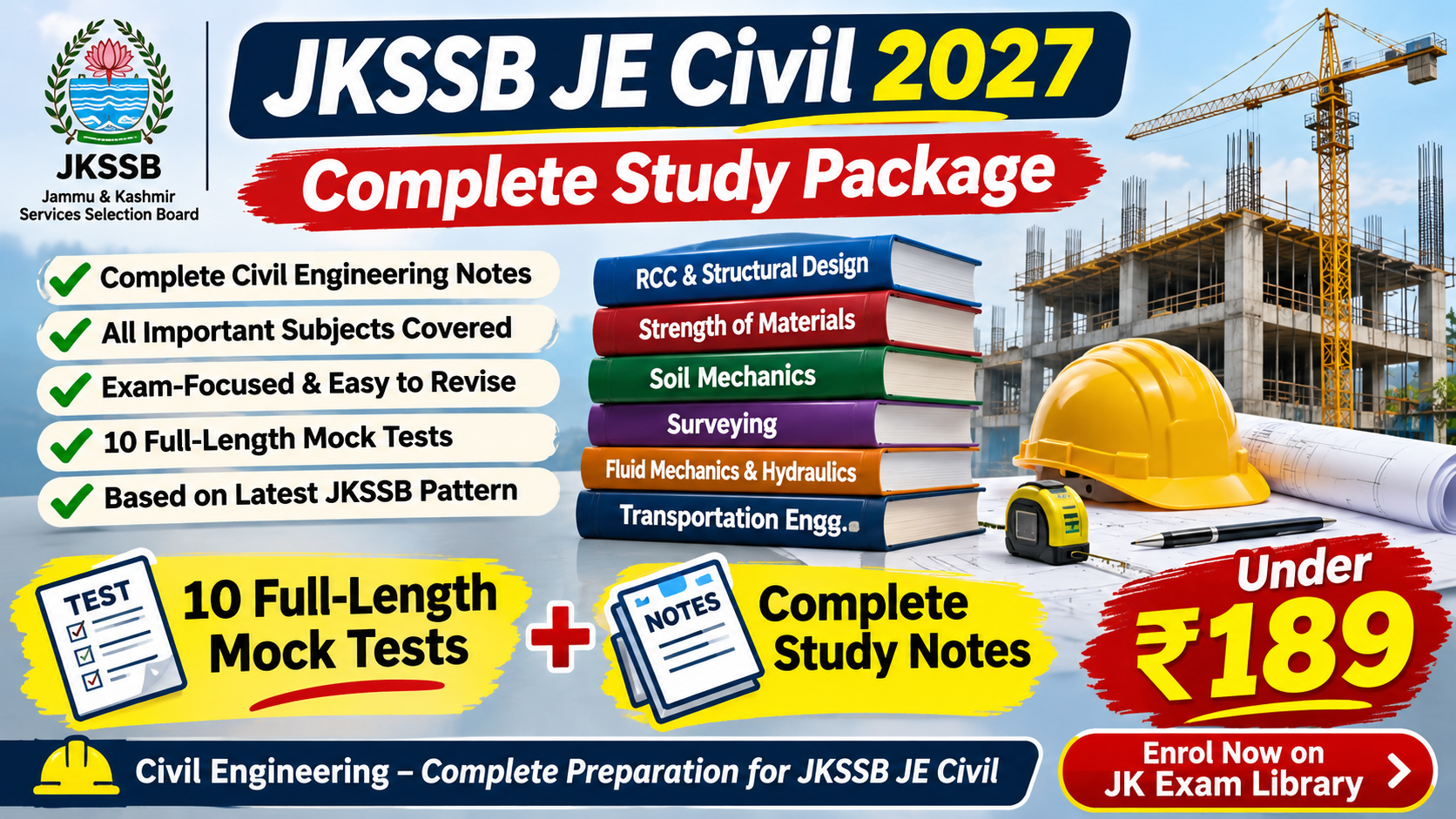
Download Complete Study material JKSSB JE Civil with Full length mocktests
JKSSB JE Civil Recruitment 2026–2027: Why Should You Start Preparing Now?
The Jammu and Kashmir Services Selection Board (JKSSB) conducts recruitment examinations for various government departments in Jammu and Kashmir.
The Junior Engineer (Civil) recruitment is an important opportunity for candidates aspiring to work in technical government positions, particularly in departments associated with public works, infrastructure development and water supply.
JKSSB Advertisement Notification No. 11 of 2026, dated 27 October 2026, includes 458 Junior Engineer (Civil) vacancies in the Public Works (R&B) and Jal Shakti departments.
With recruitment activity underway, candidates should avoid waiting until the examination date is announced to begin serious preparation.
Starting early gives you enough time to revise technical subjects, practise numerical questions, attempt full-length tests and improve your overall examination strategy.
JKSSB JE Civil Full-Length Mock Tests – Practise Before the Actual Examination
Reading theory is important, but solving questions regularly is what helps you understand how well you can apply that knowledge.
A full-length mock test gives you an opportunity to experience a structured examination environment. Instead of studying individual topics separately, you attempt questions from different Civil Engineering subjects within a single practice session.
The JKSSB JE Civil mock test practice available through JK Exam Library is intended to help candidates develop:
Better understanding of Civil Engineering concepts.
Improved speed and accuracy while solving technical MCQs.
Confidence in attempting objective-type questions.
Stronger numerical and analytical problem-solving skills.
Better time management during examinations.
Awareness of strong and weak subject areas.
Consistent preparation through regular testing.
The objective is not simply to complete more questions. It is to understand why an answer is correct, learn from mistakes and gradually improve your performance.
Important Civil Engineering Subjects to Cover for JKSSB JE
Candidates should give proper attention to the technical subjects prescribed in the applicable JKSSB syllabus. Civil Engineering preparation requires a balanced approach because questions can test both fundamental concepts and their practical applications.
The following subjects are important areas for structured preparation:
1. Surveying
Surveying is one of the fundamental subjects of Civil Engineering. Candidates should practise questions related to:
Chain and compass surveying.
Levelling and contouring.
Theodolite surveying.
Plane table surveying.
Tacheometry.
Errors and corrections.
Area and volume calculations.
2. Strength of Materials and Structural Analysis
This subject requires conceptual clarity and regular numerical practice.
Important topics include:
Stress and strain.
Hooke's law.
Elastic constants.
Shear force and bending moment.
Bending and shear stress.
Columns and struts.
Deflection of beams.
Structural analysis fundamentals.
3. Reinforced Cement Concrete (RCC)
RCC is an important technical area for Junior Engineer Civil preparation.
Focus on:
Working stress and limit state methods.
Singly and doubly reinforced beams.
Shear and bond.
Slabs and columns.
Footings and foundations.
Development length.
Reinforcement detailing.
4. Soil Mechanics and Foundation Engineering
A strong understanding of soil properties and foundation behaviour is essential.
Practise questions on:
Soil classification.
Index properties of soil.
Permeability.
Compaction.
Consolidation.
Shear strength.
Earth pressure.
Bearing capacity.
Shallow and deep foundations.
5. Fluid Mechanics and Hydraulics
This subject combines theoretical knowledge with numerical problem-solving.
Important areas include:
Properties of fluids.
Pressure and pressure measurement.
Fluid statics.
Bernoulli's theorem.
Flow through pipes.
Reynolds number.
Open channel flow.
Hydraulic machines.
6. Irrigation Engineering
Candidates should develop a clear understanding of irrigation systems and water resource management.
Important topics include:
Types of irrigation.
Irrigation requirements.
Duty, delta and base period.
Canal irrigation.
Waterlogging.
Dams and reservoirs.
Canal structures.
Cross-drainage works.
7. Water Supply and Wastewater Engineering
This subject is relevant to the technical work associated with water supply and sanitation infrastructure.
Practise:
Sources of water.
Water demand and consumption.
Water treatment processes.
Sedimentation and filtration.
Disinfection.
Sewerage systems.
Sewage characteristics.
Wastewater treatment.
Building drainage.
8. Highway Engineering
Highway Engineering is another important area for technical MCQ preparation.
Cover:
Highway planning.
Road classification.
Geometric design.
Camber and superelevation.
Sight distance.
Road construction materials.
Flexible and rigid pavements.
CBR tests.
Traffic engineering.
9. Railway Engineering and Bridge Engineering
Candidates should also revise the fundamentals of transportation infrastructure.
Important topics include:
Railway gauges.
Permanent way.
Rails and sleepers.
Railway points and crossings.
Track maintenance.
Bridge components.
Types of bridges.
Bridge foundations.
10. Construction Planning and Management
This subject combines technical and management-oriented concepts.
Important topics include:
Estimation and costing.
Rate analysis.
PERT and CPM.
Critical path method.
Construction contracts.
Tendering.
Valuation.
Depreciation.
Quality control.
Construction planning.
Important: The topics above provide a broad Civil Engineering preparation framework. Candidates must follow the syllabus and examination scheme applicable to their particular recruitment notification. Do not assume that an earlier recruitment's syllabus or marks distribution automatically applies to a new notification.
Why Are Full-Length Mock Tests Important for JKSSB JE Civil?
Many candidates complete their technical syllabus but struggle when they have to solve a large number of questions under examination conditions.
This usually happens because studying a subject and attempting an examination are two different skills.
Full-length mock tests help bridge this gap.
1. Improve Question-Solving Speed
Regular practice helps you recognise familiar concepts and apply the appropriate formulas without wasting unnecessary time.
2. Identify Weak Technical Subjects
You might be comfortable with Surveying but struggle with RCC or Fluid Mechanics. Mock tests help identify these weaknesses so that you can work on them before the actual examination.
3. Strengthen Conceptual Understanding
Good technical MCQs test more than definitions. They can include numerical calculations, conceptual applications, statements, theoretical comparisons and practical engineering principles.
4. Develop Examination Confidence
Attempting complete practice papers regularly makes the examination format more familiar and reduces uncertainty.
5. Reduce Negative Marking Mistakes
Where negative marking applies, accuracy becomes particularly important. Practising objective questions helps you develop a more disciplined approach to answering and avoiding unnecessary guesses.
What Makes JK Exam Library Useful for JE Civil Aspirants?
Preparing for a competitive technical examination becomes easier when you have access to organised study and practice resources.
JK Exam Library aims to provide an exam-focused learning experience for candidates preparing for JKSSB and other competitive examinations.
For JKSSB JE Civil preparation, candidates can use the platform to focus on:
Full-length mock test practice.
Civil Engineering technical MCQs.
Subject-wise question practice.
Important engineering concepts.
Numerical and conceptual questions.
Revision through objective-type questions.
Consistent examination-oriented preparation.
The purpose is simple: help candidates move beyond passive reading and become more comfortable with solving technical questions.
How to Prepare for JKSSB JE Civil 2026–2027: A Practical Study Strategy
You do not need to study every subject for the same number of hours. What matters is following a consistent routine and giving sufficient attention to difficult subjects.
Here is a practical preparation strategy:
Step 1: Understand the Official Syllabus
Download the applicable JKSSB JE Civil syllabus and divide it into individual subjects and topics. Make sure your preparation is aligned with the latest notification.
Step 2: Complete Your Technical Fundamentals
Start with core Civil Engineering concepts. Understand the theory, important definitions, engineering principles and numerical formulas.
Step 3: Practise Subject-Wise MCQs
After completing each topic, solve relevant MCQs. Do not wait until the entire syllabus is completed to begin question practice.
Step 4: Attempt Full-Length Mock Tests
Once you have covered a reasonable portion of the syllabus, begin attempting complete mock tests. Gradually increase your practice frequency.
Step 5: Analyse Your Incorrect Answers
Do not simply check your final score and move forward. Identify why you selected the wrong option. Was it a conceptual mistake, calculation error, formula confusion or careless reading?
Step 6: Revise Important Formulas
Maintain a separate notebook for important Civil Engineering formulas, numerical methods, definitions and technical facts.
Step 7: Repeat and Improve
Revisit difficult topics and attempt additional practice questions. Consistency is more valuable than completing a large number of tests without analysing your mistakes.
ALSO READ:J&K Bank Banking Associate: Top 50 Puzzle & Seating Arrangement MCQs
Who Should Practise JKSSB JE Civil Mock Tests?
These practice resources are useful for:
Civil Engineering Diploma holders preparing for JKSSB JE.
B.Tech Civil Engineering graduates.
Candidates preparing for Junior Engineer recruitment in Jammu and Kashmir.
Aspirants targeting the 2026–2027 recruitment cycle.
Candidates revising Civil Engineering technical subjects.
Students preparing for other State JE and technical recruitment examinations.
Whether you are beginning your preparation or revising the complete syllabus, regular MCQ practice can help you build a stronger technical foundation.
Start Your JKSSB JE Civil Online Mock Test Practice Today
The competition for technical government posts demands serious preparation. Completing the syllabus is only one part of the process. You must also develop the ability to solve questions accurately and efficiently.
With JK Exam Library, you can make online practice an important part of your preparation for JKSSB Junior Engineer Civil 2026–2027.
Do not leave mock test practice for the final weeks. Start with the subjects you have already studied, improve your technical understanding and gradually build the confidence required for the actual examination.
Visit JK Exam Library and begin your JKSSB JE Civil full-length mock test practice today.
Website: https://jkexamlibrary.in/
Your preparation today can make a difference in your performance tomorrow. Study consistently, practise seriously and keep improving.
Frequently Asked Questions (FAQs)
1. Where can I practise JKSSB JE Civil full-length mock tests for 2026–2027?
You can visit JK Exam Library at our subdomain for examination-oriented study and practice resources for competitive examinations.
2. Who can attempt JKSSB JE Civil mock tests?
Civil Engineering Diploma holders, B.Tech graduates and other eligible candidates preparing for Junior Engineer examinations can use technical mock tests for practice.
3. Which subjects should I prepare for JKSSB JE Civil?
Important technical subjects include Surveying, Strength of Materials, Structural Analysis, RCC, Soil Mechanics, Fluid Mechanics, Irrigation Engineering, Water Supply and Wastewater Engineering, Highway Engineering, Railway Engineering and Construction Planning and Management. Always check the latest applicable syllabus.
4. Are full-length mock tests useful for JE Civil preparation?
Yes. They help improve time management, technical accuracy, question-solving speed and familiarity with objective-type examinations.
5. Should I practise numerical questions for JKSSB JE Civil?
Absolutely. Numerical questions are an important part of Civil Engineering preparation. Practise calculations related to Surveying, Soil Mechanics, Fluid Mechanics, RCC, Strength of Materials and other technical subjects.
6. Is the JKSSB JE Civil 2026–2027 examination date announced?
Candidates should check the latest examination notices on the official JKSSB website. The examination date should not be assumed until officially notified.
7. Can I use JKSSB JE Civil mock tests for other Junior Engineer examinations?
Yes. Many fundamental Civil Engineering topics overlap across State JE, SSC JE and other technical recruitment examinations. However, always follow the syllabus of your target examination.
Prepare Smart. Practise More. Aim Higher.
JK Exam Library – Your Preparation Partner for Competitive Examinations.