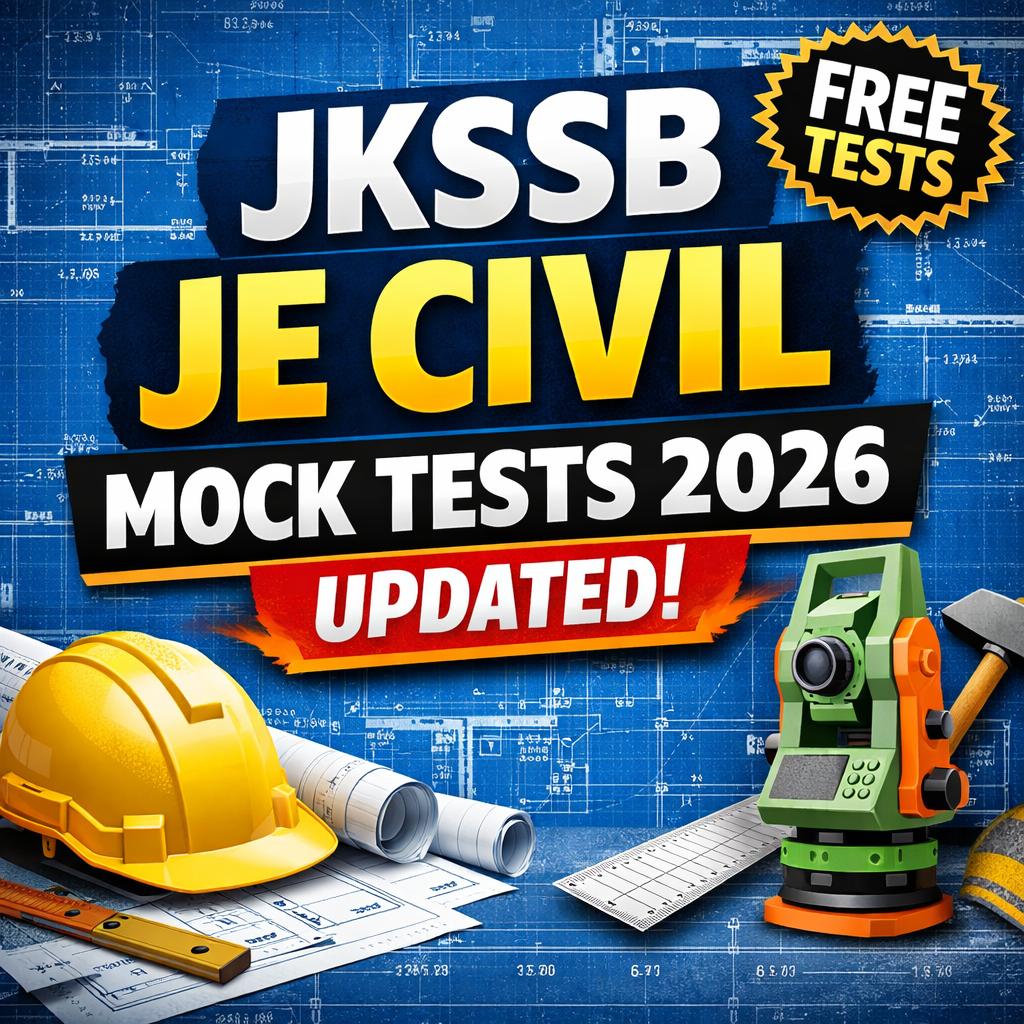
JKSSB JE Civil Mock Tests 2026 Guide
Preparing for the Junior Engineer post is challenging, but practicing with the right JKSSB JE Civil mock tests 2026 can give you a massive competitive edge. With thousands of candidates applying, relying on textbooks alone simply isn't enough.
You need a solid strategy to improve your speed, accuracy, and confidence. As per the latest official update, competition for the 2026 recruitment cycle is expected to be higher than ever.
In this comprehensive guide, we will break down the best strategies, exam patterns, and practice resources to help you secure a top rank.
Featured
What is the best way to prepare for the JKSSB JE Civil Exam 2026? The most effective preparation method is taking full-length JKSSB JE Civil mock tests 2026. These tests replicate the exact exam environment, help candidates manage their 120-minute time limit, and highlight weak areas in core subjects like Surveying, Fluid Mechanics, and Structural Engineering.
Essential Information for JKSSB JE Civil Aspirants
Before diving into mock tests, you must be clear on the basic recruitment requirements. As per the latest official update for 2026, here is what you need to know:
Eligibility Criteria: Candidates must hold a Diploma or Degree in Civil Engineering from a recognized institute.
Age Limit: The general age limit is 18 to 40 years, with category-based relaxations applicable as per government norms.
Application Process: Applications are submitted online exclusively through the official JKSSB portal.
Selection Process: The selection is strictly based on merit obtained in the OMR-based / CBT written examination.
Required Documents: Domicile certificate of J&K, educational mark sheets, valid ID proof, and category certificates (if applicable).
What is the JKSSB JE Civil Exam Pattern 2026?
Understanding the exam format is the first step toward effective preparation. You cannot plan your test strategy without knowing the weightage.
To align your studies, make sure to download complete syllabus PDF and map out your weak subjects. Below is the standardized exam pattern for the JE Civil written test:
| Subject / Section | Total Questions | Total Marks | Time Duration |
|---|---|---|---|
| General Engineering (Civil) | 120 | 120 | 120 Minutes |
Note: There is a negative marking of 0.25 marks for every incorrect answer.
Why are JKSSB JE Civil Mock Tests 2026 Important?
Taking mock tests is the closest you can get to the real exam day. They help you build the mental stamina required to sit and focus for two continuous hours.
When you practice previous year questions within a timed mock setting, you train your brain to recall formulas instantly. It directly eliminates exam anxiety.
Furthermore, analyzing your mock test results reveals your exact standing. It shows you whether you are losing marks in Soil Mechanics or making silly calculation errors in Highway Engineering.
Step-by-Step Preparation Strategy for JE Civil
A haphazard study plan will lead to burnout. Follow this step-by-step strategy to maximize your retention and output:
Master the Syllabus: Break down the Civil Engineering syllabus into smaller, manageable chunks. Focus on high-weightage topics first.
Clear Core Concepts: Do not just memorize. Understand the core principles of structural design, fluid dynamics, and surveying.
Regular Testing: Make it a habit to attempt free JKSSB mock test modules every weekend to track your progress accurately.
Analyze and Adapt: Spend at least an hour reviewing your mock test mistakes. Write down forgotten formulas in a separate notebook.
Common Mistakes to Avoid During Mock Tests
Many aspirants take mock tests but fail to see an improvement in their scores. This is often due to poor test-taking habits.
One major mistake is ignoring the negative marking. Guessing blindly will drastically lower your final score due to the 0.25 penalty per wrong answer.
Another error is skipping the analysis phase. If you just look at your score and close the test, you are wasting the most valuable part of the practice session.
How to Attempt JKSSB JE Civil Mock Tests Effectively?
Your approach to the paper dictates your success. Always read the questions carefully before jumping to the options.
Round 1: Go through the entire paper and solve the easiest, factual questions first. Secure these guaranteed marks within the first 45 minutes.
Round 2: Tackle the numerical problems and lengthy questions. If a question takes more than 90 seconds, skip it and come back later.
Top 5 Practice MCQs for JKSSB JE Civil 2026
Test your current knowledge with these high-probability questions.
Question 1: The standard size of a modular brick as per Indian Standards is: a) 19 cm x 9 cm x 9 cm b) 20 cm x 10 cm x 10 cm c) 22.5 cm x 10.5 cm x 8.5 cm d) 19 cm x 9 cm x 19 cm Answer: a Solution: The standard or modular size of a brick as per BIS is 19 cm x 9 cm x 9 cm. The nominal size, which includes the thickness of the mortar, is 20 cm x 10 cm x 10 cm.
Question 2: In fluid mechanics, the property of a fluid which offers resistance to the movement of one layer of fluid over an adjacent layer is called: a) Surface tension b) Capillarity c) Viscosity d) Compressibility Answer: c Solution: Viscosity is the internal friction of a fluid. It is the property that determines the fluid's resistance to shear forces and flow.
Question 3: The ratio of lateral strain to linear strain is known as: a) Modulus of Elasticity b) Poisson's Ratio c) Bulk Modulus d) Modulus of Rigidity Answer: b Solution: Poisson's ratio is defined as the ratio of transverse (lateral) strain to axial (linear) strain within the elastic limit of a material.
Question 4: Which type of cement is recommended in places where high early strength is required? a) Ordinary Portland Cement b) Low Heat Cement c) Rapid Hardening Cement d) Sulphate Resisting Cement Answer: c Solution: Rapid Hardening Cement develops strength rapidly due to a higher percentage of C3S (Tricalcium silicate) and finer grinding, making it ideal for fast-track construction.
Question 5: The process of determining the elevations of points on, above, or below the surface of the earth is called: a) Contouring b) Levelling c) Traversing d) Triangulation Answer: b Solution: Levelling is a branch of surveying focused on measuring the vertical distances and finding the elevations of given points relative to a given or assumed datum.
Quick Revision Summary
Format: 120 questions, 120 marks, 120 minutes.
Penalty: 0.25 marks deducted for every wrong attempt.
Focus Areas: Prioritize structural engineering, fluid mechanics, surveying, and building materials.
Strategy: Build concepts, take regular mock tests, and analyze performance deeply.
Frequently Asked Questions (FAQs)
1. Are JKSSB JE Civil mock tests 2026 available for free? Yes, many educational platforms and coaching websites offer at least one free diagnostic mock test for aspirants to gauge their preparation levels.
2. What is the total duration of the JKSSB JE Civil exam? The exam is strictly 120 minutes (2 hours) long, requiring excellent time management to attempt all 120 questions.
3. Is there negative marking in the JKSSB Junior Engineer Civil exam? Yes, a negative marking of 0.25 marks is applied for every incorrect answer, so guesswork should be minimized.
4. How many mock tests should I attempt before the final exam? Aspirants should aim to attempt at least 15 to 20 full-length mock tests before the actual exam to build optimal speed and accuracy.
5. Does the JKSSB JE syllabus change every year? No, the core technical syllabus for Civil Engineering generally remains the same. However, always refer to the official 2026 notification for any minor tweaks.
6. Can I clear the JKSSB JE Civil exam by only solving previous year papers? While previous papers are crucial, relying entirely on them is risky. You must combine them with modern mock tests and a strong conceptual foundation.
7. Which subjects carry the most weight in the JKSSB JE Civil exam? Core subjects like Surveying, Mechanics, Structural Analysis, and Building Materials historically hold significant weight in the paper.
Conclusion
Securing a government job as a Junior Engineer in 2026 requires dedication, smart work, and consistent practice. By actively utilizing JKSSB JE Civil mock tests 2026, you transition from passive studying to active performance. Remember to analyze your mistakes, refine your time management, and keep pushing forward. Start your practice journey today and take one step closer to your dream career!