
The JKSSB Social Forestry Worker exam consists of a 120-mark objective test that candidates must complete within 2 hours. The official syllabus is divided into four highly specific sections: Basic Mathematics (20 marks), Basic Reasoning (20 marks), Basic English (30 marks), and General Awareness with Science (50 marks). Candidates must aggressively prioritize the General Awareness section, as it holds the highest weightage and covers both national and J&K-specific topics.
Attempt Full full mocktests for jkssb social forestry worker post
The Complete JKSSB Social Forestry Worker Syllabus (2026)
Decoded Exam Pattern and Marking Scheme
Before diving into the individual topics, you must understand the overarching structure of the examination. The Jammu and Kashmir Services Selection Board has structured this test to evaluate foundational aptitude alongside regional awareness.
| Section Name | Total Marks | Time Allocation | Priority Level |
| Basic Mathematics | 20 Marks | Comprehensive 02 Hours | Moderate |
| Basic Reasoning | 20 Marks | Comprehensive 02 Hours | Moderate |
| Basic English | 30 Marks | Comprehensive 02 Hours | High |
| General Awareness & Science | 50 Marks | Comprehensive 02 Hours | Maximum |
| Total Assessment | 120 Marks | 120 Minutes | Crucial |
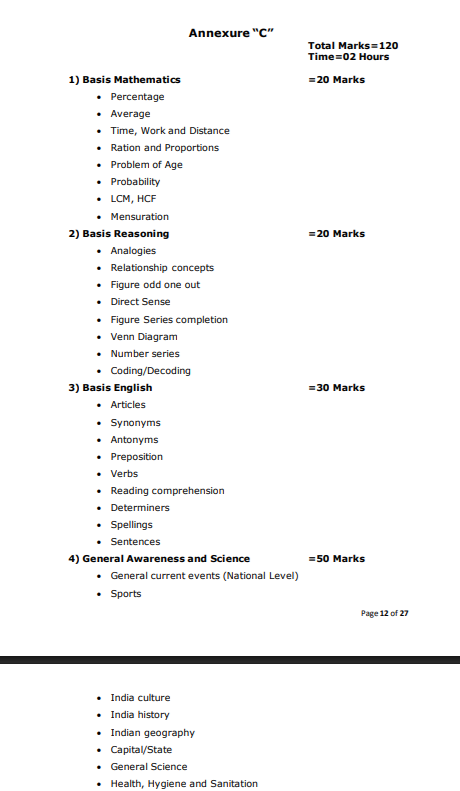 official syllabus download link
Deep Dive into Subject-Wise Syllabus Topics
Understanding the broad categories is not enough. You need to know exactly which concepts the examiners will target to maximize your scoring potential within the two-hour limit.
Basic Mathematics (20 Marks)
This section tests numerical agility and foundational problem-solving speed. The questions are generally matriculation-level but require quick calculation techniques.
Core Arithmetic: You must master Percentage, Average, and Ratio and Proportions. These three topics form the backbone of almost all data-driven questions.
Application-Based Math: Expect word problems focused on Time, Work and Distance, as well as the Problem of Age. Practice setting up equations rapidly.
Advanced Fundamentals: Ensure you are comfortable with Probability concepts, finding the LCM and HCF of complex numbers, and basic Mensuration formulas for 2D and 3D shapes.
Basic Reasoning (20 Marks)
Reasoning evaluates your logical processing and pattern recognition abilities. Speed and accuracy are the primary differentiators here.
Logical Deductions: Topics include Analogies, Relationship concepts (blood relations), and Direction Sense. Draw quick diagrams to solve these without confusion.
Visual and Pattern Reasoning: You will face questions on Figure odd one out, Figure Series completion, and Venn Diagrams. Visualizing overlapping data is crucial.
Sequence Decrypting: Number series and Coding/Decoding require you to identify the hidden mathematical or alphabetical rule connecting the elements.
Basic English (30 Marks)
With 30 marks on the line, English grammar and comprehension can make or break your final score. This section tests your command over the working language of the administration.
Grammar Mechanics: Focus heavily on Articles, Prepositions, Verbs, Determiners, and the structural integrity of Sentences.
Vocabulary Building: You will be tested directly on Synonyms, Antonyms, and correct Spellings. Regular reading is the best defense here.
Contextual Understanding: Reading comprehension passages will require you to extract information quickly. Skim the questions before reading the passage to save time.
General Awareness and Science (50 Marks)
This is the undeniable powerhouse of the examination. Scoring poorly here guarantees failure, regardless of how well you perform in math or reasoning.
National Landscape: Keep updated with General current events at the National Level, major Sports events, and the broad strokes of Indian culture, history, and geography. Knowing Capital/State pairings is mandatory.
Everyday Science: General Science questions focus on practical biology, physics, and chemistry. Special emphasis is placed on Health, Hygiene, and Sanitation, which aligns with the forestry worker profile.
J&K Specific Knowledge: A massive chunk of marks will come from the Geography of Jammu and Kashmir, the Culture of Jammu and Kashmir, and the History of Jammu and Kashmir. Do not ignore local current affairs.
Structural Framework of the Assessment
The exam features exclusively multiple-choice objective questions.
The total duration is strictly capped at 120 minutes.
The maximum achievable score is 120 marks.
The General Awareness section alone dictates nearly 42% of the total score.
Basic English carries significantly more weight than Mathematics or Reasoning.
The Science segment heavily emphasizes public health, sanitation, and hygiene.
J&K regional history and geography are tested independently of national history.
Mathematical questions are restricted strictly to the eight explicitly mentioned topics.
Visual reasoning forms a major part of the mental ability test.
Current affairs focus solely on national-level events, excluding international relations.
Tactical Alignment with JKSSB Testing Trends
Based on recent JKSSB patterns, the board has fundamentally shifted how they assess candidates. Gone are the days of simple, rote-learning trivia questions. The examiners now heavily favor application-based knowledge, particularly in the science and reasoning sections.
Commonly seen in competitive exams for state departments, the general awareness section is heavily biased toward local geography and culture. You must know the regional topography, major rivers, and historical milestones of Jammu and Kashmir. Furthermore, the inclusion of "Health, Hygiene and Sanitation" signals a move toward practical administrative knowledge over abstract scientific theory. Questions here will likely relate to waste management, disease prevention, and community health standards.
Execution Strategy for Exam Dominance
You need a structured daily routine to conquer a syllabus this vast. Start by dividing your study hours proportionally according to the mark weightage. Since General Awareness holds 50 marks, dedicate at least 40% of your daily study time to reading current affairs, J&K history, and basic science.
To build stamina and gauge your current standing, it is highly recommended to attempt free JKSSB mock test modules available online. Practicing under timed conditions is non-negotiable. Ensure you download complete syllabus PDF resources and keep them printed on your desk as a constant checklist. Furthermore, the most effective way to understand the difficulty level of the math and reasoning sections is to rigorously practice previous year questions from similar matric-level JKSSB examinations.
Critical Pitfalls to Avoid
Candidates frequently sabotage their chances by making easily avoidable strategic errors. The most common mistake is over-investing time in complex mathematics while neglecting basic English grammar. Math only accounts for 20 marks, whereas English holds 30.
Another fatal error is ignoring the "Health, Hygiene and Sanitation" topic. Many students study generic physics and chemistry but fail to cover the practical biology and public health topics explicitly stated in the syllabus. Finally, relying entirely on national-level current affairs books will leave you exposed; you must source material specifically dedicated to the history and geography of J&K.
High-Retention Blueprint for the Final Weeks
Create one-page cheat sheets for all Mensuration formulas and basic LCM/HCF rules.
Memorize the numerical alphabetical order for rapid Coding/Decoding solving.
Read one English editorial daily to naturally absorb vocabulary and Sentence structures.
Compile a dedicated notebook strictly for J&K Geography (rivers, passes, districts).
Review national sports winners and tournament venues from the past 12 months.
Revise essential vitamins, diseases, and sanitation protocols for the science section.
Practice Reading Comprehension passages with a strict timer of 5 minutes per passage.
Frequently Asked Questions
What is the total mark weightage for the JKSSB Social Forestry Worker exam?
The exam consists of a total of 120 marks, divided across four specific subjects, which must be completed within a 2-hour timeframe.
How can I get the official syllabus PDF?
You can access the official notification and syllabus document directly through the JKSSB official website under the recruitment section for forest department vacancies.
Which section carries the highest marks?
The General Awareness and Science section holds the highest weightage, accounting for 50 out of the 120 total marks.
Is there a specific focus within the General Science section?
Yes, apart from basic science, the syllabus explicitly highlights Health, Hygiene, and Sanitation, which candidates must thoroughly prepare.
What is the best way to prepare for the J&K specific topics?
Focus on regional geography, historical timelines, and cultural heritage using state-specific reference books and previous year state-level exam papers.
Are complex math topics like trigonometry included?
No, the Basic Mathematics section is restricted to foundational topics like Percentages, Averages, Ratio, Age problems, Probability, LCM/HCF, and Mensuration.
Is it important to study international current affairs?
The syllabus specifically mentions "General current events (National Level)," so your primary focus should be on events occurring within India.
Path to Final Selection
Success in the JKSSB Social Forestry Worker examination is not a product of luck; it is the result of methodical preparation and ruthless syllabus management. You have the exact breakdown, the strategic insights, and the knowledge of where the majority of candidates fail. Do not wait for the exam dates to draw closer before initiating your intensive study phase. Organize your resources, stick strictly to the outlined topics, and begin your consistent practice immediately to secure your position in the 2026 recruitment cycle.