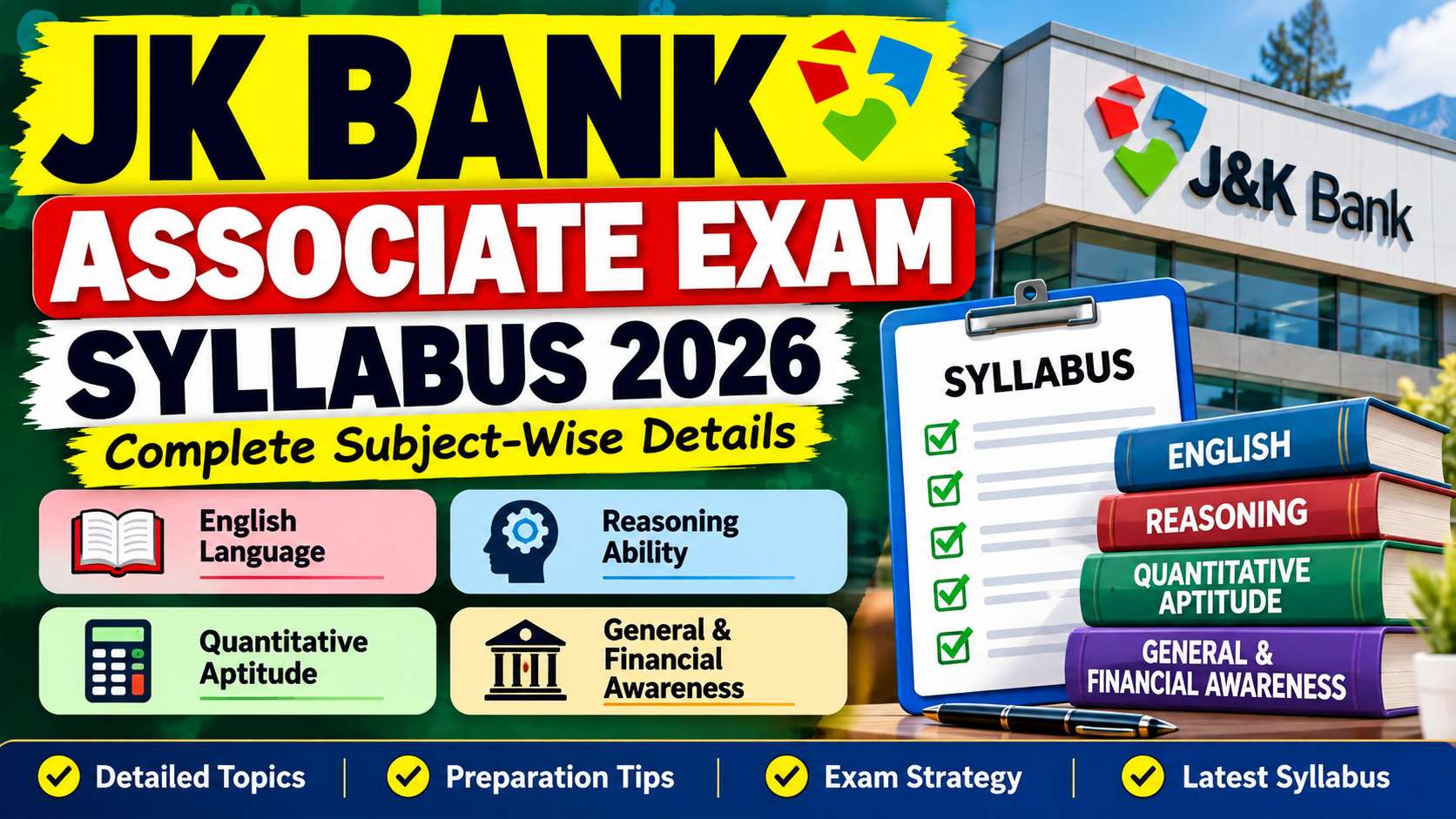
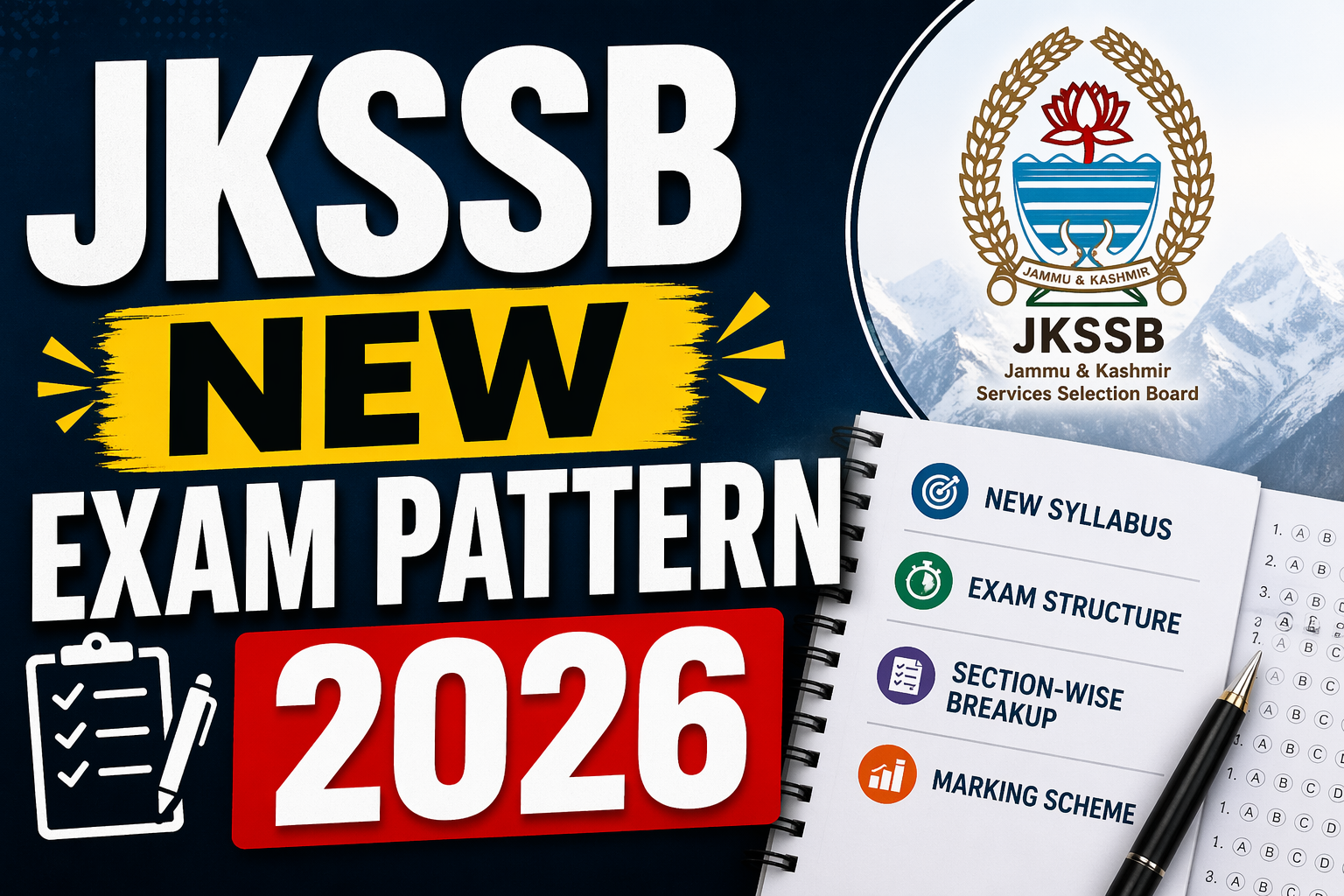
JKSSB New Exam Pattern 2026, you have probably realized that the old tricks are no longer working. The Jammu and Kashmir Services Selection Board has massively upgraded its testing style.
Direct, memory-based questions are fading out, replaced by highly analytical, time-consuming queries. To secure a government job in 2026, aspirants must adapt quickly or risk falling behind the intense competition.
What is the JKSSB Exam Pattern 2026?
Featured Answer:
As per the latest official update, the JKSSB New Exam Pattern 2026 features a 100-mark objective-type paper conducted in 120 minutes depend upon post, some posts have 120 marks, It heavily emphasizes conceptual clarity over rote learning. The exam includes sections on General Awareness, English, Reasoning, and Mathematics, with a strict negative marking of 0.25 for every incorrect answer.
Decoding the JKSSB New Exam Pattern 2026: The Shift to Conceptual Exams
how to Crack JKSSB Finance accounts assistant with this new pattern trend
download Full study material for jkssb finance accounts assistant with this new pattern questions framed by jkssb.
The JKSSB has completely transformed how it filters candidates. Gone are the days when simply memorizing a local GK book guaranteed selection.
Today, the board evaluates your depth of understanding, time management, and logical deduction skills. You must align your preparation with these modern requirements.
Latest JKSSB Exam Pattern 2026
While domain-specific marks may vary slightly by post, the core structure for most 2026 exams remains highly standardized.
| Subject | Total Questions | Total Marks | Duration |
| Basic Reasoning | 20 | 20 | 2 Hours (120 Mins) |
| Basic Mathematics | 20 | 20 | |
| Basic English | 20 | 20 | |
| General Awareness & Science | 40 | 40 | |
| Total | 100 | 100 |
(Note: Ensure you download complete syllabus PDF from the official website to verify domain-specific topic weightage for your exact post).
Why Previous Year Papers Are No Longer Enough?
It is a common habit for aspirants to practice previous year questions and assume they are fully prepared. In 2026, this is a dangerous trap.
1. Shift from Factual to Analytical
Earlier exams asked direct questions like "When was a treaty signed?" Now, exams feature multi-statement questions asking about the impact or clauses of that treaty.
2. Increased Focus on Modern Topics
The General Awareness section has evolved. There is a massive spike in questions regarding Climate Change, Biodiversity, and Sustainable Development, rather than just static history.
3. Enhanced Difficulty in Reasoning
The reasoning section is no longer basic. Questions are designed to be time-consuming, requiring strong foundational logic rather than simple shortcut tricks.
Step-by-Step Strategy to Crack JKSSB 2026
Success in 2026 requires a surgical approach to the syllabus. Follow these proven steps to maximize your ranking power.
Step 1: Master the Core Concepts
Do not just skim summaries. Read standard NCERT books for Science and Geography. Understand the "why" behind every historical event and constitutional article.
Step 2: Prioritize High-Weightage J&K Topics
The J&K Reorganization Act 2019 and J&K Geography remain non-negotiable. Ensure you study the most recent amendments and 2026 current affairs related to the UT.
Step 3: Relentless Time Management Practice
Because questions are lengthier, reading speed is crucial. You must attempt free JKSSB mock test series regularly to train your brain to process long paragraphs quickly.
Sample New Pattern MCQs
To give you a real feel of the 2026 standard, here are some conceptual questions structured precisely for the new pattern.
Question 1: As per the JKSSB New Exam Pattern 2026, what is the penalty for each incorrect answer in the objective-type paper?
a) 0.50 marks
b) 0.25 marks
c) 0.33 marks
d) No negative marking
Answer: b
Solution: As per the latest official update, JKSSB applies a negative marking of 0.25 marks for every incorrect answer to penalize blind guessing.
Question 2: Which of the following statements best describes the recent trend in the JKSSB General Awareness section?
a) Complete removal of current affairs.
b) Exclusive focus on world history.
c) Increased emphasis on environmental ecology and analytical multi-statement questions.
d) Only memory-based dates and locations are tested.
Answer: c
Solution: Recent exams show a definitive shift toward conceptual topics like Climate Change, Ecology, and analytical statements rather than simple rote facts.
Question 3: Under the standard JKSSB CBT/OMR format, what is the total duration allotted for a 100-mark paper?
a) 60 minutes
b) 90 minutes
c) 120 minutes
d) 150 minutes
Answer: c
Solution: Candidates are allotted 120 minutes (2 hours) to complete the standard 100-mark objective paper, requiring brisk reading and quick decision-making.
Question 4: Which of the following is a mandatory, high-yield topic for the J&K specific GK section?
a) The J&K Reorganization Act, 2019
b) The J&K Panchayati Raj Act, 1989
c) Both a and b
d) The history of European colonization in Asia
Answer: c
Solution: Both the J&K Reorganization Act, 2019, and the J&K Panchayati Raj Act, 1989, are critical administrative topics frequently tested in depth.
Question 5: Why is relying purely on previous year papers considered a flawed strategy for 2026?
a) The syllabus has been entirely replaced.
b) Exams have shifted from simple memory-based questions to complex, application-based formats.
c) The exam is now a descriptive essay.
d) There are no previous year papers available.
Answer: b
Solution: The core reason is the drastic shift in question framing. The syllabus may look similar, but the depth and analytical nature of the questions have vastly increased.
Common Mistakes to Avoid
Many hardworking candidates fail because of easily avoidable errors. Make sure you do not fall into these traps.
Ignoring Negative Marking: Blind guessing will destroy your score. A 0.25 penalty adds up rapidly.
Studying Outdated Material: Using 2021 current affairs or old act versions will cost you precious marks. Always rely on 2026 verified data.
Skipping the Math Section: Many aspirants fear mathematics and leave it entirely. Even scoring 50% in this section can push you ahead of thousands of competitors.
Quick Revision Summary
Pattern: 100 Marks, 120 Minutes, 0.25 Negative Marking.
Focus Areas: Conceptual clarity, Environmental Science, J&K specific Acts, and current events.
Preparation: Move beyond rote learning. Prioritize deep understanding and analytical thinking.
Actionable Step: Stop reading passively. Take timed mock tests to build exam-day stamina.
Frequently Asked Questions (FAQs)
1. What is the JKSSB new exam pattern 2026?
The new pattern features an objective-type exam with 100 to 120 questions, testing General Awareness, Reasoning, Math, and English over 2 hours. It heavily favors analytical, multi-statement questions over simple rote facts.
2. Is there negative marking in JKSSB 2026 exams?
Yes. As per the latest official update, there is a strict negative marking of 0.25 marks for every incorrect answer. Candidates must avoid blind guessing.
3. Are JKSSB exams conducted in CBT or OMR mode?
JKSSB utilizes both modes depending on the post and applicant volume. However, the current trend heavily favors Computer Based Tests (CBT) for faster processing and transparency.
4. What is the age limit for JKSSB recruitment 2026?
The general age limit for Open Merit candidates is 18 to 40 years. Reserved categories receive age relaxations according to J&K government regulations.
5. Why are previous year papers not enough for JKSSB 2026?
Previous year papers feature older, memory-based questions. The 2026 exams are highly analytical and time-consuming, requiring deep conceptual knowledge rather than just factual recall.
6. How can I download the JKSSB syllabus PDF for 2026?
You can easily download the official syllabus by visiting the "Downloads" or "What's New" section on the official JKSSB portal (jkssb.nic.in).
Conclusion
Cracking the JKSSB exam in 2026 is no longer about who can memorize the most facts; it is about who understands the concepts best. The competition is fierce, but with the right strategy, consistent practice, and an analytical mindset, your name will be on that final merit list. Do not wait for exam dates to be announced—start your preparation today, test your knowledge under timed conditions, and stay focused on your goal!