JKSSB Assistant Handicraft Training Officer Syllabus 2026
The Jammu & Kashmir Services Selection Board (JKSSB) has released the recruitment notification for Assistant Handicrafts Training Officer (AHTO) and Assistant Handlooms Training Officer posts under Advertisement No. 12 of 2025. A total of 87 vacancies have attracted a large number of aspirants across Jammu & Kashmir who are now preparing for the written examination and looking for the latest JKSSB AHTO syllabus and exam pattern.
Compared to the earlier recruitment examinations conducted years ago, the Board has now adopted the revised examination structure for the concerned posts. Candidates preparing for the examination should therefore follow the latest syllabus prescribed by JKSSB rather than relying on older syllabus patterns.
This article provides the latest JKSSB AHTO Syllabus 2026, along with the exam pattern, subject-wise topics, marking scheme, and preparation guidance for candidates.
Download Complete Study Material with Test Series full and Sectional Tests
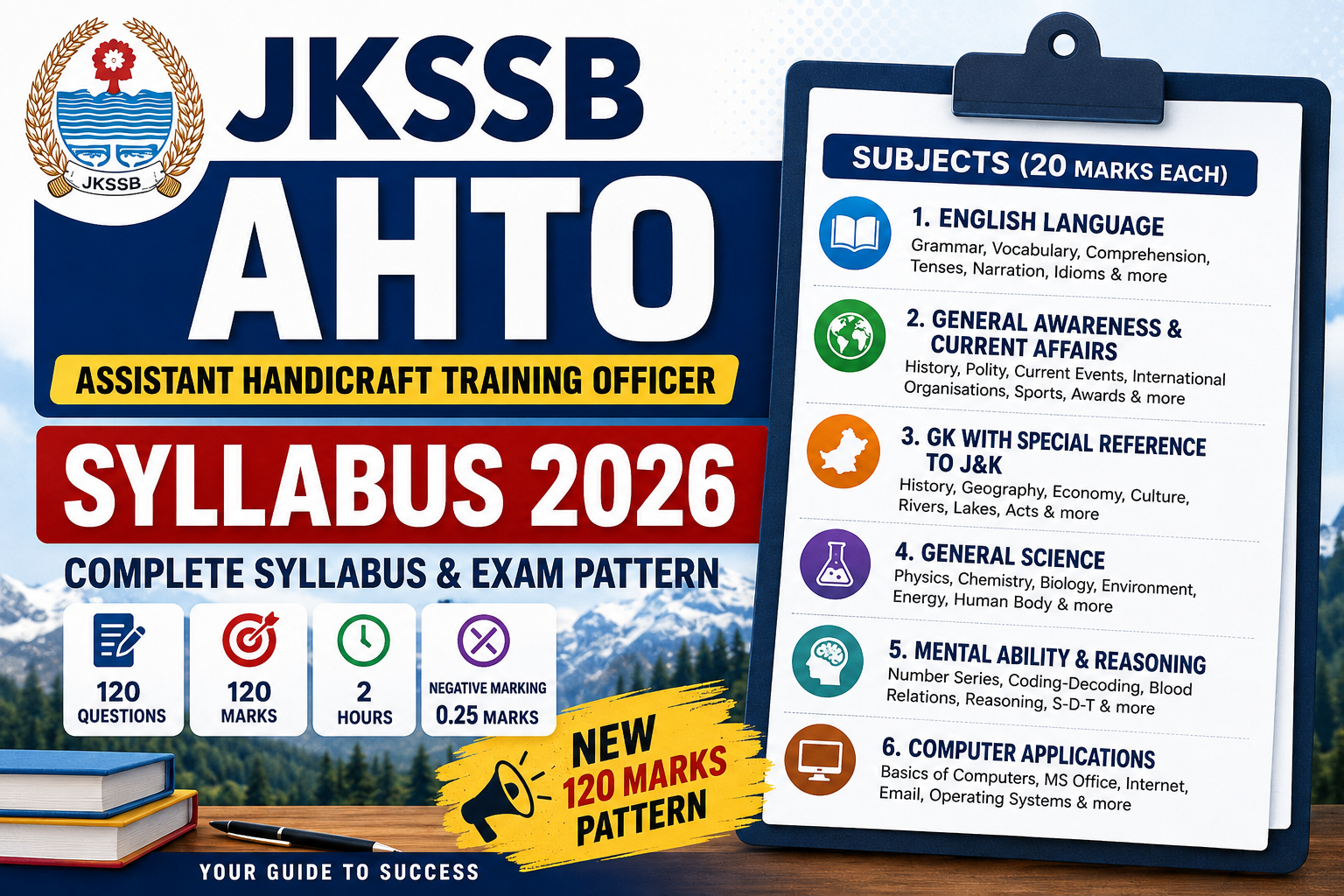
JKSSB AHTO Exam Pattern 2026
The selection process for the Assistant Handicrafts Training Officer post is based mainly on written examination merit. Candidates must understand the latest paper pattern before starting their preparation.
Exam Highlights
Examination Type: Objective Multiple Choice Questions (MCQs)
Total Questions: 120
Maximum Marks: 120
Time Duration: 2 Hours
Selection Method: Written Test & Document Verification
Interview: Not Included
Negative Marking: 0.25 marks deducted for every incorrect answer
The examination consists of different sections designed to test candidates on English and comprehension, reasoning, quantitative aptitude, computer knowledge, and other prescribed areas.
JKSSB AHTO Syllabus 2026 – Subject Wise Topics
The latest syllabus for the post of Assistant Handicrafts Training Officer and Assistant Handlooms Training Officer (AHTO) includes important areas of English, reasoning, quantitative aptitude, and computer knowledge.
Candidates should prepare each topic thoroughly because questions can be asked from both fundamental concepts and application-based areas.
1. General English & Comprehension
The General English section tests candidates on their understanding of grammar, vocabulary, sentence structure, comprehension, and correct usage of English.
Important Topics
Tenses
Narration
Modals
Articles
Reading Comprehension
Fill in the blanks with Phrases
Pronouns
Homonyms and Homophones
Clauses
Synonyms and Antonyms
Pairs of Words and their use in meaningful sentences
Rearranging of Jumbled Sentences
Idioms and Phrases
Uses of Prepositions
Active and Passive Voice
Error Spotting
Sentence Correction
Spellings Correction
Candidates should focus on both grammar rules and practical sentence usage. Regular practice of comprehension passages, error spotting, sentence correction, and vocabulary-based questions can help improve accuracy.
2. General Intelligence & Reasoning
The General Intelligence and Reasoning section evaluates the candidate's ability to identify patterns, establish relationships, solve problems, and draw logical conclusions.
Important Topics
Number Series
Letter Series
Semantic Series
Speed, Distance and Time
Statements and Conclusions
Logical Reasoning
Mental Reasoning
Word Building
Numerical Operations
Semantic Analogy
Symbolic/Number Analogy
Figural Analogy
Semantic Classification
Symbolic/Number Classification
Figural Classification
Problem Solving
Symbolic Operations
Trends
Space Orientation
Space Visualization
Venn Diagrams
Drawing Inferences
Punched Hole/Pattern – Folding & Unfolding
Figural Pattern – Folding and Completion
Indexing
Address Matching
Date & City Matching
Classification of Centre Codes/Roll Numbers
Small & Capital Letters
This section requires consistent practice. Candidates should focus particularly on series, analogy, classification, logical reasoning, Venn diagrams, spatial visualization, pattern folding, and problem-solving questions.
3. Quantitative Aptitude
Quantitative Aptitude covers numerical calculations, arithmetic concepts, algebra, geometry, mensuration, trigonometry, and data interpretation.
The scope of the test includes computation of the following topics:
Arithmetic and Basic Mathematics
Whole Numbers
Decimals
Fractions
Relationships Between Numbers
Profit and Loss
Discount
Partnership Business
Mixture and Alligation
Time and Distance
Time and Work
Percentage
Ratio and Proportion
Square Roots
Averages
Interest
Basic Algebraic Concepts
Candidates should develop strong calculation speed because quantitative aptitude questions can become time-consuming if calculations are not practiced regularly.
Algebra, Geometry and Mensuration
Graphs of Linear Equations
Triangle and its Various Kinds of Centers
Congruence and Similarity of Triangles
Circle and its Chords
Tangents
Angles Subtended by Chords of a Circle
Common Tangents to Two or More Circles
Triangles
Quadrilaterals
Regular Polygons
Circle
Right Prism
Right Circular Cone
Right Circular Cylinder
Sphere
Hemispheres
Rectangular Parallelepiped
Regular Right Pyramid with Triangular or Square Base
Heights and Distances
Data Interpretation
Candidates should also prepare basic graphical representation and interpretation, including:
Histogram
Frequency Polygon
Bar Diagram
Pie Chart
Trigonometry
Important trigonometric areas include:
Trigonometric Ratios
Degree and Radian Measures
Standard Identities
Complementary Angles
A proper understanding of formulas, identities, geometry concepts, and numerical application is important for this section.
4. Knowledge of Computers
The Computer section tests candidates on fundamental computer concepts, hardware and software, office applications, internet services, cybersecurity basics, and the role of information technology in governance.
Important Topics
Basic Applications of Computer and its Components
Fundamentals of Computer Sciences
Hardware & Software
Concept of Open-Source Technologies
Input & Output Devices
MS Word
MS Excel
MS Access
MS PowerPoint
PDF
Internet
E-mail
Concept of Computer Virus
Latest Anti-Virus
Role of Information Technology in Governance
Candidates should not restrict their preparation to definitions alone. Questions may test the practical applications and functions of computer components and software.
Special attention should be given to MS Word, MS Excel, MS Access, MS PowerPoint, Internet, Email, computer viruses, antivirus software, and e-governance.
Important Notice Regarding the Updated Syllabus
Candidates preparing for the JKSSB Assistant Handicrafts Training Officer and Assistant Handlooms Training Officer Examination 2026 should carefully follow the latest syllabus prescribed by the Board.
The syllabus has been updated from the older pattern, and candidates should avoid depending entirely on previous recruitment syllabi. In particular, aspirants should prepare the newly specified areas such as:
Reading Comprehension
Error Spotting
Sentence Correction
Spellings Correction
Semantic and Figural Analogy
Symbolic Operations
Space Orientation and Visualization
Punched Hole/Folding and Unfolding
Address Matching
Date & City Matching
Quantitative Aptitude
MS Access
Open-Source Technologies
Computer Virus and Latest Anti-Virus
IT in Governance
Following the latest prescribed syllabus will help candidates avoid wasting valuable preparation time on topics that are not part of the updated examination requirements.
Preparation Tips for JKSSB AHTO 2026
As the recruitment is taking place after several years, the competition level is expected to remain high. Candidates should follow a smart preparation strategy covering all sections systematically.
Recommended Strategy
Understand the latest syllabus first and prepare a topic-wise study plan.
Give sufficient attention to General English & Comprehension.
Practice reasoning questions daily to improve speed and accuracy.
Strengthen basic concepts of Quantitative Aptitude before moving to advanced questions.
Revise important mathematical formulas, identities, geometry and mensuration concepts regularly.
Practice MS Word, MS Excel, MS Access and MS PowerPoint questions.
Study important concepts related to Internet, Email, Computer Viruses and Antivirus.
Understand the role of Information Technology in Governance.
Solve previous year JKSSB papers wherever relevant.
Practice topic-wise MCQs after completing each chapter.
Take mock tests regularly to improve time management and accuracy.
Revise difficult questions and maintain a separate record of mistakes.
Since there is no interview stage, strong performance in the written examination becomes extremely important for candidates aiming for final selection.
Final Words
Candidates preparing for the JKSSB Assistant Handicrafts Training Officer (AHTO) and Assistant Handlooms Training Officer Examination 2026 should focus on the latest syllabus and avoid depending solely on old examination patterns.
A systematic preparation strategy covering General English & Comprehension, General Intelligence & Reasoning, Quantitative Aptitude, and Knowledge of Computers can help candidates build strong command over the prescribed syllabus.
Regular revision, topic-wise MCQ practice, previous-year question analysis, and mock-test practice can significantly improve preparation and examination performance.
Candidates should also regularly check the official JKSSB website for the latest notifications, syllabus updates, corrigendums, examination schedules, and other important announcements.
Preparing according to the latest official syllabus from JKSSB and maintaining consistent practice can greatly improve the chances of performing well in the examination.