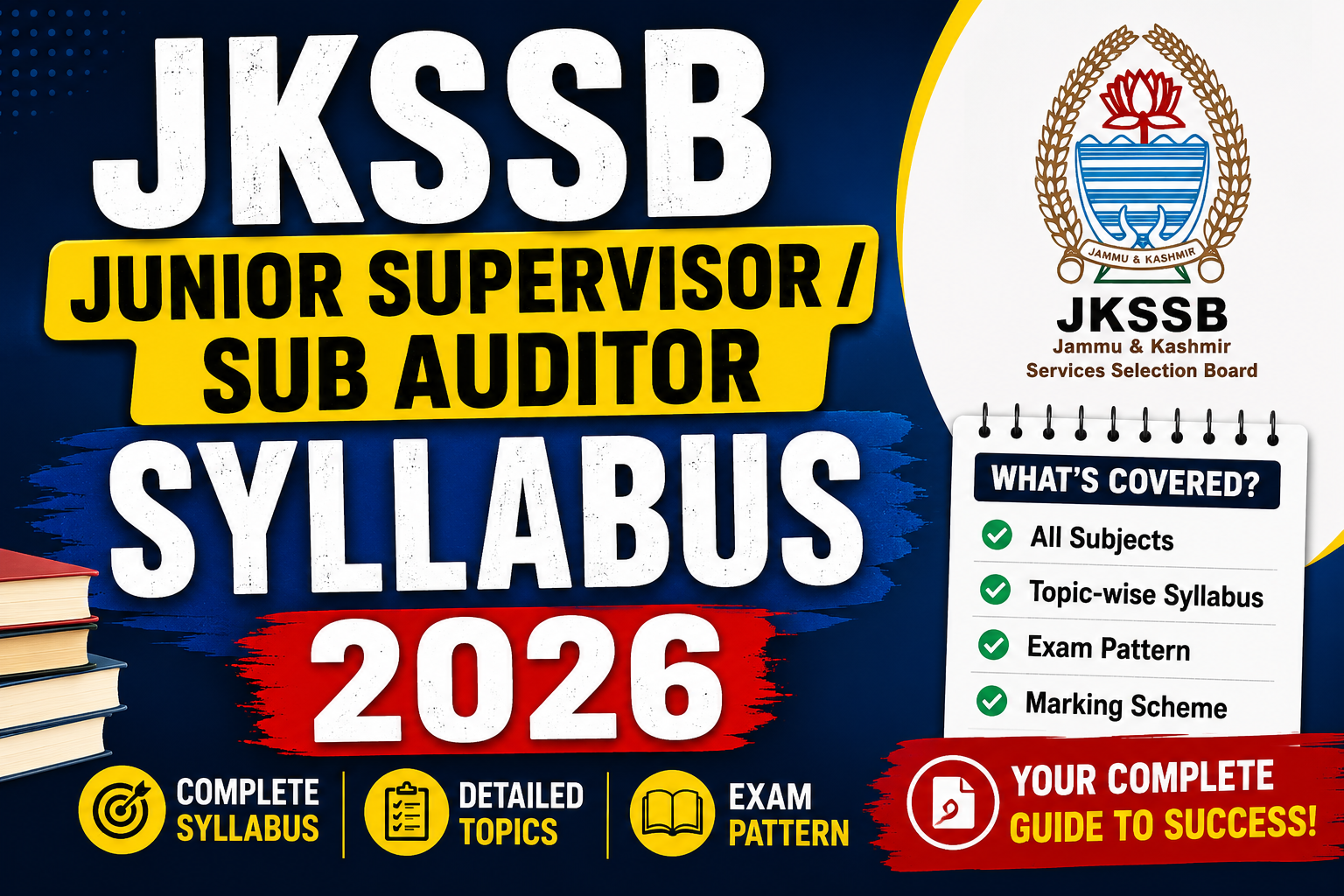
JKSSB Junior Supervisor/Sub Auditor Syllabus 2026
The JKSSB Junior Supervisor/Sub Auditor recruitment examination is expected to remain highly competitive in 2026 because of the increasing number of applicants and limited vacancies. Many candidates begin preparation without understanding the actual syllabus depth, which ultimately affects their performance in the written examination.
The JKSSB Junior Supervisor/Sub Auditor syllabus 2026 consists of six major sections carrying a total of 120 marks. The exam tests not only factual knowledge but also analytical ability, comprehension skills, awareness of Jammu & Kashmir, and computer fundamentals. Based on recent JKSSB patterns, candidates who prepare strategically according to topic weightage usually perform better than those relying only on general reading.
The written test includes:
| Subject | Marks |
|---|---|
| General English | 20 |
| General Knowledge & Current Affairs | 20 |
| JK General Knowledge | 20 |
| General Science | 20 |
| Mental Ability Test | 20 |
| Computer Applications | 20 |
| Total | 120 Marks |
Exam Duration: 2 Hours
Important Highlights of JKSSB Junior Supervisor/Sub Auditor Exam 2026
- Total written exam marks are 120
- Each section carries equal weightage
- Questions are objective type
- Time duration is 2 hours
- Jammu & Kashmir GK plays a major role
- Current affairs preparation is essential
- Computer awareness section is scoring
- Mental Ability requires regular practice
- English grammar fundamentals are important
- General Science questions are concept-based
- Static GK and economy topics are frequently asked
- Revision and mock test practice are crucial
Candidates should regularly attempt free JKSSB mock test series to improve time management and identify weak areas before the actual examination.
Detailed JKSSB Junior Supervisor/Sub Auditor Syllabus 2026
General English Syllabus
General English is often considered a scoring section, but many candidates lose marks due to weak grammar fundamentals and lack of practice.
The syllabus includes:
Grammar Topics
- Tenses
- Articles
- Modals
- Clauses
- Active and Passive Voice
- Narration
- Prepositions
Vocabulary & Usage
- Synonyms and Antonyms
- Idioms and Phrases
- Pairs of Words
- Homonyms and Homophones
Sentence Structure
- Rearrangement of Jumbled Sentences
- Meaningful Sentence Formation
- Comprehension Passages
- Fill in the Blanks using:
- Pronouns
- Phrases
- Appropriate words
Based on recent JKSSB patterns, error detection and sentence improvement questions are commonly seen in competitive exams and require consistent practice rather than theoretical learning.
General Knowledge and Current Affairs Syllabus
This section is usually the deciding factor in merit ranking because it covers both static GK and dynamic current affairs.
Major topics include:
Indian History & Freedom Movement
Candidates should focus on:
- Revolt of 1857
- INC Sessions
- Gandhian Movements
- Important Freedom Fighters
International Organizations
- UNO
- WHO
- WTO
- IMF
- UNESCO
- UNCTAD
International Groups & Blocs
- BRICS
- G20
- ASEAN
- SAARC
- BIMSTEC
- OPEC
- G7
Economy & Finance
- Inflation
- Monetary Policy
- Fiscal Policy
- Capital Market
- RBI Functions
- GST
- CBDT
- Direct & Indirect Taxes
Current Affairs Areas
- National events
- International developments
- Sports
- Awards
- Scientific discoveries
- Climate issues
- Government schemes
Geography & Agriculture
- Climate and crops in India
- Rivers and lakes
- Political divisions
- Industrialization
- Economic development
Candidates should practice previous year questions because JKSSB often repeats concepts from economy, international organizations, and current affairs themes.
General Knowledge with Special Reference to Jammu & Kashmir
This section is extremely important because many aspirants from outside core JK preparation areas underestimate its importance.
Topics include:
Jammu & Kashmir History & Culture
- Ancient history of J&K
- Cultural heritage
- Traditional arts
- Festivals and languages
Geography of J&K
- Major rivers
- Lakes
- Climate
- Flora and fauna
- Tourist destinations
Governance & Constitutional Topics
- J&K Reorganisation Act 2019
- Panchayati Raj Act 1989
- 73rd and 74th Constitutional Amendments
Economy & Transport
- Agriculture
- Handicrafts
- Tourism economy
- Means of transport
Candidates preparing seriously for JKSSB should maintain separate handwritten notes for J&K-specific GK because this section contributes directly to merit advantage.
General Science Syllabus
The General Science portion is mostly based on conceptual understanding from secondary-level science.
Physics Topics
- Motion and Mechanics
- Velocity and Acceleration
- Newton’s Laws of Motion
- Waves and Sound
- Light as Wave
- Electricity
- Voltage and Current
- Resistance and Power
Chemistry Topics
- Structure of Atom
- Solids, Liquids and Gases
Biology Topics
- Nutrition
- Respiration
- Transportation in Plants
- Vitamins and Deficiency Diseases
Environment & Ecology
- Ecosystem
- Food Chains
- Environmental Pollution
- Ozone Layer
- Greenhouse Effect
Energy Sources
- Conventional Energy
- Biomass Energy
- Wind Energy
- Solar Energy
- Tidal Energy
Unlike many state-level exams, JKSSB science questions are usually application-based instead of purely theoretical. Therefore, conceptual clarity matters more than memorization.
Mental Ability Test Syllabus
The Mental Ability section checks reasoning speed and analytical thinking.
Important topics are:
- Number Series
- Letter Series
- Coding-Decoding
- Direction Sense
- Blood Relations
- Mathematical Reasoning
- Speed, Distance and Time
- Statements and Conclusions
- Logical Reasoning
- Mental Reasoning
Students who solve reasoning questions daily generally improve accuracy significantly within a few weeks. Speed improvement comes only through repeated practice.
Computer Applications Syllabus
Computer awareness has become one of the highest scoring sections in JKSSB examinations.
Topics include:
Basic Computer Knowledge
- Fundamentals of Computer Science
- Hardware and Software
- Input and Output Devices
Operating System
- Functions of OS
- Types of OS
- File Management
MS Office
- MS Word
- MS Excel
- MS Access
- PowerPoint Presentation
Internet & Communication
- Internet Basics
Questions from MS Excel and Internet concepts are commonly seen in competitive exams, especially shortcut-related and application-based questions.
Why the JKSSB 2026 Syllabus Matters More Than Ever
The competition level in JKSSB recruitment has increased steadily over the last few years. Candidates are no longer preparing only from guidebooks. Many aspirants now combine:
- structured notes
- mock tests
- PYQ analysis
- current affairs revision
- subject-wise strategy
Because every subject carries equal marks, ignoring even one section can reduce final merit ranking significantly.
Based on recent JKSSB patterns, Computer Applications and Mental Ability sections often become score boosters for serious aspirants.
Best Preparation Strategy for JKSSB Junior Supervisor/Sub Auditor 2026
Build a Subject Rotation Plan
Do not study one subject for the entire day. Instead:
- Morning: GK + Current Affairs
- Afternoon: English + Computer
- Evening: Mental Ability + Science
Focus on Daily Revision
Retention matters more than reading multiple books.
Practice Mock Tests
Candidates should regularly attempt free JKSSB mock test sessions to improve:
- speed
- question selection
- time management
- pressure handling
Analyze Previous Papers
Practice previous year questions to understand:
- repeated topics
- question framing
- difficulty level
- scoring areas
Use Short Notes
Prepare one-page revision sheets for:
- Economy terms
- J&K GK
- Science formulas
- Important organizations
Download Official Resources
Candidates should also download complete syllabus PDF and keep a printed copy while preparing.
Common Mistakes Students Make During Preparation
Many candidates fail not because the syllabus is difficult, but because preparation lacks direction.
Common mistakes include:
- Ignoring J&K-specific GK
- Reading current affairs without revision
- Avoiding mock tests
- Memorizing reasoning instead of practicing
- Spending excessive time on one subject
- Not analyzing weak sections
- Preparing from too many sources
- Ignoring computer fundamentals
The most successful candidates usually follow limited resources with multiple revisions.
Quick Revision Notes for JKSSB 2026
- Total marks: 120
- Duration: 2 hours
- Six sections with equal weightage
- Current affairs should cover national and international events
- JK-specific GK is highly important
- English grammar fundamentals are essential
- Mental Ability requires daily practice
- Computer Applications is one of the easiest scoring sections
- General Science is concept-oriented
- Revision and mock tests are key to success
FAQs
What is the total marks distribution in JKSSB Junior Supervisor/Sub Auditor exam 2026?
The examination carries 120 marks divided equally among six subjects.
Is the JKSSB Junior Supervisor syllabus the same as Sub Auditor syllabus?
Yes, both posts follow the same written examination syllabus and exam pattern.
What is the best way to prepare for JKSSB 2026?
The best strategy includes daily revision, mock test practice, current affairs preparation, and regular practice of reasoning questions.
How important is Jammu & Kashmir GK in JKSSB exams?
It is extremely important because J&K-specific questions directly affect merit ranking and are commonly asked in almost every JKSSB examination.
Is Computer Applications section easy to score?
Yes, candidates with proper practice of MS Office and computer fundamentals can score high in this section.
How many hours should I study daily for JKSSB preparation?
A focused study schedule of 5–7 hours with revision and mock tests is generally sufficient for serious preparation.
Are previous year questions useful for JKSSB preparation?
Yes, practice previous year questions because many concepts and question patterns are repeated.
Where can I get the JKSSB syllabus PDF?
Candidates should download complete syllabus PDF from trusted educational platforms or official notifications for accurate preparation.
Final thoughts for jkssb junior supervisor asiprants
The JKSSB Junior Supervisor/Sub Auditor syllabus 2026 is broad but highly manageable with a disciplined preparation strategy. The examination does not demand advanced academic knowledge; instead, it rewards consistency, revision, conceptual clarity, and smart practice.
Candidates who combine subject-wise preparation with regular mock tests, current affairs revision, and previous paper analysis usually stay ahead in the competition. Focus on accuracy, maintain short revision notes, and avoid random preparation sources.
Most importantly, start early, stay consistent, attempt free JKSSB mock test series regularly, and practice previous year questions to build real exam confidence before the final examination day.