Junior Pharmacist Syllabus 2026 PDF Download
Candidates preparing for the JKSSB Junior Pharmacist examination in 2026 must understand one thing clearly — most aspirants waste months studying random pharmacy material without focusing on the actual syllabus. That is exactly why many fail despite working hard.
The latest Junior Pharmacist syllabus is extensive, technical, and highly practical. It combines anatomy, public health, drugs, nursing, sterilization, surgical procedures, and operation theatre knowledge. Based on recent JKSSB patterns, the board focuses heavily on practical medical understanding rather than theoretical memorization alone.
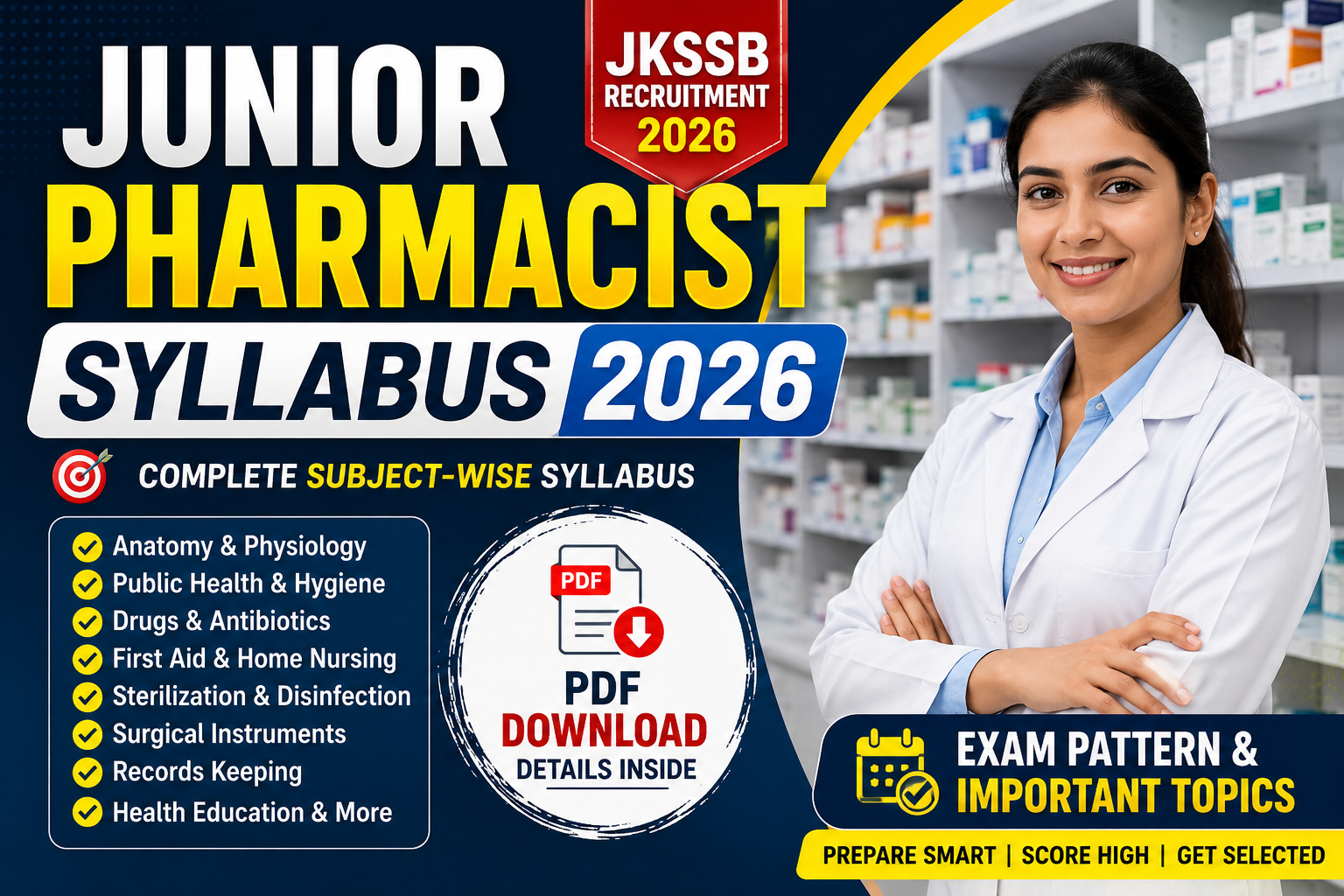
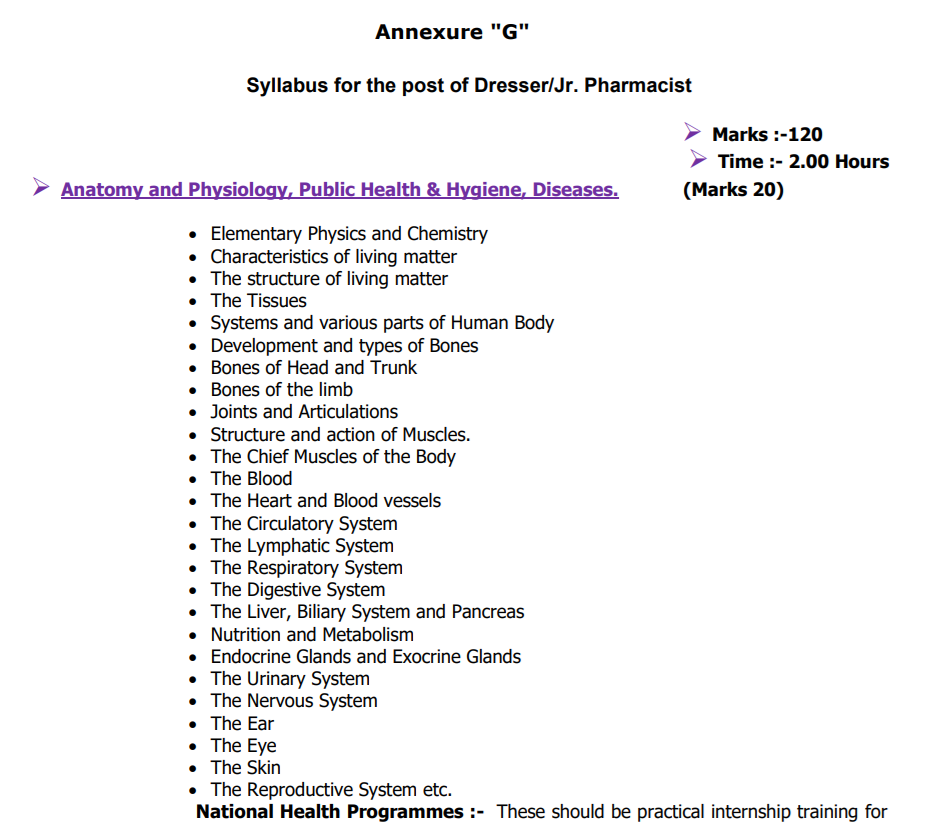
Candidates looking for the official Junior Pharmacist syllabus 2026 PDF download can refer to the detailed syllabus below extracted from the official notification.
The syllabus includes:
- Anatomy and Physiology
- Public Health and Hygiene
- Drugs and Antibiotics
- Records Keeping
- First Aid and Home Nursing
- Sterilization and Disinfection
- Surgical Instruments
- Pre and Post Operative Care
- Health Education
This makes the exam multidisciplinary and highly competitive.
Key Highlights of JKSSB Junior Pharmacist Syllabus 2026
- Total syllabus divided into multiple medical and healthcare sections
- Strong emphasis on practical healthcare knowledge
- Important weightage given to Anatomy and Physiology
- Public Health and Hygiene carry significant marks
- Questions commonly seen in competitive exams include sterilization and emergency care
- Surgical instruments and operation theatre procedures are highly important
- Home Nursing topics are frequently ignored by candidates but remain scoring
- Drug preparation and prescription reading are major scoring areas
- Previous year trend shows focus on patient care and infection control
- Records keeping and stock management are important for practical pharmacy roles
- Preparation strategy should combine theory + revision + mock tests
- Time management is critical because the syllabus is vast
Download Official syllabus link
JKSSB Junior Pharmacist Exam Pattern 2026
| Section | Marks |
|---|---|
| Anatomy, Physiology, Public Health & Diseases | 20 |
| Drugs & Antibiotics | 20 |
| Records Keeping | 5 |
| First Aid & Home Nursing | 15 |
| Home Nursing | 10 |
| Health Education | 5 |
| Sterilization & Disinfection | 10 |
Surgical Instruments & Patient Care
other | 15
20 |
The syllabus clearly shows that healthcare fundamentals dominate the paper. Candidates preparing only pharmacy-specific subjects often miss important medical assistant concepts.
Download complete ebook /notes for jkssb junior pharmacist 2026
Anatomy and Physiology Syllabus
The anatomy and physiology section forms the foundation of the Junior Pharmacist examination.
Important topics include:
- Elementary Physics and Chemistry
- Characteristics of living matter
- Human body systems
- Bones and joints
- Muscles and tissues
- Circulatory system
- Respiratory system
- Digestive system
- Nervous system
- Skin, ear, eye, reproductive system
This section tests conceptual clarity rather than superficial definitions.
For example, questions may not simply ask about the respiratory system. Instead, candidates may face application-based questions involving oxygen transport, blood circulation, or muscle action.
Based on recent JKSSB patterns, anatomy questions are increasingly integrated with clinical relevance.
Public Health and Hygiene
Public health is one of the most underestimated areas in the syllabus.
Candidates should focus on:
- Development of public health
- Comprehensive healthcare systems
- Health committees
- Family planning organizations
- Primary Health Centres
- Disease prevention methods
- Epidemiological approaches
- Sterilization and disinfection
- Outbreak investigation
Many aspirants ignore healthcare administration topics, but these are commonly seen in competitive exams because they assess awareness of India's healthcare structure.
Understanding the role of PHCs, district health systems, and disease control strategies can significantly improve scoring potential.
Drugs and Antibiotics
This section is highly technical and extremely important.
Topics include:
- Drug classifications
- Pharmaceutical methods
- Prescription reading
- Dose calculation
- Weights and measures
- Incompatibility of drugs
- Suppositories
- Ointments
- Nebulizers and inhalations
- Common medicines and uses
Candidates should practice:
- Prescription abbreviations
- Formula conversion
- Dosage calculations
- Drug preparation techniques
A major mistake students make is memorizing only medicine names without understanding preparation methods and dosage logic.
Records Keeping and Store Procedures
Although this section carries fewer marks, it can become a scoring advantage.
Topics include:
- Drug storage
- Stock books
- Codification
- Preparation of indents
- Main store procedures
Because many candidates neglect this area, even basic preparation can secure easy marks.
First Aid and Emergency Care
The First Aid section is practical and clinically oriented.
Important topics:
- CPR
- Wounds
- Haemorrhage
- Shock
- Fractures
- Artificial respiration
- Snake bite
- Dog bite
- Poisoning
- Foreign body injuries
Questions are often situation-based.
For example:
- Immediate treatment during electric shock
- First response in fractures
- Emergency management of poisoning
Candidates should understand treatment sequence, not just terminology.
Home Nursing
Home Nursing is broad and detailed.
Major areas:
- Bed making
- Observation of patients
- Surgical techniques
- Diet management
- Infectious diseases
- Care of elderly patients
- Mental health care
- Blood transfusion
- Childbirth management
This section evaluates patient-care understanding.
Based on recent JKSSB trends, nursing care procedures and infection control are becoming increasingly important.
Health Education
Health education is short but highly conceptual.
Focus areas:
- Principles of health education
- Ethics
- Methods of health education
- Development of health education in India
Candidates should understand practical implementation rather than theoretical memorization.
Sterilization and Disinfection
This section is highly important for operation theatre and infection control awareness.
Important concepts:
- Physical sterilization methods
- Chemical sterilization
- Mechanical methods
- Disposal of contaminated media
- Sterilization of syringes and apparatus
Questions from this section are frequently direct and scoring.
Surgical Instruments and Operation Theatre Procedures
This is one of the lengthiest sections in the syllabus.
It covers:
- General surgery instruments
- ENT procedures
- Ophthalmic surgery
- Orthopaedic trays
- Cardiovascular trays
- Pediatric trays
- Neurosurgical procedures
- Gynecological operations
Candidates often struggle because they attempt to memorize everything mechanically.
A smarter strategy is:
- Categorize instruments by department
- Learn tray arrangements visually
- Revise procedure-wise instruments together
Pre and Post Operative Patient Care
This section focuses on surgical patient safety and hospital procedures.
Key topics:
- Psychological support
- Admission procedures
- Transfer procedures
- Environmental controls
- Counting procedures
- Radiation safety
- Infection control
- Chemical hazards
These are practical hospital management concepts commonly asked in healthcare recruitment exams.
Why the Junior Pharmacist Syllabus Matters for JKSSB 2026
The 2026 examination is expected to remain highly competitive because pharmacy and healthcare recruitments attract candidates from multiple medical backgrounds.
The syllabus matters because:
- It defines exact preparation boundaries
- It prevents irrelevant study
- It helps prioritize high-weightage topics
- It improves revision efficiency
- It aligns preparation with actual exam demand
Candidates who follow the syllabus strictly usually perform better than those relying only on coaching material.
Best Preparation Strategy for Junior Pharmacist Exam 2026
Focus on High-Weightage Sections First
Start with:
- Anatomy
- Drugs and Antibiotics
- Surgical Instruments
- First Aid
These sections collectively carry major weightage.
Build Practical Understanding
Do not rely entirely on rote memorization.
Understand:
- Why procedures are performed
- How instruments are used
- What infection control methods achieve
Practice Daily Revision
The syllabus is vast. Without revision, retention becomes weak.
A good approach:
- Morning: Theory study
- Evening: Revision
- Night: Mock test analysis
Solve Previous Year Questions
Candidates should regularly practice previous year questions because question framing patterns often repeat.
Attempt Mock Tests
Aspirants should attempt free JKSSB mock test series regularly to improve speed, accuracy, and pressure handling.
Use the Official Syllabus
Always download complete syllabus PDF and prepare topic-wise instead of depending on incomplete notes.
Common Mistakes Students Make
Ignoring Smaller Sections
Many candidates skip:
- Records keeping
- Health education
- Sterilization
These are scoring areas.
Memorizing Without Understanding
The exam increasingly includes applied questions.
No Revision Plan
Reading once is not enough for medical terminology-heavy subjects.
Avoiding Mock Tests
Students who avoid mock exams usually struggle with time management.
Studying Random Sources
Following multiple books without syllabus alignment creates confusion.
Quick Revision Points
- Anatomy and Physiology form the core foundation
- Public health concepts are highly important
- Drug dosage calculations are frequently asked
- CPR and emergency care remain high-priority topics
- Sterilization methods are scoring sections
- Surgical instruments require repeated revision
- Infection control is commonly seen in competitive exams
- Patient care procedures should be understood practically
- Practice previous year questions regularly
- Attempt free JKSSB mock test for real exam simulation
FAQs
What is the syllabus of Junior Pharmacist 2026?
The syllabus includes Anatomy, Physiology, Public Health, Drugs and Antibiotics, Home Nursing, First Aid, Surgical Instruments, Sterilization, and Patient Care procedures.
How can I download the Junior Pharmacist syllabus PDF?
Candidates can download complete syllabus PDF from the official recruitment notification and verified educational portals.
Is Anatomy important for JKSSB Junior Pharmacist exam?
Yes. Anatomy and Physiology carry major weightage and form the conceptual base for many medical questions.
What is the best way to prepare for Junior Pharmacist exam?
The best strategy is syllabus-based study, regular revision, mock test practice, and solving previous year questions.
Are surgical instruments important for the exam?
Yes. Instrument names, uses, and operation theatre trays are highly important sections.
Is the JKSSB Junior Pharmacist exam difficult?
The exam is manageable for candidates who follow the official syllabus properly and practice consistently.
Which section is most scoring in Junior Pharmacist syllabus?
First Aid, Sterilization, Records Keeping, and Drugs sections are usually considered scoring.
How much time is required to complete the syllabus?
Most candidates require 3–5 months of focused preparation with consistent revision.
The JKSSB Junior Pharmacist syllabus 2026 is not just a list of topics — it is a blueprint of the actual healthcare responsibilities expected from candidates. Every section, from anatomy to operation theatre safety, reflects practical medical knowledge required in real clinical settings.
Candidates who prepare strategically, revise consistently, and practice regularly gain a major advantage over average aspirants. Instead of studying everything blindly, focus on the official syllabus, strengthen conceptual clarity, attempt free JKSSB mock test series, and practice previous year questions regularly.
A disciplined preparation approach today can become the deciding factor in securing your selection in JKSSB Junior Pharmacist Recruitment 2026.
Also chck our new course jkssb cssd attendant /nursing aid G-iii course