UNO and Its Organs
Introduction
International organizations play a very important role in maintaining peace, cooperation, development, and diplomatic relations among countries. Among all such organizations in the world, the United Nations Organization (UNO) is considered the most important and influential global body.
For JKSSB aspirants, UNO is an extremely important topic for jkp constable exam because questions are regularly asked from:
- formation of UNO
- headquarters
- organs of UNO
- veto power
- Security Council
- International Court of Justice
- specialized agencies
- peacekeeping missions
- Secretary-General
- important days and reports
Many students memorize only factual points like “UNO was established in 1945,” but competitive exams increasingly test conceptual understanding. Therefore, these notes will explain not only facts but also:
- why UNO was created
- how it functions
- why the Security Council is controversial
- how the International Court works
- what makes specialized agencies important
- how UNO influences world politics
These detailed notes are written in an educator-style format to help serious JKSSB aspirants build deep understanding as well as revision strength.
What is UNO?
The United Nations Organization (UNO) is an international organization formed to maintain international peace and security, promote friendly relations among nations, and encourage social and economic development.
It is the largest and most important global organization in the modern world.
Formation of UNO
Historical Background
To understand UNO properly, students must first understand why it was formed.
Failure of the League of Nations
Before UNO, there existed another international organization called the League of Nations.
It was established after the First World War in 1920 with the aim of preventing future wars.
However, it failed because:
- major powers ignored it
- it lacked military power
- aggressive countries like Germany, Italy, and Japan violated international law
- it could not stop World War II
This failure taught the world that a stronger international organization was necessary.
Formation After World War II
The destruction caused by the Second World War shocked humanity.
Millions of people died.
Entire cities were destroyed.
Nuclear weapons were used on Hiroshima and Nagasaki.
World leaders realized that another world war could destroy civilization itself.
As a result, countries decided to establish a stronger global organization.
Important Conferences Related to UNO Formation
| Conference | Year | Importance |
|---|---|---|
| Atlantic Charter | 1941 | Roosevelt and Churchill discussed peace principles |
| Declaration by United Nations | 1942 | 26 nations pledged cooperation |
| Moscow Conference | 1943 | Supported creation of international organization |
| Dumbarton Oaks Conference | 1944 | Framework of UNO prepared |
| Yalta Conference | 1945 | Agreement on Security Council voting |
| San Francisco Conference | 1945 | UN Charter signed |
Establishment of UNO
- UNO officially came into existence on 24 October 1945
- UN Charter was signed at San Francisco (USA)
- Initially, 51 countries became members
- Today, the United Nations has 193 member states
Headquarters
The headquarters of UNO is located in:
📍 New York City, United States of America
Why 24 October is Important?
24 October is celebrated as:
United Nations Day
This date marks the official establishment of the United Nations.
Main Objectives of UNO
The objectives of UNO are extremely important for examinations.
Objectives
1. Maintain International Peace and Security
This is the primary objective of the UN.
The organization tries to:
- prevent wars
- reduce conflicts
- encourage peaceful negotiations
- deploy peacekeeping forces
2. Promote Friendly Relations Among Nations
UNO encourages:
- diplomacy
- international cooperation
- peaceful coexistence
This became especially important after the devastation of world wars.
3. Promote Human Rights
UNO works to protect:
- human dignity
- equality
- freedom
- rights of women and children
The Universal Declaration of Human Rights (1948) is one of the most important achievements of the UN.
4. Encourage Social and Economic Development
UNO helps countries in:
- poverty reduction
- education
- healthcare
- climate action
- food security
5. Promote International Cooperation
Countries cooperate through the UN in:
- trade
- environment
- health
- science
- humanitarian aid
Official Languages of UNO
Many students confuse official and working languages.
Official Languages
| Language |
|---|
| Arabic |
| Chinese |
| English |
| French |
| Russian |
| Spanish |
Principal Organs of UNO
This is the most important section for JKSSB.
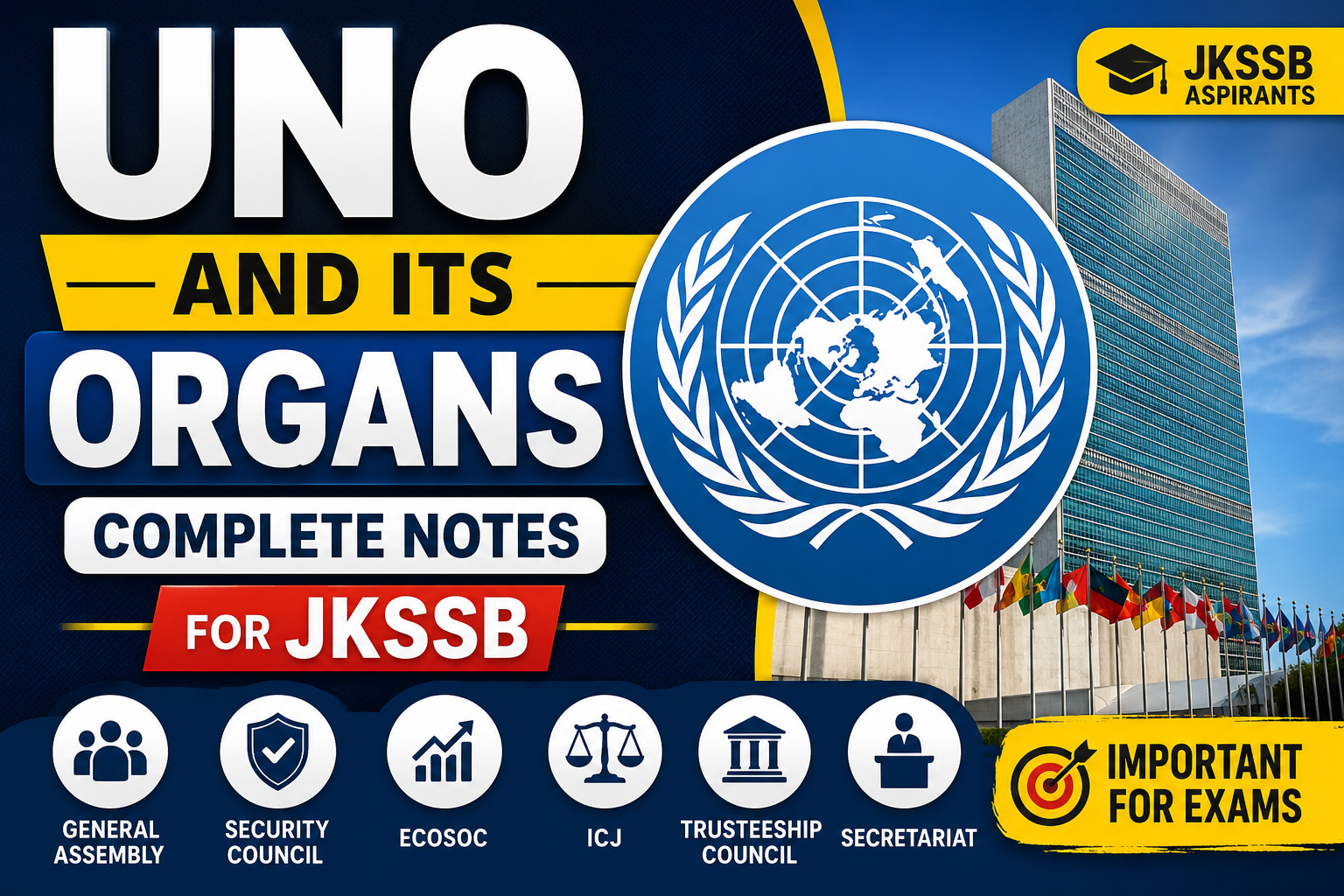
According to the UN Charter, UNO has six principal organs.
| Principal Organ | Headquarters |
|---|---|
| General Assembly | New York |
| Security Council | New York |
| Economic and Social Council (ECOSOC) | New York |
| International Court of Justice (ICJ) | The Hague, Netherlands |
| Trusteeship Council | New York |
| Secretariat | New York |
Quick Memory Trick
“G-S-E-I-T-S”
| Letter | Organ |
|---|---|
| G | General Assembly |
| S | Security Council |
| E | ECOSOC |
| I | International Court of Justice |
| T | Trusteeship Council |
| S | Secretariat |
1. General Assembly
Introduction
The General Assembly is often called the:
“Parliament of Nations”
because all member countries are represented here.
Composition
- All UN member states are members
- Each country has one vote
- Every member enjoys equal voting rights regardless of size or power
This is important conceptually.
For example:
- India has one vote
- USA has one vote
- Bhutan also has one vote
This reflects sovereign equality.
Sessions
The General Assembly meets annually.
Special sessions may also be called during emergencies.
Functions of General Assembly
1. Discuss International Issues
It discusses:
- peace
- security
- development
- environment
- human rights
2. Approves Budget
The UN budget is approved by the General Assembly.
3. Elects Members
It elects:
- non-permanent members of Security Council
- judges of ICJ (with Security Council)
- Secretary-General (on Security Council recommendation)
4. Makes Recommendations
The Assembly mainly makes recommendations rather than binding laws.
This is a commonly misunderstood point.
Students Often Confuse
| Organ | Nature of Decisions |
|---|---|
| General Assembly | Mostly recommendatory |
| Security Council | Binding in many cases |
Important Educational Observation
Many students think the General Assembly controls the entire UN. In reality, although it is the most representative body, it does not possess strong enforcement powers like the Security Council.
This distinction is frequently tested in competitive exams.
2. Security Council
The Security Council is considered the most powerful organ of the UNO.
Why is the Security Council So Important?
Because it has the primary responsibility for:
Maintaining International Peace and Security
It can:
- impose sanctions
- authorize military action
- issue binding resolutions
- establish peacekeeping operations
Composition of Security Council
The Security Council has:
15 Members
| Type | Number |
|---|---|
| Permanent Members | 5 |
| Non-Permanent Members | 10 |
Permanent Members (P5)
| Country |
|---|
| United States |
| United Kingdom |
| Russia |
| China |
| France |
Veto Power
This is one of the most important topics from UNO.
What is Veto Power?
A veto means the power to reject a decision.
If any permanent member votes against an important resolution, the resolution fails even if all others support it.
Educational Understanding of Veto
The veto system reflects post-World War II power politics.
The major victorious powers wanted special authority to ensure their participation in the organization.
Without veto power, these countries may not have joined the UN.
Criticism of Veto Power
Many countries criticize the veto because:
- it creates inequality
- one country can block global action
- reforms become difficult
- smaller nations feel underrepresented
India has repeatedly demanded reforms in the Security Council.
India and UNSC Reform
India argues that:
- current structure reflects 1945 realities
- modern global realities have changed
- developing nations deserve greater representation
India seeks permanent membership in the Security Council.
G4 Countries
The G4 group supports expansion of permanent membership.
| Country |
|---|
| India |
| Germany |
| Japan |
| Brazil |
Functions of Security Council
| Function | Explanation |
|---|---|
| Maintain peace | Handles conflicts and wars |
| Impose sanctions | Economic or diplomatic restrictions |
| Peacekeeping operations | Sends UN peacekeeping forces |
| Recommend Secretary-General | Important administrative role |
| Admit new members | Recommends membership |
Students Often Confuse
| Topic | Clarification |
|---|---|
| General Assembly resolutions | Usually non-binding |
| Security Council resolutions | Often binding |
| Permanent members | Have veto power |
| Non-permanent members | No veto power |
3. Economic and Social Council (ECOSOC)
Introduction
ECOSOC coordinates the economic and social activities of the United Nations.
It acts as a bridge between the UN and specialized agencies.
Importance of ECOSOC
Modern international relations are not limited to wars and diplomacy.
Issues like:
- poverty
- hunger
- unemployment
- literacy
- disease
- sustainable development
are equally important.
ECOSOC helps coordinate international efforts in these areas.
Composition
- ECOSOC has 54 members
- Members are elected by the General Assembly
- Term: 3 years
Functions of ECOSOC
| Function | Explanation |
|---|---|
| Promote economic growth | Encourages development programs |
| Improve social conditions | Supports welfare measures |
| Coordinate specialized agencies | Works with WHO, UNESCO etc. |
| Promote human rights | Encourages social justice |
Specialized Agencies Linked with ECOSOC
| Agency | Headquarters | Function |
|---|---|---|
| WHO | Geneva | Health |
| UNESCO | Paris | Education & culture |
| IMF | Washington D.C. | Financial stability |
| ILO | Geneva | Labour rights |
| FAO | Rome | Food and agriculture |
| UNICEF | New York | Child welfare |
Quick Revision Block
| Agency | Remember This |
|---|---|
| WHO | Health |
| UNESCO | Education and heritage |
| UNICEF | Children |
| FAO | Food |
| IMF | Monetary stability |
| ILO | Workers |
WHO (World Health Organization)
Importance
WHO became globally famous during the COVID-19 pandemic.
It coordinates:
- disease control
- vaccination campaigns
- health emergencies
- international medical cooperation
UNESCO
UNESCO promotes:
- education
- science
- culture
- heritage preservation
India has many UNESCO World Heritage Sites like:
- Taj Mahal
- Red Fort
- Ajanta Caves
UNICEF
UNICEF works for:
- children’s health
- nutrition
- education
- child protection
4. International Court of Justice (ICJ)
Introduction
The ICJ is the judicial organ of the UNO.
It settles legal disputes between countries.
Headquarters
📍 The Hague, Netherlands
This is extremely important for exams.
Composition
- 15 judges
- Elected for 9 years
- Judges are elected by:
- General Assembly
- Security Council
Jurisdiction of ICJ
The ICJ deals with disputes involving:
- borders
- maritime issues
- treaties
- international law
Important Conceptual Point
The ICJ settles disputes between states only.
It does not hear cases from individuals like normal courts.
Students often confuse ICJ with ICC.
ICJ vs ICC
| ICJ | ICC |
|---|---|
| UN organ | Independent court |
| Settles disputes between countries | Tries individuals |
| Located in The Hague | Also in The Hague |
| Handles state disputes | Handles war crimes |
Educational Insight
The ICJ depends heavily on cooperation by countries.
Unlike domestic courts, it has limited enforcement power.
This shows an important reality of international law:
global governance often depends more on diplomacy and cooperation than direct force.
5. Trusteeship Council
Purpose
The Trusteeship Council was created to supervise trust territories and help them move toward self-government and independence.
Historical Context
After World War II, many territories were under colonial control.
The UN aimed to help such territories achieve independence.
Present Status
The Trusteeship Council has suspended operations because most trust territories gained independence.
6. Secretariat
Introduction
The Secretariat is the administrative organ of the UN.
It carries out the day-to-day work of the organization.
Head of Secretariat
The head is called:
Secretary-General
Role of Secretary-General
The Secretary-General:
- manages UN operations
- represents the UN globally
- mediates international disputes
- speaks on global issues
Important Secretaries-General
| Secretary-General | Country |
|---|---|
| Trygve Lie | Norway |
| Dag Hammarskjöld | Sweden |
| U Thant | Myanmar |
| Kofi Annan | Ghana |
| Ban Ki-moon | South Korea |
| António Guterres | Portugal |
Current Secretary-General
António Guterres
Educational Observation
The Secretary-General is often called the “chief diplomat of the world.”
Although the office has limited direct power, moral influence and diplomatic leadership make the position highly significant.
Peacekeeping Operations
What are UN Peacekeeping Missions?
Peacekeeping missions involve deployment of international forces to conflict regions to maintain peace.
Functions
Peacekeepers may:
- monitor ceasefires
- protect civilians
- support elections
- maintain stability
India’s Contribution
India is one of the largest contributors to UN peacekeeping missions.
This fact is highly important for Indian competitive exams.
Important UN Agencies and Programs
| Agency | Headquarters | Main Work |
|---|---|---|
| WHO | Geneva | Health |
| UNESCO | Paris | Education and culture |
| UNICEF | New York | Child welfare |
| FAO | Rome | Food security |
| IMF | Washington D.C. | Monetary cooperation |
| World Bank | Washington D.C. | Development loans |
| ILO | Geneva | Labour welfare |
| UNDP | New York | Development |
| UNEP | Nairobi | Environment |
Students Often Confuse
| Organization | Main Area |
|---|---|
| UNESCO | Culture and education |
| UNICEF | Child welfare |
| WHO | Health |
| FAO | Agriculture and food |
| IMF | International finance |
Important Facts for JKSSB
| Fact | Answer |
|---|---|
| UNO established | 24 October 1945 |
| UN Headquarters | New York |
| ICJ Headquarters | The Hague |
| Number of principal organs | 6 |
| Permanent UNSC members | 5 |
| Current UN Secretary-General | António Guterres |
| UN Day | 24 October |
| WHO Headquarters | Geneva |
| UNESCO Headquarters | Paris |
Quick One-Liner Revision
- UNO replaced the League of Nations.
- The UN Charter was signed at San Francisco.
- Security Council is the most powerful UN organ.
- ICJ is located in The Hague.
- General Assembly gives equal voting rights to all members.
- Permanent members possess veto power.
- ECOSOC coordinates social and economic activities.
- Secretariat performs administrative functions.
Most Important Exam Traps
| Trap | Correct Understanding |
|---|---|
| ICJ and ICC are same | They are different |
| General Assembly passes binding laws | Mostly recommendations |
| All UNSC members have veto | Only permanent members |
| WHO is a UN principal organ | It is a specialized agency |
| Trusteeship Council still active normally | Operations suspended |
Difference Between Major UN Organs
| Organ | Main Function |
|---|---|
| General Assembly | Discussion and recommendations |
| Security Council | Peace and security |
| ECOSOC | Economic and social coordination |
| ICJ | Judicial settlement |
| Secretariat | Administration |
| Trusteeship Council | Supervision of trust territories |
Memory Technique for P5 Nations
“RUCFF”
- R → Russia
- U → USA
- C → China
- F → France
- F → United Kingdom is remembered separately because students often confuse the initials
Another better method:
“RUCF + UK”
JKSSB-Oriented Analytical Observation
In recent examinations, questions are increasingly conceptual rather than purely factual.
Instead of asking:
“Where is ICJ located?”
Examiners may ask:
“Which organ of the UNO settles disputes between states?”
Therefore, students should focus on:
- functions
- comparisons
- institutional roles
- conceptual differences
rather than only rote memorization.
MCQs for JKSSB Preparation
1. UNO was established on:
A. 15 August 1945
B. 24 October 1945
C. 26 January 1946
D. 10 December 1948
Answer: B
Solution: UNO officially came into existence on 24 October 1945.
2. Headquarters of the United Nations is located at:
A. Geneva
B. Paris
C. New York
D. The Hague
Answer: C
Solution: The UN headquarters is situated in New York City, USA.
3. Which organ of UNO is responsible for maintaining international peace?
A. ECOSOC
B. Trusteeship Council
C. Security Council
D. Secretariat
Answer: C
Solution: The Security Council has primary responsibility for international peace and security.
4. Which country does NOT possess veto power?
A. Russia
B. India
C. China
D. France
Answer: B
Solution: India is not a permanent member of the Security Council and therefore has no veto power.
5. ICJ is located in:
A. Geneva
B. Paris
C. Vienna
D. The Hague
Answer: D
Solution: International Court of Justice is located in The Hague, Netherlands.
6. Which organ is known as the Parliament of Nations?
A. Security Council
B. General Assembly
C. Secretariat
D. ECOSOC
Answer: B
Solution: General Assembly includes all member nations and is therefore called the Parliament of Nations.
7. How many principal organs does UNO have?
A. 5
B. 6
C. 7
D. 8
Answer: B
Solution: UNO has six principal organs.
8. Which organization works for child welfare?
A. UNESCO
B. WHO
C. UNICEF
D. IMF
Answer: C
Solution: UNICEF works for children's welfare, nutrition, and education.
9. Which UN organ has suspended operations?
A. ECOSOC
B. Trusteeship Council
C. Secretariat
D. ICJ
Answer: B
Solution: Trusteeship Council suspended operations after trust territories achieved independence.
10. The current Secretary-General of the United Nations is:
A. Ban Ki-moon
B. Kofi Annan
C. António Guterres
D. U Thant
Answer: C
Solution: António Guterres is the present Secretary-General.
Frequently Asked Questions (FAQs)
What is UNO?
UNO is an international organization established in 1945 to maintain peace, promote cooperation, and support development among nations.
How many organs does UNO have?
UNO has six principal organs:
- General Assembly
- Security Council
- ECOSOC
- ICJ
- Trusteeship Council
- Secretariat
Which is the most powerful organ of UNO?
The Security Council is considered the most powerful organ because it can pass binding resolutions and maintain international peace.
Which countries have veto power?
The five permanent members:
- USA
- UK
- Russia
- China
- France
Where is the ICJ located?
The International Court of Justice is located in The Hague, Netherlands.
Final Revision Summary
| Topic | Key Point |
|---|---|
| UNO Formation | 24 October 1945 |
| Headquarters | New York |
| Main Aim | International peace |
| Most Powerful Organ | Security Council |
| Judicial Organ | ICJ |
| Administrative Organ | Secretariat |
| Economic Coordination | ECOSOC |
| Equal Representation | General Assembly |
| Suspended Organ | Trusteeship Council |
| Veto Holders | P5 Nations |