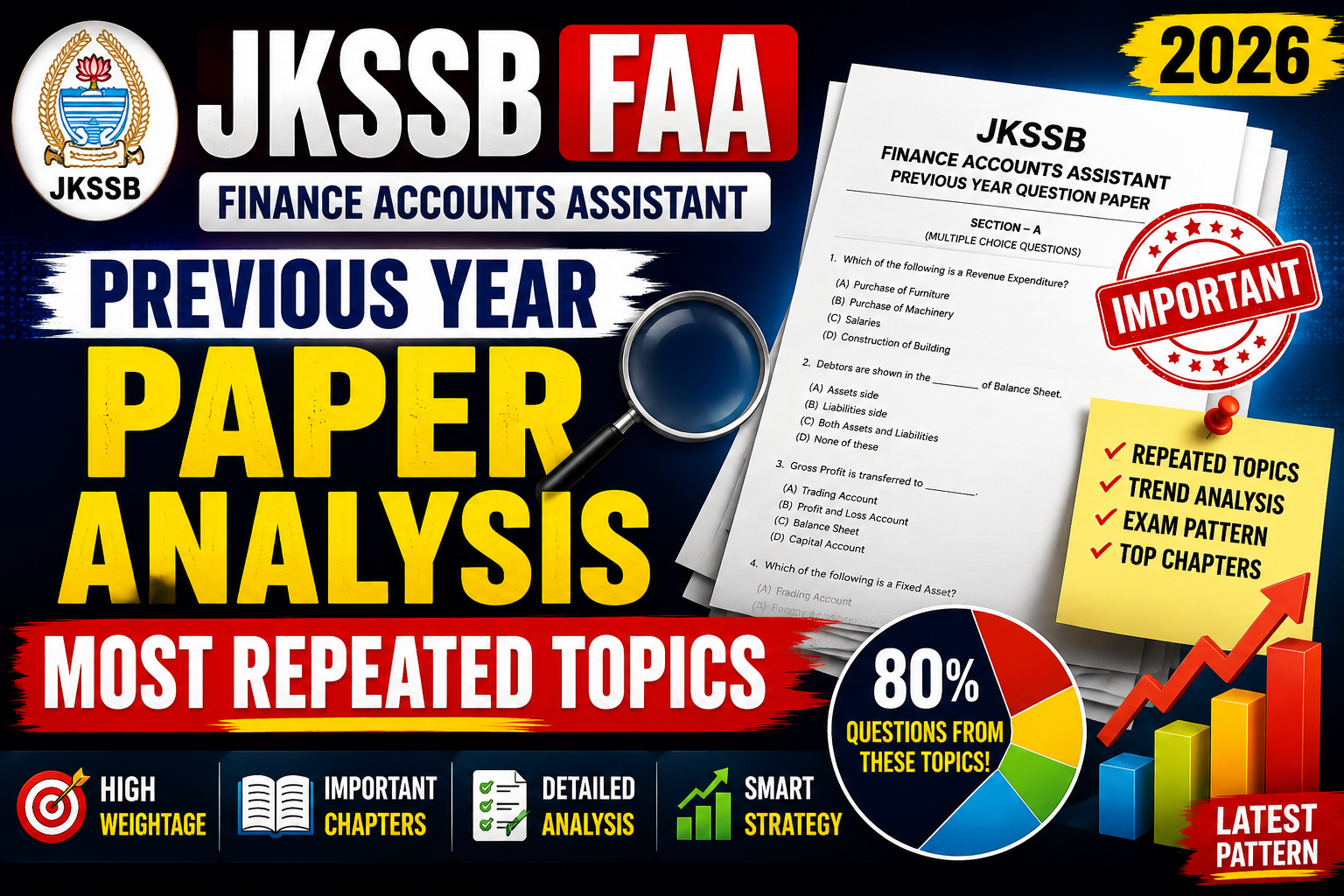
JKSSB FAA Previous Year Paper Analysis: The Topics That Quietly Dominate the Exam
Most JKSSB Finance Accounts Assistant aspirants spend months collecting PDFs, joining Telegram groups, downloading notes they never fully revise, and watching strategy videos that all sound strangely identical.
Then the exam arrives.
And suddenly, a pattern becomes obvious.
A surprisingly large portion of the paper doesn’t feel random at all.
Certain accounting concepts return repeatedly. Some chapters quietly carry disproportionate weight. A few “ordinary-looking” topics keep appearing in different forms year after year — while heavily discussed sections on social media sometimes contribute barely anything meaningful.
That disconnect is where many serious aspirants lose marks.
The real value of analyzing a JKSSB previous year paper is not memorizing old questions. It’s understanding the psychology of the recruitment pattern itself.
And for the Finance Accounts Assistant examination, that pattern has become increasingly visible.
Download Complete Finance Accounts Assistant Notes with Full testseries
Understanding the Real Nature of the JKSSB FAA Exam
The Finance Accounts Assistant examination sits in an unusual space.
It isn’t designed like a pure commerce graduation paper. It also isn’t entirely comparable to SSC-style objective recruitment exams. JKSSB tends to mix conceptual commerce understanding with practical screening logic.
Which means the paper often rewards aspirants who can:
- Recognize recurring accounting structures
- Solve quickly under pressure
- Identify predictable topic clusters
- Understand practical application
- Avoid over-studying low-yield chapters
This is exactly why previous year paper analysis matters more here than in many other JKSSB posts.
Not because questions repeat word-for-word — although some concepts absolutely do — but because the board’s conceptual preferences remain surprisingly consistent.
What Previous Papers Actually Reveal
After reviewing multiple JKSSB FAA-style papers, mock trends, syllabus mapping patterns, and repeated objective frameworks commonly used in recruitment-based commerce exams, a few clear observations emerge.
The exam consistently prioritizes:
- Fundamental accounting clarity
- Ratio-based reasoning
- Journal-entry understanding
- Practical business finance
- Budgeting concepts
- Banking awareness
- Basic economics
- Financial statement interpretation
What’s interesting is that advanced theoretical commerce sections often receive less weight than aspirants expect.
That changes preparation strategy entirely.
The Most Repeated Topics in JKSSB FAA Papers
1. Journal Entries & Rectification of Errors
If there’s one area that repeatedly appears in FAA-oriented papers, it’s this.
Not because it’s difficult — actually, quite the opposite.
These questions help examiners quickly separate candidates with real accounting familiarity from those relying on surface-level memorization.
Common question patterns include:
- Incorrect journal entries
- Suspense account adjustments
- Error identification
- Double-entry system logic
- Ledger balancing
Many aspirants underestimate this section because it feels “basic.” Yet it repeatedly contributes easy scoring opportunities.
Ironically, these are also the questions candidates lose through haste rather than lack of knowledge.
2. Final Accounts & Financial Statements
This remains one of the highest-yield sections.
Questions often revolve around:
- Trading account calculations
- Profit and loss adjustments
- Balance sheet positioning
- Depreciation treatment
- Outstanding expenses
- Closing stock effects
The board consistently appears to favor practical accounting interpretation rather than deeply theoretical accounting standards.
That distinction matters.
Aspirants focusing excessively on advanced theory while ignoring adjustment-based practical questions often end up misallocating preparation time.
3. Ratio Analysis Quietly Carries Significant Weight
Ratio analysis has become one of the safest scoring areas for prepared candidates.
Especially:
| Frequently Asked Ratios | Common Question Style |
|---|---|
| Current Ratio | Liquidity interpretation |
| Quick Ratio | Formula-based MCQs |
| Debt Equity Ratio | Financial stability analysis |
| Gross Profit Ratio | Business profitability |
| Net Profit Ratio | Performance comparison |
| Inventory Turnover Ratio | Operational efficiency |
What makes ratio analysis important is not merely repetition.
It’s predictability.
The conceptual framework rarely changes dramatically, which means properly revised aspirants can answer these questions rapidly during the exam.
That speed advantage matters more than many realize.
Cost Accounting Questions Are Usually Simpler Than Expected
There’s a tendency among FAA aspirants to fear cost accounting.
The actual paper often tells a different story.
JKSSB generally leans toward straightforward conceptual questions involving:
- Fixed vs variable cost
- Break-even analysis
- Cost sheet basics
- Marginal costing
- Budgetary control
The exam rarely behaves like a CA Intermediate paper.
Yet aspirants sometimes prepare for it as if it does.
That mismatch creates unnecessary pressure.
Banking & Financial Awareness Has Become More Noticeable
Over recent recruitment cycles, financial awareness sections have started carrying greater practical relevance.
Questions increasingly touch areas such as:
- RBI functions
- Monetary policy basics
- Inflation concepts
- Banking abbreviations
- Budget terminology
- Financial institutions
- Taxation basics
This reflects a broader shift visible across Indian recruitment examinations where economic awareness is becoming operational rather than purely academic.
Aspirants ignoring current financial developments often struggle here despite strong accounting backgrounds.
The Hidden Importance of Computer Awareness
This section quietly influences final rankings.
Not because it dominates the paper — but because it offers comparatively easy marks.
Repeated areas include:
- MS Excel shortcuts
- Spreadsheet basics
- Internet terminology
- Operating systems
- Computer memory concepts
- Networking fundamentals
For FAA aspirants coming from commerce-heavy preparation backgrounds, this section sometimes becomes unexpectedly weak.
And in competitive cutoffs, those small gaps matter.
English & Reasoning: The Silent Cutoff Deciders
A common mistake among commerce-focused candidates is treating English and reasoning as secondary.
Previous paper trends suggest otherwise.
These sections are often:
- Less time-consuming
- More scoring
- More accuracy-friendly
Especially for candidates already comfortable with commerce subjects, reasoning and English can stabilize overall performance.
The exam isn’t purely about subject expertise anymore. It increasingly rewards balanced preparation.
Topic Weightage Trends Based on Previous Paper Analysis
While exact distribution changes, the broader pattern generally looks like this:
| Section | Approximate Importance |
|---|---|
| Accounting Fundamentals | Very High |
| Financial Management | High |
| Ratio Analysis | High |
| Cost Accounting | Moderate to High |
| Economics & Banking | Moderate |
| Computer Awareness | Moderate |
| Reasoning | Moderate |
| English | Moderate |
| Advanced Commerce Theory | Lower Than Expected |
This is precisely why blindly studying every chapter with equal intensity is inefficient.
Strategic preparation matters more than exhaustive preparation.
Why Most Aspirants Misread Previous Year Papers
There’s a deeper issue here.
Many candidates collect previous papers.
Far fewer actually analyze them.
Real analysis involves identifying:
- Repeated conceptual structures
- High-frequency chapters
- Predictable question framing
- Easy-score segments
- Time-consuming traps
- Pattern evolution
The difference is subtle but important.
Aspirants who merely solve old papers often improve familiarity.
Aspirants who analyze them improve decision-making.
And recruitment exams increasingly reward the second group.
Smart Preparation Strategy Based on Paper Trends
A practical FAA strategy now looks very different from the traditional “complete syllabus first” approach.
A more efficient structure would involve:
Phase 1: High-Yield Core Topics
Focus aggressively on:
- Journal entries
- Final accounts
- Ratio analysis
- Financial management basics
- Cost accounting fundamentals
Phase 2: Scoring Support Sections
Then strengthen:
- Computer awareness
- English
- Reasoning
- Banking awareness
These sections collectively stabilize accuracy.
Phase 3: Previous Paper Simulation
This stage is often skipped.
And it’s probably the most important.
Not just solving papers — but analyzing:
- Why mistakes happen
- Which sections consume time
- Which topics repeatedly appear
- Which concepts remain weak under pressure
That feedback loop is what converts preparation into exam performance.
Important and Useless of Heavy Previous Paper-Based Preparation
| Advantages | Limitations |
|---|---|
| Improves pattern recognition | Questions may not repeat exactly |
| Helps identify high-yield topics | Can create false confidence |
| Improves speed & familiarity | New syllabus emphasis may appear |
| Reduces exam anxiety | Over-dependence can hurt adaptability |
| Strengthens revision efficiency | Doesn’t replace conceptual clarity |
The strongest aspirants usually balance both:
pattern awareness and conceptual understanding.
The Broader Reality of JKSSB FAA Competition
There’s another uncomfortable truth many aspirants eventually discover.
The FAA exam is no longer just about eligibility-level preparation.
Competition intensity has shifted.
Commerce graduates, banking aspirants, SSC candidates, and even candidates preparing for broader finance-sector recruitment exams increasingly overlap in this space.
That means cutoffs are often shaped not merely by difficult questions — but by avoidable mistakes.
One incorrect ratio formula.
One misread adjustment.
One overlooked English section.
Margins become extremely narrow.
FAQ
Are JKSSB FAA previous year papers enough for preparation?
No. They are extremely valuable for pattern analysis and revision, but they should support conceptual preparation rather than replace it.
Which topic repeats most in JKSSB FAA papers?
Accounting fundamentals, ratio analysis, final accounts, and financial management concepts consistently appear with high frequency.
Is cost accounting difficult in JKSSB FAA?
Usually not at an advanced level. Most questions tend to focus on practical conceptual basics rather than deep theoretical complexity.
How many previous papers should FAA aspirants solve?
At minimum:
- 5–10 full previous-style papers
- Multiple topic-wise practice sets
- Timed mock simulations
Consistency matters more than quantity alone.
Is computer awareness important for JKSSB FAA?
Yes. It’s often underestimated, but these sections contribute easy scoring opportunities that can significantly affect final merit position.
Aspirants should check this
- JKSSB FAA Syllabus Complete Guide
- JKSSB FAA Study Material Complete 2026 updated
- Best Books for JKSSB FAA Preparation
Final Editorial Perspective
What previous year papers really reveal is not just repetition.
They reveal institutional preference.
And once aspirants begin recognizing that — once they stop preparing randomly and start studying patterns intelligently — the examination becomes far less unpredictable.
That doesn’t make the FAA exam easy.
But it does make it understandable.
And for serious aspirants, understanding the structure behind the competition is often the first real advantage.