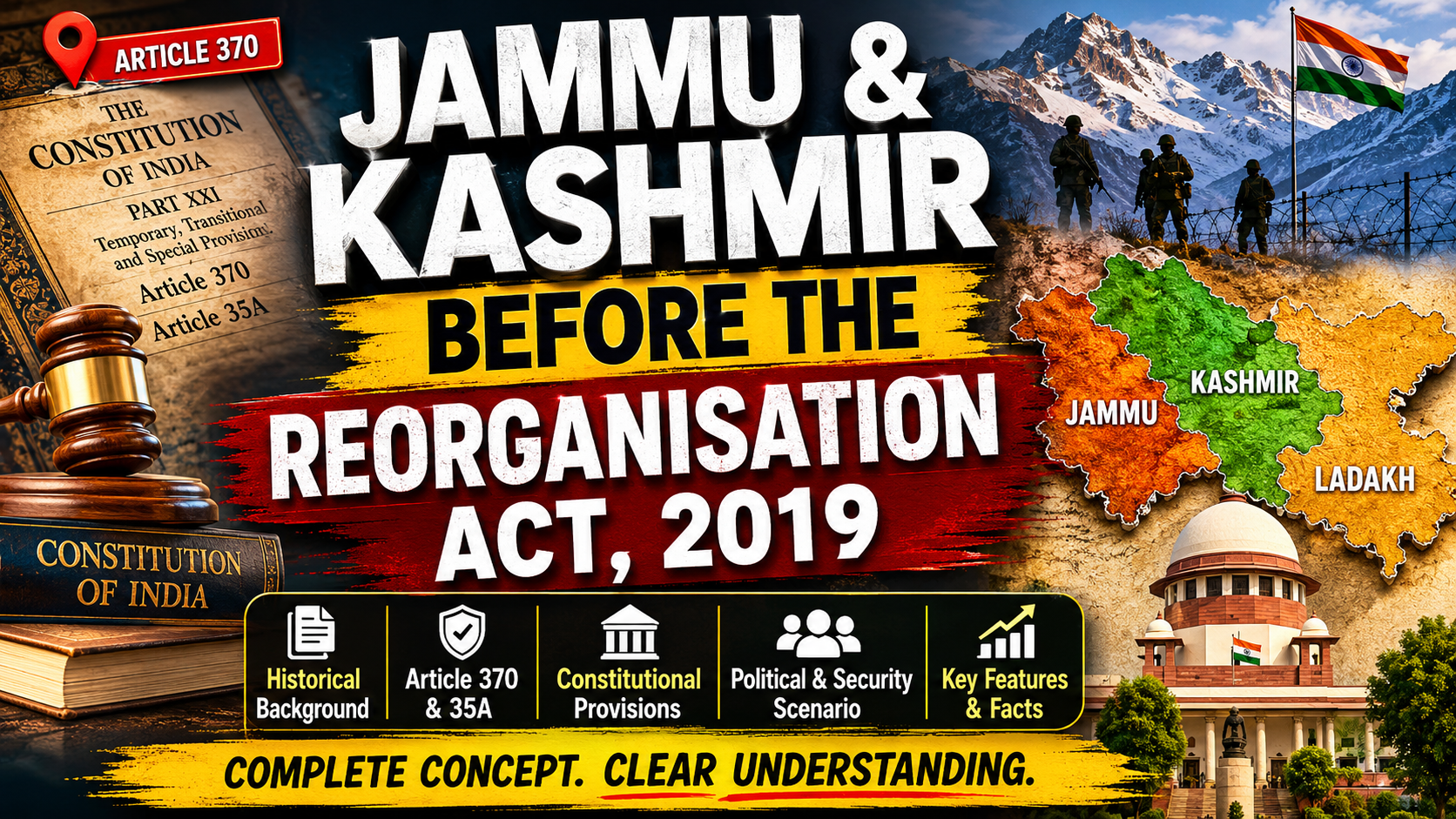
Historical Evolution of Jammu and Kashmir Before the Reorganisation Act, 2019
To understand the Jammu and Kashmir Reorganisation Act, 2019, one must first understand the unique constitutional position historically enjoyed by the former State of Jammu and Kashmir within the Indian Union. The Reorganisation Act was not an isolated legislative event; rather, it represented the culmination of decades of constitutional developments, political negotiations, security concerns, federal debates, and administrative restructuring.
The princely state of Jammu and Kashmir acceded to India through the Instrument of Accession signed on 26 October 1947 by Maharaja Hari Singh. Unlike many other princely states whose integration was relatively straightforward, Jammu and Kashmir’s accession occurred under exceptional geopolitical circumstances involving tribal invasion supported from Pakistan, military conflict, and internationalisation of the issue at the United Nations.
An important point to understand is that the accession of Jammu and Kashmir to India was legally complete and constitutionally valid under the same framework applicable to other princely states. However, due to prevailing political and security conditions, the Union government adopted a special constitutional mechanism that later became embedded in Article 370 of the Constitution of India.
Constitutional Position of Jammu and Kashmir Before 2019
Article 370 and Its Constitutional Nature
Article 370 was included in Part XXI of the Constitution under the heading “Temporary, Transitional and Special Provisions.”
A highly important exam-oriented fact is that although Article 370 was commonly referred to as a “special status” provision, constitutionally it was categorized as a temporary provision.
The Article restricted Parliament’s legislative powers over Jammu and Kashmir except in matters specified in the Instrument of Accession, namely:
- Defence
- Foreign Affairs
- Communications
- Ancillary matters
Any extension of additional constitutional provisions required:
- Concurrence of the State Government
- Presidential Orders under Article 370(1)
The State also possessed:
- Its own Constitution
- Separate flag
- Autonomy over residuary powers
One of the most misunderstood concepts is that Jammu and Kashmir was never outside the Indian constitutional framework. The Constitution of India applied to Jammu and Kashmir, though with modifications and exceptions.
U can download full pdf in Free study material section jk exam library
Complete List of Sections under the Jammu and Kashmir Reorganisation Act, 2019
| Section No. | Heading / Provision |
|---|---|
| 1 | Short title |
| 2 | Definitions |
| 3 | Reorganisation of existing State of Jammu and Kashmir |
| 4 | Formation of Union territory of Ladakh |
| 5 | Saving powers of State Government |
| 6 | Lieutenant Governor of Union territory of Ladakh |
| 7 | Legislative Assembly of Union territory of Jammu and Kashmir |
| 8 | Composition of Legislative Assembly |
| 9 | Reservation of seats |
| 10 | Delimitation of constituencies |
| 11 | Duration of Legislative Assembly |
| 12 | Sessions of Legislative Assembly, prorogation and dissolution |
| 13 | Speaker and Deputy Speaker |
| 14 | Vacation and resignation of, and removal from, offices of Speaker and Deputy Speaker |
| 15 | Power of Deputy Speaker or other person to perform duties of office of Speaker |
| 16 | Conduct of business |
| 17 | Disqualifications for membership |
| 18 | Decision on questions as to disqualifications |
| 19 | Penalty for sitting and voting before making oath or affirmation |
| 20 | Powers, privileges, etc., of members |
| 21 | Salaries and allowances of members |
| 22 | Right of Lieutenant Governor to address and send messages |
| 23 | Special address by Lieutenant Governor |
| 24 | Ministers and Advocate-General to have right to speak in Assembly |
| 25 | The Council of Ministers |
| 26 | Other provisions as to Ministers |
| 27 | Advocate-General for the Union territory of Jammu and Kashmir |
| 28 | Conduct of Government business |
| 29 | Duties of Chief Minister as respects furnishing of information to Lieutenant Governor |
| 30 | Power of Administrator to promulgate Ordinances during recess of Legislative Assembly |
| 31 | Constitution of Legislative Council abolished |
| 32 | Representation in House of the People |
| 33 | Delimitation of Parliamentary constituencies |
| 34 | Provision as to sitting members of House of the People |
| 35 | Representation in Council of States |
| 36 | High Court of Jammu and Kashmir |
| 37 | Judges of common High Court |
| 38 | Jurisdiction of common High Court |
| 39 | Practice and procedure in common High Court |
| 40 | Custody of seal of common High Court |
| 41 | Form of writs and other processes |
| 42 | Powers of Judges |
| 43 | Procedure as to appeals to Supreme Court |
| 44 | Transfer of proceedings |
| 45 | Interpretation |
| 46 | Authoritative texts of laws |
| 47 | Territorial extent of laws |
| 48 | Power to adapt laws |
| 49 | Power to construe laws |
| 50 | Provisions relating to Boards, Corporations, etc. |
| 51 | Provisions relating to inter-State corporations |
| 52 | Continuance of facilities in certain State institutions |
| 53 | Provisions relating to electricity |
| 54 | Provisions relating to water and power development |
| 55 | Assets and liabilities of successor Union territories |
| 56 | Contracts |
| 57 | Liability in respect of actionable wrongs |
| 58 | Right to recover arrears of tax |
| 59 | Provisions as to certain taxes |
| 60 | Finance Commission |
| 61 | Treasury and banking arrangements |
| 62 | Continuance of grants |
| 63 | Audit and accounts |
| 64 | Provisions relating to services |
| 65 | Provisions relating to All India Services |
| 66 | Provisions relating to other services |
| 67 | Continuance of officers in same posts |
| 68 | Advisory committees |
| 69 | State Public Service Commission |
| 70 | Provisions relating to prisons |
| 71 | Provisions relating to State cadres |
| 72 | Provisions relating to pensions |
| 73 | Provisions relating to provident fund |
| 74 | Provisions relating to legal proceedings |
| 75 | Transfer of pending proceedings |
| 76 | Proceedings not invalidated by reason of territorial changes |
| 77 | Provisions relating to Bar Council |
| 78 | Provisions relating to advocates |
| 79 | Provisions relating to subordinate courts |
| 80 | Authorisation of expenditure pending its sanction by Legislative Assembly |
| 81 | Reports relating to the accounts of the Union territory of Jammu and Kashmir |
| 82 | Distribution of revenues |
| 83 | Apportionment of assets and liabilities |
| 84 | Apportionment of benefits and liabilities |
| 85 | Certain expenditure to be charged on Consolidated Fund |
| 86 | Power to remove difficulties |
| 87 | Amendment of Constitution (Scheduled amendments) |
| 88 | Amendment of Representation of the People Act, 1950 |
| 89 | Amendment of Representation of the People Act, 1951 |
| 90 | Amendment of Delimitation Act |
| 91 | Amendment of Union Territories Act |
| 92 | Amendment of Central laws |
| 93 | Amendment of State laws |
| 94 | Adaptation of laws |
| 95 | Repeal and saving |
| 96 | Legal proceedings unaffected |
| 97 | Protection of action taken in good faith |
| 98 | Continuance of existing laws |
| 99 | Power of Central Government to issue directions |
| 100 | Validation of certain actions |
| 101 | Continuance of courts and authorities |
| 102 | Transfer of employees |
| 103 | Special provisions relating to administration |
| 104 | Transitional provisions |
| 105 | Removal of difficulties |
| 106 | Rule-making power |
| 107 | Laying of rules before Parliament |
| 108 | Repeal and savings |
Article 35A and Its Implications
Through the Constitution (Application to Jammu and Kashmir) Order, 1954, Article 35A was inserted.
It empowered the Jammu and Kashmir legislature to define:
- Permanent residents
- Special rights regarding:
- Land ownership
- Government jobs
- Scholarships
- Settlement rights
Critics argued that Article 35A:
- Encouraged constitutional asymmetry
- Restricted integration
- Created discrimination in certain contexts
Supporters argued that:
- It protected demographic identity
- Preserved regional culture and land ownership
- Safeguarded local autonomy
Conceptually, this indicates the broader tension between:
- Asymmetric federalism
and - National constitutional uniformity
Progressive Constitutional Integration of Jammu and Kashmir
Over decades, numerous Presidential Orders gradually extended most provisions of the Indian Constitution to Jammu and Kashmir.
This included:
- Fundamental Rights
- Supreme Court jurisdiction
- Election Commission powers
- Comptroller and Auditor General
- Emergency provisions (partially)
- Financial institutions
- Constitutional bodies
From an analytical perspective, this gradual extension significantly diluted the original autonomy structure even before 2019.
Political and Security Context Leading to Reorganisation
The Reorganisation Act cannot be understood merely as an administrative law. It emerged from a complex intersection of:
- Militancy and terrorism
- Cross-border infiltration
- Political instability
- Separatist movements
- Governance challenges
- Debate over federal integration
- Developmental concerns
- Security strategy
Between 1989 and 2019, Jammu and Kashmir witnessed:
- Insurgency
- Ethno-political conflict
- Periodic President’s Rule
- Coalition instability
- Large-scale security deployment
A highly important exam-oriented fact is that immediately before the 2019 changes, Jammu and Kashmir was under President’s Rule under Article 356.
This became constitutionally significant because Parliament effectively exercised the powers of the State Legislature during the reorganisation process.
Constitutional Mechanism Used in 2019
Presidential Order C.O. 272
On 5 August 2019, the President issued:
The Constitution (Application to Jammu and Kashmir) Order, 2019
This superseded the 1954 Order and applied all provisions of the Indian Constitution to Jammu and Kashmir.
The Order used Article 370(1) to modify the interpretation of:
Article 367
This reinterpretation replaced:
- “Constituent Assembly of Jammu and Kashmir”
with - “Legislative Assembly of Jammu and Kashmir”
Since the State was under President’s Rule, Parliament acted as the Legislative Assembly.
This constitutional interpretation became one of the most debated legal aspects of the entire process.
Resolution Under Article 370(3)
Under Article 370(3), the President could declare Article 370 inoperative upon recommendation of the Constituent Assembly of Jammu and Kashmir.
Since the Constituent Assembly had ceased to exist in 1957, the Union government interpreted Parliament’s concurrence as sufficient during President’s Rule.
Thereafter, Article 370 became effectively inoperative.
Enactment of the Jammu and Kashmir Reorganisation Act, 2019
The Bill was introduced in Parliament on:
5 August 2019
It was passed by:
- Rajya Sabha: 5 August 2019
- Lok Sabha: 6 August 2019
It received Presidential assent on:
9 August 2019
The Act came into force on:
31 October 2019
Core Objective of the Reorganisation Act
The Act reorganised the former State of Jammu and Kashmir into two Union Territories:
| Feature | Union Territory of Jammu & Kashmir | Union Territory of Ladakh |
|---|---|---|
| Legislature | Yes | No |
| Constitutional Model | Similar to Delhi/Puducherry | Centrally Administered |
| Administrative Head | Lieutenant Governor | Lieutenant Governor |
| High Court | Common High Court | Common High Court |
| District Composition | Jammu + Kashmir divisions | Leh and Kargil |
| Legislative Assembly | Present | Absent |
A highly important exam-oriented fact is that this became the first instance in independent India where a full-fledged state was downgraded into Union Territories.
Territorial Structure Under the Act
Union Territory of Jammu and Kashmir
This Union Territory includes:
- Kashmir Division
- Jammu Division
It possesses:
- Legislative Assembly
- Council of Ministers
- Lieutenant Governor
However, Parliament retains extensive legislative powers.
Union Territory of Ladakh
This includes:
- Leh district
- Kargil district
It does not possess a Legislative Assembly.
Administration functions directly under the Union Government through the Lieutenant Governor.
Constitutional Basis of State Reorganisation
The Reorganisation Act was enacted under:
Article 3 of the Constitution
Article 3 empowers Parliament to:
- Form new states
- Alter boundaries
- Change names
- Reorganise territories
However, Jammu and Kashmir’s case was constitutionally unique because:
- It involved Article 370
- It involved President’s Rule
- It involved conversion of a state into Union Territories
Important Constitutional Articles Related to the Reorganisation
| Constitutional Provision | Significance |
|---|---|
| Article 1 | J&K as part of India |
| Article 3 | Reorganisation of states |
| Article 356 | President’s Rule |
| Article 370 | Special status provision |
| Article 367 | Interpretation clause |
| Article 239 | Administration of Union Territories |
| Article 239A | Legislatures for some UTs |
| Article 239AA | Delhi model reference |
| Article 35A | Permanent resident provisions (removed) |
Legislative Structure of the Union Territory of Jammu and Kashmir
The UT of Jammu and Kashmir has:
- Unicameral Legislature
- Lieutenant Governor
- Council of Ministers headed by Chief Minister
However, unlike states, Parliament retains overriding powers.
The Legislative Assembly can legislate on:
- State List subjects
- Concurrent List subjects
Except:
- Public order
- Police
These remain under Union control through the Lieutenant Governor.
Conceptually, this arrangement resembles the constitutional structure of the National Capital Territory of Delhi, though not identically.
Delimitation Under the Reorganisation Act
One of the most significant consequences of the Act was the initiation of:
Delimitation of Assembly Constituencies
The Delimitation Commission restructured electoral constituencies based on:
- Population
- Geographical considerations
- Accessibility
- Administrative convenience
Delimitation Outcomes
The number of Assembly seats increased from:
107 to 114
(24 seats reserved for Pakistan-occupied territories remain vacant)
Effective elected seats:
83 → 90
Reserved seats included:
- Scheduled Castes
- Scheduled Tribes (for first time in J&K Assembly history)
A highly important exam-oriented fact is that Scheduled Tribes obtained Assembly reservation in Jammu and Kashmir for the first time after the reorganisation process.
Administrative Reorganisation
The Act required redistribution of:
- Employees
- Assets
- Public sector undertakings
- Corporations
- Financial liabilities
- Administrative records
This involved:
- Cadre restructuring
- Central services integration
- Police administration changes
The former Jammu and Kashmir cadre under All India Services was merged into:
AGMUT Cadre
(Arunachal Pradesh-Goa-Mizoram-Union Territories)
Judicial Structure After Reorganisation
The High Court of Jammu and Kashmir continued as:
Common High Court for both UTs
All pending proceedings continued uninterrupted.
Subordinate judiciary was reorganised administratively under the new territorial structure.
Impact on Fundamental Rights and Constitutional Applicability
After the 2019 changes:
- Entire Constitution of India became fully applicable
- All central laws extended automatically
- Separate Constitution of J&K ceased to operate
This led to application of laws relating to:
- Right to Education
- SC/ST protections
- Minority rights
- Reservation laws
- Anti-corruption statutes
- Property and succession reforms
Removal of Permanent Resident Category
The category of “Permanent Residents” ceased after the abrogation of Article 35A.
Subsequently, the administration introduced:
Domicile Rules
These determined eligibility for:
- Government employment
- Certain local rights
This transition represented a shift from:
Ethno-territorial identity framework
to
Administrative domicile framework
Security Dimension of the Reorganisation
The government justified the move partly on grounds of:
- National security
- Counter-terrorism
- Better governance
- Integration
- Development
Supporters argued that:
- Special status encouraged separatism
- Integration was incomplete
- Central laws could improve governance
- Investment would increase
Critics argued that:
- Democratic consent was bypassed
- Federal principles weakened
- Political detentions raised concerns
- Communication restrictions affected civil liberties
From an analytical perspective, the Reorganisation Act became one of the most debated examples of the balance between:
- National integration
and - Democratic federalism
Preventive Measures and Restrictions During 2019 Transition
Before implementation:
- Internet restrictions imposed
- Political leaders detained
- Section 144 applied
- Communication networks restricted
The Union government argued these measures were necessary to:
- Prevent violence
- Maintain public order
- Avoid militant mobilisation
Civil liberties groups criticised:
- Extended communication shutdowns
- Preventive detention
- Press restrictions
A highly important exam-oriented concept is that constitutional changes can involve simultaneous legal, administrative, and security dimensions.
Supreme Court Challenges
Several petitions challenged:
- Abrogation of Article 370
- Validity of Presidential Orders
- Reorganisation into UTs
The major constitutional questions included:
- Whether Article 370 was permanent
- Whether Parliament could substitute Constituent Assembly
- Whether a state can be downgraded into Union Territories
- Scope of Presidential powers during President’s Rule
Supreme Court Judgment (2023)
In December 2023, a Constitution Bench of the Supreme Court upheld the constitutional validity of the abrogation process.
The Court observed:
- Article 370 was temporary
- Jammu and Kashmir did not retain internal sovereignty
- Parliament could exercise powers during President’s Rule
However, the Court also directed:
- Restoration of statehood at the earliest possible opportunity
- Conduct of Assembly elections
A highly important exam-oriented fact is that the Court distinguished between:
Temporary asymmetrical autonomy
and
Permanent sovereignty
Federalism and the Reorganisation Act
The Act generated major debates in Indian federalism.
Supportive Argument
Supporters argued:
- Parliament constitutionally acted under Article 3
- National integration required uniformity
- Asymmetric provisions had outlived their purpose
Critical Argument
Critics argued:
- Federal consent principle weakened
- State autonomy reduced
- Centralisation increased
Conceptually, this case illustrates the dynamic nature of:
Indian quasi-federalism
Asymmetric Federalism in India
Before 2019, Jammu and Kashmir represented one of the strongest forms of:
Asymmetric Federalism
Other examples include:
- Article 371 provisions
- Sixth Schedule areas
- Special protections for northeastern states
An important point to understand is that asymmetric federalism allows differentiated constitutional arrangements to accommodate diversity.
The Jammu and Kashmir case therefore became a major constitutional turning point regarding the future interpretation of special-status arrangements in India.
Socio-Economic Implications of the Reorganisation
Claimed Benefits
The Union government projected:
- Greater investment
- Tourism development
- Infrastructure expansion
- Better governance
- Uniform legal rights
- Improved anti-corruption mechanisms
Central schemes could now apply fully and uniformly.
Examples:
- Reservation laws
- Women’s property rights
- Minority protections
- Child protection laws
Concerns Raised
Critics highlighted:
- Land ownership anxieties
- Cultural identity concerns
- Employment competition fears
- Political alienation
One of the most misunderstood concepts is that debates over Jammu and Kashmir often combine:
- Constitutional questions
- Identity politics
- Security considerations
- Developmental aspirations
Important Administrative Changes After Reorganisation
New Governance Structure
| Aspect | Before 2019 | After 2019 |
|---|---|---|
| Status | State | Two UTs |
| Constitution | Separate Constitution | Only Indian Constitution |
| Flag | Separate flag existed | No separate flag |
| Article 370 | Applicable | Inoperative |
| Article 35A | Applicable | Removed |
| Residuary Powers | State | Parliament |
| Citizenship Rights | Special residency protections | Uniform constitutional framework |
| Cadre System | J&K Cadre | AGMUT Cadre |
Legislative Powers After Reorganisation
The Union Territory Legislature of J&K cannot legislate on:
- Police
- Public Order
These remain with the Union Government.
This creates a stronger central administrative role compared to ordinary states.
Reorganisation and Panchayati Raj
The government also linked the reorganisation process with:
- Grassroots democracy
- Panchayat empowerment
- Direct central funding
District Development Council (DDC) elections became an important post-reorganisation political development.
International Dimension
Pakistan strongly opposed:
- Abrogation of Article 370
- Territorial reorganisation
India maintained that:
- Jammu and Kashmir is an internal matter
- Constitutional restructuring falls within sovereign authority
The issue also generated international discussion regarding:
- Human rights
- Regional stability
- India-Pakistan relations
However, most countries treated it primarily as India’s domestic constitutional matter.
Legal Interpretation of “Temporary” Nature of Article 370
One of the most debated constitutional questions was whether Article 370 became permanent after the dissolution of the Constituent Assembly of Jammu and Kashmir.
Two views existed:
View 1: Permanent After Dissolution
- Constituent Assembly no longer existed
- Therefore Article 370 could not be removed
View 2: Still Temporary
- Temporary nature remained intact
- President retained constitutional authority
The Supreme Court eventually leaned toward the second interpretation.
Conceptual Themes Emerging from the Reorganisation Act
The Act is not merely about territorial restructuring. It represents deeper constitutional themes:
- Federalism vs centralisation
- Security vs liberty
- Integration vs autonomy
- Uniformity vs diversity
- Parliamentary sovereignty vs regional consent
From an analytical perspective, the Act is one of the most transformative constitutional events in post-independence India.
Important Chronology Related to Jammu and Kashmir Reorganisation
| Year | Event |
|---|---|
| 1947 | Instrument of Accession signed |
| 1949 | Article 370 incorporated |
| 1954 | Presidential Order and Article 35A |
| 1957 | J&K Constituent Assembly dissolved |
| 1989 | Beginning of large-scale insurgency |
| 2018 | President’s Rule imposed |
| 5 Aug 2019 | Article 370 effectively nullified |
| 9 Aug 2019 | Reorganisation Act received assent |
| 31 Oct 2019 | Act came into force |
| 2023 | Supreme Court upheld abrogation |
Important Analytical Constitutional Observations
An important point to understand is that Article 370 functioned as both a bridge and a barrier.
It acted as:
- A bridge by facilitating accession under unique conditions
- A barrier according to critics who believed it prevented complete constitutional integration
A highly important exam-oriented fact is that the Reorganisation Act changed not only administrative boundaries but also the constitutional identity of Jammu and Kashmir.
Conceptually, the Reorganisation Act demonstrates the extraordinary flexibility of the Indian Constitution in territorial governance.
From an analytical perspective, this case reveals how constitutional law can interact with geopolitics, national security, identity politics, and democratic governance simultaneously.
Important Terms Related to the Topic
| Term | Meaning |
|---|---|
| Instrument of Accession | Legal document through which princely states joined India |
| Asymmetric Federalism | Different constitutional arrangements for different units |
| President’s Rule | Central rule under Article 356 |
| Union Territory | Territory administered by Union Government |
| Delimitation | Redrawing electoral constituencies |
| Domicile Rules | Rules defining local residency eligibility |
| Constituent Assembly | Body responsible for framing Constitution |
| Presidential Order | Executive constitutional order issued by President |
Administrative Importance of Ladakh Becoming a Separate Union Territory
The separation of Ladakh had long-standing political roots.
Supporters in Ladakh argued:
- Administrative neglect under Kashmir-centric governance
- Geographic challenges
- Distinct cultural identity
- Need for direct Union support
The new Union Territory status was expected to:
- Improve infrastructure
- Enhance border administration
- Increase strategic governance capacity
Given Ladakh’s borders with:
- China
- Pakistan
its strategic importance is extremely high.
Reorganisation and Centre-State Relations
The Act intensified discussions on:
- Constitutional morality
- Democratic consultation
- Nature of cooperative federalism
Critics viewed the move as:
“Centralised constitutional restructuring”
Supporters viewed it as:
“National constitutional integration”
Both interpretations remain important for analytical answers in UPSC, JKPSC, and university examinations.
Electoral and Political Consequences
Post-reorganisation politics witnessed:
- Emergence of new regional alliances
- Debate over restoration of statehood
- Electoral restructuring
- Reconfiguration of political representation
Political discourse shifted from:
“Special Status Politics”
to
“Statehood and Representation Politics”
Governance Reforms Introduced After Reorganisation
The administration implemented reforms relating to:
- Anti-corruption
- Land records digitisation
- Direct Benefit Transfer systems
- Panchayat empowerment
- Industrial policy
- Tourism development
The Union government argued that full constitutional integration would:
- Improve administrative efficiency
- Reduce corruption
- Enhance developmental delivery